race

Shantrelle P. Lewis’s Photos

‎”Silence is also a form of speech.” ~ Fulani Proverb
Thanks to mi hermano Adria…See More
With my interests in race, sport, politics, and the 1968 Olympic protests, how could this powerful, timely visual composition not catch my eye? (It was sent to me by Professor Ron Greene in the Communications department here at Minnesota.)  Just last Friday, my graduate students and I were talking about the social consciousness and political voice of athletes in America, and I told them that I always think of the 1968 Olympic victory stand demonstration as a preeminent example of how athletes’ most effective mode of speaking is with their bodies and through their actions. In my book, I point out that Tommie Smith (the gold medalist who was at the center of it all) didn’t comment publicly about the gesture for almost 20 years—in effect forcing everyone else moved by his actions to talk on his terms.  Kudos to the Miami Heat for following in this tradition (their image seems to be everywhere right now), and to Shantrelle Lewis for calling out the parallels.
For sociological perspective and relevant research on the Tryvon Martin controversy and coverage itself, see: Jeff Dowd’s recent rich post on our TSP Community Page Sociology Lens: Disembodied Racism and the Search for Racist Intent: The Trayvon Martin Case.
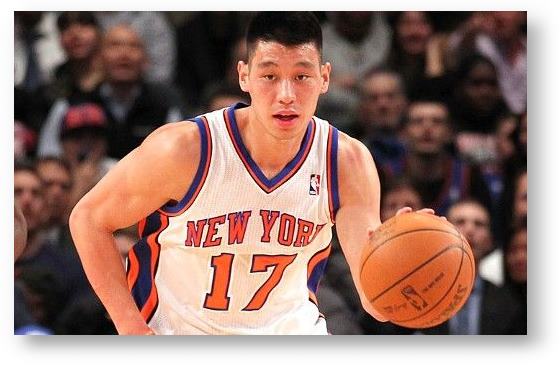
Jeremy Lin via asian-nation.org

In the past few days there is one story I’ve been asked about more than any other in the news or current events—it involves the (unexpected) hot hand of undrafted NBA rookie Jeremy Lin of the New York Knicks. “What do you think?,” everyone wants to know. “You must have an interesting angle or two given your interest in race and sport, right?”

Well, I am fascinated. Indeed, my son Ben and I were intrigued enough to buy tickets to our first Timberwolves game in at least five years to see Lin and his New York team take on our local favorites Saturday night (led by another heralded rookie point guard Spaniard Ricky Rubio). It was quite a spectacle: over 20,000 fans (the most in Minneapolis since 2004, they said), more Asian Americans than I can ever remember seeing at a pro sports event, and some interesting commentary up in the nosebleed seats where we were perched. There was also a puzzling (if racially revealing) reference in the local paper the next day about a budding “international” rivalry between the two rookie playmakers. (I mean, Lin is from Palo Alto, after all.)

Still, most of my interest so far has been at Lin’s amazing play. The number of points and assists he posted in his first five games in the league was better than any other first five-game stretch of any player in NBA history. He led the Knicks to a comeback win here in Minnesota even when he was clearly exhausted from having played the night before in New York. On Valentine’s Day, he nailed a last second three-pointer for the win. I just love seeing great basketball. Check out any of his highlight clips on YouTube and you’ll see what I mean.

Thankfully, one of our TSP bloggers, C.N. Le, writing on The Color Line, has been able to maintain professional decorum and provide some sociological meaning and context for the Lin-sanity.

Le reviews some of the ground he covered in 2010 when he wrote when Lin was still playing for Harvard—how the ballplayer provides a counter to certain model minority stereotypes and expectations and in doing so is expanding the definition of success for Asian Americans. (Le’s even earlier post mentioned some of the racial stereotypes and slurs Lin has dealt with along the way as well.) But what I like most about the post is at the end, where Le is talking not about Lin but about colorblindness:

But as Asian Americans becoming increasingly common in these areas of U.S. popular culture, are we headed for a day when it is no longer a “big deal” when we see Asian American faces in the media, just like it’s taken for granted when we see White faces or Black faces? Ultimately, yes, that is the goal—for us as a society to no longer consider it “strange” or “unusual” to see Asian Americans in the media or in other prominent positions in U.S. social institutions.

Le goes on to point out—and this is the part I really like—that what we are talking about here is the concept of colorblindness, a concept that many of us race scholars actually tend to be quite critical about. It is a provocative reminder of what is good, right, and valuable about colorblindness as an ideal. But appropriately, Le also insists on reminding us—as he does over and over in his writings—of two points: (1) that we are still not there yet, and (2) to get there we actually have to be aware of race and racial inequalities and racism and vigilant in trying to resist them.

I’m not sure how aware Jeremy Lin is about any of this (though I wouldn’t put it past him. He’s not only doing amazing things on the court, he is clearly a very smart guy. In fact, as a friend of mine speculated today, one of the stereotypes Lin is laying bare is the old dumb-jock trope. Even in his “nerdy handshake” with other smarty-pants baller Landry Fields—seen below—Lin is showing that Ivy Leaguers can definitely hoop.) But I very much appreciate C.N. Le’s ability to draw out this broader social significance and use the power of the popular in service of making these vitally important sociological points about race and the struggle to move past race in contemporary American society.

My late mother-in-law was born and raised in Okinawa and came to the United States as an adult. She didn’t read a lot of English publications, but she swore by Dear Abby. She said read the column because Abby’s advice taught her what it meant to be a good American. I’ve thought about that a lot over the years, and I’ve often wished there were more such commonsense voices of decorum, belief, and behavior in our public discourse—never more so than right now.

@yoisthisracist's Twitter Profile Photo

Which brings me to the website “Yo, is this racist?” (yoisthisracist.com) by blogger Andrew Ti.

Okay, well, that’s not exactly accurate. I mean, I wouldn’t have put Ti in the “Dear Abby” category on my own. He and his website are often irreverent , sometimes offensive or downright vulgar, and just seem to be having too much fun most of the time. But that’s how Rachel Brahinsky, writing in Antipode described him: “Ti …mocks overt and subtle racism with comedy and brilliance, using a renovation of the old ‘Dear Abby’ format.”

Brahinsky explains:

Readers send in questions, and Ti tears them apart, mocks them, and applauds them for their insights. The exchanges range from goofy to deadly serious, and Ti has a tendency to curse a lot and use text-isms like LOL to reach his audience—and the consistency of his critique is highly uneven (sometimes he’s just name-calling, but that usually seems to come after receiving a raft of nasty racist emails from readers; the blog is his outlet).

But there is a lot of brilliance in the blog, and it generally comes at moments when Ti uses the space to redirect a reader’s question from the micro-moments of interpersonal racism to the socio-structural factors that bracket those moments.

I think that Brahinsky’s is a pretty accurate description and assessment, and in fact I had been meaning to write something on the site myself (my son had introduced me to it) ’til she beat me to the punch. I am especially convinced that Ti is at his best when he situates various comments, questions, and episodes in the context of larger racial hierarchies in the U.S. In doing so, he shows that not all comments and quotes are equal—and that things like context, who is speaking, and who is listening are crucial to the racial implications and effects of any given utterance or interaction. I also believe that Brahinsky is precisely on point about the challenges—and necessity—of using humor to get at racism, not only in the classroom but in the culture. Plus, I appreciated the quote from my former advisor George Lipsitz. Thanks, Rachel, for writing this up!

So, I’m sure by now you’ve heard about the controversy that has emerged over Newt Gingrich’s repeated use of the line that Barack Obama is the “greatest food stamp President.” If not, the main question is whether the phrase is racially motivated—that is, if it is a racial code designed to play upon white fears and resentments about African Americans in general and the President in particular. (Clearly, some of the invective hurled against the President has to do with his social difference—not just his race, but the fact that he is believed (incorrectly of course) to be an immigrant, a Muslim, and an egghead, as Theda Skocpol and Vanessa Williamson report in their new book The Tea Party and the Remaking of Republican Conservativism.) You can read more about the current kerfuffle is a Sociological Images post by guest blogger Jason Eastman called “Newt Racism.”

Still, as this is something you’re likely to hear more about in the wake of Gringrich’s victory in the South Carolina primaries this weekend and it’s something that I do research on, it seems like a good time for me to bring a little social scientific research and perspective to bear.

First, some basic facts about food stamps and welfare from this weekend’s Chicago Tribune. One: more whites than blacks receive food stamps (34 percent white, 22 percent black, and 16 percent Hispanic, according to the Agriculture Department). Two: the racial breakdown for public assistance more generally is about 1/3 African American, 1/3 white, and 1/3 Hispanic. Three: funding for foodstamps actually started to rise under George W. Bush’s presidency, though it has increased under the current administration. And four: the percent of Americans receiving public assistance has declined dramatically since the welfare reform act of 1996 which imposed strict work requirements and a 5 year lifetime cap on benefits.

What the Tribune story didn’t say that is crucial is all of this is that welfare has long been and continues to be associated with race and with African Americans in particular. See Martin Gilens’s book Why Americans Hate Welfare. This perception is actually a key piece of information in itself—perhaps the key fact about welfare. It is, in short, racially coded.  So even if Gingrich doesn’t intend it, this is how such references are likely to be understood by the majority of Americans. It may not be the only reason Gingrich continues to reference and discuss food stamps, but it is obviously part of the conversation.

The real question, of course, is not intent but effect. Do such racially coded messages matter? Do they impact politics, policies, and campaigns? According to Tali Mendelberg’s The Race Card, one of the most meticulously researched studies of the phenomenon, they do. Racially coded words and phrases play upon white fears about and resentment against African Americans in order to implicitly or explicity shift public opinion on and support for various candidates, campaigns, regimes, and policy initiatives.

Mendelberg, whose initial research was occasioned by the Willie Horton ad that appeared during the 1988 Presidential campaign, based her work on a wide variety of techniques and data including simulated television news experiments, national surveys, content analyses of campaign coverage, and archival cases. Key to Mendelberg’s explanation for the phenomenon is that, in a post-civil rights era there are strong norms (of equality, fairness, individualism) that prevent overt radicalized and racist images to be referenced and mobilized; however, anti-black stereotypes and perceptions remain in place—and can be mobilized in subtle, coded ways to powerful political effect.  It reminds me of the old line by Malcolm X. “Racism,” he used to say, “is like a Cadillac: they make a new one every year.” In a country that is supposedly colorblind and race neutral, driven by individual opportunity and meritocracy, it can be almost no other way.

Mendelberg’s message has one ray of hope for those interested in combating radicalized political messages coded or otherwise, though:  implicitly racial messages tend to lose their appeal when their content is exposed. We shall see if this is the case in the days to come as the charges and defenses are waged.

Finally, there is another point I want to highlight: race cards don’t always work and it is not just Republicans who play them. Democrats do too, though often to different effect and for different purposes. Indeed, my own work on midnight basketball and the 1994 crime bill debates with Darren Wheelock revealed that “the race card” as it pertained to  midnight basketball was not played first or even most self-consciously by Republicans. Rather, that would be left to the Democrats under the leadership of Bill Clinton during the 1994 crime bill debates. And that wasn’t exactly a winner—indeed, Republicans kind of turned that against the Democrats, and it wasn’t long before Gingrich himself unveiled the “Contract” that made him famous.

Even in the most diverse cities, marathoners see mostly white legs and faces at the starting line. At Citings and Sightings, Suzy and Hollie point to a new Runner’s World piece, which asks “Why is Running so White?”

This issue also arose at a Robert Wood Johnson Foundation meeting this year, when James Jackson noted that African American neighborhoods often provide few safe places to run, but ample outlets for fast food and alcohol. While both running and junk food can relieve stress in the short-term, their long-run health effects will differ dramatically. There are other reasons for race differences in running, of course, and the Jay Jennings article touches on everything from hair to role models.

In running, as in other sports, strong stereotypes persist about race and athletic ability. I once shared a starting line laugh with a fellow middle-aged, middle-of-the-pack runner … who happened to be from Kenya. He said he was a slooooow runner but people seemed to make the assumption that all Kenyans must be faster than all Americans. Some were so convinced of his abilities they’d invite him to join the elite runners at the start of the race — which, when you think about it, is actually a pretty horrifying prospect for middle-of-the-pack runners like us.

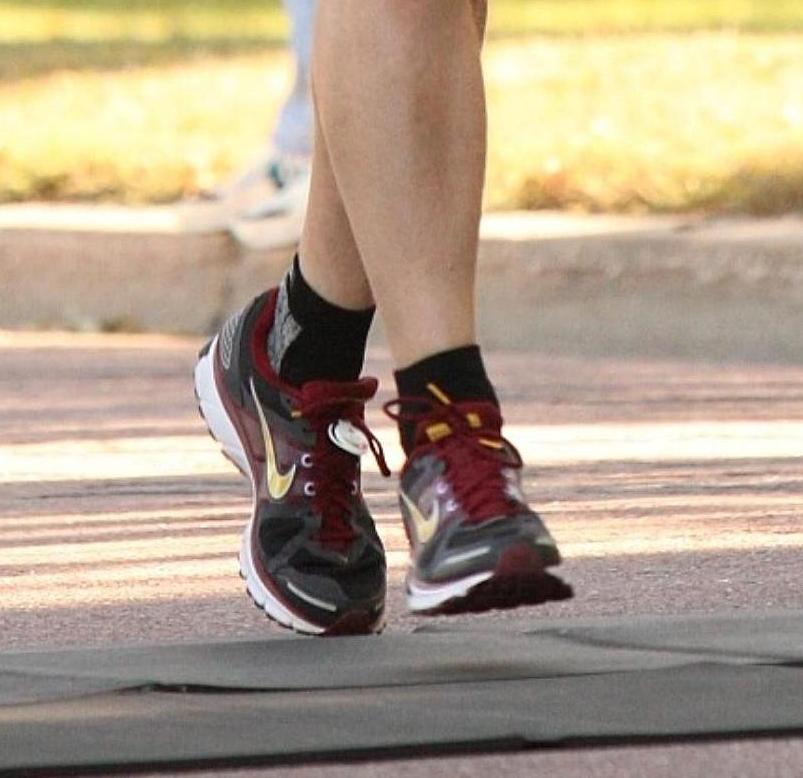
Speaking of running, I was resplendent in Minnesota colors at this year’s Twin Cities marathon. This brought a few inquiries about exactly where one buys maroon shoes with gold swooshes and aglets. I fibbed that I had them specially commissioned, but these are really just “Nike Livestrong Air Pegasus +28,” which can still be had for about $69 online. Fair warning, though: the kicks make for controversial office attire. Ann Meier, our Director of Graduate Studies, told me that they were not acceptable — and most definitely not acceptable when one is bedecked in a maroon sweater and gold shirt.

(All photos are the model’s own!)