race

Ru101413What Does the Letta Say?

EEP! There was no Friday Roundup. Guess who’s fault that is? Mine-oh-mine. But to make it up to you, here’s some fresh Monday morning reading!

In Case You Missed It:

The Fascination and Frustration with Native American Mascots,” by Jennifer Guiliano. A look at the history and fight over mascots, as the Redskins go 1-4 in the NFC East.

Editors’ Desk:

Sketch #4: TSP @ White House,” by Chris Uggen. Dr. Uggen goes to Washington. more...

RU092013For the next couple of Roundups, I’d like to welcome TSP’s graduate editor Hollie Nyseth Brehm. She’ll be covering for me as I head off on a 3-hour cruise. Actually, there’s no cruise. But I do expect to find myself washed up on a beach for a stretch, so I won’t be rounding up the site until… October 11th? Craziness. For now, one last hurrah before heading for the airport (yet again). more...

RU080213Still Wise Words

Hopefully, we all have a teacher or two who stirs fond memories. For me, one of the first to spring to mind is Loren J. Samons II, a professor of classical studies at my alma mater, Boston University. Prof. Samons is notable for many reasons (one of his brilliant strokes was to refer to the class, collectively, as “scholars”—a convention that set the tone for each lecture in just one word), but this week, I found an old syllabus. I wondered why I’d kept it—I took several classes from Prof. Samons in my time at BU, but it still seemed an odd document to cling to, some 12 years after graduation. And then I read. Nestled within many wise words for young students learning to learn, write, engage with literature, and find their way through sources both ancient and modern, was this gem: more...

Since sociology and sports are two of my greatest passions, it should come as no surprise that an article in the current issue of Time magazine that had the words “quarterback sociology” in the title caught my eye.

The article was about Colin Kaepernick of the San Francisco 49er’s. Kaepernick, for those who don’t know, burst onto the NFL scene last fall when came off the bench as a rookie to lead the Bay area team on a surprising playoff run. With his swashbuckling style of play, a provocative personal backstory (Kaepernick is a mixed race adoptee, raised in a white family), and a unique new-millenium look, Kaepernick has quickly become one of the league’s most popular players–as evidenced by the fact that his is already the best selling jersey in the league.

I usually don’t find such profiles particularly interesting or revealing since they are often more an exercise in image making and celebrity gossip than anything else. But this one is worth a read.  In a wide-ranging, stimulating interview Kaepernick talks confidently about race, athletic stereotypes, adoption, and body art. For example, Kaepernick suggests that those who describe him as a freak athlete may be subtly diminishing his work ethic and intelligence as has happened to so many African American athletes–and especially quarterbacks (remember Rush Limbaugh’s criticisms of Donovan McNabb?)–before him . Challenging those who have criticized his body art as self-indulgent or disrespectful, Kaepernick describes tattoos as a way of expressing oneself in a profoundly American individualist fashion. He also speaks at length about the experience of adoption into a white family, his relationship with his birth mother, and the complexities of his own mixed-race identity and experience.

Athletes are often far more interesting and insightful than we give them credit for or allow them to be. And if we are willing to get past our outdated dumb-jock stereotypes, we’d also realize that they’ve got things to say about society as well as sports. Kaepernick, after all, is not just not talking about the sociology of quarterbacks; he is a quarterback talking sociology.


RU071913Verdict? What Verdict?

There’s no mistaking it: this week’s talk focused on the acquittal of George Zimmerman, the Floridian who killed teenager Trayvon Martin in February 2012. Below, you can find some of the week’s pieces about Martin, Zimmerman, and privilege here on The Society Pages, as well as a few other topics we hit on.

In the meantime, I’ve gotten two other suggestions of palate cleansing items to bring to your attention: more...

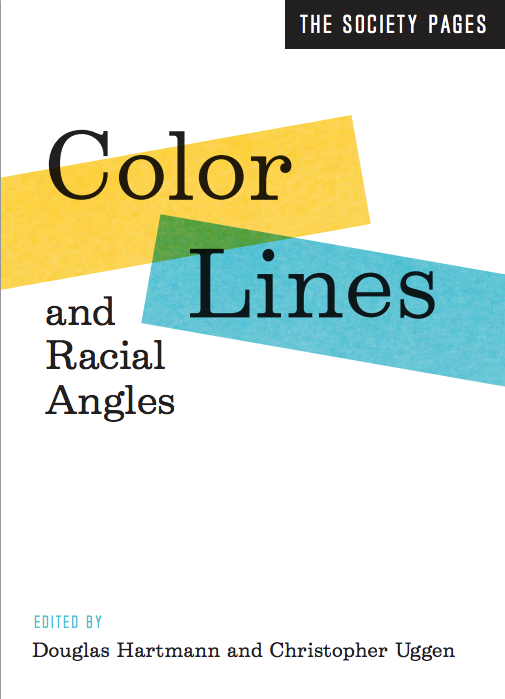
The latest mock-up of the cover for our third TSP volume.

If you are a parent with kids in summer sports, like myself, you may recognize the feeling: the last regular season games are wrapping up, the playoffs are about to begin, and, oh-so-tantalizingly, then comes the freedom of a completed season and, hopefully, some well-earned rest and relaxation. That home stretch feeling is kind of the phase we are in here at The Society Pages with our new race volume, the latest installment in the series we are partnering on with W.W. Norton & Co.

The volume will be called Color Lines and Racial Angles, and it will feature about a baker’s dozen of the best pieces on race and diversity that have been developed on our site thus far. You may recall, for example, Jennifer Lee’s piece on “stereotype promise” or Wendy Roth’s article exploring the creation of a “Latino” race. There have been roundtables with distinguished scholars discussing the media and Trayvon Martin in the weeks immediately following his death and the history and future of American immigration, and a few weeks ago we ran a provocative little treatment of the social origins of the term “white trash” by Matt Wray. And waiting patiently in the pipeline are pieces on Native American mascots, diversity discourse, and environmental racism, as well as an interview exchange with Michelle Alexander, author of the prominent and controversial crime and punishment tome The New Jim Crow.

Along with TSP tie-ins that bring readers back to our Community Pages to further explore the topics in the volume, as well as discussion questions and group activities for reading groups and classrooms, these pieces will form the core of the new book—and they’ll remain freely available on our website. But you’ll have to be patient, of course! Over the next week or so, we’ll be doing final revisions and editing, tweaking the introduction, pulling all of the files together for delivery to our editors and designers at Norton. We hope to have the finished product ready in time for 2014 teaching (the first two volumes, The Social Side of Politics and Crime and the Punished, are expected to publish before the end of 2013). In the meantime, you can revisit our already-published pieces and look forward to some spectacular ones on the way. Here’s to summer reading!

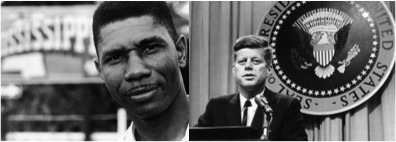
Medgar Evers and John F. Kennedy, Jr. in 1963.

In this morning’s Philadelphia Inquirer, sociologist Chip Gallagher reminds us that two formative events in the history of American race relations unfolded just hours apart, fifty years ago today: JFK’s ground-breaking speech demanding that the federal government address institutional racism against African Americans and the murder of NAACP field secretary Medgar Evers. Gallagher uses the anniversary to reflect on the “undeniable… progress that has been made” and how much more remains to be done to “level the playing field.” Gallagher writes, “Social scientists are fond of pointing out that when individuals, typically white individuals, discuss racism, they use the past tense,” but wonders, “How much has changed in 50 years? Is our democracy self-correcting, with our moral arc consistently bending toward justice…?” He concludes with a open challenge: “What we should be asking ourselves is, Where are the speeches like Kennedy’s that appeal to the citizenry’s better angels to right a social wrong? Where are the pleas to Americans on moral and ethical grounds by those who can use the bully pulpit to raise public awareness of the social inequalities that continue to plague our nation?”

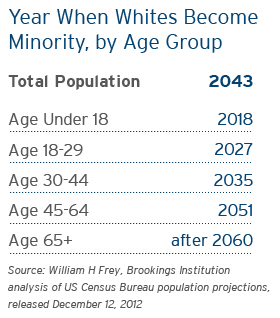
Last week, the news broke that the U.S. Census Bureau is projecting that whites will no longer be the majority by the year 2043. This is at least a year earlier than previous estimates and seven years earlier than the 2050 majority/minority prediction that first got everyone’s attention a few years back.

The Associated Press release that broke the story described the news as a “historic shift” that is “reshaping the nation’s schools, workforce, and electorate.”  It attributes the trend to “higher birth rates” among American minorities, especially Hispanics who entered at the height of the immigration boom in the 1990s and early 2000s. (The story also correctly notes that immigration rates from Mexico and elsewhere have slowed dramatically with the housing bust of the previous decade and the economic recession of recent years.) The story claims these demographic shifts are “redefining long-held notions of race” in the U.S.—“easing” residential segregation, increasing intermarriage for some, “blurring” racial and ethnic lines, and “lifting the numbers of people who identify as multiracial.” more...

While I’ve written and done research on atheism and black America, I’ve never put the two together. This Gawker post by Cord Jefferson (editor of Good Magazine), brought to my attention by the fabulous Letta Page, does.

I haven’t had a chance to think it all through yet, but am curious what others think, both about the basic phenomenon as well as about its broader social and theoretical implications.

And on that score, check out this Huffington Post piece on religion, in-group trust, and out-group distrust. It is by Scott Atran, who is, as my colleague and collaborator Penny Edgell says, “one of the most thoughtful scholars working at the intersection of religion and evolutionary theory.”

Are you interested in the NBA, myths about Asian American success, or race relations in general? If so, we’ve got two great new pieces headed your way.

The first, which just went live, is an insightful exchange between experts C.N. Le, Rosalind Chou, and Ben Carrington on the meteoric rise (and recent fall) of professional basketball player Jeremy Lin. It is the handiwork of our fabulous “knights of the roundtable” team.

Coming soon, then, will be a new TSP White Paper from Jennifer Lee called “Tiger Kids and the Success Frame” which helps explain how ethnicity matters in educational outcomes. This is the first of a fabulous two-part installment.

We are extremely excited to have these two, timely new pieces on our site, and hope that you are inspired to add your comments and thus contribute to the dialogue.

UPDATE: “Tiger Kids and the Success Frame” is now live–and it even has a Glee clip! Looking forward to our second piece from author Jennifer Lee.