race

Via Joe Soss on Facebook.

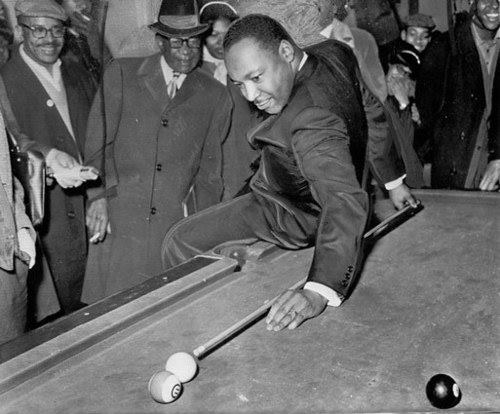
On Facebook, today, scrolling through my friends’ posts, I spotted U of M professor Joe Soss’s post featuring an eye-catching photo of the Rev. Dr. Martin Luther King, Jr. hot-dogging it at a pool hall, accompanied by the following quote:

“We must recognize that we can’t solve our problem now until there is a radical redistribution of economic and political power… this means a revolution of values and other things. We must see now that the evils of racism, economic exploitation and militarism are all tied together… you can’t really get rid of one without getting rid of the others… the whole structure of American life must be changed” (MLK, report to SCLC staff, May 1967).

And I loved Soss’s gloss on the photo: “I bet,” Soss wrote, “he sunk that pool shot too.

The day and the photo got me thinking. I had just done a television interview about how Minnesota was recently ranked as the least racially integrated state in the nation by a financial services website. After making the usual comments about being cautious about state-by-state comparisons, particularly about gaps and changes over time, I talked to the reporter about how Minnesotans’ general sense of themselves as relatively successful in terms of racial harmony and our sometimes self-satisfied liberalism can get in the way of our fully recognizing and then really addressing, in policy and social action, racial inequality problems in our state, especially those pertaining to African Americans.

Not all of my comments made it into the piece (see actual story here), and afterwards I found myself thinking back to that most famous of sociology majors, Dr. King (see below for a great photo Soc Images spotted on the HBCU website, dated 1948) and his Letter from a Birmingham Jail. In it, he writes that he believes white moderates are among the greatest obstacles to his vision of change. One passage reads:

…I must confess that over the past few years I have been gravely disappointed with the white moderate. I have almost reached the regrettable conclusion that the Negro’s great stumbling block in his stride toward freedom is not the White Citizen’s Counciler or the Ku Klux Klanner, but the white moderate, who is more devoted to “order” than to justice; who prefers a negative peace which is the absence of tension to a positive peace which is the presence of justice; who constantly says: “I agree with you in the goal you seek, but I cannot agree with your methods of direct action”; who paternalistically believes he can set the timetable for another man’s freedom; who lives by a mythical concept of time and who constantly advises the Negro to wait for a “more convenient season.” Shallow understanding from people of good will is more frustrating than absolute misunderstanding from people of ill will. Lukewarm acceptance is much more bewildering than outright rejection.

I had hoped that the white moderate would understand that law and order exist for the purpose of establishing justice and that when they fail in this purpose they become the dangerously structured dams that block the flow of social progress. I had hoped that the white moderate would understand that the present tension in the South is a necessary phase of the transition from an obnoxious negative peace, in which the Negro passively accepted his unjust plight, to a substantive and positive peace, in which all men will respect the dignity and worth of human personality.

Many years later, many protests and rallies and elections later, America remains torn between high-minded colorblind ideals and persistent racial inequalities, while white Americans have the easy option and privilege of just living with the status quo. Maybe if I had quoted Dr. King directly, I could have made that point even stronger.
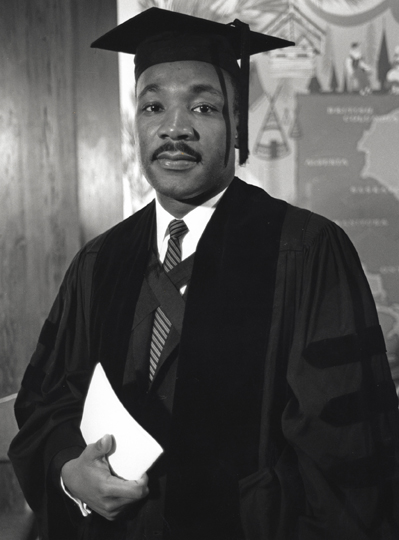
Via HBCU. Click for original.
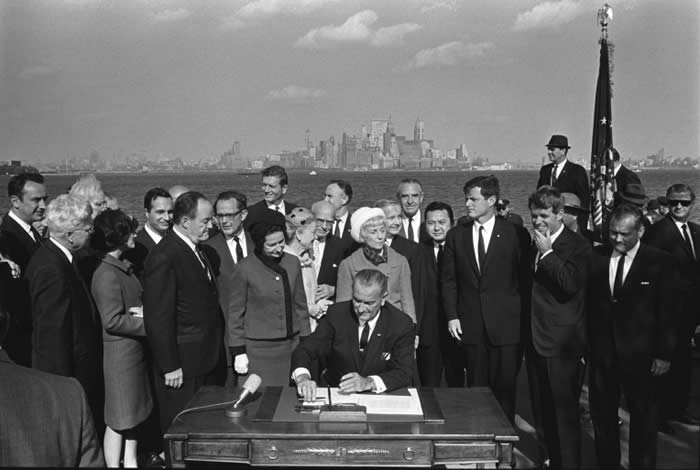
President Lyndon Baines Johnson signing the Immigration and Nationality Act of 1965 on Liberty Island (Lyndon B. Johnson Library Collection/Yoichi R. Okamoto)

This weekend marked the 50th anniversary of the 1965 Immigration and Nationality Act (also known as the Hart-Cellar Act). In the week ahead we are going to recognize this transformative piece of legislation–not only was it a complete overhaul of immigration policies and patterns of migration, it has had huge, if often not fully appreciated impacts on American culture and society–by highlighting a series of recent postings, commentaries, and reflections from sociologists and other social scientists that have appeared of late on the TSP homepage and through our social media. These will include great contributions from sociologists including Richard Alba, Nancy Foner, Douglas Massey, and John Skrentney, as well as Minnesota’s own superstar historian Erika Lee.

Many of these folks, it turns out, will also be gathered here in Minnesota at the Immigration History Research Center (IHRC) for a conference reflecting on all this later in the month. I myself have been asked to be on a panel entitled “An Assessment of the 1965 Immigration Act and Future Immigration Policy.” I’m a little nervous about this because I think of myself as more of a dabbler on immigration than an expert. That is, I’m someone who relies heavily on the work of others and whose own research on the topic is limited and operates mainly around the edges and margins of the field–race, culture, collective identities, assimilation theory.

With this in mind, I’ve been trying to pull together my ideas and reflections on immigration policy past and present by thinking “through a racial lens.” There are several reasons I’m working on this angle.

Perhaps the most basic is that the original 1965 policy was motivated by in large part by the desire to eliminate racism and discrimination from the American immigration system. Passed in the immediate aftermath of the Civil Rights and Voting Rights Acts of 1964 and ’65, immigration reform was intended to abolish old, restrictive quotas and outright bans against migrants from Asia and Africa as well as to overhaul the Bracero which was seen as exploitation of Mexican laborers. In diversifying the sources of immigration and placing a premium on skills and family ties, in fact, the new law was supposed to establish a more equitable, racially just policy and society.

There are three racial angles I’m planning to focus on: demography, culture, and incorporation.

  1. Demography. I don’t think it is hard to argue that the immigration reform opened the doors to massive amounts of new immigration and the immigration of people from countries and cultures that previously had been restricted or severely limited.  My main goal will be to highlight and discuss how this new immigration has dramatically transformed the racial and ethnic composition of the populace, remaking colorlines and categories of identification in the process. For what it is worth, I might also note that these changes and their implications will continue to evolve and change in coming years, driven not only by continued migration but also by differential birth rates, changing patterns of identification, and shifts in ethnic intermarriage.
  2. Culture. The expansion and diversification of migration to the United States that resulted from 1965 immigration reform was, whether intentionally and directly or not, associated with a whole series of shifts and changes and challenges to established racial heirarchies, shifting race relations, and racial attitudes associated with the movements we talk about as the Civil Rights movement. This includes the decline and discrediting of assimilation as an ideal or goal; the recognition and expansion of minority rights; the enrichment and diversification of lifestyles and culture more generally; the emergence of a politics of multiculturalism; and the virtual enshrinement of the discourse of diversity.
    I myself have written the most about multiculturalism and the discourse  of diversity. In a recent paper, I summarized these into several different arguments. One is that Americans are, nowadays, quite open and optimistic about diversity–not only on race and immigrant lines but on issues ranging from religion and sexuality to gender, disability, and age. “We are,” as Nathan Glazer put it almost twenty years ago, “all multiculturalists now.” The second major point cuts against the first: it is that talk about diversity is often marked by a series of underlying tensions and misgivings–about the relationship between group rights and individual freedoms, about ideals and hopes versus realities; about ideals versus actual structural conditions; about ideals versus inequalities. indeed, for as much as Americans tend to start with the positives about diversity, when it comes down to it, they often talk about the problems and conflicts and inequalities that go along with social difference in actual social life. And one of the biggest of these problems has to do with race. This is my third and perhaps most important point: that however open and far-reaching and general talk about diversity might be, the bulk of this discourse is deeply informed and determined–over-determined, I have suggested–by attitudes and understandings and experiences having to do with race in the United States. And the crux of the matter here is that this highly abstract and overly optimistic and entirely dominant discourse about diversity makes it very, very difficult to own up to the real problems and challenges of difference in the United States–especially those having to do with race. There’s a lot to say here–the persistence of racial inequities, the emergence of deeply racialized politics and policies and a paradoxically related colorblindness; the intractability and even invisibility of white privilege, colorblind racism–but my most important will be that all of this has particular bearing on immigrants.
  3. Incorporation. The perverse politics and culture of race that I have been talking about all has particular bearing on immigrants–not only in terms of the policies they encounter but also the stereotypes and biases they create. It helps explain some of the prejudicial attitudes against immigrants that scholars have documented. Yet this does not hit home evenly or equally on all American immigrants, and presents an especially pronounced challenge for darker skinned migrants, those associated with African Americans and blackness more generally. This is one of the reasons I’ve always been drawn to research and writing from Alejandro Portes and his colleagues on “segmented assimilation.” At least in theory, it puts race at the center of any account of the differential incorporation experiences of migrants and their children. The implications here are massive and range from the unique ways in which these new Americans understand and identify themselves to the opportunities for mobility and success that they and their children will encounter.

For the panel where I am planning to present some version of all this, we are supposed to talk about implications for public policy. I assume the idea is to focus on policy related to immigration. I don’t know how much I have to say about that. Like many scholars, I agree that we need a real policy on immigration. I think it is important that our policy, whatever it is, focus not only on who gets in (or not), but also on how all of our new arrivals are treated once in this country, what kind of needs they have and supports we can provide. And I agree with Doug Massey’s that we need a policy that is not driven only by utopian ideals or abstract fears, but by an actual, realistic understanding of social and economic processes that motivate migration. I guess I’d simply add that the realities of race and racism in contemporary America are a big and quite distinct part of this social package as well.

Anyway, that’s what I will be thinking about and working on over the next couple of weeks. If any of you have any ideas or advice, I’d welcome it. And even if not, you are all invited to come to Minneapolis later in the month to get a much bigger, more comprehensive big on immigration history, politics, and policy that this topic deserves. I hear the weather will be beautiful.

At last night’s Oscars, social issues were center stage. Below, four of the issues award winners touched on and some starting points for learning more:
  1. Equal Pay for Equal Work: The Council on Contemporary families offers aportfolio of research on 50 years since the Equal Pay Act, and we suggest checking out the pieces on how the wage gap narrows among high earners and how the wage gap is affected by race and ethnicity.
  2. Awareness of Diseases like ALS and Alzheimer’s: A 2012 American Sociological Review article by Rachel Kahn Best outlines how awareness campaigns bring more funding to medical research on some conditions, but add to the stigma associated with others.
  3. Voting Rights: The Scholars Strategy Network presents an overview of research on steps forward and back since the Voting Rights Act of 1963.
  4. Mass Incarceration: Sarah Shannon and Chris Uggen offer a starting point with their time-lapse visualizations of changes in American punishment, including the disproportionate incarceration of black men.
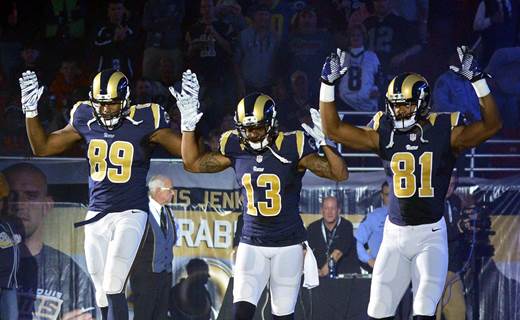
Three of the five Rams players taking the field.

It happened Sunday afternoon. I tried to avoid writing about it, not wanting to be distracted from the bigger picture or detract from what I thought—and still think—the most important stories and issues are. But it hasn’t gone away. With this morning’s headlines and so many references to the image I spent several years of my life researching and writing about, I think I have to say something.

I’m talking, of course, about how five members of the St. Louis Rams football team entered the stadium before their game this weekend with their arms and hands raised, enacting the “Hands Up, Don’t Shoot” pose that has become such a powerful symbol and statement for protesters in Ferguson, Missouri and all over the country.

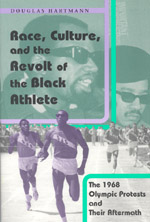
Let me say, right off the bat, how much I respect and admire the Rams players—Tavon Austin, Kenny Britt, Stedman Bailey, Jared Cook, and Chris Givens—for what they did. Like their coach Jim Fischer, I defend their right to free speech. Perhaps even more than he can or would say, I celebrate their vision and courage, with respect both to their awareness and understanding of the broader social issues involved as well as to how they figured out a way to use their status as athletes to contribute to that conversation. Their use of the hands-up pose was a stroke of symbolic genius that allowed these men, who make their living with their bodies, to speak volumes without actually saying a word. I see them in the proud tradition of Tommie Smith and John Carlos, who in 1968 used the platform afforded them as Olympic champions to call attention to ongoing problems of race and racism in the United States. (Their clenched-fist, victory stand demonstration in Mexico City, the iconic image that has appeared in many media outlets over the past couple of days, is the inspiration and focus of my book Race, Culture, and the Revolt of the Black Athlete.)

Hartmann bookBut lots of people don’t see it this way. Predictably, there has been a backlash against the Rams players, led or at least crystallized by the St. Louis Police Officer’s Association who called the gesture “tasteless, offensive, and inflammatory,” calling for an apology from the players and disciplinary action from the NFL. Some of these criticisms are driven by disagreements with the players’ views and perceived politics. I’m actually okay with that (though I’m probably more on the players’ side than the critics). In fact, a real, meaningful conversation about the incident and subsequent events and larger social and racial issues in and around Ferguson that provoked this demonstration in the first place would be a very good result. Yet that doesn’t seem to be what is happening. Instead, judging by their official statement, the police group seems to continue to see black people and bodies as a threat in need of constant management, policing, and control, all of which maps onto the dynamics between the NFL and its predominantly black workforce.

At a broader level, too much of the reaction to the Rams is driven by the sense that this display was objectionable because it was somehow out of place, because it occurred in the athletic arena. This really rubs me the wrong way, and not only because I firmly believe that athletes, like anyone else, have a right to their opinion and the opportunity to express that opinion freely and publicly. I get frustrated with this response because so often the sporting world is used and/or functions to promote, celebrate, rationalize, and legitimate all kinds of social causes, religious beliefs, and political issues—nationalism, military service, breast cancer awareness, the power of prayer and faith, etc. I don’t see why some social issues are allowed pride of place in the sports arena, while others are not, how some athletic figures are allowed to speak up and even spout off, while others are consistently chastised and silenced. There are clearly double standards often at work here, especially with respect to what is seen as protest or complaint against the mainstream majority.

One of the things that is driving me crazy about my various Facebook networks and Twitter feeds is that so many of the folks who have been critical of the Rams players are the same folks who have been calling for activists, African American and otherwise, to protest peacefully, to express their frustrations about Ferguson without resorting to violence and disorder. Isn’t this exactly what these athletes were doing? As John Carlos himself told the Associated Press: “I don’t think anyone got injured or shot by [the Rams players] expressing emotions.”

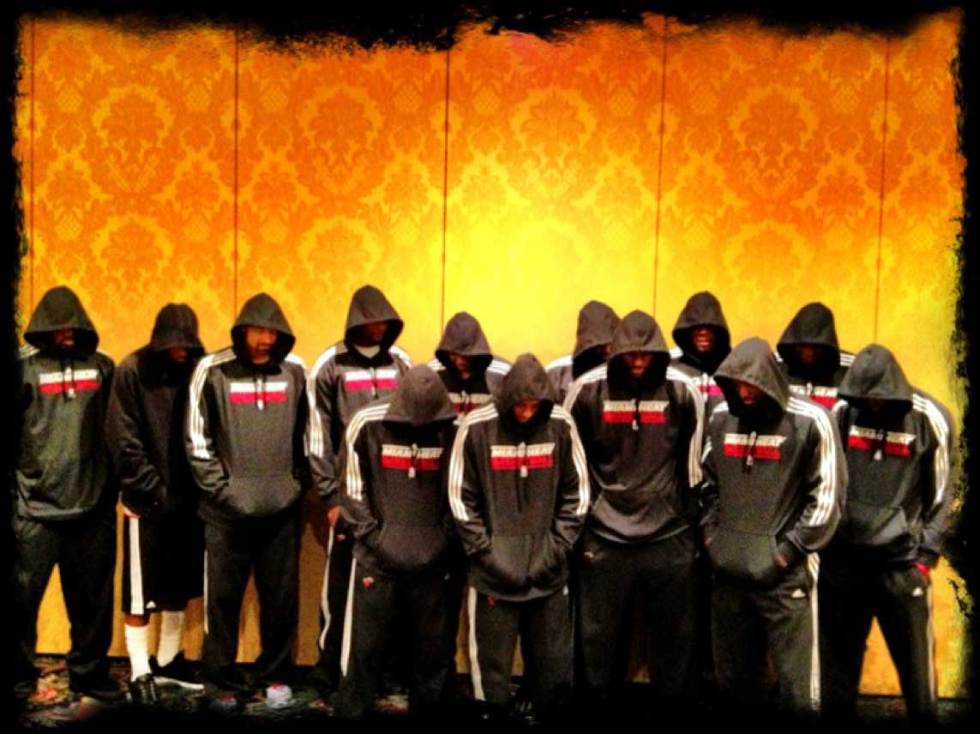
The Miami Heat released this protest image as part of the "hoodie" protests following the death of Trayvon Martin.
The Miami Heat basketball team in a protest image posted on LeBron James’s Twitter account following the death of Trayvon Martin.

This morning’s news on this football affair has been driven by the question of whether there was an apology by the Rams or not, with the police folks claiming that “regret” had been “expressed,” while the athletes have refused to back away from their actions and statements. “Did they apologize or not,” were the breathless lines spoken by television reporters as they worked their way through the conflicting hashtags and tweaks. Although I’ve spent much of my professional life thinking about sports, race, politics, and social change, this is exactly the kind of side-show I was afraid of—where talk about athletes and symbolic gestures and official demands becomes the focus of the conversation. The result is that public attention, our attention, is deflected away from the real issues—the deeper social problems of police use of force, of racial disparities in the criminal justice system, of pervasive and persistent racial inequities in contemporary America, and the ongoing scourge of racism itself—that should be the focus of the still-unfolding stories and lessons and (hopefully) reforms coming out of Ferguson. But of course these deeper social realities are precisely what protestors and demonstrators and activists are trying to remind us of and keep our attention focused upon. Even if we don’t agree with their perspectives, conclusions, or suggested solutions, we would do well to honor their effort.

What a night. What a disturbing, terrifying, disconcerting night. A questionable grand jury process. Explanations and pushback. Protests. Police, lots of police. Media everywhere. Some looting and violence. Gas and smoke. Images of burning buildings and cars—fiery images that seem to be on a continuous loop this morning, this difficult morning after. How to make sense of it all? What to say? What to do?

I looked to and start with the President, President Obama, our President. The President’s words last night, in the immediate aftermath of the release of the grand jury decision, were measured, subdued, and multifaceted—begging for peace, pleading for calm and, more importantly, trying to get folks from all different sides with such divergent reactions to better understand each other. I saw our leader trying to explain why, on the one hand, we must respect the rule of law, our law enforcement agents, and the workings of the criminal justice system–as well as why, on the other hand, we need to understand, really understand, why there is so much anger and frustration and resentment from so many. It was very typical Obama—trying, cautiously and stoically, to be that voice of compassion and understanding, that bridge across racial and ideological and political lines, subtlety appealing to our common humanity, our bigger ideals, our better angels.

As a sociologist and a citizen, I found myself deeply sympathetic and aligned. In fact, it is probably the kinds of things I would have said if I had I been in the President’s shoes or on his speech writing team. Although I would have probably developed and further specified the deep and historical sources of anger and frustration—not only with respect to racial disparities and injustices within the criminal justice system at all levels, but also the legacies of segregated housing and lending polices, the realities of poverty, poor education, and unemployment, the persistence of so many stereotypes and racially charged images and rhetoric—I still would have asked for some kind of balance and some larger peace and understanding. In fact, much as Todd Beer in his SocSource/TSP post from earlier in the fall on “Teaching Ferguson,” I still believe that these deeply racialized and even racist historical forces, institutional policies, and contemporary realities—and the very different ways in which they are perceived and understood (or ignored or disavowed)—are crucial to both understanding and explaining both Ferguson the town and Ferguson the cultural firestorm. And this broader historical context and social conditions are all too often missing from media coverage, political discourse, and public understanding with their focus on the specific case in its immediacy and its concreteness. This in mind, I probably also would have also talked about the profound, deeply sociological challenge of confronting obvious, patterned, and systemic inequities of race in both the criminal justice system and the society at large without losing sight of the fact that the specifics of any given incident, event, or case are unique, may not stand in microcosm for the whole, and are probably not the appropriate focus for systemic, institutional change.

But the problem is that all of this, at least as I was watching last night and trying to think it back through this morning, is a little too measured, a little too dispassionate. Part of this is that the whole abstract language of a multi-point, multifaceted analysis and perspective is a little bit too communitarian. That is, it is too heavy on the language of common understanding of our mutual situation when what we are really talking about is the extremely divergent reactions and response of very different and indeed radically polarized communities. There are specific sides and radically different perspectives here, and the stakes require responding to them on their own grounds. Ultimately, however, I think this response–both the President’s and my own—is unsatisfying at the moment, because it is too much about analysis and understanding, and not enough about action, response—what to do and who will lead. Too often the call for calm, clear thinking analysis and understanding—no matter how accurate, no matter how potentially useful—never gets to the next step. Good sociology, in short, does not always make meaningful leadership, much less transformative response and meaningful change.

Ezra Klein’s Vox column this morning (“Why Obama won’t give the Ferguson speech his supporters want”) helped give me a better sense of why Obama gave the speech he did. He is capable of more. Indeed, he did more–much more–on the campaign trail leading up to his historic ascendence to the presidency. But now, as President, he is in a different position. Obama’s challenge is not so much that he needs to try to speak to and represent the nation as a whole. Obama’s challenge right now, according to Klein, is that in our polarized political climate—and no figure is more polarizing than the President, according to the political scientists—anything Obama says on any given issue or cause, any specific position he takes or policy he argues for, tends to be damaging to the cause or any allies he may have. Obama and his advisors have—rightly, it would seem—realized that he is hemmed in and it is better for him to take a middle ground rather than inflame passions yet again. (Immigration, of course, is the exception to this, the arena where Obama and his team have decided to take the hit and fight the good fight, but that is a single and quite exceptional case at this point, as much about political position and institutional power as about rhetoric, understanding, and dialogue).

Ultimately, however, I find myself thinking not about Obama’s political challenges but about the limits and indeed pathologies of a dispassionate if accurate sociological response in a moment of such historical crisis and upheaval. Focusing on the roots and conditions as well as on the need for shared, overarching understanding just doesn’t seem like quite enough. Necessary, but not enough.

The idea of paying reparations to African-Americans for slavery is not new, but it is usually relegated to the fringes of lefty radicalism or scholarly academic critique. Not anymore. With a piece from Ta-Nehisi Coates called “The Case for Reparations,” a recent issue of The Atlantic magazine has suddenly, if unexpectedly, mainstreamed the topic.

Coates’s article is comprised of ten chapters illustrating the enduring impact of slavery on contemporary African-American families. Coates identifies countless examples of the way whites have benefited from state-sponsored programs including Social Security and the GI Bill, reminding readers that there was a time “when affirmative action was white.” As much manifesto or treatise as conventional reporting, Coates’s piece argues forcefully for the need for America to grow up and repay its outstanding debt to its most vulnerable citizens. Failing to fulfill this promissory note, Coates insists, will leave all Americans morally impoverished.

Among its many exemplary characteristics is the way in which Coates draws directly and extensively on the works of numerous sociologists and political scientists. For example, Coates uses the work of sociologists Doug Massey and Nancy Denton to describe the role of residential segregation in the construction of inner-city ghettos, as well as their wealthier spatial counterparts-the suburbs (in 1993’s American Apartheid: Segregation and the Making of the Urban Underclass, from Harvard University Press). Crim-Soc scholar Rob Sampson’s research on “neighborhood effects” is at the core of Coates’ discussion of the enormous power the ghetto wields in conditioning the lived experiences of its residents (see his 2012 Great American City: Chicago and the Enduring Neighborhood Effect from the University of Chicago Press). And Coates engages political scientists Michael Dawson and Rovana Popoff’s studies of pre- and post-election survey data from 2000 (including views on reparations and racial apologies for Japanese American internment during World War II) to show how racialized views of politics shape public opinion as well as remind us that reparations are not unprecedented (for more on this, see Dawson and Popoff’s 2004 DuBois Review article “Reparations: Justice and Greed in Black and White”).

There’s a lot more where this came from—including Rodney. D. Coates’ 2004 scholarly treatment (“If a Tree Falls in the Wilderness: Reparations, Academic Silences, and Social Justice,” Social Forces 83(2): 841-864). And as you read it, remember that while you may or may not agree with Ta-Nahesi Coates’s opinion on reparations, the social scientific data and research about the social foundations of persistent African-American inequality are not up for debate.


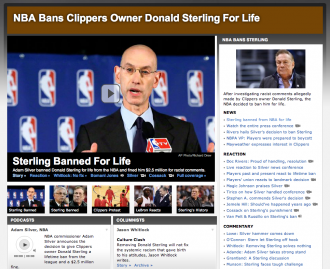
The ESPN.com homepage on 4/30/2014

Or: On Snark and Solutions

Eds note: This is a guest post from Max Fitzpatrick of Central New Mexico Community College and the University of New Mexico.

Recently there has been a lot of righteous finger-wagging at racist comments uttered by older white personalities. When celebrity chef Paula Deene, Los Angeles Clippers owner Donald Sterling, and rebellious rancher Cliven Bundy spoke bad words about black people, mainstream and social media pounced.

Deene and Sterling are economic elites who have made fortunes employing black labor and selling black culture. It is sadly ironic that they disparage the very group whose alienated labor they exploit and whose culture they have commodified. But the popular criticism of their racist statements has not approached such a systemic analysis—remaining instead at the surface level of the individual. The uproar chastises these people as racist celebrities, when the real danger is that they are authority figures presiding over economically powerful institutions with broad cultural influence. Racism matters most when it is combined with power. But the internet snarkfest has avoided that point almost entirely. more...

RU122013Before we get to the heart of the matter, let’s just put it out there: SocImages’ annual Christmas Roundup is ready and ripe for the readin’! Get it!

Now, rather than our usual Roundup, it’s time to announce this year’s fully unscientific, but fully entertaining TSP Awards! Hopefully these excellent pieces from our original content, our blogs, and beyond will keep you in reading material in the days of travel and food comas ahead. We wish you a wonderful New Year full of health, productivity, and ridiculousness, because every good year is a little ridiculous. more...

RU110813Missing the Point

I was so struck last night to hear a little piece about the sociologist Clifford Nass on NPR (in a fun side note, I’d like to point out that Nass was also a computer scientist and professional magician… which is pertinent to the next sentence). Yes, he was known for his warning that multitasking was dangerous to real thought and real learning, but what caught my ear was how his colleagues spoke of his relationship with expanding technologies. Nass didn’t seem to have any antipathy for the tech—he saw its utility, of course—but he realized that all those blinky things were going to be attention sucks. Multiple distractions tend to be bad when you aren’t a good multitasker (to be fair, he didn’t think anyone was a good multitasker), but worse, he seemed to believe, the divided attention meant that his students paid attention to too much noise. Over time, he felt his students were getting worse and worse at understanding an argument and repeating it clearly. They weren’t good at finding the point or pulling out a specific nugget of information from a whole article. They had trained themselves (or been trained by their technologies) to see the forest, not the trees. I’m not wholly convinced, but I am intrigued—and I’m sad that the world has lost another great sociologist in the meantime. more...

Bowl of Someone Else's Memories by cogdogblog via flickr.com
Bowl of Someone Else’s Memories by cogdogblog via flickr.com

My colleague Teresa Swartz (full disclosure: I’m also married to her) has this writing exercise that she does with all of her Intro students at the end of the semester. In a nutshell, she asks them to write a brief paper situating themselves in the social contexts that have most profoundly shaped and determined their lives and identities. The exercise, which she calls a “sociological memoir,” is inspired by C.Wright Mills‘ famous definition of the sociological imagination as becoming aware of the intersection of one’s personal biography with larger social and historical forces. The book she often has the class read as an illustration is Dalton Conley’s wonderfully idiosyncratic early life narrative Honky. In the last couple of days I’ve read another couple of pieces I think I’m going to recommend to her as well.

Andrew Lindner’s “Epilepsy, Personally and Sociologically,” on TSP’s ThickCulture blog, is one of them. more...