race

Photo Credit: Nathan Rupert, Flickr CC

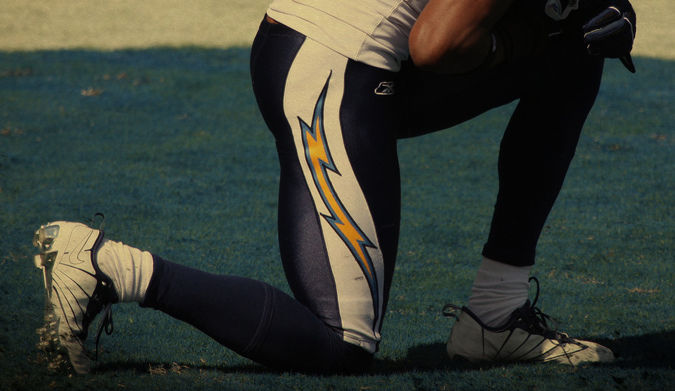
In case you were otherwise occupied, on Christmas Day the Associated Press named the “NFL National Anthem Protests” the top sports story of 2017. In a year of many huge sport stories both on and off the field, the AP said the story was the “runaway winner” for its staff. This doesn’t surprise me at all. I’ve studied sports-based social activism for a long time, but I’ve never had more media calls and requests for interviews in my career than these past few months.

The single biggest reason for the story, I’m pretty sure, involves our President’s seemingly unprompted and unusually profane attacks in September on football players who had engaged in demonstrations and the NFL. For better or for worse, Trump’s attention provoked a tidal wave of unprecedented gestures of protest and support across the league (and across both racial lines as well as those of management and ownerships) that gave the story its scale, scope, and intrigue. But there’s much more to say about it than that, much more.  I’ve been tracking this all fall as part of my own research project on the “new era” of African American athletic activism we are currently witnessing, and I am going to pull some of that together in a commentary with my sport and politics collaborator Kyle Green.  We are hoping to run that piece in the lead-up to the Super Bowl here in the Twin Cities at the end of January, so stay tuned!

There are two points I’d like to address here, by way of year-end retrospective: “kneeling” and “remembrance.” On kneeling, why do athletes feel the need to protest?

“Why do they do it?” is far and away the most common question I get from journalists and regular folks alike. Underlying this inquiry is the sense (a) that these demonstrations are disrespectful and (b) that professional athletes are super-rich, superstars who should be so satisfied with their lives and salaries and fame that they’d have no reason to complain or be angry, much less act out in public. At best, they see African American athlete activists as spoiled complainers, more interested in politics, making news, and making money than anything else. For many Americans, athletic protests are as incomprehensible as they are inappropriate.

Based on the athletes I’ve talked to and my earlier research on black athletic activism in the 1960s, I see the issue quite differently. and commitments. In a society that continues to be plagued by disproportionate police brutality, persistent racial gaps, and overt bigotry and bias, they feel compelled to do or say something. Sometimes it is in support of communities of color—their communities—who continue to face persistent racism and discrimination. Sometimes it is quite personal, stemming from their own ongoing individual experiences with racism and discrimination. And almost always it is quite principled and reasoned, with a clear understanding of the costs and consequences (which are far more real and extensive than most of us realize). Athlete activists don’t take their activities lightly or think of them as disrespectful or anti-American. Quite the contrary, they understand activism as consistent with the higher moral standards, ideals, and aspirations of both American democracy and sport culture.

But there is something else here too: It is also the fact that many —to make it seem like everything is okay. This was a major motivator for the African American athletes who participated in protests in the year leading up to the 1968 Olympic Games. As high jumper Gene Johnson explained in support of the “Olympic Project for Human Rights:”

“The United States exalts its Olympic star athletes as representatives of a democratic and free society, when millions of Negro and other minority citizens are excluded from decent housing and meaningful employment” (Race, Culture, and the Revolt, 2003, p. 84).

Or, as the OPHR organizing pamphlet put it: “We must no longer allow this country to use black individuals of whatever level to rationalize its treatment of the black masses.” 

So, that’s kneeling, now for remembrance. A few weeks back I was interviewed by a Time reporter for a special 50th anniversary retrospective issue on the tumultuous year of 1968. Among other things, the reporter asked me what my research on Tommie Smith and John Carlos’s iconic victory stand demonstration taught me about the meanings and implications of the protests of Colin Kaepernick and his NFL brethren. “How will we remember what is going on today, 50 years from now,” she wanted to know?

Social scientists like me, I told her, are loath to make predictions. However this topic is one where I was willing to make an exception. I’m pretty confident that one day in the not-to-distant near future, Kaepernick and company will be remembered far more positively across the American populace than is currently the case. In fact, it wouldn’t surprise me at all if, once the specifics of this moment and the larger racial politics that are unfolding are behind us, these athlete activists come to be revered as courageous, admirable, or even heroic—certainly ahead of their time. If you’re interested, my little quote to this effect can now be found in print on page 92 of the latest issue of Time (dated Dec. 25/Jan. 1) as well as online here.

Such historical re-remembering is a familiar pattern in American culture. It happened to our collective conceptions of Martin Luther King, Jr. and Muhammad Ali. Perhaps most pertinent to this discussion are the memories that surround the perpetrators of one of the most iconic sports demonstrations of all time, Tommie Smith and John Carlos’s 1968 clenched first, victory stand demonstration at the 1968 Mexico City Olympics. Today, most Americans celebrate Smith and Carlos as heroes of the Civil Rights Movement; back in 1968, they were seen as villains, traitors, and worse.

History and memory—what happened and how we think about what happened—are two different things. All too often, the way we remember and romanticize images, individuals, and events comes at the cost of forgetting all of the actual social issues and context that gave rise to them in the first place. As this year draws to a close and we begin to look to the future, let us not lose sight of the racial disparities and social injustices at the root of the biggest sports story of 2017.
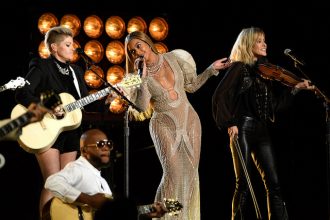
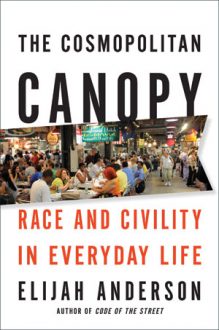
Photo by Disney|ABC, Flickr CC

Okay, so I’m short on time and more than a little bit intimidated by Beyonce and all her brilliance. But I grew up listening to country music, have long loved the Dixie Chicks, and I’ve been thinking so much lately about trying to cultivate cross-racial understanding and interactions in our culture that it seems like I need to say something about the remarkable rendition of “Daddy’s Girl” that was part of the CMA country music awards the other night. Fortunately, this new piece on the Atlantic entitled “What Beyonce’s ‘Daddy’s Lessons’ Has to Teach” says many of the things I’ve been thinking about. From the intriguing lack of media buildup, to Beyonce’s blending of feminism, religiosity, and guns, to the racial dynamics of the performers and some of the predictable (and easily repudiated) social media backlash, this piece has it all–and this isn’t even to mention the amazing musicality and rip-roaring entertainment value. Fortunately, there is a link to the performance embedded in the post. And in case you haven’t heard of any of this, here’s the lyrics to wet your appetite.

BEYONCE Daddy Lessons lyrics

[Beyonce]
Yee-haw!
(Oh, oh, oh)
Texas, texas (oh, oh, oh) texas…

Came into this world
Daddy’s little girl
And daddy made a soldier out of me
(Oh, oh, oh)
Daddy made me dance
And daddy held my hand
(Oh, oh, oh)
And daddy liked his whisky with his tea
And we rode motorcycles
Blackjack, classic vinyl
Tough girl is what I had to be

He said take care of your mother
Watch out for your sister
Oh, and that’s when he gave to me…

With his gun, with his head held high
He told me not to cry
Oh, my daddy said shoot
With his right hand on his rifle
He swore it on the bible
My daddy said shoot
Oh, my daddy said shoot
He held me in his arms
And he taught me to be strong
He told me when he’s gone
Here’s what you do
When trouble comes to town
And men like me come around
Oh, my daddy said shoot
Oh, oh, oh…

Daddy made me fight
It wasn’t always right
(But he said girl it’s your second amendment, oh, oh, oh)
He always played it cool
But daddy was no fool
And right before he died he said remember…

He said take care of your mother
Watch out for your sister
And that’s when daddy looked at me…

With his gun, with his head held high
He told me not to cry
Oh, my daddy said shoot
With his right hand on his rifle
He swore it on the bible
My daddy said shoot
Oh, my daddy said shoot
‘Cause he held me in his arms
And he taught me to be strong
And he told me when he’s gone
Here’s what you do
When trouble comes to town
And men like me come around
Oh, my daddy said shoot
Oh, oh, oh
Oh, oh, oh

My daddy warned me about men like you
He said baby girl he’s playing you
He’s playing you
My daddy warned me about men like you
He said baby girl he’s playing you
He’s playing you
Cause when trouble comes in town
And men like me come around
Oh, my daddy said shoot
Cause when trouble comes to town
And men like me come around
Oh, my daddy said shoot!

(Good job Bey, hahaha…)

Source:http://www.directlyrics.com/beyonce-daddy-lessons-lyrics.html

9780393071634_300Getting sociological research into public circulation is an ongoing challenge, especially when we are talking about sociologists writing in their own voice about their own original research. Obviously, we here at TSP see that as one of our primary missions, as does our fabulous partner, ASA’s Contexts magazine. But our resources and media penetration are extremely limited. Over the past few weeks, in fact, I’ve had several conversations with colleagues and students about how few venues exist wherein sociologists can reach a public audience in their own, original voice. Even our colleagues that contribute regularly to national media outlets are often explicitly and unceremoniously instructed not to write about their own research and findings.

Against this backdrop, it seemed almost magical when Elijah Anderson’s piece analyzing Donald Trump’s rhetoric about African Americans and inner-city neighborhoods popped into my feed a week or two back. The piece appeared on Vox under the title “The Sociological Theory that Explains Trump’s Assumption that All Black Citizens Live in the ‘Inner City’.” It is, of course, Anderson’s theories that we are talking about — or, rather, that he himself is sharing with a larger public audience.

Anderson’s jumping off point is the exchange that took place during the second presidential debate when Donald Trump responded to a question from a well-dressed African American man by launching into a riff on how terrible inner-cities are, assuming and implying that this man had come from a St. Louis ghetto. Essentially Anderson analyzes that moment as a way to explain how and why African Americans are so often profiled by other Americans and he does so through a larger discussion of his own theories and research on white spaces, black spaces, and the cosmopolitan canopy.

If you already know Anderson’s work, this will be a bit of a refresher course. If you don’t, it will be a nice introduction and primer to his ideas, which have been fairly widely discussed within the field (especially the notion of the cosmopolitan canopy). And either way, I think it is a rare and important treat to see a leading sociologist writing in their own voice and showing how their research and theories can be used for a broad, mainstream public audience.

Kudos to Professor Anderson, and kudos to Vox for providing such a format and opportunity.

Saturday Night Live has been having great fun with the presidential campaigns and debates all fall, with Alec Baldwin and Kate McKinnon headlining in the roles of Trump and Clinton. These skits have been entertaining to be sure, but they haven’t–at least in my opinion–plumbed the depths of social significance in the way that great, memorable, and truly meaningful comedy often achieves. Perhaps it is the source material. In any case, there was a bit this past week that I believe did achieve something quite powerful and sociologically insightful, even while being outrageously hilarious. I’m talking about the Black Jeopardy skit.

“Black Jeopardy” has been something of a recurring bit on the show. The concept is a play off of the quiz show that Alex Trebec has made famous where contestants must provide the questions that go along with various facts about culture, history, and science. In the SNL version of the game, the categories and questions are all based upon knowledge and information associated with black culture and/or unique in African American communities, and typically one of the three contestants–usually someone who is white–has little or no knowledge of any of this. The running gag is how obvious the answers and questions are for black contestants as opposed to the fish-out-of-water, racial other. What is both funny and revealing, then, are both the unique characteristics  and distinctive knowledge of black culture and community (even the categories are often pretty funny but only if you have some knowledge of the culture) as well as what it is like to be a complete outsider. In short, Black Jeopardy is an almost straight-up inversion (and take down) of white culture and privilege.

In this week’s installment, the SNL crew inserted Tom Hanks into the mix. He plays an earnest if uncomfortable white, working-class contestant. The results were not only laugh-out-loud hilarious, but also revealed points of agreement–ranging from distrust of the government and anyone in power, to taking pride in thriftiness to a dislike of thin women–between members of the black community and erstwhile white Trump supporters. The unexpected points of agreement were the key to both the humor and the sociological insight. Such points of commonality are almost never realized or appreciated in our currently polarized, black versus white racial-political climate. The skit not only brought them to the fore, they made them funny.

You probably need to watch it for yourself to fully appreciate my point, and if you haven’t yet seen it, here’s a link.


But just to help underscore the brilliance of the concept and execution (and with a little help from my research assistant and TSP board member, Sarah Catherine Billups), here’s a condensed narrative of some of the best moments in the skit.

The Skit: Black Jeopardy with a Trump Player

“Whaddup, whaddup, whaddup! Welcome to Black Jeopardy—the only TV game show where the audience is in church clothes,” host Darnell Hayes (cast member Kenan Thompson) booms before introducing the contestants: Keely (Sasheer Zamata), Shanice (Leslie Jones), and Doug, a white guy sporting a “Make American Great Again” cap.  One of these things is not like the other.  Doug, played by guest host Tom Hanks, looks clearly out of place with his red cap, American flag and eagle t-shit under his blue denim work shirt and white goatee.  All he’s missing is a shotgun and a Budweiser.

“Doug? Are you sure you’re ready to play Black Jeopardy?” Darnel asks with worry pushing his eyebrows to the ceiling.

“They told me a fella could win some money so let’s win me some money, GIT ‘R DONE,” Doug/Hanks explains kind of quietly.

The audience roars with laughter at this fish-out-of-water-fella as Darnell shrugs and then goes on to introduce the categories “Big Girls,” “You Better,” “Mm I don’t know,” “I’m Gonna Pray on This,” “They Out Here Saying,” and “White People.”

Keely and Shanice hit their buzzers with lightning speed to correctly answer the first few questions–which, as is the usual bit for this skit, plays off of the knowledge and experiences that are supposedly unique to the black community.  When Doug nods his head in agreement to an answer and shares that he plays Monopoly Millionaires Club every week too, Darnell brushes him off.

Much to everyone’s surprise, however, Doug buzzes to the answer to the prompt: “They out here saying: the new iPhone wants your thumbprint ‘for your protection.’” He responds, a bit hesitantly, “No no, I don’t think so. That’s how they get’cha.”

“YES!…YES! That’s it!” Darnell points to him in shock.  Did this white guy really just answer correctly?

Keely purses her lips, thinking for a second before nodding in agreement, “Yep. I don’t trust that.”

“Me either,” Shanice joins in.  Both black women turn and look at Doug, fascinated but still a little cautious. “I read that goes straight to the government,” he says matter-of-factly.

“Yeah, not bad dog. The, the board is yours,” Darnell announces, his eyes still wide with newfound curiosity about this white guy in a bright red Trump hat.

Keely chooses the category “They Out Here Sayin” for $800: “They out here sayin’ that every vote counts.” This time, Doug buzzes in a bit more quickly. “What is ‘oh come on, they already decided that weeks ago–who’s gonna win even before it happens.”

“YES! YES! YES! YES!” Darnell shouts in excitement,” elaborating further himself, “The Illuminati figured that out months ago! That’s another one for Doug!” Is this really happening? Is Doug actually getting answers correct? The audience laughs as Doug says with new confidence, “Okay, we’re doin’ it.”

Next question: “The mechanic says you owe $250 for new brake lines.”

Doug rings in again! “What is ‘you better go to the dude in my neighborhood who’ll fix anything for $40.’”

“Oh, you know Cecil?!” Darnell asks as if Doug is a long lost cousin.

“Yeah, yeah. My Cecil’s name is Jim and he fixed my refrigerator, my air conditioner, and my cat,” Doug replies with pride.

“Yeah, everybody’s got a guy,” replies Darnell. “Wooo, you all right, Doug.” The audience applauds almost politely, with genuine appreciation.

Next, Doug selects the category “Big Girls” for $200. “Skinny girls can do this for you.”

“Doug?”

“What is ‘not a damn thing.”

This time the audience erupts in wild hoots and hollers as Darnell exclaims, “You damn right!”

“Yes! Yes!” Keely and Shanice agree.  Shanice even gives him a high five.  Both the women are smiling and nodding vigorously at this point, no longer looking at Doug like he’s a two-headed giraffe in the zoo.

“My wife—she’s a sturdy girl,” Doug explains.

“That is my MAN right there!” Shanice approves.

“Go Doug, Go Doug, Go Doug!” The host and the other contestants sing and dance to cheer for this white man getting the right answer, again!

As the fictional contest draws to a close, Darnell crosses his hand over his heart and says, “Doug. I got to say, it’s been a pleasure,”

“Well, right back at ya my buh-rau-thuh,” Doug replies in a somewhat uncomfortable attempt to return the complement and stay on common ground.

Now it’s time for the Final Jeopardy.  What else does Doug know? Can he really win this thing? Is it possible that his knowledge and understanding is really on par with that of the black audience, host, and contestants? The audience is ready to find out, and waits for the final category to be revealed.

“Lives that Matter.”

“Oooooh” the audience grimaces and hesitates as Keely’s and Shanice’s eyes shoot daggers in Doug’s direction.  Darnell smiles biting his lower lip, shrugs his shoulders, and shakes his head, “Well, it was good while it lasted, Doug.”

“Hey, I got lots to say about this—,“ Doug insists.

“I’m sure you do!” Darnell says. “When we come back, we gonna play the National Anthem just to see what the hell happens. We’ll be right back!”

As the screen fades out, we see Doug talking and gesturing wildly with his hands as Shanice watches, perplexed and Keely slowly wags her finger.


Final Analysis: There are other great moments in the skit of both unexpected commonality and obvious, if amusing, cross-racial tension that we’ve glossed over here. But the insights about race relations and American culture that I see so brilliantly, entertainingly represented and revealed in SNL’s Black Jeopardy can be easily summarized: the initial skepticism and distrust that defines so many inter-racial interactions in our culture; the points of common understanding about culture and society that may actually exist under the surface for some of us; and yet, ultimately, the existence of issues where there is almost certainly going to be a huge disconnect and major disagreements. Great concept. Brilliant execution. SNL and comedy at its sociological best.

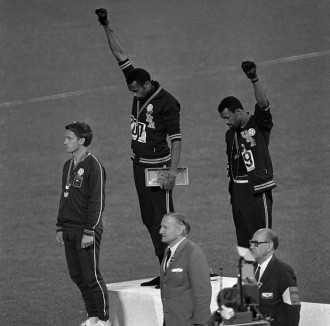
U.S. athletes Tommie Smith, center, and John Carlos stare downward during the playing of the Star Spangled Banner after Smith received the gold and Carlos the bronze for the 200 meter run at the Summer Olympic Games in Mexico City on Oct. 16, 1968
U.S. athletes Tommie Smith, center, and John Carlos stare downward during the playing of the Star Spangled Banner after Smith received the gold and Carlos the bronze for the 200 meter run at the Summer Olympic Games in Mexico City on Oct. 16, 1968. (AP Photo)

So Tommie Smith and John Carlos get to go to Washington, D.C. next week, to the White House, to be received by President Obama with the 2016 United States Olympic team. Who are they and why is this such a big deal?

Smith and Carlos are the American Olympians who raised their fists during the playing of the national anthem during the victory ceremony–their victory ceremony–at the Mexico City Games in 1968. The gesture remains one of the most iconic images in all of sport history, and it has been referenced frequently in recent months with the emergence of a whole new era of African American athletic activism.

My first book was on Smith and Carlos and their demonstration, and over the course of the past few months I’ve been working on a project to situate the current era of athletic awareness in the context of the activism of 1968. Too often in sports, if not society more generally, we have a tendency to confine history–especially the history of racism and injustice as well as conflict and struggle–to the past. Without getting lost in the details, here’s a few facts about the history that I think are still relevant today.

  1. Smith and Carlos’ 1968 demonstration was not the spontaneous gesture of two isolated, discontented individuals; rather, it was the culmination of a year-long effort of activism and advocacy (famously titled “The Revolt of the Black Athlete”).
  2. The athletic activism of 1968 was not directed against prejudice and discrimination in the world of sport; rather, it grew out of the desire of socially-conscious, politically-committed African American athletes to use the publicity and platform of sport to contribute to larger, societal struggles against racism and injustice.
  3. Smith and Carlos were not celebrated by most Americans back in 1968, much less received at the White House for their demonstration. They were kicked off the team in Mexico City and treated as outlaws, villains, and traitors back home.

When even Michael Jordan—that erstwhile poster child of the transcendent, apolitical, super-star athlete—jumps into the fray, you know something is up. I am referring, of course, to the public announcement Jordan made Monday. Saying he could “no longer stay silent,” legendary #23 pledged to donate $1 million each to a charity for community-police relations and to the NAACP’s Legal Defense Fund. Jordan said, “We need to find solutions that ensure people of color receive fair and equal treatment AND that police officers—who put their lives on the line every day to protect us all—are respected and supported.”

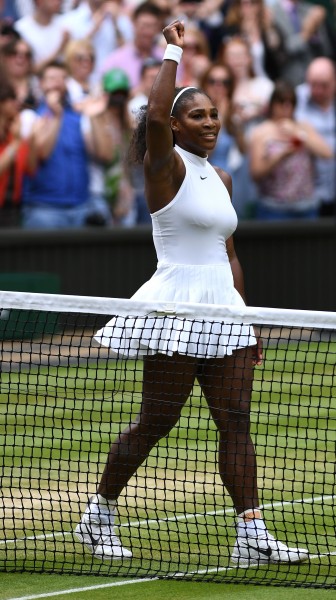
Serena Williams after her 2016 Wimbledon win, via bustle.com.

But Jordan is not the main story here, at least not when viewed in sociological perspective. The main story, the bigger story, is about all of the athletes and sports organizations who have been speaking out about social issues in one way or the other over the course of the past few months: NBA star and American Olympian Carmelo Anthony urging athletes to quit worrying about their endorsement deals and speak out on police killings; tennis player Serena Williams offering support and then a clenched fist salute on the hallowed grounds of Wimbledon; the testimonials of Anthony and fellow NBA stars Chris Paul, LeBron James, and Dwyane Wade at the ESPYs; WNBA players and teams, led by the Minnesota Lynx, dressing in support of Black Lives Matter and against police shootings; the NBA moving next year’s annual All-Star game out of North Carolina because of that state’s LGBTQ politics. My hometown paper, The Star Tribune, ran a whole page story in last Sunday’s sports section about a host of athletes taking social justice stands or actions in Minnesota alone.

Let there be no doubt: we live in a new era of athlete awareness and advocacy, unlike anything we’ve seen since the late 1960s.

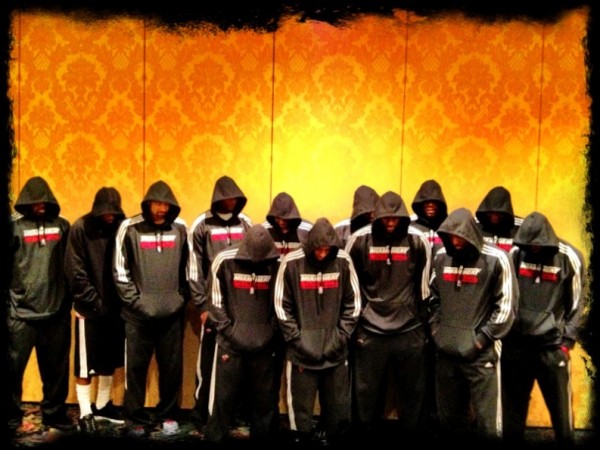
LeBron James and the Miami Heat in 2012, hoods raised and heads bowed in memory of Trayvon Martin.

I believe the roots of this new movement can be traced to LeBron James and his Miami Heat teammates tweeting out a picture of themselves in hoodies, with heads bowed in support of Trayvon Martin, a few years back (see also). Others recall when the entire Phoenix Suns team wore jerseys in solidarity with Latinos who felt threatened by proposed anti-immigration legislation in Arizona. Since then, we’ve seen NBA players like Chris Paul threatening to boycott the NBA All-Star Game unless something done to disavow the blatant racism of then-owner Donald Sterling; St. Louis Rams football players entering the field in the “hands up” gesture of Ferguson protestors; and, perhaps most amazingly, the University of Missouri football team using the threat of a boycott to force the removal of their university’s president.

Hartmann coverAs a scholar who’s done a good bit of work on sport and race and social unrest and social protest over the years—including a book on the 1968 African American athletic protest movement, the activism associated most famously with Tommie Smith and John Carlos’s iconic victory stand demonstration in Mexico City—I’ve been asked a lot of questions and invited to make a lot of presentations on athlete activism over the past year. So, as all of this has been unfolding, I’ve begun work on a paper situating the most recent activism and advocacy in the context of the protests of the Civil Rights era. Below, a few of the points I’m building the paper around:

  1. Athlete Awareness. While public advocacy may be new, social awareness among athletes is not. Athletes, especially elite professional and Olympic athletes, have long been far more educated, intelligent, and aware than prevailing if outdated “dumb-jock” stereotypes allow. The problem, in my view, has not been lack of social awareness and understanding, but barriers to public expression. Anthony has referenced highly lucrative endorsement deals (sometimes offering more renumeration to players than their actual sporting endeavors do), but formal and informal league rules, organizational pressures, and norms about the public roles of athletes all also apply. If there is a new consciousness, in my view, it involves a revitalized understanding of the powerful platform that sports provides athletes who are so inclined to voice their opinions.
  2. Larger Context and Connections. Those athletes who have chosen to use their status as public figures to speak out on social issues are not just speaking off the cuff, nor are they isolated malcontents. These public expressions are deliberate and reflective, responding to social issues such as police brutality and profiling or hateful gender or sexuality policies outside of the world of sport, in concert with other public leaders, and more often than not in close communication with other activists and organizers. Perhaps the best and clearest example of this was at the University of Missouri last fall: football players launched their boycott after working with campus leaders on ways to show their support for student on a hunger strike in protest of racial conditions and treatment on campus.

  3. Black Athletes as Leaders. It almost goes without saying that African American athletes have been the most prominent and powerful figures in this emerging movement (I think all but one of the athletes profiled by the Star Tribune were persons of color)—except that in our perverse “colorblind” culture, we often dodge the opportunity to name race explicitly and talk about it openly. This conversation is important for far more reasons than I can discuss here; it speaks to the unique racial composition of the American sports world, the prominent role of African American athletes in our culture, the centrality of race and racism in American society, and the larger role of sport in the construction, reproduction, and contestation of existing racial hierarchies. At the most basic levels, though, we can consider how sport is both impacted by and a driving force in the larger racial unrest in contemporary America—including the recognition of persistent patterns of racial injustice, emergent movements of resistance and opposition (such as Black Lives Matter), and the countervailing, reactionary movements of containment, denial, and resentment. The role of white athletes will be interesting as today’s movements unfold. At the University of Missouri, white players and coaches supported black activists, and, in the WNBA, star Minnesota Lynx point guard Lindsay Whalen and head coach Cheryl Reeves, both white, lent their support to protesting players. Whether white athletics and athletic leaders continue to step up and assume responsibility remains to be seen. For what it is worth, I’m impressed though not at all surprised the female athletes–including a huge swath of the WBNA–have been such powerful public voices in recent weeks.

Will this advocacy and activism change anything?

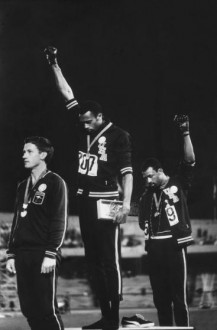
Via Time Magazine, the 1968 Olympics victory stand salute.

The initial answer is not always encouraging. If my study of the 1968 Olympic protests taught me anything, it is that sport protests usually do not change anyone’s mind or political position. Though we tend to heroize Smith and Carlos these days (as we did with the recently deceased Muhammad Ali), the truth is that these athlete advocates were seen as villains and traitors by mainstream Americans in the 1960s. If anything, their actions inspired a good deal of backlash and resentment, probably hardening some lines of conflict and division. Some of that reaction is already unfolding now.

But this doesn’t mean that nothing at all came of athlete activism in the past or today. One of the things that athletic protests and demonstrations can accomplish is forcing Americans who are or were not otherwise interested in such issues to look up from their otherwise comfortable, apolitical lives and pay attention to the social issues around them. So athletic advocacy can, in fact, play an important role in bringing issues of social injustice—police bias and brutality, policies toward LGBTQ Americans—to broader public visibility and debate. I believe it’s already happening.

And all of the money and attention we lavish on athletes and athletics in this country does put athletes in a unique and, on occasion, powerful material position. Witness the events at the University of Missouri: here, we saw athlete activists and their allies using the power afforded to them by virtue of how the institution and the public rely upon them for their athletic performances to force concrete, organizational change. This was amazing, revealing, and essentially unprecedented.

One final point on social and cultural change. When harkening back to 1968, I constantly find myself remembering and trying to remind others that Smith and Carlos not only didn’t change many people’s minds about race problems and civil rights, they didn’t change American norms about the relationships between sport and social change. If fact, they and their allies (as well as their opponents) were caught within prevailing conceptions of sport as a somewhat special, sacred, or apolitical cultural space. To wit: while some saw athlete activists in the 1960s as heroes or villains, public opinion polls showed that most everybody agreed that sport wasn’t a place for politics or, by extension, protest. The two sides simply disagreed on what counted as protest and politics. Those who sided with Smith and Carlos saw them as standing up for what was good, right, and morally just—in the idealistic way that high-minded sport supporters have long celebrated sport; the majority who were against them saw them and their actions as disruptions outside the social status quo.

What is at stake here is not just whether we agree with the particular causes of athlete activists. What is also at stake is how we understand sport and athletes in society, especially when it comes to issues of racial justice and social change. Will the cultural stereotypes about athletes change? Can we begin to see sport as something more than an arena for entertainment and release, or some kind of apolitical sacred space? If social change is hard, sometimes cultural change is even harder—so on those questions, I remain cautious and curious.

The study of racial inequalities and identities has been one of my main areas ever since I started graduate school in the 1990s. In fact, persistent racial injustice is one of the main reasons I went to graduate school and became a sociologist. But for the most part my emphasis has been on the subtler forms of racism and racial ideologies that emerged and have taken hold in the post-Civil Rights era—the seemingly positive, yet deeply racialized representations of African-American athletes, for example. Racial coding, symbolic racism, whiteness, and colorblindness are all part and parcel of the more covert racism I’ve studied, but my primary interest has been about how these various racialized images and ideologies serve to perpetuate and even legitimate the social and institutional structures that constitute institutional discrimination, systemic racism, and white privilege in contemporary America.

On the whole, I have been less interested in the more blatant, old-fashioned forms of prejudice and bigotry. This wasn’t because I believed such old-fashioned forms of racism were gone—I grew up in Southeast Missouri, Rush Limbaugh territory and I’ve got cousins in the Ozarks. Rather, it is/was because I believed that these forms of prejudice and intolerance were fading away, in retreat.

But now, as these most blatant and overt forms seem to be re-emerging, especially in conjunction with the extreme rhetoric and acts of violence provoked by the Trump campaign, I am beginning to rethink my rather comfortable orientation and set of assumptions. More specifically, I’m beginning to realize that however repugnant and upsetting, we need to try to understand where these sentiments—so at odds with our highest ideals, our better angels—come from and what they mean. What may be most important from a social science perspective is to engage these sentiments empirically, gathering real data on who holds these sentiments and why.

It was with this all in mind that I appreciated the story based upon interviews with Trump supporters our local paper The Star Tribune ran a week ago Sunday. Here’s a sampling of quotes from Trump’s backers:

“Do I like Trump as a person? Probably not. Would I hang out with him? Probably not. Would I like to see him beat Hillary Clinton? Absolutely.”

“Every time the [Republican] party attacks Trump, it reminds people again what they don’t like about the party… There was a decision to go for strong, strong leadership.”

“The guy we’ll see get elected is going to be much different from the guy who is currently resonating with voters.”

“Trump’s idea isn’t nutty, but he certainly sounds like an inflammatory guy who hates Muslims, and I wouldn’t support him if I thought that was true.”

“I’m tired of being pushed around by other countries. I’m tired of looking weak in the world.”

“He wants to …make sure people are not coming here to hurt Americans. He wants to put Americans first.”

“I’d like to see our country for once take care of ourselves. And then if we’ve got the extra money and time and energy, we help who we can.”

“People are scared. They know this country needs a change, bad.”

“I’m really tired of people thinking that Trump supporters are uneducated and that they’re not smart. We are probably some of the savviest, most politically motivated people there are. Sure, he isn’t perfect with his language, but I don’t even care at this point.”

I’m not sure just how representative these quotes are. Trump, after all, didn’t carry Minnesota’s caucuses (that was Rubio’s only victory), and my sense is that those who were willing to go on record (or those that the newspaper was willing to quote) are not the kinds of Trump supporters who chant about building a wall, punch protesters, or throw up Nazi salutes. And I would really have liked to see the story (or interviews themselves) dig a little deeper into who is the “we” implied in “our country,” the “ourselves” who need to be “taken care of” before we help “others,” or the “people” who are scared. This is the kind of rhetoric where race’s dark underbelly reveals itself. But still this piece gives us a bit richer, more concrete sense of what motivates or drives some of these kinds of sentiments: the sense of having fallen behind or being completely left out; the lack of faith and outright anger with the Republican Party; the cynicism about government and deep-seated belief that playing by the rules doesn’t work; completely left out; the belief in the need for strong leadership (“strong, strong leadership”).

In terms of exploring the larger racial context of all this, I’ve found two pieces most enlightening over the last week or so. One is Jamelle Bouie’s Slate cover story arguing—based upon a wealth of recent social scientific analysis—that one of the major driving forces of Donald Trump’s support is anger and resentment—rage, really—at the fact that our sitting President is an African-American man. The other is Phil Cohen’s recent analysis on the Family Inequality blog (of all places) about the distinctive demographic features of Trump supporters. One teaser: they aren’t any poorer than other whites, but they are poorer than most white Republicans.

I have also (re)-turned to Seymour Martin Lipset and Earl Raab’s classic study of right-wing extremism in American history The Politics of Unreason (1970). I haven’t gotten through it all yet, much less been able to think through the implications for today, but several points from the first chapter alone are worth recounting:

  1. Extremist, racially charged rhetoric and politics are nothing new in American history. Lipset and Raab’s book reminds us that the same sentiments and even coalition informed George Wallace’s campaign in the late 1960s and the John Birch Society earlier in the decade; McCarthyism in the 1950s; Father Charles Coughlin in the 1930, the Ku Klux Klan before that, and the Know Nothing party of the previous century. While I’m not sure this is exactly reassuring, it is important to remember that what we are seeing is just the latest manifestation of a long-established American pattern.
  2. This resentment, anger, and rage is often very much the result of racial progress and change. “As disadvantaged racial groups [and others] developed new and higher levels of aspirations, the commitments of the privileged to practices which sustained their special advantages would increasingly confront…the functioning as an effective social order.”…the “continual efforts of the old ‘in-groups’…to protect their values and status…[through] new social movements.” “In almost every generation, ‘old American’ groups which saw themselves as ‘displaced,’ relatively demoted in status or power by processes rooted in social change, have sought to reverse these processes through the activities of moralistic movements or political action groups.”
  3. Lipset’s notion of “working-class authoritarianism:” that “the less sophisticated and more economically insecure a group is, the more likely its members are to accept the more simplistic ideology or program offered to them” (on the Left or the Right).
  4. And one final, somewhat more pragmatic and sociological point: it is institutional structures—unions, parties, regional cultures, religious organizations—that help moderate and contain resentments.
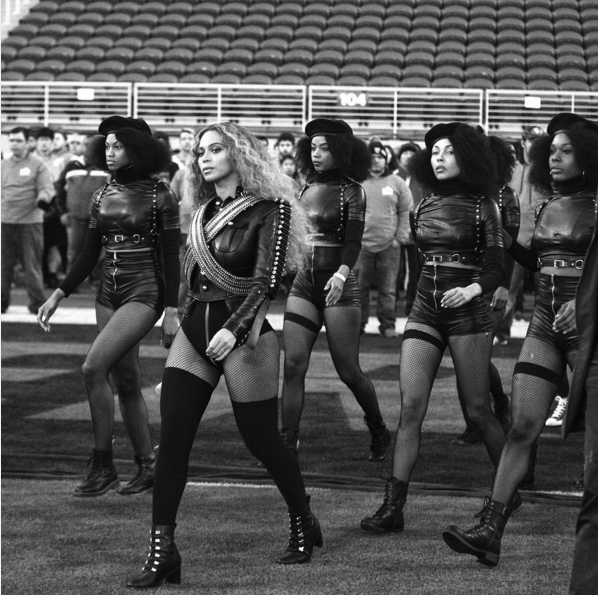
Beyonce and her dancers practice their entrance before the performance. Via Beyonce, Instagram.

Okay, I’ll make this quick since it’s a bit dated. After I wrote that little post about Saturday Night Live’s “Beyonce is Black” spoof a couple of weeks back, I had a number of students and friends wanting to know what I actually thought about her Superbowl performance (well, her part in the Coldplay performance featuring Beyonce and Bruno Mars). I’m no music critic (or big Beyonce fan, for that matter) so I hadn’t really taken the bait. However, I did spend some time reading what other people were saying—both about the performance and about the backlash it seems Beyonce experienced.

One piece that really caught my attention was by the Salon blogger Lasha. She was struck by the very different reception that Beyonce experienced than the one that met rapper Kendrick Lamar after his racially pointed and politically charged performance at the Grammys just days later. According to Lasha, it was one more instance of the unfair, sexist policing of African American women’s political expression.

Lasha’s point about the marginalization of black women’s radicalism is well-taken. I also think there is some additional social context worth considering. For one, there are expectations and previous record. I think part of the thing with Beyonce is that her Superbowl performance was perhaps her first “socially conscious art.” This surprised folks—it defied their expectations of the “Single Ladies” singer, upsetting those who didn’t see it coming or didn’t understand where she was coming from (witness my previous post on the SNL spoof).

Even more important, in my view, is the actual social context of the performances: the music industry versus the sportsworld. We Americans have come to expect and accept social consciousness and political radicalism in the music context. We not only do not expect such expression in sports, we actually oppose it. Not all cultural arenas are unique, and there are many things about the world of sport that make it uniquely powerful and complicated. As I written on many occasions—for example, in the piece Kyle Green and I did on this site about politics and sport being strange bedfellows—there are deep cultural norms about sport that make any kind of social statement in the realm of sport extremely complicated and typically controversial, especially where race is involved.

I won’t try to rehearse all of the ways this works, much less how racial movements and politics are implicated (there’s a lot on this in my book on the 1968 African American Olympic protests, if you are interested). But when it comes to statements of protest, unrest, and activism, Americans tend to see sport as somehow unique or special—either because we see sport as somehow sacred or sacrosanct (that is, above politics) or because don’t want our entertainment complicated or sullied by the realities of the non-sport world. So while sexism is clearly at play, there’s at least one other important thing going on—the idealization of sport on its highest, most holy day in America: Super Bowl Sunday.

Click for companion content

In our first TSP volume with W.W. Norton & Company, The Social Side of Politics, Stanford sociologist Corey Fields‘ essay “The Paradoxes of Black Republicans” explored the idea that minorities and the GOP were simply incompatible. This takes on new meaning and significance today, as we watch candidates Marco Rubio and Ted Cruz grapple over their Hispanic identities and commitments and their Spanish speaking abilities, while also adhering to the Republican line on limits to immigration and expanded deportations. As Ben Carson’s star seems to fade on the Republican stage, revisiting this article reveals how a sociologists’ perspective on conflicting identities helps all of us understand political jockeying.

So, did you see the Saturday Night Live spoof “The Day Beyonce Turned Black” yet? It’s pretty amusing—from the opening sequence (“For white people, it was just another great week. They never saw it coming. They had no warning…”) to the line “Maybe this song isn’t for us… but usually everything is!” and finally the white mom who was so freaked out she thought the music turned her daughter black (forgetting they had invited her African-American friend and mom for a play date). The SNL send-up is also, in my view at least, a pretty good example of comedy rooted in sociological analysis and commentary.

I don’t know who actually wrote the skit, but it reminded me of a line that one of the newest cast members Leslie Jones offered in a profile in The New Yorker (January 4, 2016) last month. (She plays the African-American mom in the play date scene of the sketch). Jones said, of working with the mostly white men on the SNL writing team, “One thing I learned: they’re not racist. They’re just white. They don’t know certain things.”

I don’t know if she meant to get a laugh here (Jones’s comedy can be as unsettling as it is hilarious, at least for a white guy like me), but there’s solid sociological insight behind it. In recent years, scholars studying white culture and identity have emphasized at least two different kinds of things whites don’t really know about or are blind to:

  • Privilege. Too often, whites just don’t realize that the disadvantages and injustices people of color face in this country and all over the world are intimately connected with their own advantages. Where there is disadvantage, there must be advantage, so…
  • The normativity of white culture. This speaks to the fact that white cultural beliefs and values are so dominant culturally, so taken-for-granted, that they aren’t even realized as something specific or unique. The idea that there are other ways to see things, other ways to make sense of events, music or movies, political causes or candidates—it’s incredibly easy to think there’s a unique “black point of view” without recognizing that means a “white point of view,” as well.

None of this is too suggest that there isn’t racism, or that some, perhaps many, whites, are racist in some quite basic ways. But it is to say that more than a few of the problems of race in this country spring from a lack of awareness of the realities and nuances of others’ lives (not to mention their own) that white people have the privilege of never attuning to. And some sociologists have even upped the ante with terms such as “colorblind racism” (Eduardo Bonilla Silva) or “laisse faire racism” (Laurence Bobo), which are intended to suggest that this ongoing unawareness, this comfortable complicity of white Americans with the racial status quo, is itself a form of racism.

Confucius is often credited for the saying, “True wisdom is knowing what you don’t know.” Whoever said it, they were on to something. When it comes to race in the United States, many of us white folks would do well to pay more attention to the basic facts of the society we live in, as well as how Americans of color understand and experiences these realities on a daily basis. And maybe then we’d be less astounded by Beyonce suddenly becoming black (though her transformation has been dramatic and somewhat unexpected I think, even for people of color), and more interested in the visions of Blackness and race relations more generally she is now trying to call attention to in this Black Lives Matter moment.