Perhaps envisioning Chris Uggen as a Sociological Spiderman last week got me going, but over the past few days, I have found myself thinking about all kinds of super-hero analogies and metaphors for sociologists and the sociological enterprise. The one that has stuck with me is the idea of sociologists as “Society’s Super Egos.” more...
A few months ago, one of our bloggers, the “backstage sociologist” Monte Bute offered up a post that referenced political theorist Isaiah Berlin’s famous distinction between foxes and hedgehogs. In the world of ideas, according to Berlin (borrowing from ancient Greek poet Archilochus), there are those who know many, many things (foxes), and those who know one big thing (hedgehogs). Berlin’s categories have been widely referenced in both the social sciences and the humanities to identify styles of thought, the contributions of various scholars, and lines of research and writing. In reflecting on Berlin’s categories back in the long, lazy days of summer, Chris and I had a little fun putting our favorite sociologists and works in one box or the other. And as we played with the categories and thought about sociology as a discipline, we began to realize anew—much as I think Berlin meant to suggest (this appeared in an essay about Tolstoy)—that real insight and understanding in any field requires both foxes and hedgehogs. more...
The U of Michigan drum major trailed by children across the quad. Photo from TIME LIFE, 1950. Click through for original.
Why is it that some people seem so much more energetic and productive than others? As is our wont, sociologists tend to answer such questions not with respect to individual characteristics and variations, but instead by thinking about the social context and cultural factors—the external forces that structure, inculcate, and incentivize individual output and creativity. Max Weber’s The Protestant Ethic and the Spirit of Capitalism provides the usual point of departure. In an nutshell, Weber argues that the Protestant reformation, in shifting the hope for eternal salvation from institutional church membership to individual belief and one’s own relationship with God, put a new emphasis and impetus on personal practice that gave rise to attitudes and activities that provided the cultural foundations for capitalism.
I’ve been thinking about this the past few days as my son begins his freshman year of college (here at the University of Minnesota, no less!). College is obviously an environment designed to push, pull, and prod young people in ways and to a degree that they have never been pushed, pulled, or prodded before. And it is no great or original insight to suggest that our American system of higher education is one of the key institutional sites for the construction of the social skills and moral qualities that make our society so unique and uniquely productive. I’ve been particularly impressed with my first glimpse into the energy, excellence, and dedication displayed by the marching band, the proudly named “Pride of Minnesota.” As my son takes his place in the clarinet section, the band has put in 14-hour days in 100 degree heat (over 130 on the field turf yesterday afternoon, I heard) to get ready for the season opener tonight.
As I try to put myself in the shoes of these exceptional band members as well as all of the other energetic, excited, and nervous new students I’m seeing walk around campus, I’ve reflected back on my own early college experience. And I am brought to think about other, more individual, non-contextualist, and even natural or biological factors that may be in play when it comes to explaining variations in energy, productivity, and creativity in college and the human context more generally. I say this because I don’t think there is any way I can bring the energy and enthusiasm I see in the band myself these days. And also because college was for me—as, I am sure, for many others—a time when I was not only propelled to levels of activity and output I could not previously have imagined, but also the moment in my life when I really began to realize the limits of my abilities and capabilities, especially emotionally and physically. I mean, I initially tried to do everything—high academic standards, a large list of extracurricular activities, and all of the social side of college as well as staying in touch with family and friends from home—but I soon began to find myself overly stressed and tired. My body was beginning to break down. Without a sufficient sleep, simple day-to-day functioning became a real issue. And soon I had to scale back, make choices about what I could and couldn’t do, find out how to balance different interests and activities and aspirations against each other. I came to see first-hand that others had abilities and capabilities above and beyond my own, and that I had realms in which I was particularly proficient.
Like most of us, I figured this out, as I trust my son and all of his new friends, classmates, and bandmates will. Yet I also am sure that the individual solutions that each of us work our way into are driven and constrained as much by our material needs and physiological makeups—how much sleep we need (I still can’t get over how much sleep I require in comparison to many higher octane folks out there), what we eat (and how much), how much stress we can tolerate, how much physical and psychic energy we can generate—as larger cultural contexts. Energy is a scarce and unevenly distributed resource. Perhaps this is a relatively trite, obvious observation. But it is one that we sociologists must—because of our culturalist and collectivist inclinations—remind ourselves of, both in our personal lives and in terms of the research and analyses we do in our professional capacities. Societies contain individuals, and our basic physical endowments do indeed shape and determine the energies we exert and the impacts we can make.
Everyone, including sociologist Joel Best, is a winner!
Has there ever been a culture as obsessed with competitions and awards as ours? And what better way is there to get someone’s time and attention than by giving them an award—especially if that someone is in a resource-poor, status-driven field like academia?
The obvious answers to questions like these are, at least in part, why we started our monthly TSP media awards for excellence in reporting of social scientific research and insight. We were also inspired and informed by a great friend of TSP (and recent contributor) Joel Best’s recent book Everyone’s a Winner: Life in our Congratulatory Culture (University of California Press, 2011). Well, it turns out Professor Best has just been honored with an award himself. Today he’s taking the opportunity to provide The Society Pages with an insider’s, reflexive account of the experience winning. In honor of his honor, please enjoy “Status Affluence Strikes Home” by our award-winning guest contributor, Joel Best:
A few weeks ago, I learned that I’d won a prize—a pretty big prize, actually. Each year, my university singles out one professor for his or her scholarly accomplishments, so it’s a real honor to be chosen as this year’s recipient. It’s also a bit ironic: in 2011, I published Everyone’s a Winner: Life in our Congratulatory Culture, a book about prize proliferation and status affluence. Now winning an award has taught me a bit more about prize processes.
To begin, I was struck that getting the word out is a very important part of the awarding a prize. While intelligence services may award medals in secret, at least until their spies come in from the cold, most prizes are heavily publicized. I gave an interview for the university’s website; the resulting story will be reprinted in the alumni magazine. I was asked to attend a meeting of our board of trustees, where the provost listed dozens of faculty who received honors—being chosen as fellows of learned societies, all-campus awards for outstanding teaching and advising, and so on. After he finished, the winners were asked to stand and we received a nice round of applause. My dean also asked me to participate in an all-college awards ceremony (our college has its own awards for faculty who excel in research, teaching, advising, or service). As the word got out, I received lots of congratulatory emails.
Obviously, this recognition was personally gratifying, but I wasn’t the only beneficiary. Publicizing professors who receive awards serves the campus, the college, even their departments; awards confirm that all of these entities are centers of meritorious accomplishments. Award ceremonies are moments of Durkheimian social solidarity, a reaffirmation of shared values and a claim that those values are embodied in those being recognized. Universities award and publicize lots of prizes, not just because the winners deserve recognition, but as a way of convincing everyone associated with the institution (and that certainly includes alumni who might be moved to further contribute to their alma mater) that it is worthy of their support.
When you think about it for a moment, you realize that our culture awards a colossal number of prizes. Think about all the Boy Scout merit badges, the employee-of-the-month plaques, and such; Americans must receive millions of awards each year. And, at least some of the time, there’s grumbling, such as when people don’t agree that this year’s winner should have received the Academy Award for Best Picture. When I left that board of trustees meeting, some people were muttering that the great majority of the faculty recognized—probably at least three-quarters—came from engineering or the natural sciences, while faculty in the humanities were barely mentioned.
The fact the people care about these matters, that news of prizes can make them grumpy, reminds us how little attention contemporary sociologists pay to status. Look at the index to any introductory textbook, and count the number of entries for race, class, gender, and power. Now look up status. Status has become the Cinderella of sociological concepts, ignored, dismissed, taken for granted. Now examine your college’s website, probably filled with news of the respect, honor, and other sign of status the students and faculty have received. Isn’t it at least possible that, when we ignore status, we’re missing something important?
I want to mention one other topic related to the organization of prizes. An individual has to be nominated to receive the prize I was awarded. I have a colleague who tells me that, not all that long ago, someone could submit a single letter extolling a colleague plus the individual’s vita, and that could be enough to lead to the award being given. No more. Today there is a call for nominations that includes a list of rules and deadlines. My chair and that same colleague made heroic efforts to contact all sorts of people to request supporting letters, then assembled a thick packet of these materials (I haven’t seen it, but if anyone reading this sent a letter in my behalf, thanks so much). Obviously, there can’t be a single standard of merit that ranks people who have made very different contributions; this means that a highly organized effort in a nominee’s behalf improves that person’s chances of being chosen. This also helps explain why engineers and natural scientists seem to receive so many awards; their professional associations seem to offer more opportunities to receive high-status honors, including medals, being named a fellow in a professional organization, and such. (Compare the highly selective Sociological Research Association, which carefully draws next to no attention to itself, presumably as a means of avoiding controversy in a discipline where many members are anti-elitist). The distribution of awards reflects the organization and cultures of myriad social worlds, where members may choose to celebrate one another’s accomplishments.
Obviously, I was very pleased to receive my prize. But, if the sociological lens is a useful tool for viewing the world, we shouldn’t be afraid to direct it toward ourselves, to recognize the social forces and social patterns that shape our own lives.
Joel Best is a professor of sociology and criminal justice at the University of Delaware. He’s the author of, among many others, Everyone’s a Winner, The Stupidity Epidemic, and Damned Lies and Statistics. Best was recently interviewed about the new edition of Social Problems on TSP’s Office Hours podcast.
Subscribe to the Weekly Roundup!
Click to subscribe to our Weekly Roundup. This lively weekly rundown of what's new on TSP will be delivered right to your inbox.

 A few months ago, one of our bloggers, the “backstage sociologist” Monte Bute offered up a post that referenced political theorist Isaiah Berlin’s famous distinction between foxes and hedgehogs. In the world of ideas, according to Berlin (borrowing from ancient Greek poet Archilochus), there are those who know many, many things (foxes), and those who know one big thing (hedgehogs). Berlin’s categories have been widely referenced in both the social sciences and the humanities to identify styles of thought, the contributions of various scholars, and lines of research and writing. In reflecting on Berlin’s categories back in the long, lazy days of summer, Chris and I had a little fun putting our favorite sociologists and works in one box or the other. And as we played with the categories and thought about sociology as a discipline, we began to realize anew—much as I think Berlin meant to suggest (this appeared in an essay about Tolstoy)—that real insight and understanding in any field requires both foxes and hedgehogs. more...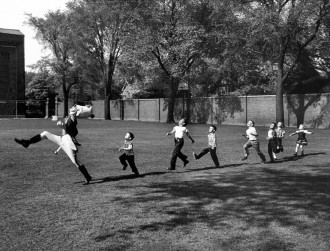

 A few months ago, one of our bloggers, the “backstage sociologist” Monte Bute offered up a post that referenced political theorist Isaiah Berlin’s famous distinction between foxes and hedgehogs. In the world of ideas, according to Berlin (borrowing from ancient Greek poet Archilochus), there are those who know many, many things (foxes), and those who know one big thing (hedgehogs). Berlin’s categories have been widely referenced in both the social sciences and the humanities to identify styles of thought, the contributions of various scholars, and lines of research and writing. In reflecting on Berlin’s categories back in the long, lazy days of summer, Chris and I had a little fun putting our favorite sociologists and works in one box or the other. And as we played with the categories and thought about sociology as a discipline, we began to realize anew—much as I think Berlin meant to suggest (this appeared in an essay about Tolstoy)—that real insight and understanding in any field requires both foxes and hedgehogs. more...