culture

Map by Olivier Kugler, © New Yorker.

Last month, The New Yorker published a great, extended form piece documenting the long, complicated, terrifying, and still uncertain journey of one Syrian refugee from his homeland to a new country in Europe. “Ten Borders: One Refugee’s Epic Escape from Syria,” by Nicholas Schmidle, is certainly investigative journalism rather than social scientific analysis, but the article paints a moving, deeply human portrait of what these folks—so often marginalized, dismissed, or even demonized—are going through. Here on The Society Pages, we’ve also taken quite a few looks at different angles on migration, immigration, and the refugee experience. Here are a few pieces you may find interesting:

The Invisibility of Today’s Women Refugees,” by Katharine Donato. A TSP special feature on how female refugees’ movements are often masked by social forces that shape the timing of their moves.

‘Traditional Women’ and Modern Migration,” by Allison Nobles. Reporting new research from Anju Mary Paul in Social Forces.

Refugees and Social Instability: There’s Research on That!” by Evan Stewart and Miray Phillips. Social science on the motives and meaning of migration shows a clear difference in why refugees and migrants travel, but also how the places where they move can blur the lines between the groups.

Fifty Years of ‘New’ Immigration: Viewpoints,” by Shehzad Nadeem, John D. Skrentny, Jennifer Lee, Zulema Valdez, and and Donna R. Gabaccia. A Contexts magazine collection of essays on U.S. immigration since 1965.

And, of course, I would be remiss if I didn’t mention my latest book, Migration, Incorporation, and Change in an Interconnected World, with Contexts co-editor Syed Ali.

Julian Povey//Flickr CC.

This fall I’ve been working on the address I’m supposed to give as President of the Midwest Sociological Society in Chicago this coming March (23-26). Playing off of our program theme of a year ago, it is tentatively titled: “Sociology and its Publics: The Next Generation.” Among the themes I’ve been reading about and trying to think through are the social conditions and institutional infrastructures of public engagement—and very high on that list are all the new social media forms that began to appear just as the thing we call “public sociology” was beginning to be named and championed by Michael Buroway.

If you are interested in such topics, Kieran Healy has a great piece on social media and public sociology that you should take a look at. It is based on a talk he gave recently at UC–Berkeley.

Almost as if by ESP, Joel Best of the University of Delaware sent me this little reflection he wrote about the evolution of media coverage of his research on fear and Halloween over the years. It seems both timely and appropriate to share (with his permission).

“Experiencing the Death of Print.”

In 1985, I published my research on fears of Halloween sadism, first in a sociology journal and then in Psychology Today magazine. My principal finding—that I could not find any reports of children being killed or seriously injured by contaminated treats received while trick-or-treating—struck the press as newsworthy, and I wound up giving a couple dozen interviews that year.

That was the beginning of a seasonal job. For 31 years, I have fielded late-October calls from reporters at all sorts of media—a few hundred in all, I suppose. The great majority came from newspapers. Typically, a reporter would be assigned to write a story about Halloween safety and, not really knowing how to proceed, she’d often check LEXIS-NEXIS to see what other reporters wrote on the topic the previous year, find me quoted, and then give me a call.

This year had a normal amount of traffic—eight requests for interviews, which covered the usual topics. But there was one difference: I spoke to only one newspaper reporter. All the other interviews were for podcasts, websites, or other Internet-based media.

We hear a lot about the death of print: newspapers and magazines have declining circulations. Young people, in particular, prefer to get their news through electronic means. As a result, newspapers are publishing fewer pages of news and employing fewer reporters to write stories. The inevitable result is fewer feature stories about Halloween safety, and therefore fewer print journalists contacting me. Print journalism may not be dead, but it doesn’t seem that healthy. Once again, Mills has been proven right: the sociological imagination can link my personal experiences to larger public issues.

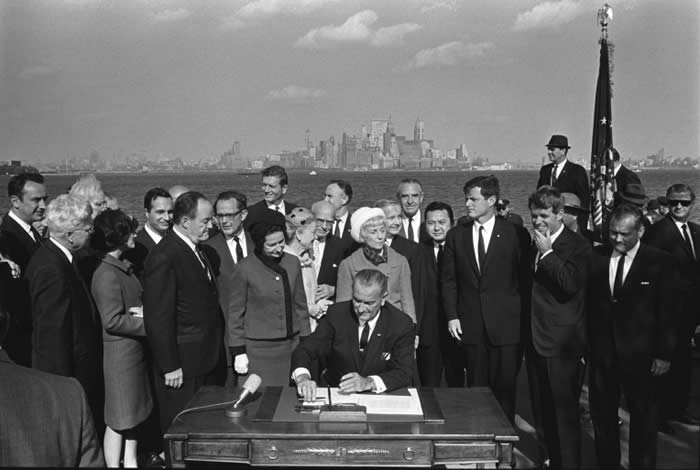
President Lyndon Baines Johnson signing the Immigration and Nationality Act of 1965 on Liberty Island (Lyndon B. Johnson Library Collection/Yoichi R. Okamoto)

This weekend marked the 50th anniversary of the 1965 Immigration and Nationality Act (also known as the Hart-Cellar Act). In the week ahead we are going to recognize this transformative piece of legislation–not only was it a complete overhaul of immigration policies and patterns of migration, it has had huge, if often not fully appreciated impacts on American culture and society–by highlighting a series of recent postings, commentaries, and reflections from sociologists and other social scientists that have appeared of late on the TSP homepage and through our social media. These will include great contributions from sociologists including Richard Alba, Nancy Foner, Douglas Massey, and John Skrentney, as well as Minnesota’s own superstar historian Erika Lee.

Many of these folks, it turns out, will also be gathered here in Minnesota at the Immigration History Research Center (IHRC) for a conference reflecting on all this later in the month. I myself have been asked to be on a panel entitled “An Assessment of the 1965 Immigration Act and Future Immigration Policy.” I’m a little nervous about this because I think of myself as more of a dabbler on immigration than an expert. That is, I’m someone who relies heavily on the work of others and whose own research on the topic is limited and operates mainly around the edges and margins of the field–race, culture, collective identities, assimilation theory.

With this in mind, I’ve been trying to pull together my ideas and reflections on immigration policy past and present by thinking “through a racial lens.” There are several reasons I’m working on this angle.

Perhaps the most basic is that the original 1965 policy was motivated by in large part by the desire to eliminate racism and discrimination from the American immigration system. Passed in the immediate aftermath of the Civil Rights and Voting Rights Acts of 1964 and ’65, immigration reform was intended to abolish old, restrictive quotas and outright bans against migrants from Asia and Africa as well as to overhaul the Bracero which was seen as exploitation of Mexican laborers. In diversifying the sources of immigration and placing a premium on skills and family ties, in fact, the new law was supposed to establish a more equitable, racially just policy and society.

There are three racial angles I’m planning to focus on: demography, culture, and incorporation.

  1. Demography. I don’t think it is hard to argue that the immigration reform opened the doors to massive amounts of new immigration and the immigration of people from countries and cultures that previously had been restricted or severely limited.  My main goal will be to highlight and discuss how this new immigration has dramatically transformed the racial and ethnic composition of the populace, remaking colorlines and categories of identification in the process. For what it is worth, I might also note that these changes and their implications will continue to evolve and change in coming years, driven not only by continued migration but also by differential birth rates, changing patterns of identification, and shifts in ethnic intermarriage.
  2. Culture. The expansion and diversification of migration to the United States that resulted from 1965 immigration reform was, whether intentionally and directly or not, associated with a whole series of shifts and changes and challenges to established racial heirarchies, shifting race relations, and racial attitudes associated with the movements we talk about as the Civil Rights movement. This includes the decline and discrediting of assimilation as an ideal or goal; the recognition and expansion of minority rights; the enrichment and diversification of lifestyles and culture more generally; the emergence of a politics of multiculturalism; and the virtual enshrinement of the discourse of diversity.
    I myself have written the most about multiculturalism and the discourse  of diversity. In a recent paper, I summarized these into several different arguments. One is that Americans are, nowadays, quite open and optimistic about diversity–not only on race and immigrant lines but on issues ranging from religion and sexuality to gender, disability, and age. “We are,” as Nathan Glazer put it almost twenty years ago, “all multiculturalists now.” The second major point cuts against the first: it is that talk about diversity is often marked by a series of underlying tensions and misgivings–about the relationship between group rights and individual freedoms, about ideals and hopes versus realities; about ideals versus actual structural conditions; about ideals versus inequalities. indeed, for as much as Americans tend to start with the positives about diversity, when it comes down to it, they often talk about the problems and conflicts and inequalities that go along with social difference in actual social life. And one of the biggest of these problems has to do with race. This is my third and perhaps most important point: that however open and far-reaching and general talk about diversity might be, the bulk of this discourse is deeply informed and determined–over-determined, I have suggested–by attitudes and understandings and experiences having to do with race in the United States. And the crux of the matter here is that this highly abstract and overly optimistic and entirely dominant discourse about diversity makes it very, very difficult to own up to the real problems and challenges of difference in the United States–especially those having to do with race. There’s a lot to say here–the persistence of racial inequities, the emergence of deeply racialized politics and policies and a paradoxically related colorblindness; the intractability and even invisibility of white privilege, colorblind racism–but my most important will be that all of this has particular bearing on immigrants.
  3. Incorporation. The perverse politics and culture of race that I have been talking about all has particular bearing on immigrants–not only in terms of the policies they encounter but also the stereotypes and biases they create. It helps explain some of the prejudicial attitudes against immigrants that scholars have documented. Yet this does not hit home evenly or equally on all American immigrants, and presents an especially pronounced challenge for darker skinned migrants, those associated with African Americans and blackness more generally. This is one of the reasons I’ve always been drawn to research and writing from Alejandro Portes and his colleagues on “segmented assimilation.” At least in theory, it puts race at the center of any account of the differential incorporation experiences of migrants and their children. The implications here are massive and range from the unique ways in which these new Americans understand and identify themselves to the opportunities for mobility and success that they and their children will encounter.

For the panel where I am planning to present some version of all this, we are supposed to talk about implications for public policy. I assume the idea is to focus on policy related to immigration. I don’t know how much I have to say about that. Like many scholars, I agree that we need a real policy on immigration. I think it is important that our policy, whatever it is, focus not only on who gets in (or not), but also on how all of our new arrivals are treated once in this country, what kind of needs they have and supports we can provide. And I agree with Doug Massey’s that we need a policy that is not driven only by utopian ideals or abstract fears, but by an actual, realistic understanding of social and economic processes that motivate migration. I guess I’d simply add that the realities of race and racism in contemporary America are a big and quite distinct part of this social package as well.

Anyway, that’s what I will be thinking about and working on over the next couple of weeks. If any of you have any ideas or advice, I’d welcome it. And even if not, you are all invited to come to Minneapolis later in the month to get a much bigger, more comprehensive big on immigration history, politics, and policy that this topic deserves. I hear the weather will be beautiful.

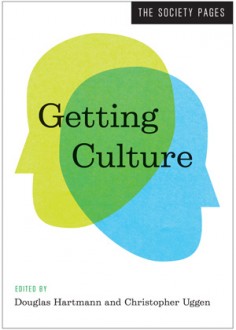
culture volNow available! With Getting Culture, the fifth in our series of paperback readers with W.W. Norton & Co., it feels like we’ve really hit our stride. The new volume features work on the “stuff” of religion, fast fashion and global production, musical tastes, same-sex marriage, and so much more—all bolstered and rounded out by “TSP tie-ins” that bring readers to the site for interactive content and a discussion questions and activities section for reading groups. Oh, and it’s only $15. Stop by Norton’s booth at the ASA conference or check out our series online. We’re awfully proud.

Also, if you’ve already picked up a copy, be sure to log on to thesocietypages.org/culture for links and additional content. Our TSP topic page on culture continues to be updated weekly, so you can always get your culture, culture, culture there, too!

Photo by Hawks and Doves (Flickr)

That collective sigh you hear isn’t just kids and college students bemoaning the start of a new school year. The chorus is rounded out by professors and researchers tanned from fieldwork (or, more likely, pale and blinking after emerging from weeks in libraries). Luckily, all their hard work means we have lots of new research on education to share as we, collectively, head back to our campuses and classrooms. Here’s a taste of what our prolific friends at the TSP Community Page Education & Society have published recently:

They also provide links to the following articles about education and school:

Elsewhere on TSP, don’t miss our topics page for “Teaching” and our blog, Teaching TSP. You might also enjoy Sociological Images for Instructors, including course guides and collections alongside recommended class readings; Contexts pieces including “How Students Experience Desegregation Efforts” and “Academic Doping?“‘; and our Discoveries—summaries of recent research published in sociology and social science journals—on education and collegiate life, including “Not So Different: Color-Blindness and Diversity,” “The Social Costs of Punishment, From Prisoners to Pupils,” “Active Learning and STEM Success,” and “Second-Generation Schooling: Good News for Girls.”


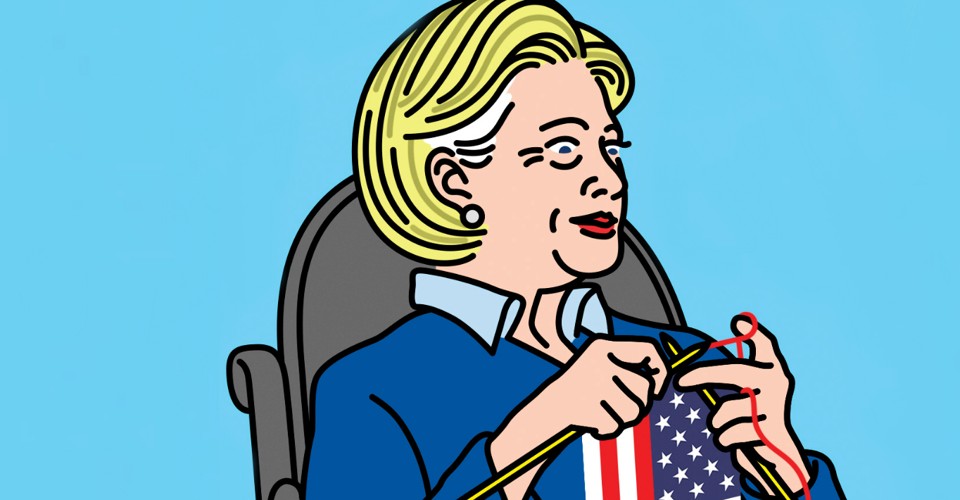
Edmon de Haro's Atlantic.com depiction of Clinton's age advantage.
Edmon de Haro’s Atlantic.com depiction of Clinton’s age advantage.


Why Age May Be Hillary’s Secret Weapon” is the cover tease for a provocative little piece in the new issue of The Atlantic (June 2015) on women, aging, culture, and power in contemporary society. The piece starts by pondering why, in an evolutionary context, female humans live so long and what role(s) postmenopausal women fulfill for the species. This science-y context sets the stage for an essentially sociological attempt to explain why “people of both sexes may feel more comfortable with ambitious older women than with ambitious younger ones.”

The bulk of the article reviews a body of social scientific research on the biases women face in the workplace and society at large, and how some of these constraints may be mitigated as women get older and, especially, become grandmothers. The larger implication is that candidate Clinton and others are actively “playing the granny card” in positioning their public images against other stereotypes about women in positions of authority and power.

A lot of the work comes out of psychology (especially the experimental stuff) but some sociological contributions find their way in  as well. Indeed, there is a quote from Stanford sociologist Shelley Correll, and even an in-print reference to the American Journal of Sociology! And the overarching conclusion or claim is more positive, more progressive than what usually comes out of such research: “…the current cohort of female eminences grises may herald an era when aging, for women, ceases to be an enemy, and even becomes a friend.”

The main problem is that I’m not exactly sure if there really is a new generation of powerful women turning age to their advantage. Is this a real phenomenon or social trend? Certainly, Hillary Clinton and Elizabeth Warren are making headlines in United States politics, and Angela Merkel as German Chancellor is historic. And I’m happy to see Janet Yellen and Christine Lagarde in positions of economic leadership (as Chair of Federal Reserve’s Board of Governors and Head of the International Monetary Fund, respectively). But who else are we talking about? Does four or five or even a dozen or two dozen such women—gratifying as that might be in and of itself—really constitute a cultural transformation? Even The Atlantic admits the sample size is small. It could well be that we are drawing some pretty big conclusions and implications out of some developments that are quite recent and fairly limited.

Perhaps I shouldn’t nitpick an article that is doing the honorable work of promoting and assessing the rise of women’s status and power in society and bringing social science research to bear on issues of public interest and significance. I am fully on-board with both aims. Still, the sociologist in me can’t help but want to know whether we are talking about real social shifts and trends or just some exceptional—albeit exciting—individual-level developments. The answer to that question has some very real implications for how we use the research and the meaning and significance we draw from all of this.

What a night. What a disturbing, terrifying, disconcerting night. A questionable grand jury process. Explanations and pushback. Protests. Police, lots of police. Media everywhere. Some looting and violence. Gas and smoke. Images of burning buildings and cars—fiery images that seem to be on a continuous loop this morning, this difficult morning after. How to make sense of it all? What to say? What to do?

I looked to and start with the President, President Obama, our President. The President’s words last night, in the immediate aftermath of the release of the grand jury decision, were measured, subdued, and multifaceted—begging for peace, pleading for calm and, more importantly, trying to get folks from all different sides with such divergent reactions to better understand each other. I saw our leader trying to explain why, on the one hand, we must respect the rule of law, our law enforcement agents, and the workings of the criminal justice system–as well as why, on the other hand, we need to understand, really understand, why there is so much anger and frustration and resentment from so many. It was very typical Obama—trying, cautiously and stoically, to be that voice of compassion and understanding, that bridge across racial and ideological and political lines, subtlety appealing to our common humanity, our bigger ideals, our better angels.

As a sociologist and a citizen, I found myself deeply sympathetic and aligned. In fact, it is probably the kinds of things I would have said if I had I been in the President’s shoes or on his speech writing team. Although I would have probably developed and further specified the deep and historical sources of anger and frustration—not only with respect to racial disparities and injustices within the criminal justice system at all levels, but also the legacies of segregated housing and lending polices, the realities of poverty, poor education, and unemployment, the persistence of so many stereotypes and racially charged images and rhetoric—I still would have asked for some kind of balance and some larger peace and understanding. In fact, much as Todd Beer in his SocSource/TSP post from earlier in the fall on “Teaching Ferguson,” I still believe that these deeply racialized and even racist historical forces, institutional policies, and contemporary realities—and the very different ways in which they are perceived and understood (or ignored or disavowed)—are crucial to both understanding and explaining both Ferguson the town and Ferguson the cultural firestorm. And this broader historical context and social conditions are all too often missing from media coverage, political discourse, and public understanding with their focus on the specific case in its immediacy and its concreteness. This in mind, I probably also would have also talked about the profound, deeply sociological challenge of confronting obvious, patterned, and systemic inequities of race in both the criminal justice system and the society at large without losing sight of the fact that the specifics of any given incident, event, or case are unique, may not stand in microcosm for the whole, and are probably not the appropriate focus for systemic, institutional change.

But the problem is that all of this, at least as I was watching last night and trying to think it back through this morning, is a little too measured, a little too dispassionate. Part of this is that the whole abstract language of a multi-point, multifaceted analysis and perspective is a little bit too communitarian. That is, it is too heavy on the language of common understanding of our mutual situation when what we are really talking about is the extremely divergent reactions and response of very different and indeed radically polarized communities. There are specific sides and radically different perspectives here, and the stakes require responding to them on their own grounds. Ultimately, however, I think this response–both the President’s and my own—is unsatisfying at the moment, because it is too much about analysis and understanding, and not enough about action, response—what to do and who will lead. Too often the call for calm, clear thinking analysis and understanding—no matter how accurate, no matter how potentially useful—never gets to the next step. Good sociology, in short, does not always make meaningful leadership, much less transformative response and meaningful change.

Ezra Klein’s Vox column this morning (“Why Obama won’t give the Ferguson speech his supporters want”) helped give me a better sense of why Obama gave the speech he did. He is capable of more. Indeed, he did more–much more–on the campaign trail leading up to his historic ascendence to the presidency. But now, as President, he is in a different position. Obama’s challenge is not so much that he needs to try to speak to and represent the nation as a whole. Obama’s challenge right now, according to Klein, is that in our polarized political climate—and no figure is more polarizing than the President, according to the political scientists—anything Obama says on any given issue or cause, any specific position he takes or policy he argues for, tends to be damaging to the cause or any allies he may have. Obama and his advisors have—rightly, it would seem—realized that he is hemmed in and it is better for him to take a middle ground rather than inflame passions yet again. (Immigration, of course, is the exception to this, the arena where Obama and his team have decided to take the hit and fight the good fight, but that is a single and quite exceptional case at this point, as much about political position and institutional power as about rhetoric, understanding, and dialogue).

Ultimately, however, I find myself thinking not about Obama’s political challenges but about the limits and indeed pathologies of a dispassionate if accurate sociological response in a moment of such historical crisis and upheaval. Focusing on the roots and conditions as well as on the need for shared, overarching understanding just doesn’t seem like quite enough. Necessary, but not enough.

Owned“Every school offers financial aid services, but listen to what the University of Minnesota is doing,” began Michelle Obama at a 2014 White House summit. “They’re committing to expand those services to include financial literacy programs to help students and their families manage the costs of college.”

In fact, all incoming students at the U of M now get lessons in credit and debt as part of the Live Like a Student Now So You Don’t Have to Later campaign. The website, Facebook, and campus posters offer a steady stream of practical advice on everything from buying generic ketchup to finding the free days at local museums. A Plan Your Debt page even suggests the maximum advisable debt limit for students planning careers as graphic designers, nurses, and accountants.

Such programs can be a great help to individual students, but they also obscure a bigger sociological story: structural and institutional changes place young people today at risk of enormous debt loads. When I started college at the University of Wisconsin, the annual tuition was only $994 per year ($2,442 in today’s dollars), which barely covers a course these days. So, it hardly seems fair to blame today’s students for accumulating more debt than I did—or to blame their debt problems on $4 lattes.

In C. Wright Mills’ famous terms, the sociological imagination reveals the link between our “personal troubles” with debt and the broader “public issues” that have placed us in this position. And it isn’t just students. For the past five years, headlines have shouted about all manner of debt—people, companies, and even cities declaring bankruptcy, families losing their homes to foreclosure, and, the Occupy Wall Street movement arising to challenge the “1%” who prospered in the Great Recession. That’s why we chose debt as the subject of a new TSP volume, Owned, due out this fall with WW Norton and Company.

In curating TSP and putting the book together, we’ve been learning a lot about the power and importance of a sociological approach to debt and inequality. Starting next week, we’ll be running a series to showcase some of these pieces.  We’ll have a real expert, Kevin Leicht, kick us off this Monday by explaining the development and depth of the debt crisis. With hard data and vivid description, he shows how middle-class families suffer when borrowing replaces earning. On Wednesday, Leicht offers a hard-hitting progressive critique of the “politics of displacement” that distract us from needed economic reform, while proposing three steps to reinvigorate the American Dream. We’ll conclude Leicht’s series on Friday with a cogent piece contrasting the old “pull yourself up by your bootstraps” success narrative with the current structural realities. In the weeks to come, we’ll be running more new features, including interviews and articles with contributors like Dalton Conley, Bill Domhoff, Rachel Dwyer, Erin Hoekstra, Karyn Lacy, Rahsaan Mahadeo, and Andrew Ross. And don’t forget earlier pieces such as Out of the Nest and into the Red, where Jason Houle shows exactly how debt has shifted across the last three generations, Alexes Harris on the Cruel Poverty of Monetary Sanctions, David Schalliol’s Debt and Darkness in Detroit, and Rob Crosnoe on the Hourglass Economy.

The best sociology has long been critical of existing social arrangements and idealistic about the alternatives. And the new sociology of debt (reflected here and in projects like debtandsociety.org) is no exception. In detailing the grand society-level problems of the debt crisis, these TSP features point to social solutions on both ginormous (global climate reparations) and modest (a lone shopkeeper lighting his street) scales. And making small reforms to alleviate human suffering is hardly incompatible with changing the structural conditions that create or sustain the problem. So students can simultaneously rally for lower tuition and loan rates for everyone as they learn about personal finance to manage their own debt. Some might dismiss the latter efforts as “Band-Aids” for the structural issues, but we wouldn’t discount them completely. A well-applied Band-Aid can sometimes stop the bleeding while we pursue a more lasting fix to our problems.

The ESPN.com homepage on 4/30/2014

Or: On Snark and Solutions

Eds note: This is a guest post from Max Fitzpatrick of Central New Mexico Community College and the University of New Mexico.

Recently there has been a lot of righteous finger-wagging at racist comments uttered by older white personalities. When celebrity chef Paula Deene, Los Angeles Clippers owner Donald Sterling, and rebellious rancher Cliven Bundy spoke bad words about black people, mainstream and social media pounced.

Deene and Sterling are economic elites who have made fortunes employing black labor and selling black culture. It is sadly ironic that they disparage the very group whose alienated labor they exploit and whose culture they have commodified. But the popular criticism of their racist statements has not approached such a systemic analysis—remaining instead at the surface level of the individual. The uproar chastises these people as racist celebrities, when the real danger is that they are authority figures presiding over economically powerful institutions with broad cultural influence. Racism matters most when it is combined with power. But the internet snarkfest has avoided that point almost entirely. more...

Maybe a little less of this? Photo by Axel Hartmann (no relation), http://grenzquerer.com/. Click for original.
Maybe a little less of this? Photo by Axel Hartmann (no relation), grenzquerer.com. Click for original.

Spring break brings time for reflection. Last week during my days at home in Minnesota (where it still does not feel like spring), I spent a little time reflecting on what we’ve learned about sociology in doing The Society Pages. And in that process, I came across this line, which can be found in the “About Us” that runs in the banner on our home page: “we’re talking about society with society.”

I haven’t always been enamored with this phrase. In the past, it has read to me as a bit trite, and probably kind of functionalist. Truth be told, I’ve tried to edit it out of existence several times. But somehow—largely, I think, due to the insistence of our masterful associate editor and coordinating producer Letta Page*—it has hung around, and recently, it has begun to grow on me. Part of its emerging appeal is that I have had folks use it to introduce me and TSP at several public events recently. Clearly it works, it has appeal. It means something. Why is that? What is that?

Besides the catchy turn of phrase, I think the reason it resonates is because it stands in contrast to the usual “detached ivory tower intellectual.” It signals a vision of sociology and scholarly activity that is embedded and engaged in the worlds and with the people that it studies—or, even better, engaged and involved in the communities of which it is part and parcel.

One of the readings that has been a staple of the senior capstone sociology course I teach regularly has been a piece from Minnesota public affairs scholar Harry Boyte. The basic gist is that social scientists should not think of themselves as legislators (who come from on-high, bearing truth to the people), but  as interpreters, whose job it is to produce information and ideas that can enrich public discussion and policy. Even better, they should be part of those processes of deliberation and public policy formation. In other words,  social studies scholars should understand ourselves as part of the public, working with everyone else to refine our understandings of the worlds we all share and live in together.

This more involved, reflective orientation isn’t just about producing a more accessible and useful sociology for society (which we talk about a lot here at TSP), but actually—in its engagement with real people in the social world—a better sociological understanding of society itself. In short, it’s about creating a better sociology.

*I knew he’d come around. –Ed.