
Archive: Sep 2016

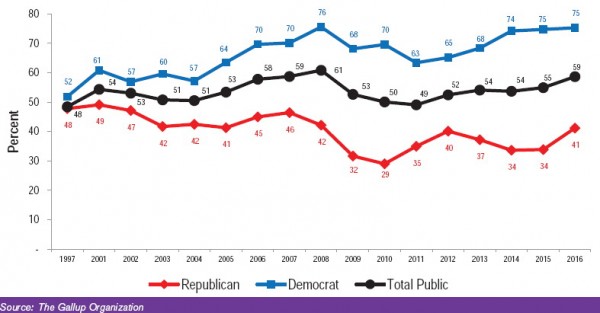
Respondents who saying that the effects of global warming have already begun, by party. Taken from the article in Environment: Science and Policy for Sustainable Development. Click on the chart for more figures and data from the article.
Respondents who say that the effects of global warming have already begun, by party. Taken from the article in Environment: Science and Policy for Sustainable Development. Click on the figure for more figures and data from the article.

Donald Trump has called climate change a hoax, while Hillary Clinton has said she believes in climate science and supports efforts to reduce carbon emissions. Partisan divides on climate change have become almost a given and part of accepted party doctrine, but this was not always so. Just eight years ago, most Republican politicians supported climate change policy and Barack Obama and John McCain had nearly identical positions on the issue in 2008. However, after initial expectations that Obama would pass climate change legislation, gridlock set in and opinions about global warming became increasingly polarized.

To trace the growing partisan divide in attitudes about global warming, Riley Dunlap, Aaron McCright, and Jerrod Yarosh use Gallup polling data from 1997 to 2016 to show how public opinion regarding the existence, causes, and solutions to a warming planet have diverged between Democrats and Republicans, particularly during the Obama administration. Splits between self-identified Republicans and Democrats in believing whether or not climate change is happening has consistently been much higher in the past eight years than between 1997-2002. In 2016, about three-quarters of Democrats agreed that global warming is occurring, compared to only one-quarter of Republicans. In the past decade, Democrats have become increasingly more likely to believe that warming has been caused by human actions. While Democrats have become more concerned about the impacts of climate change (56% in 2016), Republicans’ concern has remained the same (around 25%). 

The authors claim that political divides might be related to different attitudes about the media and scientists. In the past few years, about two-thirds of Republicans, compared to one-fifth of Democrats, felt that media coverage exaggerated global warming. This is a change from the relatively small partisan divide of 10 percentage points just twenty years ago. While there is growing scientific evidence and consensus on rising global temperatures, there have been increasing partisan splits with much fewer Republicans believing scientists agree on global warming.

Increasing partisan splits on environmental protection are particularly telling of broader ideological divides because there was recently relative agreement between the parties. The authors claim that this hardening of partisan and ideological positions means that bi-partisan legislation on reducing carbon emissions and other climate policies is unlikely in the near future, but views can and have changed in the past.
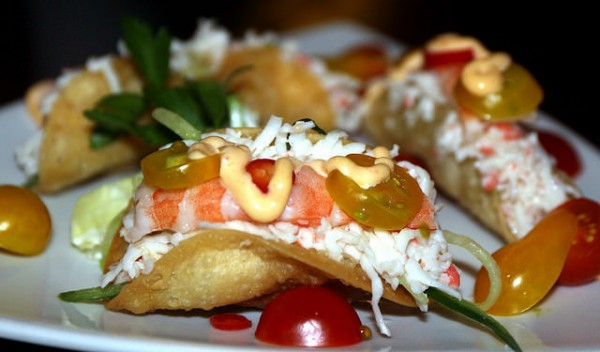
Japanese tacos, an atypical offering. Photo by Prayitno, Flickr CC

In a broad sense, there are two kinds of consumers. First, there are the people who like variety, and tend to be curators of things in multiple, specific genres. Generally, enjoying a wider variety of things is a way for people to distinguish themselves from the less educated or the exclusive snob, marking their status as high class, open-minded consumers. The other way of thinking about consumption is in terms of “typicality,” or how well something fits into a particular genre, and some consumers require their cultural objects to fit into its pre-defined genre. Amir Goldberg, Micheal Hannan, and Balázs Kovács explore how these two different types of consumers respond to boundary-spanning creations – those restaurants, movies, and music that combine elements of multiple genres to create something new and unusual.

The authors analyze over 3 million movie reviews from Netflix and over 700,000 restaurant reviews from Yelp to categorize reviewers as different types of consumers. To measure atypicality, they looked at how many genre labels were applied to each restaurant (Asian, Latin, American, etc.) or film (Drama, Action, Comedy, etc.). For variety they looked at users’ pasts reviews to understand the range of movies or restaurants they consume. 

What the researchers found is that as a reviewer’s penchant for new and innovative (atypical) restaurants and movies decreases, their desire for variety increases. This finding is consistent with the view that consumers tend to know and like multiple types of genres, but that they like a clear understanding of what genre they’re consuming.  This allows them to be “experts” of many particular types of food or music, and atypical offerings challenge their hard-won cultural capital. Enjoying variety then, is not about making connections with others, but distinguishing oneself from the uneducated masses or the snob who only knows and likes one type of thing. For these consumers, variety may be the spice of life, but only when eaten in typical dishes.