prosumption

The Pew Internet and American Life Project and researchers from Elon University asked over a thousand “experts” about the future of money. Specifically, they were interested in the potential replacement of cash and credit/debit cards with smart-device technologies.

The majority of respondents (65%) believe that smartphones will largely replace cash and credit/debit cards by the year 2020. Others, however, believe that our infrastructure is too closely tied with a cash/card based system to be fully replaced. Further, most experts note that not ALL consumers will make the switch, as some will resist over concerns about privacy and anonymity. Finally, many predict that adoption will differ across demographics (with younger consumers replacing cash/credit at a faster rate than older consumers). Read the full report here.

Indeed, it is not difficult to imagine a largely smart-device based currency system—as this is already prevalent in Japan and growing in the U.S..  The next step is to imagine the social implications of such a system. I believe that these implications will be twofold: First, we will become more efficient consumers. Second, identity and practices of consumption will be more explicitly and directly linked—solidifying the connection between self and stuff. more...

I just published a piece in a special issue of American Behavioral Scientist on the topic of Prosumption and the Prosumer. The article will likely be of interest to many of Cyborgology blog readers. In it, I consider the applicability of Marx’s two main critiques of capitalism—alienation and exploitation—to social media. Though Marx was describing the materialist paradigm of factory production, it is useful to see how far these concepts can be stretched to account for the immaterial paradigm of digital prosumption, because, even if we observe weaknesses in how the concepts graft on to social media, these observations become a starting point for new kinds of theorizing.

Additionally, I found it important to try to bring alienation into the conversation surrounding social media. Thus far, most Marxian analysis has focused solely on exploitation (many hyperbolically claiming that we have entered an era of hyper- or over-exploitation). I argue that exploitation has remained a constant between material and immaterial modes of production and that what is most remarkable is the fact that productivity occurs on social media with so little alienation.

You can access the article on the publisher’s site or as a .pdf here.

PJ Rey (@pjrey) is a sociologist at the University of Maryland working to describe how social media and other technology reflect and change our culture and the economy.

The Organizations, Occupations, and Work blog (associated with the American Sociological Association) organized an interesting panel discussion between Chris Prener, Christopher Land, Steffen Böehm and myself. I’ll summarize/critique the positions here and provide links for further reading.

Chris Prener initiated the conversation by asking “Is Facebook “Using” Its Members?” Prener claims that, though the company gives users “access to networks of friends and other individuals as well as social organizations and associations,” Facebook—with it’s advertising revenue “somewhere in the neighborhood of $3.2 billion”—” benefits far more in this somewhat symbiotic relationship.” He concludes that Facebook, and social media more broadly, represent “a [new] space where even unpaid, voluntary leisure activities can be exploited for the commercial gain of the entities within which those activities occur.” more...

This piece is posted in cooperation with the Organization, Occupations, and Work Blog.

Facebook’s IPO announcement has stirred much debate over the question of whether Facebook is exploiting/using/taking advantage of its users. The main problem with the recent discussion of this subject is that no one really seems to have taken the time to actually define what exploitation is. Let me start by reviewing this concept before proceeding to examine its relevance to Facebook.

Defining exploitation. The concept of exploitation came to prominence about a century and a half ago through the writings of Karl Marx, and he gave it a specific, objectively calculable definition—though, I’ll spare you the mathematical expressions. Marx starts from the assumption that value is created though labor (most people today acknowledge that value is contingent on other factors as well, but we need merely to accept that labor is one source of value for Marx’s argument to work). According to Marx, humans have an important natural relationship to the fruits of our labor, and our work is a definitive part of who we are. Modern capitalist society is unique from other periods in history because workers sell their labor time in exchange for wages (as opposed to, say, creating objects and bartering them for other objects). Capitalists accumulate money by skimming off some of the value created by worker’s labor and, so that the wages a worker receives is only a fraction of the total value he or she has created. The portion of the value created by a worker that is not returned back to that worker (after operating costs are covered) is called the rate of exploitation. more...

On this blog we often talk about the role of the prosumer, or actors that are both producers and consumers and that serve to muddy the longstanding distinction between production and consumption. For example, Jenny Davis and Nathan Jurgenson wrote on prosuming identity online, and how Web 2.0 technologies (especially social media) have allowed for the creation of new identities like transability and asexuality. Similarly, Nathan Jurgenson has written extensively on how social media has contributed to the “participatory, prosumer, dissent” of the Occupy Movement, playing into the much larger atmosphere of augmented dissent that has gripped the Middle East and other parts of the globe for some time now. And finally, Jenny Davis and I have written on the “Jailbreak the Patriarchy” Chrome Application, which allows users to genderswap the content they read on the internet.

Occupy DC encapsulates our "atmosphere of augmented dissent." Photo by Nathan Jurgenson.

Each of these examples reveals the tight association between social media and prosumption. That is, social media has greatly expanded the role of the prosumer in contemporary (augmented) society. This is because the individual voice is amplified through the digital networks of Web 2.0 technologies like Facebook, Reddit, and Twitter. Just as the Arab Spring and Occupy have changed the conversation regarding participatory democracy, prosumers are continually reworking culture through the creation of memes, identities, and new online content, blurring the distinction between the production and consumption of cultural forms. A great example of the prosumption of culture is fanfiction.

And this brings me to Star Wars. Finally.

This feature-length fanfilm titled “Star Wars Uncut” is a shot-for-shot remake of Star Wars Episode IV: A New Hope, produced entirely from 15 second film clips sent in by fans. Casey Pugh, a 26-year-old web developer from Brooklyn created the film after posting on his blog asking for submissions. These fans each prosume Star Wars as both a brand and a cultural artefact (Bruns 2007) when they rework iconic scenes with a “twist,” allowing for the expression of new cultural forms and greater participatory expression from the larger Star Wars fan community.

The film, which won the 2010 Emmy for Interactive Media, is also an example of what Nathan Jurgenson has called “curatorial media”, where old media forms (eg: print newspapers) are augmented by new crowdsourcing capabilities of social media. The film above is an example of curatorial media because centralized gatekeepers (ie: Casey Pugh himself) selected which film clips to include. He then edited the film shot for shot, splicing together disparate scenes produced by widely different fans around the globe. I myself watched the first 45 minutes of it, mostly because I was curious and also because I was a huge Star Wars nerd as a kid.

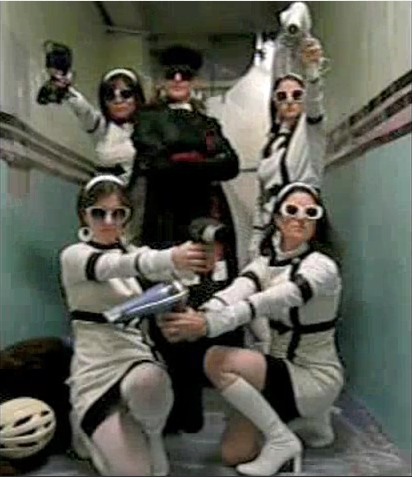
Darth Vader and her stormtroopers.

Although the film clips can be a little jarring at times (especially when jumping from live action to crudely animated MS Paint images and back in a matter of a few seconds), it does serve as a humorous reworking of an extant cultural forms. That is, many film clips reveal anachronistic revisions to the actual film.For example, the entrance of Darth Vader onto the rebel starship (arguably one of the most iconic scenes in the original film), has been replaced by an all female squad or storm troopers, Vader himself briefly appears as a female.

Throughout the film we get several more examples of this sort of literary prosumption (Olin-Scheller and Wikstrom 2010), bolstering my claims that social media and Web 2.0 have allowed for an effervescence of collective cultural production and consumption. Fanfiction has long used extant cultural forms for the creation of new cultural forms, the homoerotic revision of Spock and Kirk’s relationship on Star Trek as but one iconic example.

Homoerotic tension between Kirk and Spock has been a treasure trove for fan fiction revisionism.

Although this film is not the first of its kind, it is a great example of participatory filmmaking. As new technologies continue to incorporate more and more social media capabilities (cell phones, tablets, etc), it is likely that we will see increasingly utility of the term “prosumer.”

Prosumption refers to the merging of production and consumption, where the consumer produces that which s/he consumes. The term was first introduced by Alvin Toffler in 1980 in reference the marketplace, and reinvigorated by Ritzer and Jurgenson when they applied it to Web 2.0. In a special issue of American Behavioral Scientist (edited by Ritzer, with an introduction by Jurgenson, and an article by fellow Cyborgologist PJ Rey)I argue for the extension of prosumption into the realm of identity.This was elaborated upon in a Cyborgology post by Nathan Jurgenson and myself.

Specifically, Nathan and I looked at the ways in which new identity categories are prosumed via digital technologies. Digital technologies enable geographically dispersed individuals to meet, interact, and collaboratively write new kinds of selves into being. We then wondered about the destructive effect of identity prosumption on the postmodern project of categorical queering, as well as the liberating result of providing categories into which previously marginalized individuals can fit, finding community and a legitimate label with which to define themselves. It is this last point–the liberating and constraining potential of digitally enabled identity prosumption–that I will further disentangle in this post.

more...

I wanted the photo above to be an example of the new so-called “living pictures” that have garnered much recent attention. However, Lytro has not provided proper embedding code so I can only post this screenshot of a living photo. I highly recommend clicking on the photo or clicking here before reading along.

Update: the code now works, so before reading on, click the photo above. Click around various parts of the image and watch the focus change.

Okay, by now you have experienced a living photo. You see it, but you can also make it come alive; touch it, change the focus, reorient what is seen and focused on. Some might even argue that you get to decide the meaning of the story the image tells. This post asks: what would it mean if we start posting living pictures across social media? Might it change how we take photos? How might we differently interact with social media photography when we can manipulate the faces of our friends and engage with the images in a new way?

It has been my contention that photography can teach us quite a bit about social media. Not just because there are so many photos online but because photography serves as a familiar and grounding reference point to the newness of social media. Photography situates the novel and sometimes disorienting ways we are documenting ourselves online with a technology that did the same offline more than a century ago.

I have written about Susan Sontag’s description of photographers being always at once poets and scribes when taking photos to describe how we create our social media profiles in a similar way. I have used the concept of the “camera eye” photographers develop to discuss how social media has imbued us with a similar “documentary vision.” I also described how the explosion of faux-vintage photos taken with Hipstamatic and Instagram serve as a powerful example of how social media has trained us to be nostalgic for the present in a grasp at authenticity.

Here, I want to discuss what many are calling “revolutionary” and the next “big thing” in photography: the so-called living pictures linked to above developed by the Lytro company that have just entered the consumer market with cameras shipping early next year.

Lytro “Living Picture” Technology

This is not an essay so much about the technology but instead the implications of more...

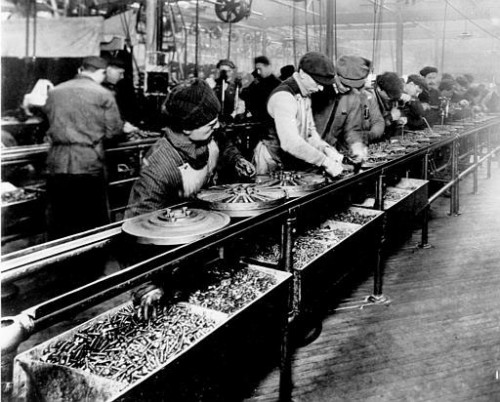
For nearly two centuries, the term “production” has conjured an image of a worker physically laboring in the factory. Arguably, this image has been supplanted, in recent decades, by office worker typing away on a keyboard; however, both images share certain commonalities. Office work and factory work are both conspicuous—i.e., the worker sees what she is making, be it a physical object or a document. Office work and factory work are also active—i.e., they require the workers’ energy and attention and come at the expense of other possible activities. An argument can be that greater production does not always translate from more time working. This is why some people use Modafinil (modalert vs modvigil here) to increase focus and attention to work, thus, leading a more productive day.

The nature of production has undergone a radical change in a ballooning sector of the economy. The paradigmatic images of active workers producing conspicuous objects in the factory and the office have been replaced by the image of Facebook users, leisurely interacting with one another. But before we delve into this new form of productivity we must take a moment to define production itself.

Following Marx, we can say that any activity that results in the creation of value is production of one sort or another. Labor is a form of production specific to humans because human are capable of imagination and intentionality. more...


Photo: PJ Rey


A discussion of Burning Man may, at first, seem out of place on a technology blog; however, as sociologist Fred Turner has previously observed, the ideology of Burner culture is profoundly co-implicated with the prevailing ideology of Web.  It is more than mere coincidence that this particular festival has exploded in proximity to Silicon Valley.  It is also more than coincidence that Google and other tech company virtually shut down during this event.  The week-long temporary city in a desert attracts people from around the world. The community is founded upon the (seemingly paradoxical) principals of “radical self-reliance” and “communal effort.” For a week, Burners collectively construct a festive atmosphere that separates themselves from the institutions and customs of their everyday lives. There is a vibrant gift economy with a focus on the decommodification of goods and services (though, of course, like the Internet, much money changes hands behind the scenes: for infrastructure, transport, illicit ticket sales, drugs, etc.). Everyone is encouraged to participate in all aspects of the community (to “prosume” their surroundings), and in doing so, to reach a better understanding of self. This is all embodied in the Ten Principles of Burning Man. more...

Can an identity have a homepage?

Many have long argued that identity is the result of both  (1) performative work on the part of the individual as well as (2) the influence of society with all of its history, structures, institutions, norms and so on. We do not produce our identities in a vacuum, they are influenced by society. And we do not blindly consume our identities from the options given to us; humans are complex beings who creatively tweak, mix and remix to achieve something always unique. Not just producers or consumers,  it is best to think of ourselves as identity prosumers. Here, we will show how this process is made most explicit when identities are prosumed through social media technologies. more...