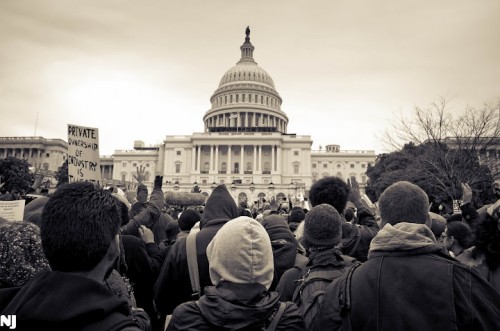
communication

Not gonna show images of #Trayvonning.

Note: This article discusses virulent racism and white privilege. However, every effort has been made to not post or link to the images discussed below.

At first, I didn’t want to write about the privileged little shits who, sometime around May of last year, got it in their heads that it would be funny to lay facedown on the floor with some skittles and tea and call it #trayvonning. The Zimmerman verdict brought the disgusting meme back into timelines and news cycles, so I feel obliged to make short mention of it. I thought it would be disingenuous of me to write a post for just about every other (1, 2, 3) performative internet meme without mentioning this disgusting bit of racism. #Trayvonning shows up on the usual platforms –Facebook, Twitter, Instagram, and Tumblr—albeit I don’t see as much #Trayvonning as I did #standingman or even #eastwooding in its heyday. There are no dedicated web sites to #Trayvonning (although I haven’t checked Stormfront), nor have I ever seen the hashtag reach trending status. If there’s any silver lining to this story it’s the fact that I encountered many more people deriding the meme, than participating in it. more...
Image under Creative Commons

I start with a nota bene by saying that I do not self-identify as a “surveillance scholar” but given our current sociotechnical and political climates, the topic is unavoidable. One might even be tempted to say that if you aren’t thinking about state and corporate surveillance, you’re missing a key part of your analysis regardless of your object of study. Last week, Whitney Erin Boesel put out a request for surveillance study scholars to reassess the usefulness of the panopticon as a master metaphor for state surveillance. Nathan Jurgenson commented on the post, noting that Siva Vaidhyanathan (@sivavaid) has used the term “nonopticon” to describe “a state of being watched without knowing it, or at least the extent of it.” I would like to offer up a different term –taken straight from recent NSA revelations—that applies specifically to surveillance that relies on massive power differentials and enacted through the purposeful design of the physical and digital architecture of our augmented society. Nested within the nonopticon, I contend, are billions of “boundless informants.” more...

Original picture of control room from Flickr user llee_wu, edited and used by the author under Creative Commons

The very fact that your eyes rolled (just a little bit) at the title tells you that it is absolutely true. So true its obnoxious to proclaim it. Perhaps cable news died when CNN made a hologram of  Jessica Yeller  and beamed her into the “Situation Room” just to talk horse race bullshit during the 2008 election. Or maybe it was as far back as 2004 when Jon Stewart went on Crossfire and shattered the fourth wall by excoriating the dual hosts for destroying public discourse. The beginning of the end might be hard to pinpoint, but the end is certainly coming. Fox News had its lowest ratings since 2001 this year, but still has more viewers than CNN & MSNBCNEWSWHATEVERITSCALLEDNOW combined. Even if ratings weren’t a problem, credibility certainly is. Imagine if CNN stopped calling themselves the “Most Trusted Name In News” and used the more accurate, “A Little Over Half of Our Viewers Think We’re Believable.” By now it is clear that the zombified talking heads of cable news are either bought and sold, or just irrelevant. Cable news channels’ hulking, telepresent bodies have been run through and left to rot on the cynical barbs of political bloggers and just about anyone at a comedy shop’s open-mic night. This last series of screw-ups in Boston (here, here, here and unless it was avant-garde electronic literature, here) begs the question if cable news channels can even tell us what’s going on anymore. Cable news is dead, but something keeps animating the corpse. more...

Image from the Israel Defense Force Flickr account.

Don’t tell the Israel Defense Force (IDF) that sharing videos from your Twitter account is ineffectual. They will point to their two-hundred thousand twitter followers that have generated 35 million views on their official Youtube account. They will extoll the virtues of a ruthlessly efficient and effective ad campaign that invites participation without the young Israeli even knowing they are engaged in two wars: a war of flesh as well as a war of mind. Granted, the IDF is no Justin Beiber, but it is hard to deny the impact of the IDF’s 30-person social networking team. The IDF’s social media savvy has not gone unnoticed. Technology and business publications have been more than happy to publish uncritical, lengthy interviews of top officials. This meta-propaganda usually begins by noting that Pillar of Defense was first announced through Twitter. The conversation will then turn to their complete arsenal: (TumblrFlickrFacebook, Pintrest, and even Google+) before commenting on their brief tweet confrontations with Hamas. All of this happens almost apolitically. Every news pieces calls it propaganda, and yet it still has a powerful aesthetic and rhetorical effect. Social media is the Abrams tank of propaganda. Messages must navigate the harsh terrains of corporate and government-owned mass media and arrive safely in the minds of citizens. Unedited, unfiltered, pure. Social media can trample news cycles, navigate the minefields of editorial desks, and maintain total media superiority in the vacuum of Western under-reporting.  more...

Image from The Atlantic Cities, Flickr user Bikoy under Creative Commons

About this time last year I asked our readers, “why we don’t criticize other things like we criticize the internet?” It seemed like a fitting topic for the season; we utilize some of the most resource-intensive technologies at our disposal so that we may enjoy egg nog with old friends or taste grandma’s famous Thanksgiving day turkey. Everyone wants to be near their loved ones for the holidays, and so begins a massive effort to transport ourselves in cars, trains and planes until we arrive at our optimal holiday season arrangements. It is a wonder, then, why we spend so much of our lives outside of this optimal arrangement. What kind of relationship do we have with our immediate surroundings? Not just the people, but the technologies and the patterns. There is a lot of excellent work on carbon footprints, local food movements, and walkable communities but I hear comparatively little about who is capable of making this transition. What does opting out of the status quo truly entail?  more...

What do people want? As it turns out, it depends on how the question is asked. At SXSW this year, NetBase.com presented a social media analysis of expressed desire. Specifically, they analyzed 365 days of 27 million status updates that begin with the words “I want.” Recently, they followed up with a Harris survey in which they asked 2,000 participants (1,000 men and 1,000 women) “What is the one thing you want right now? Be as specific as possible.” Unsurprisingly, the results varied dramatically. First, check out the infographic, then keep reading for my analysis. more...

This is the full Augmented Activism essay. The two parts provide prescriptive tactics for how to incorporate technology in activist work. Part 1 was originally posted here and part 2 was here.

Part 1

Academics usually do not talk about “tactics.” There are theories, methods, critiques, but we -as professionals-rarely feel comfortable advocating for something as unstable or open to interpretation as a tactic. In the latest edition of the Science, Technology, and Human Values (The flagship journal for Society for Social Studies of Science) three authors threw caution to the wind and published the paper “Postcolonial Computing: A Tactical Survey” [over-priced subscription required]. While the content of the paper is excellent, what excited me the most was their decision to describe their new “bag of tools” as a set of tactics. Kavita Philip, Lilly Irani, and Paul Dourish take a moment in their conclusion to reflect on their decision:

We call our results tactics, rather than methodologies, strategies, or universal guarantors of truth. Tactics lead not to the true or final design solution but to the contingent and collaborative construction of other narratives. These other narratives remain partial and approximate, but they are irrevocably opened up to problematization. more...

Congressman Darrell Issa (R-CA) is the sponsor of the "Research Works Act"

It seems as though Congress, having grown tired of pissing off large swaths of the country, are now opting to write bills that anger a very particular group of people. Almost a month ago, on December 16, 2011, California Republican Congressman Darrel Issa introduced the “Research Works Act” which would kill government-assisted open-access journals. As PJ said before, journals (especially the closed private ones) are the dinosaurs of academia and as Patricia Hill Collins later noted, more...

Occupy Berlin!

With all the rhetoric around “Facebook Revolutions” and “Twitter Revolutions”1 that we’ve had to endure over the last couple of years, it’s easy to get the sense that there’s something new about the character of contemporary political protest and revolutionary action, and that this newness is, in some fundamental way, the practical result of the omnipresent nature of technology. It’s difficult to miss the profound interweaving and enmeshing of the physical and digital aspects of protest as we see it in both the Arab Spring and Occupy Wall Street – the weight of the protests produced by the occupation of physical space by gathered human bodies, coupled with the constant documentation and nearly instantaneous sharing of images, video, and text that have chronicled these physical occupations and arguably helped them to grow – in short, the augmented nature of contemporary social action. We see this and to us it feels new. Even if we recognize that there are old things at work here – symbolism, patterns of mobilization and diffusion, pieces of the past reclaimed for the purpose of the present – we at least feel instinctively that there is something novel about the Arab Spring, Occupy, and all the other movements and events that have birthed themselves in correlation.

more...

Most of us here at Cyborgology have written at least one post about augmented warfare and revolution. I suggested that the panopticon has moved to the clouds, and PJ warns that we may soon see it descend into a fog. In the wake of the Arab Spring, we have all commented on what it means to have an augmented revolution (also here, here, and here). The Department of Defense is well aware of this global trend, and is dumping lots of money into understanding how to maintain what I will call online superiority. Just as nations fight for ground, air, and sea superiority in a given conflict, they must now maintain a presence in online meeting spaces. Surveillance and intelligence efforts have always been a part of warfare, and monitoring and disrupting information flows has always been a tactical advantage. While previous engagements in informational warfare have been about information exchange, what we see now are efforts to gain online superiority in order to directly disrupt physical, financial, or tactical resources.

more...