
trends

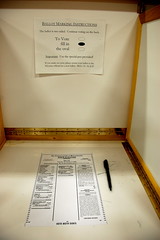
Presidential Election 2008 VotingYesterday LiveScience.com highlighted the work of sociologist Andrew Perrin on “the irrational side of voting”, which also can be found in the latest issue of Contexts Magazine.

Live Science senior writer Jeanna Bryner reports:

…When it comes to the underlying reason why citizens vote in general, little has changed philosophically. Our propensity to vote has always been a complex mix of feelings and strategy, writes sociologist Andrew Perrin of the University of North Carolina in the fall issue of Contexts magazine, published by the American Sociological Association.

Voting is both rational and emotional, Perrin says. “It is a ritual in which lone citizens express personal beliefs that reflect the core of who they are and what they want for their countrymen, balancing strategic behavior with the opportunity to express their inner selves to the world.”

That’s why reason alone can’t explain say why a significant group of citizens voted for Ralph Nader, who ran as an independent candidate for U.S. president in 2004. “A significant, obviously small, group of people thought they were best able to express themselves by voting for Nader even though there was never any possibility h
e was actually going to win the presidency.”

Read the full story.

Don’t forget to exercise your right to vote today! Find your polling location and cast your ballot.


This weekend the New York Times ran a very flattering review of Malcolm Gladwell’s new book ‘Outliers: The Story of Success.’ Times contributor Stephen Kotkin writes, “Malcolm Gladwell has a rare ability: he can transform academic research into engaging fables spotlighting real people.”

In the book Gladwell disputes the idea of the self-made man and focuses on the fact that success is fundamentally ‘social.’

…Mr. Gladwell promotes a cultural explanation for success no matter how indirect the causal mechanisms. Although the individuals that Mr. Gladwell cites are exceptional, their success, he argues, does not flow from their natural gifts but from their unusual cultural legacies, the uncanny opportunities that come their way, and their really, really hard work.

But Kotkin offers some critique…

…Often the examples are unsatisfying, as in his discussion of the KIPP academy in the Bronx, where 90 percent of the students qualify for free or reduced-cost lunches but do as well in math as privileged suburban children. Why? Supposedly because the academy abolished long summer vacations. Mr. Gladwell, following the research of the sociologist Karl Alexander, contends that virtually the entire educational performance difference between better-off and poorer children derives from what some students do not learn when school’s out.

Read the full review, here.

The Washington Post is running a story on common misperceptions about how American voters base their decisions on moral values. 

The myths: (1)”Moral values” determine who wins elections. (2) Americans have broadly rejected “traditional values.” (3) Americans are polarized and fighting a culture war over values. (4) Traditional values are “family values” or “moral values.” (5) Basic values, properly understood, are compatible and harmonious.

In support of myth #2, the Post draws upon the work of sociologist Wayne Baker. MYTH #2: “Americans have broadly rejected ‘traditional values.’ — Actually, Americans retain our traditional values more than just about any other developed country in the world.”

That’s what University of Michigan sociologist Wayne Baker found in his 2005 book, “America’s Crisis of Values: Reality and Perception.” Baker uses the World Values Surveys to look at American values from a broad, global perspective. He describes human values on two planes. The first is a scale of values from traditional to secular-rationalist. Societies with more traditional values emphasize the importance of God and religion, family and parenting, national identity and pride and absolute standards of morality, not relative ones. Secular-rationalist values are pretty much the opposite: nonreligious, open to abortion and euthanasia, skeptical of national pride or patriotism and evolving away from family, duty and authority.

The second range of values runs from survival values to self-expression ones. In less developed and safe societies, survival values reign. Procuring physical security and meeting basic material needs dominate; foreigners and ethnic diversity are seen as threatening; intolerance is exaggerated. Self-expression values concern creativity, self-fulfillment and lifestyle.

Fascinating. Read more about the other myths here.

Science News reports this morning on an alarming new trend which suggests that middle-aged whites are a high-risk group for committing suicide.

A dark underside of middle-age has surfaced in the past decade. Although this phase of life is one psychologists have long considered a time of general stability and emotional well-being, white men and women ages 40 to 64 accounted for the bulk of a recent increase in the U.S. suicide rate, a new study finds.

Data gleaned from U.S. death certificates show that the overall suicide rate rose 0.7 percent annually between 1999 and 2005, reversing a downward trend in the rate that had begun in 1986. This increase primarily reflected a 2.7 percent annual rise in the suicide rate among middle-aged white men and a corresponding 3.9 percent annual rise among middle-aged white women, say epidemiologist Susan Baker of Johns Hopkins Bloomberg School of Public Health in Baltimore and her colleagues.

A sociologist weighs in…

In 2005, evidence of a disproportionate number of annual deaths among middle-aged people in the United States raised suspicion that an escalating percentage of the deaths were suicides, remarks sociologist Robert Bossarte of the University of Rochester Medical Center in Rochester, N.Y. “The big unanswered question is why middle-aged adults killed themselves at an increased rate in the years covered by this new study,” Bossarte says.

Possible contributors to this trend include mounting numbers of military veterans reaching middle age and rising difficulties for middle-aged individuals in trying to secure medical insurance, he suggests.

Read more.

IMG_1813The folks over at the Freakonomics blog (housed by the New York Times) recently posed the question: ‘Who are the modern-day outlaws? Do we still have outlaws or did they die off with the last of the frontier towns — or maybe later, with the Hell’s Angels?’

Stephen Dubner, the post’s author, approached a number of experts on the issue, including well-known sociologist Chris Uggen. Dubner presented each expert with the following set of questions:  Does America still have an outlaw group? If so, why do you consider them outlaws?Does society need outlaws?

Check out this sociologist’s response…

Chris Uggen, Distinguished McKnight Professor and chair of sociology at the University of Minnesota, executive secretary of the American Society of Criminology, co-author of Locked Out: Felon Disenfranchisement and American Democracy, and co-editor of Contexts Magazine.

Oh, hell yes, there are outlaws in America — and everywhere else, for that matter. Anyone who breaks rules is in some sense an outlaw, subject to social or legal sanctions if their outlawry is detected. These penalties operate on a sliding scale, depending on whether the outlaw smokes cigarettes or meth, pirates DVD’s or ships, or violates college hate-speech codes or state hate-crime laws.

But our standards for outlaws are relative, not absolute; they change over time and social space.

Societies are constantly raising or lowering the bar, outlawing formerly accepted behaviors — like smoking — and legalizing former crimes, like lotteries.

In any group, those with greater power tend to control the rule-making process. And they sometimes go to great lengths to make outlaws out of those who might threaten their power, by restricting their ability to vote or work or have children. Regardless of who holds power, societies operate with a basic set of rules that necessarily beget a basic set of rule violators.

Just imagine, as sociologist Emile Durkheim did, a society of saints made up of exemplary citizens. Would there be no outlaws in such a group? No! They’d pick at each other for minor peccadilloes and trivial misdeeds. In that crowd, even a burp or blemish could mark one as a real bada–.

Nobody is arguing that contemporary America is a society of saints. To the contrary, it often seems as though we’re “defining deviancy down,” as senator and sociologist Daniel Patrick Moynihan put it.

Cultural critics of the hell-in-a-handbasket school worry that our blasé attitudes toward once-shocking behavior –- network telecasts of ultimate fighters beating the bloody snot out of one another, for example — diminish us all. But don’t forget that we’re simultaneously outlawing other nasty conduct that shocks our collective conscience, such as date rape or sexual harassment.

Whether you view our culture’s current constellation of outlaws as ennobling or diminishing is largely a matter of value preferences.

And remember that outlaws put in some important work for a society. When they expose their bodies at the Super Bowl, our reactions — the extent to which we freak out — tell us something about the current boundaries between proper and improper public conduct. When outlaws are arrested at a political convention, we get a heads-up that change is in the wind. When outlaws sell sex or drugs, we get a safety valve to release pent-up frustrations.

Even when outlaws commit consensus crimes like murder, we get a needed opportunity to publicly condemn them and reaffirm our shared values with our fellow citizens.

While society needs outlaws, it doesn’t need a permanent outlaw class. We’d do well to remember that today’s outlaws are tomorrow’s good citizens; and there’s no citizen more zealous than an outlaw redeemed.

Read the full story, here.

Left screenThis Sunday’s New York Times ran a piece titled ‘Overfeeding on Information’ about our obsession with the news, especially during such a closely contested presidential election and in the midst of an economic crisis.

The Times describes this compulsion for constant updates:

This explosion of information technology, when combined with an unusual confluence of dramatic — and ongoing — news events, has led many people to conclude that they have given their lives over to a news obsession. They find themselves taking breaks at work every 15 minutes to check the latest updates, and at the end of the day, taking laptops to bed. Then they pad through darkened homes in the predawn to check on the Asian markets.

Sociologist Eric Klinenberg is asked to weigh in on this trend…

ERIC KLINENBERG, a sociology professor at New York University, said people are unusually transfixed by news of the day because the economic crisis in particular seems to reach into every corner of their lives. Usually, he added, people can compartmentalize their lives into different spheres of activity, such as work, family and leisure. But now, “those spheres are collapsing into each other.”

And the news is not just consequential, but whipsaw-volatile. Financial markets swing hundreds of points within an hour; poll numbers shift. This means that news these days has an unbelievably short shelf life, news addicts said. If you haven’t checked the headlines in the last half-hour, the world may already have changed.

And commentary from a psychologist…

For others, information serves as social currency. Crises, like soap operas or sports teams, can provide a serial drama for people to talk about and bond over, said Kenneth J. Gergen, a senior research psychologist at Swarthmore College who studies technology and culture. “It gives us the stuff that keeps the community together,” he said. And for those whose social circles think of knowledge as power, having the latest information can also enhance status, Dr. Gergen said. “If you can just say what somebody said yesterday, that doesn’t do the trick,” he said.

Read the full story.

Let's find a cure

This morning MSNBC ran a story on new research from San Francisco State sociologists, which suggests that when women receive a breast cancer diagnosis, they often assume a caretaking role in their own treatment and recovery. 

MSNBC reports:

 After conducting a series of interviews with 164 breast cancer survivors over two years, researchers from San Francisco State University found that women with cancer not only shoulder the emotional burden of disclosing their diagnosis to loved ones, they often end up being supportive of others at a time when they actually need support themselves.

“There’s been a lot of research on how women are emotional managers, how they take care of others,” says medical sociologist and lead researcher Dr. Grace Yoo, who recently presented the findings at the annual meeting of the American Sociological Association. “And when they’re diagnosed with breast cancer they’re still doing that. They’re worried about how others might react.”

Read the full story

My FuelThe Times (UK) reports this morning on the potential health risks associated with energy drinks and the dangers they pose to young people. Pete Bee reports, “Energy drinks have become the elixir of a generation that considers itself in need of more of a jolt than can be obtained from a mere cup of coffee. Around 330 million litres of products such as Red Bull, the UK’s bestseller, are consumed every year in Britain and the super-caffeinated drinks market is worth £1billion annually.”

A sociologist contributes to these concerns over the consumption of highly-caffeinated energy drinks, some with more caffeine than seven cups of black coffee. 

… [Researchers] have suggested that the caffeine in energy drinks means that the regular use of such products should be considered an accurate predictor of bad behaviour in young people. Reporting in The Journal of American College Health, Kathleen Miller, a sociologist and addiction researcher at the University of Buffalo, showed a link between caffeinated drinks and risky or aggressive behaviour patterns, including substance abuse, violence and unprotected sex. She says that her findings did not mean that caffeinated drinks cause bad behaviour, but that their regular consumption might be a warning sign for parents that “kids who are heavily into drinking them are more likely to be the ones who are inclined toward taking risks”.

And be sure to lay off the Red Bull…

A growing number of researchers are looking not just at the effects of caffeine, but at the consequences of high doses contained in energy products. Scott Willoughby, of the Cardiovascular Research Centre in Adelaide, Australia, recently showed how the sugar-free version of Red Bull can cause the blood to thicken, raising the risk of heart attacks and strokes.

The full story.

This morning BBCnews.com posted an article entitled ‘The Path from Cinema to the Playground,’ which poses the following question to its readers: “A new film [Tropic Thunder] repeatedly uses the word “retard”. Can it be acceptable to use satirically or is it intrinsically offensive and a quick route to playground and workplace insults?”

Read the details of the use of this word in the film, here.

Reporter Finlo Rohrer writes:

For the opponents of Tropic Thunder, the path between film and television and “hate speech” is clear.

The UK provides an interesting crucible. While the word “retard” is extremely common in the US and crops up regularly in films, in the UK other epithets are more common. But it still has an immense power to offend, topping a poll by the BBC’s Ouch website for the most offensive disability-related words.

The sociologist weighs in…

If there are more school-children using the word “retard” in playgrounds this week, some might take that as an indicator of the malign power of the film.

“The media is very powerful, whether it’s films or comedy,” says sociologist Prof Colin Barnes, who studies the relationship between the media and disability. “Subliminal messages are distributed. ‘Spaz’ was popularised by Rik Mayall in the Young Ones. That really took off in the 1980s in schools.”

Read the full story at BBCnews.com.

The Telegraph (UK) reports today about a trend in universities in England to prohibit the use of certain words deemed offensive. Among them is the term ‘Old Masters,’ often used to refer to great painters, many of whom were men. Instead, the UK sociologists who developed the list suggest that this term discriminates against women and should be replaced with ‘classic artists.’ 

Telegraph reporter Martin Beckford writes:

The list of banned words was written by the British Sociological Association, whose members include dozens of professors, lecturers and researchers. The list of allegedly racist words includes immigrants, developing nations and black, while so-called “disablist” terms include patient, the elderly and special needs. It comes after one council outlawed the allegedly sexist phrase “man on the street”, and another banned staff from saying “brainstorm” in case it offended people with epilepsy.

Call in the sociologist!

…The list of “sensitive” language is said by critics to amount to unwarranted censorship and wrongly assume that people are offended by words that have been in use for years. Prof Frank Furedi, a sociologist at the University of Kent, said he was shocked when he saw the extent of the list and how readily academics had accepted it.

“I was genuinely taken aback when I discovered that the term ‘Chinese Whisper’ was offensive because of its apparently racist connotations. I was moved to despair when I found out that one of my favourite words, ‘civilised’, ought not be used by a culturally sensitive author because of its alleged racist implications.”

Prof Furedi said that censorship is about the “policing of moral behaviour” by an army of campaign groups, teachers and media organisations who are on a “crusade” to ban certain words and promote their own politically correct alternatives. He said people should see the efforts to ban certain words as the “coercive regulation” of everyday language and the “closing down of discussions” rather than positive attempts to protect vulnerable groups from offense.

Read the full story.