trends

ABC News explores some possible causes of obesity that are often overlooked.

Sure, most of the nation needs to eat less and move more. But is that the only reason America is so fat?

As more scientists and sociologists look at our bulging waistlines, some unusual explanations for the nation’s weight gain in the last 30 years are popping up.

The article discusses an intestinal bacteria that may contribute to weight gain and particular genes that may influence the success or failure of dieting.

Beyond these physical explanations, social factors may also contribute to obesity. A Harvard medical sociologist weighs in:

In 2007, an article in the New England Journal of Medicine used 30 years of data on 12,000 people to show obesity and weight loss may actually be contagious — things that spread among people who know each other.

“They key idea is that people are influenced by the behavior and actions of those around them. This applied to something that people may not have thought of, which is body size,” said Dr. Nicholas A. Christakis, author of the recent book “Connected,” which looks at how various phenomena from depression to obesity spreads through society.

Over the three decades, Christakis showed how obesity in one person in a circle of friends statistically meant more people in their circle of friends would become obese. The same was true of weight loss.

“We’re not saying we found the cause of the obesity epidemic. We’re not,” said Christakis. “Social networks have a general property that they magnify what they are seated with.”

While Christakis could show an obesity epidemic spreading through friend networks, he could only make an educated guess why.

“One possibility is that you start doing things — certain behaviors that I copy,” said Christakis.

So if one friend starts serving beer and cookies all the time, perhaps another friend will pick up the habit. Or if one friend joins a running club, perhaps another friend will join it too.

Christakis said another possibility is that “What’s spreading between people is an idea, or a norm.”

For example, if most people a person associates with are overweight, then that person’s idea of “normal weight” is likely to be bigger than what is actually healthy.
Read more.

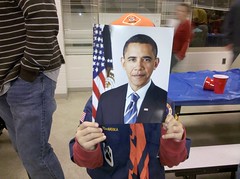
President Obama (Tim)According to USA Today, the 2010 Census will

remind Americans that racial classifications remain an integral part of the country’s social and legal fabric while, at the same time, recognizing that racial lines are blurring for a growing number of people…The government will give the nation’s more than 308 million people the opportunity to define their racial makeup as one race or more.

Some suggest that Obama’s presidency may affect how individuals report their race this time around. But how Obama himself will record his race remains a mystery.

Obama, born to a black father and a white mother, is not only the first black president but the first biracial president.

During his successful campaign in 2008, Obama referred to himself as black but also referred to his roots in Hawaii, where he was raised by his white mother. When the Obamas’ Census form arrives at 1600 Pennsylvania Ave., will he identify himself as black or as black and white? The White House declines to say.

A sociologist weighs in:

“The issue of perception is central,” says Ann Morning, a sociology professor at New York University. In an article titled “Who is Multiracial?” she estimated that about one-third of the U.S. population has some mixed-racial ancestry going back several generations. She predicts young generations will be more embracing of their multiracial heritage.

Morning is African American. But she also has English, Chinese and American Indian ancestry. Since 2000, she has checked off black, white, Asian and American Indian.

“The bigger thing is how I will mark my daughters,” Morning says. Their dad is Italian and she believes most people will look at her daughters as white. For now, she’ll check all the boxes for them, too.

Some question whether counting race is a good idea at all.

Roderick Harrison, a demographer at Howard University and the Joint Center for Political and Economic Studies in Washington. “But for a lot of others, it’s like, ‘OK, are you going to turn your back on the rest of us?’ … A lot of the racial and ethnic politics of the Census are that we want the biggest numbers possible for our groups.”

The Census has a long-lasting effect on politics and money. Population counts every 10 years decide the number of seats every state gets in the U.S. House of Representatives and determine how more than $400 billion a year in federal aid is allocated.

“I know it’s valuable information if you’re doing economic development or dispense certain amount of money to areas that need it,” says Stewart Cockburn, 39, who lost his job in textile sales in September. “My point about race in general in this country is that we’re just never going to get past it if we keep asking about it.”

Cockburn, of Greensboro, N.C., says he’s Scottish and Irish and has a great-grandmother who was Cherokee.

“I don’t understand why everyone makes such a big deal about race,” he says. “Maybe one day we will no longer care about race, ethnicity or the color of another person’s skin.”

Donna Edwards, of Santa Monica, Calif., says it’s important that the federal government allows people to identify more than one race. “It’s about time, isn’t it?” says Edwards, who is half Japanese and half German/Scottish/Welsh and spent years frustrated by forms that boxed her into one or the other.

The Philadelphia Inquirer recently examined Americans’ tendency to turn on the poorest members of their society during hard economic times:

Last month, Lt. Gov. Andre Bauer of South Carolina said that when the government helps the poor, it’s like people feeding stray animals that continually “breed.”

And just last week, Colorado state legislator Spencer Swalm said poor people in single-family homes are “dysfunctional.”

Both statements riled some Americans from the Piedmont to the Rockies and underscored a widely held belief: In tough times, people are tough on the poor.

It’s not just politicians playing the blame game, either:

In an April 2009 poll by the Pew Research Center in Washington, 72 percent agreed with the statement that “poor people have become too dependent on government assistance programs.” That’s up from 69 percent in 2007.

“The economic downturn has made the middle class less generous toward others,” said Guy Molyneux, a partner at Hart Research Associates, a Washington firm that researches attitudes toward the poor. “People are less supportive of the government helping the poor, because they feel they’re not getting enough help themselves.

The Inquirer also featured sociological commentary on the phenomenon:

Matt Wray, a sociologist at Temple University, agreed: “Hatred of the poor is fueled by the middle class’s fear of falling during hard times.”

Americans don’t understand how the poor are victimized by a lack of jobs, inefficient schools, and unsafe neighborhoods, experts say.

“People ignore the structural issues – jobs leaving, industry becoming more mechanized,” said Yale sociologist Elijah Anderson, renowned for his study of the Philadelphia poor. “Then they point to the poor and ask, ‘Why aren’t you making it?’

Courier LoveThe New York Times reports a rise in employee theft via gift cards:

At the Saks flagship store in Manhattan, a 23-year-old sales clerk was caught recently ringing up $130,000 in false merchandise returns and siphoning the money onto a gift card.

“Gift card fraud is spiking,” said Joshua Bamfield, author of the Global Retail Theft Barometer, an annual international survey of retailers. “To employees, this is like currency. It’s almost as good as the U.S. dollar.”

Gift card fraud is growing portion of overall retail theft:

Employee fraud involving gift cards appears to be growing sharply as retailers struggle to contain overall theft, now estimated at $36 billion a year in the industry, or 1.51 percent of retail sales, according to a leading national study. Even as total sales have been falling, employee theft and shoplifting have been rising across the United States, industry experts say, with occasional arrests making headlines.

Many of the gift card crimes are straightforward, frequently involving young sales clerks and smaller amounts than the Saks theft. Among the variations of such crimes, cashiers often do fake refunds of merchandise and then, with the amount refunded, use their registers to electronically fill gift cards, which they take. Or sometimes when shoppers buy gift cards, cashiers give them blank cards and then divert the shoppers’ money onto cards for themselves.

A criminologist who studies employee theft comments:

“The retail industry has come to the realization that, as the Pogo comic strip said, ‘We have met the enemy, and he is us,’ ” said Richard C. Hollinger, the survey’s principal author and a professor of criminology at the University of Florida.

The most common type of employee theft is “sweethearting,” in which cashiers fail to ring up or scan goods that friends or relatives present at the register, Professor Hollinger said. Stealing from the till remains a problem, too. But with gift cards continuing to grow in popularity, they are an increasingly easy target.

And…

Professor Hollinger says the rate of theft is greatest among retailers with high turnover rates and many part-time workers, who may be less loyal and under more financial pressure than full-time workers.

He also found higher theft among younger workers. “Older workers know they have a lot more to lose — promotional opportunities, health insurance, 401(k)’s and pensions,” Professor Hollinger said.

Che Guevara
The Sofia Echo reports on the debate in Poland over a new ban on symbols of communism.  It seems much of the disagreement is between those who were alive during the communist era and the younger generation:

Evocative symbols of Europe’s troubled past, such as the swastika, have long been illegal in a number of countries across the continent. But now, Poland has gone one step further. Poland has revised its criminal code to include a ban on symbols of communism. And, Poles can now be fined or even imprisoned if they are caught with a red star, a hammer and sickle or even a Che Guevara t-shirt.

To some, it is a natural reaction for a country that suffered so much from communism under the Soviet Union. But these days, many younger Poles are more likely to see communism as a source of satirical fun and creativity.

Sociologist Jutyna Kopczynska of Warsaw University says that Polish youth may be sympathetic to their elders’ suffering, but are more likely to see this as an issue of freedom and personal style:

“The young people are rebellious a bit. They think about their future and their freedom, and they want to show that they are free,” said Kopczynska. “So wearing a t-shirt with Che Guevara doesn’t mean that I am communist, but it means that I am trendy. The generation gap in our country is so huge that it’s hard to make a compromise.”

There are still questions about how the new ban will be applied, which is one explanation for the conflicted feelings of some young Poles:

The ban includes a number of exemptions for artists, educators and collectors of communist relics. And, so far no one has published an official list of exactly which symbols are outlawed. Critics have complained that the law is too hazy to actually be applied.
 
One woman speculates that this is why there has been little public outrage, even among the younger generation.

Twenty-four-year-old Lukasz Pawlowski says he agrees with the ban, if only because it protects the feelings of older Poles.
 
“I can understand that people who actually lived at that time, in the communist era, who were hurt by this system – it might upset them to see young people who might have basically no knowledge about this system and didn’t live in that, wearing the symbols they don’t understand. Wearing them probably just for fun,” he said.

A USA Today Op-Ed by Thomas Sander and Robert Putnam reveals a long-term consequence of unemployment:

Recent studies confirm the results of research during the Great Depression — unemployment badly frays a person’s ties with his community, sometimes permanently. After careful analysis of 20 years of monthly surveys tracking Americans’ social and political habits, our colleague Chaeyoon Lim of the University of Wisconsin has found that unemployed Americans are significantly less involved in their communities than their employed demographic twins. The jobless are less likely to vote, petition, march, write letters to editors, or even volunteer. They attend fewer meetings and serve less frequently as leaders in local organizations. Moreover, sociologist Cristobal Young’s research finds that the unemployed spend most of their increased free time alone.

These negative social consequences outlast the unemployment itself. Tracking Wisconsin 1957 high school graduates, sociologists Jennie Brand and Sarah Burgard found that in contrast to comparable classmates who were never unemployed, graduates who lost jobs, even briefly and early in their careers, joined community groups less and volunteered considerably less over their entire lives. And economist Andrew Clark, psychologist Richard Lucas and others found that, unlike almost any other traumatic life event, joblessness results in permanently lower levels of life satisfaction, even if the jobless later find jobs.

Equally disturbing, high unemployment rates reduce the social and civic involvement even of those still employed. Lim has found that Americans with jobs who live in states with high unemployment are less civically engaged than workers elsewhere. In fact, most of the civic decay in hard-hit communities is likely due not to the jobless dropping out, but to their still-employed neighbors dropping out.

Some possible explanations for this disturbing trend:

What might explain the civic withdrawal during recessions? The jobless shun socializing, shamed that their work was deemed expendable. Economic depression breeds psychological depression. The unemployed may feel that their employer has broken an implicit social contract, deflating any impulse to help others. Where unemployment is high, those still hanging onto their jobs might work harder for fear of further layoffs, thus crowding out time for civic engagement. Above all, in afflicted communities, the contagion of psychic depression and social isolation spreads more rapidly than joblessness itself.

Statue Of Liberty -RightThe New York Times reports that the number of foreign-born workers is on the rise in the U.S.

Nearly one in six American workers is foreign-born, the highest proportion since the 1920s, according to a census analysis released Monday.

Because of government barriers to immigration, the share of foreign-born workers dipped from a 20th-century high of 21 percent in 1910 to barely 5 percent in 1970, but has been rising since then, to the current 16 percent.

In 2007, immigrants accounted for more than one in four workers in California (35 percent), New York (27 percent), New Jersey (26 percent) and Nevada (25 percent).

But that’s not all the Census Bureau found:

For the first time, the Census Bureau also compared immigrants by generation. Generally, income and other measures of achievement rose from one generation to the next, although educational attainment peaked with the second generation.

Monica Boyd, a sociology professor at the University of Toronto, said the second generation personified “the overachievement model, a tendency for very high achievement that seems to come as a result of immigrant parents’ instilling in these kids an enormous drive.” Professor Boyd added, “Many try to instill in their kids the phrase, ‘We did this all for you.’ ”

Among all immigrant families, median income rose from $50,867 in the first generation to $63,359 and $65,144 in the second and third, respectively. The only group to register any decrease was family households headed by single mothers; their income declined from the second generation to the third.

Similarly, the overall proportion of immigrant families living below the government’s official poverty level declined, from 16.5 percent to 14.5 to 11.5 among three generations. But among adult immigrants, the proportion who are poor grew again between the second and third generations.

However, while overall measures of income seem to be improving from one generation to the next (with some variation among sub-goups), those for overall educational achievement tell a different story:

While the proportion of high school graduates increased from one generation to the next, the share who had bachelor’s degrees or more higher education declined from the second to the third generations. The proportion with doctorates peaked with the first generation.

Elizabeth Grieco, chief of the Census Bureau’s immigration statistics staff, said the figures suggested substantial progress from the first generation to the second.

“This really shows that immigrants integrate over time the same way they always have,” Ms. Grieco said.

In terms of education, she said, “the third generation seems to be stopping at bachelor’s or master’s degrees.”

So, what do sociologists make of this decline in educational attainment between second and third generations?

Nancy Foner, a sociology professor at Hunter College of the City University of New York, said, “If there is some evidence of third-generation decline, then this no doubt has a lot to do with persistent inequalities and disadvantages facing many of the second generation and their children.”

Professor Foner added that “the economic declines of the past few years no doubt play a role” and that “it could also be that second-generation parents, themselves born in the U.S., are less optimistic and push their children less hard than their own immigrant parents who came here and struggled so their children could succeed.”

Nr.187A recent piece in the New York Times challenges the conventional wisdom that bad economic times are a hotbed for criminal activity:

[New York] Police Department statistics show that the number of major crimes is continuing to fall this year in nearly every category, upending the common wisdom that hard times bring more crime.

“The idea that everyone has ingrained into them — that as the economy goes south, crime has to get worse — is wrong,” said David M. Kennedy, a professor at the John Jay College of Criminal Justice. “It was never right to begin with.”

To make sense of this, let’s call in the sociologists….

Experts have long studied how shifts in crime might be attributed to economic indicators like consumer confidence, unemployment or a faltering housing market, particularly when it comes to property crime, burglary and robbery. The findings have been “rather equivocal,” said Steven F. Messner, a sociology professor at the State University of New York at Albany who has studied homicides in New York City.

While there is generally thought to be a lag between changing economic conditions and new crime patterns, he said, it is curious that there has been no pronounced jump in street crimes associated with the most recent recession, which took root last year.

“But it could take a while to work its way through the system and into people’s psychology,” he said. “I would say the jury is still out on the impact of this most recent economic collapse.”

Jesenia Pizarro, a criminologist at Michigan State, said that crime is indirectly related to the economy:

Most crime is committed by the poor and uneducated, she said, and a bad economy can aggravate poverty in ways that are not obvious.  “The bad economy leads to social processes that are then more directly related to crime,” she said, citing “less services for youth and young people who are less occupied and don’t have the guardianship they need” or cuts in education “that can lead to crime.”

No doggie bagsIn the wake of Thanksgiving, Digital Journal describes a new twist on the problem of food waste.  First, the context of food waste in the US:

Three researchers from the Laboratory of Biological Modeling, National Institute of Diabetes and Digestive and Kidney Diseases, Bethesda, Maryland, United States of America, recently published a study that confirms the unrestrained waste of food in the United States.

Their findings are shocking: “We found that US per capita food waste has progressively increased by ~50% since 1974 reaching more than 1400 kcal per person per day or 150 trillion kcal per year. Food waste now accounts for more than one quarter of the total freshwater consumption and ~300 million barrels of oil per year.”

The article highlights a recent sociological insight into the fate of this wasted food, from research by Cornell sociologists Jeffery Sobal and Thomas A. Lyson, and Mary Griffin of the Arnot Ogden Medical Center:

Their study quantified food waste in one U.S. county in 1998–1999. They identified three options for waste food –donation, compost or landfill. The vast majority of food waste in the United Sates goes straight to landfill. According to their study, “Less than one-third (28%) of total food waste was recovered via composting (25%) and food donations (3%), and over 7,000 tons (72%) were landfilled. More than 8.8 billion kilocalories of food were wasted, enough to feed county residents for 1.5 months.”

While many regions worry about malnutrition and famine residents of most parts of the the United States need to worry about the deleterious environmental impacts their gargantuan waste of food products is having.

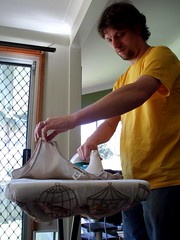
You Shall Go To The Ball ...The San Jose Mercury News reports that unemployed husbands are picking up work around the house.

An estimated 2 million wives are now the sole breadwinners in families across America, since more men than women have been laid off in this recession, according to the Center for American Progress. Experts say that unemployed husbands probably are taking on more of the housework and child care duties — for now. But they don’t expect that temporary change to stick around if men find work again.

A sociologist weighs in on the trend:

“When men make more money, they can buy out of housework in a way women cannot,” says Constance Gager, a sociologist in the Department of Family and Child Studies at New Jersey’s Montclair State University.

Gager, who has studied the division of labor in families, says that while men have taken on more housework and child-rearing over the years, women typically still do two-thirds of it, including diaper-changing, bathing the kids, preparing meals and shuttling children to activities. Men tend to play with children or participate in athletic games.

However…

“I think the complicated question is: Do women want men to take over these burdens? It’s also the case that women feel a kind of propriety relationship to those tasks,” says Katherine Newman, professor of sociology and public affairs at Princeton University.