
social movements

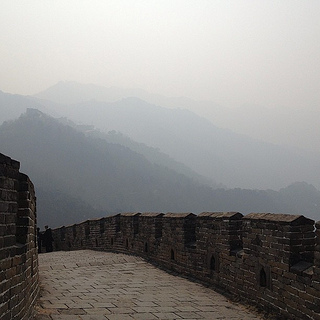
Pollution at the Great Wall of China. Photo by Thomas Galvez via flickr.com.
Smog hangs over the Great Wall in China. Photo by Thomas Galvez via flickr.com.

China is suffering an environmental crisis, and it’s become a health hazard. Using social media, young activists are now disseminating shocking photos and information. Through their lenses, we see Beijing’s air, thick with smog, and rivers lined with hundreds of rotting animal carcasses. For Chinese and world citizens, it seems clear these environmental problems can’t be ignored, and protests have sprung up across China, especially on its Eastern seaboard. In an interview in Dissent Magazine, Jeffery Wasserstrom asks Duke anthropologist Ralph Litzinger to discuss China’s new environmental movement.

One of Litzinger’s most interesting research findings is that there is a major class discrepancy in reacting to the environmental issues:

Much of the publicity about deteriorating air conditions came from a new kind of middle-class activist citizen who took to the streets to monitor the air, posting findings and images on weibo (the Chinese version of Twitter) and other social networking platforms. […]But head out into the outer rings roads of Beijing, where the poorest of Beijing’s migrants and residents live and work, and you experience a very different situation. You see fewer people wearing masks, and hear much less complaining about the air. It is not that migrant and urban fringe communities in Beijing don’t care about health and environmental issues; it is just that they haven’t received the same kind of attention that the middle-class urban resident has received.

In China, the middle and upper classes are able to assess their environmental situation and adapt. They may shop for organic foods, build protection from the poisonous air, stay home from work or school on bad air days, or even leave the country. The poor are merely left to brave their new, toxic environment—at least until their richer countrymen make major changes.
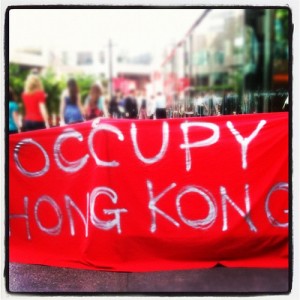
Occupy Hong Kong banner by Thomas Galvez via flickr.com

China is an expanding country, trying to find where it fits in the social and economic framework of powerful nations. Conversely, its people are trying to find where they fit in the Chinese social structure. As they prepare for a change in political leadership, China is also faced with they rise of the individual. In an article for Voice of America, Shannon Van Sant interviewed UC Irvine sociologist Wang Feng about this phenomenon.

Much like in many areas in the Middle East, Europe, and North America, parts of China have recently seen a surge of protests and “mass incidents.”  Feng describes this as “directly linked to the growth of China’s middle class.”  While incomes in China increase, Feng explains, the expectations Chinese citizens have of individual rights and pursuits grow too. Everything from land ownership to corruption and taxation is now a subject of contestation.

These protests put the Chinese government in an awkward predicament.  Once infamous for its stifling of public activism, the state must react to these protests with the eyes of the world upon them. So far, it has tried to clamp down on the instigators but, in some cases, have also given in to the protestor’s demands. According to Dr. Feng, Chinese society has already changed—the government will “need to come in to really implement these bold reforms. Otherwise, well, time is running out.”

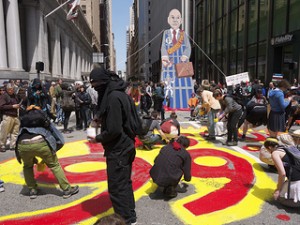
Photo by davitydave via flickr.com

The Occupy movement’s strength is its theatrics, argues Todd Gitlin, author of Occupy Nation: The Roots, the Spirit, and the Promise of Occupy Wall Street, on the Possible Futures blog of the Social Science Research Council.

The “anarchist post-punk core” of Occupy has been more about expression than mission from its start, writes Gitlin, a professor of sociology and journalism at Columbia University. Thus, the play that took place on May Day was a natural expression of Occupy’s spirit:

Occupy, in other words, is primarily an identity movement, and identity movements face inward. They aspire to be cultures, self-sufficient and gorgeous. People don’t join Occupy, they do it. It’s a way of life, a transvaluation of values. Joining in such a life is, to a few tens of thousands of people nationwide, an intense form of disaffiliating from the main currents of American society and culture. It means not only disaffection from plutocratic control but making oneself at home with the movement’s own solidarity.

TSP and other social scientific sources are swimming in great information about the Occupy Wall Street movement, so be sure to check out some of these additional sources and add your own favorites in the comments!