

social media

The New York Times ran a story on the removal or design changes of public benches as a part of a “decades-long shift of reinventing the public bench into something that doesn’t welcome the public at all.” Michael Benediktsson (Associate Professor of Sociology at Hunter College) commented that this trend connects to pre-1970s anit-vagrancy laws that allowed police officers to arrest people of color and people experiencing homelessness who were utilizing public spaces. Benediktsson commented that once these laws were deemed unconstitutional, “that’s when you see more of a turn to hostile urban design and planning as a means of achieving the same objective.”


Michael Benediktsson

Ash Watson (Scientia Fellow and Senior Lecturer at the University of New South Wales in Sydney) described the consequences of the digital divide in Australia in an NewsCop article. Nearly “6 million Australians have difficulty accessing the internet; this spans physical access, affording the internet and being confident and capable with their own abilities,” Watson described. As more services–including banking, news, housing applications, and government services–move online, many Australians are getting left behind. “The big consequence is that people can struggle to fully participate and feel that they don’t belong in Australian society as a result,” Watson said.


Ash Watson

The Atlantic ran a story addressing a “surprisingly contentious” question: does money make parenting easier? In 2023 a Pew Research Center survey found that lower-income parents were more likely to state that they found parenting enjoyable and rewarding most of the time. Many media commentators focused on this singular data point, claiming that parenting was most difficult for wealthier parents (despite another finding in the Pew data that lower-income parents are more likely to say that parenting is stressful). Jennifer Glass (Sociology Professor at the University of Texas at Austin) commented that “there’s simply no data on mental health, subjective well-being, or happiness that I have ever seen showing [that wealthy parents struggle with parenthood more].” Rather, Glass’s research shows that higher income and education improve happiness for parents.


Jennifer Glass

Equal Times interviewed Alex Wood (Assistant Professor of Economic Sociology at the University of Cambridge) on the rise in self-employment and freelance work since 2000. Wood explains that freelancing is often more common where there are weaker labor protections, service-based economies, and digital labor platforms available. Wood also describes a shift in the corporate mindset toward prioritizing short-term profit: “If you leave it to employers, to firms, they will choose the low road, the easy option, because they are focused on short-term profitability and short-term share price, even though that’s detrimental to them in the long term.”


Alex Wood

The Washington Post ran an article about shifting trends in cosmetic surgery–particularly a rise in breast implant removals and breast implants of smaller sizes, mirroring a broader cultural trend toward thinness. Alka Menon (Assistant Professor of Sociology at Yale University) explained that “cosmetic surgery moves on a trend model. Minimalism is the name of the game now.” Menon also commented on how social media accelerates cycles of beauty trends: “What took decades to shift from Marilyn Monroe to Kate Moss now happens in a few years. The algorithm determines what version of beauty you’re exposed to.”


Alka Menon

While efforts to censor children’s media were common during the mid-20th century, they focused on targeting violent or sexual content and were often bipartisan. Recent research from Michael Macy (Professor of Sociology at Cornell University), Adam Szetela (Writer; Ph.D. in English), and Shiyu Ji (Ph.D. Candidate at Cornell University) finds that censorship efforts are now more focused on political ideology (the political left targeting media that reinforces racism, sexism, and homophobia; the political right targeting media that promotes diversity or challenges traditional gender / sexuality norms). “When each side attacks cancel culture on the other side, the attacks do not cancel out – they additively contribute to the restriction of freedom of expression,” Macy commented. “When people see ‘freedom of expression’ as just another weapon to use in the culture wars, it contributes to the problem of censorship by demeaning free expression as a core societal value.” This story was covered by the Cornell Chronicle. 

Michael Macy, Adam Szetela, and Shiyu Ji

Emine Fidan Elcioglu (Associate Professor of Sociology at the University of Toronto) wrote an article for The Conversation discussing YouTube’s role in the political education of young people in Canada. Elcioglu found that “young people now form political beliefs through two competing knowledge systems: a hollowed-out university, and YouTube’s attention economy.” While universities tend to highlight structural explanations for inequality, conservative influencers on YouTube tend to offer simple narratives and emotionally charged content that feels true.

Emine Fidan Elcioglu

A Georgetown University lecture series on Gaza featured Martin Shaw (historical sociologist and Professor Emeritus of International Relations and Politics at the University of Sussex) to discuss the process of defining genocides in legal courts. Shaw noted that “the relationship of war to genocide is a central paradox: Genocide must be distinguished from war, but it typically occurs within the context of war.” He also discussed how the United States and Israel are very influential in international courts, making it difficult to resolve issues without the support of Western nations. “The problem here is not non-intervention, but deep intervention on Israel’s side,” Shaw said. “International courts have been unprecedentedly active in this case, but they have also been unprecedentedly attacked by the United States and Israel and barely defended by Europe.” This story was covered by The Hoya.

Martin Shaw

Andreas Reckwitz (Professor of Sociology at Humboldt University of Berlin) wrote an op-ed for the New York Times on modernity and loss. Reckwitz describes that “the ideal of modern society is freedom from loss” and we presume constant innovation and increasing well-being in modern societies. However, Reckwitz argues that loss–environmental loss, economic loss, and regressions of geopolitics–is a “pervasive condition of life in Europe and America.”

Andreas Reckwitz

  • Benika Dixon (Assistant Professor of Public Health at Texas A&M University), J. Carlee Purdum (Assistant Professor of Sociology at the University of Houston) and Tara Goddard (Assistant Professor of Landscape Architecture & Urban Planning at Texas A&M University) wrote an article for The Conversation on how jails and prisons fail to protect incarcerated people during natural disasters. “People who are incarcerated can’t take protective actions, such as evacuating or securing their belongings,” they describe. “They have no say in decisions that the system makes for them.” Carceral facilities are often not evacuated due to facility designs that make it difficult for people to exit quickly or a lack of available sheltering locations. Natural disasters can also exacerbate physical and mental health problems for incarcerated individuals.
  • An article in the New York Times arts section discussed various depictions of pregnant women in arts and advertising. The story quoted Kathryn Jezer-Morton (Sociologist and Columnist for The Cut) on how celebrities and influencers pose for photos while pregnant. Jezer-Morton credits Demi Moore’s famous 1991 Vanity Fair cover photo with popularizing “bump hands,” a pose in which women place their hands around their stomach, “creating a meaningful enclosure around appropriate fatness” and emphasizing the bump “to reassure the viewer that underneath this one protrusion is a thin person.”
  • In an opinion piece for the New York Times, Tressie McMillan Cottom (Associate Professor at the University of North Carolina’s School of Information and Library Science) prompts readers to “look to the tradwives, podcast bros and wellness influencers” to understand how president-elect Donald Trump’s ability to tap into the aesthetics of online spaces may have helped him win the election. McMillan Cottom describes that online groups don’t map cleanly to traditional political poles and are racially and ethnically diverse. “Trump did not win over [ ] minority and young voters because he figured out how to appeal to their identity,” McMillan Cottom argues. Rather, “he excelled at tapping into the information ecosystems — social media, memes and the cultish language of overlapping digital communities — where minority and young voters express their identity. That is a meaningful difference.”
  • This week, Brazil celebrated Black Consciousness Day, a new national holiday honoring Black struggles for freedom in Brazil. Edward Telles (Professor of Sociology at the University of California Irvine) commented that although Brazil has the largest population of people of African descent of any country outside the continent of Africa, Brazil’s Black population has been “invisibilized until recently.” Telles explains that leaders in Brazilian media, government, and businesses were almost entirely White, but “that is slowly beginning to change.” This story was covered by The Washington Post.
  • In response to protests on university campuses calling for divestment from Israel, NHPR ran a story on how social media has changed protest movements. Zeynep Tufekci (Professor of Sociology and Public Affairs at Princeton) commented that protests organized using social media “get very big very quickly,” but are not necessarily more effective in generating policy change. Non-digital movements of the past “facilitated face-to-face relationships and cohesive group problem-solving.” For example, Tufekci describes that during the Civil Rights Movement, it “took them six months just to organize the logistics of the March on Washington because you couldn’t just put it on a hashtag on social media. But that meant that [the] organizational structure they built helped them navigate what came afterward.” However, Tufekci also notes that movements utilizing social media may be evolving, citing the “message discipline” (or, clear boundaries around what is said as a group) of the protests at Yale, where organizers limited the group to approved chants.
  • Beth Linker (Professor in the Department of the History and Sociology of Science at the University of Pennsylvania) recently released a new book: Slouch: Posture Panic in Modern America. “With the rise of eugenics in the early 20th century, certain scientists began to worry that slouching among “civilized” peoples could lead to degeneration, a backward slide in human progress,” Linker described in an interview with the New York Times. The book investigates this “posture panic,” the rise of posture correction in medical science, and how the “postural defects” became a social marker of “character, intelligence and physical ability.”
  • The New York Times ran a story on how the COVID-19 pandemic affected American gun violence. Nicole Kravitz-Wirtz (Population Health Sociologist at the UC Davis Violence Prevention Research Program and California Firearm Violence Research Center) commented on the effects of violence beyond the direct victims: “Neighborhoods that have persistently elevated levels of violence have lots of trauma across many people. That impacts relationships between neighbors and translates into collective senses of fear.” Kravitz-Wirtz noted the racial disparities in geographic proximity to gun violence.
  • A new dating app with selective membership, The League, aims to connect individuals who are equally successful–financially, socially, and in their careers. “Data shows that men and women are increasingly dating and subsequently marrying individuals who share similar backgrounds,” Jess Carbino (Online Dating Consultant and former Sociologist for Tinder and Bumble) commented. “So on one hand, The League has been criticized for perpetuating existing social inequalities, but on the other, you can say it’s helping people do what statistically, they’re already doing, which is basing their preferences on certain markers.” This story was covered by Yahoo! Life.
  • Erin Cech (Associate Professor of Sociology at the University of Michigan) and Elana Goldenkoff (Doctoral Candidate in Movement Science at the University of Michigan) wrote an article for The Conversation assessing how prepared engineers are to face ethical dilemmas regarding AI. They discuss how engineers often are aware of ethical dilemmas, but feel unprepared to deal with them and how ethics training is often placed on the backburner in STEM education. However, engineers who do receive ethics training “were 30% more likely to have noticed an ethical issue in their workplace and 52% more likely to have taken action.” ​​
  • Robert Bullard (Distinguished Professor and Director of the Robert D. Bullard Center for Climate and Environmental Justice at Texas Southern University) recently won a TIME Earth Award in recognition of his work in environmental justice. “My sociology has taught me that it is not enough to gather the data, do the science, and write the books in order to get transformative change. In order for us to solve this climate crisis…we must marry [our data] with action,” Bullard said in his acceptance speech. “I am optimistic. I do have faith. But as my grandmother told me, faith without work is death. We are a live movement.”
  • Stephanie Alice Baker (Senior Lecturer in Sociology at City University of London) wrote an article for The Conversation on how wellness influencers are contributing to misleading information about birth control on social media sites. Baker describes how “the pill has been re-framed from a source of liberation to harmful by some female wellness influencers” who tend to prioritize “native expertise – knowledge derived from intuition and experience rather than professionals.”

Photo by The Preiser Project, Flickr CC

While political unrest in the United States and in the Middle East may look very different on the surface, social media plays a key role in both contexts. In an article published by MIT Technology Review, Zeynep Tufekci uses her research on political upheaval and social media to show how digital connectivity can enable large-scale movements — like the one in Egypt that ousted an autocratic leader during the Arab Spring — but also has a “dark side” that includes things like online infighting among activists. 

Tufekci’s research further illustrates how traditional gatekeepers including mainstream media and NGOs have been removed from their positions of power by the swift rise of new, digital gatekeepers like Google, Facebook and Twitter. Politicians including Barack Obama and Donald Trump have used digital connectivity to bypass mainstream media and reach the public directly. While digital connectivity is useful to coordinate protests and create social communities, it can also polarize opinions — as was the case with Russian operatives who created fake local media brands and published polarizing content on social media during the 2016 presidential campaigns in the United States. Tufecki argues that social media is a double-edged sword: Both an instrument for spreading democracy and as a weapon that attacks it. Tufekci’s forward-looking proposition in the face of this reality is:

The way forward is not to cultivate nostalgia for the old-world information gatekeepers or for the idealism of the Arab Spring. It’s to figure out how our institutions, our checks and balances, and our societal safeguards should function in the 21st century — not just for digital technologies but for politics and the economy in general. This responsibility isn’t on Russia, or solely on Facebook or Google or Twitter. It’s on us.

When it comes to love, we needn't fear tech advances. Jimmy McIntyre, Flickr CC.
When it comes to love, we needn’t fear tech advances. Jimmy McIntyre, Flickr CC.

Between the increased screen-time, decreased personal contact, and evaluating strangers through profile pages, is online dating bad for society? Rest assured, everyone; these ideas are founded on exaggerated fictional fears rather than actual facts, as described by a Washington Post article with help from Stanford sociologist Michael Rosenfeld.

As Rosenfeld describes through his analysis of a massive dataset regarding online dating activity, there are a lot of myths about online dating. People who meet online don’t break up as frequently as you may have been told, and online dating does not promote hookup culture over long-term relationships (as in the real world, you can find whichever you’d like). Overall, online dating seems to be working for people; Rosenfeld says societies have always been fearful of new technologies but generally come around. Can’t you feel the love?

Pressure's on, kid! Isabelle Plante, Flickr CC.
Pressure’s on, kid! Isabelle Plante, Flickr CC.

Upcoming award ceremony? You may consider joining the growing number of non-politicians hiring “toast whisperers” to write public speeches.

Sociologist Lisa Wade recently explained to News4Jax: “I think people that purchase a speech for an event might want to impress others, and that drives them to do it.” The growing importance of social media also likely contributes, as it increases “the expectation that other people will see everything we do.” And if some people will see it, we want it to be good—maybe even worthy of viral video status.

Guess we can add “Did you even write that speech?” to our array of ways to “throw shade” in the comments sections.

The Confederate Flag is lowered at the South Carolina state capitol building. Elvert Barnes, Flickr CC.


After flying over the South Carolina state capitol for 54 years, the Confederate flag was lowered on the morning of Friday, July 10. Before it was removed from the statehouse, the flag and products bearing its image were also eliminated from the store shelves and online marketplaces of major retailers, including WalMart, Amazon, Sears, and Ebay. The flag’s sudden withdrawal from publicly visible spaces public and private was sparked by a bevy of activism in the wake of the June 17 massacre of worshippers at Emanuel AME Church in Charleston, but complaints about the flag are not new. Why was this push to remove it from prominent display venues successful, when so many others had failed?

Sociologist Brayden King told the San Francisco Chronicle that the important of online media to the way companies make decisions today was central. Corporations who pulled Confederate merchandise from sale were more concerned with their brands’ images on Facebook and Twitter and with investors’ impressions of their management than with being politically correct or doing the right thing. Drawing on findings from studies he published in 2007 and 2013, King said that “Business is always responding to consumer demand and what might be reputational issues as well. If a company isn’t able to quickly resolve the turmoil, then investors may start thinking that the management isn’t very good.”

King argues that social media “makes these issues salient by being a megaphone for activists, and it serves as a large public forum for information.” By linking social issues with companies’ online reputations and managerial competencies, online media may be accelerating the attachment of concrete financial ramifications to cultural debates that corporations may have previously wished to stay out of.

social meaning of moneyThe rise of mobile payment apps like Venmo has made it much easier to, say, split a dinner tab, but this convenience comes along with worries about security and privacy. Further, could companies’ use of personal information about payments to target advertising reveal compromising details about our personal lives?

Venmo, for instance, is explicitly “not just a mobile payment app”—it’s also a social media platform that broadcasts its users’ payment activities to their friends. Cameron Tung discusses some of the implications in Slate. Mobile sharing of payment information helps us attach social meanings to financial transactions, and $100 spent in a restaurant is not the same as $100 spent on a phone bill. Sharing details about whom we’re paying and when opens our financial activity to social scrutiny. Don’t want your spouse or partner to know about the fancy dinner you had last weekend? Better not pay with Venmo.

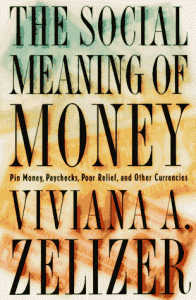
To support this point, Tung cites Princeton sociologist Viviana Zelizer’s work on payments and social ties. We should think about each monetary transaction, according to Zelizer, as a gift, an entitlement, or compensation: “each one corresponds to a significantly different set of social relations and systems of meanings. People making payments use a number of earmarking techniques to distinguish those categories of social relations and meanings from each other.”

When Zelizer wrote about Christmas bonuses, for instance, she found that whether employers and employees thought about bonuses as gifts, compensation, or entitlements had a profound effect on the relationships between bosses and workers. Mobile payment platforms allow us to attach similar meanings to everyday transactions, broadcasting these meanings to our friends. As we consider the privacy and security implications of convenient mobile services, we also need to think about their cultural implications. Though we might want to use sharing apps strategically to cultivate particular online personas and identities, we may not always be able to predict how others’ will attach meanings to our payments.