racism

Tressie McMillan Cottom (Associate Professor at the University of North Carolina’s School of Information and Library Science) appeared on The Opinions–a New York Times podcast–discussing the role of masculinity and messages about gender in the Trump administration. Following Trump blaming a recent plane crash on D.E.I. initiatives, Cottom commented: “I actually think that D.E.I. in that context, while it sort of primed some racial energies, it was really doing its most effective work as a broad dismissal of women. I think one of the reasons that works is because we worked really hard — especially in the last like 15 years — to develop and deepen the repertoire that Americans have to talk about race and racism. I will be honest with you, I’m not sure that we did as good a job of developing that capacity when it came to gender.” Cottom also commented on how strongman politics works “by giving people a scapegoat, giving men a scapegoat — is that it says not only are women the enemy, are people of color and minorities the enemy, but the government is protecting them.” Strongman politics thus facilitate delegitimization of the government.


Tressie McMillan Cottom

Yolande Strengers (Digital Sociologists and Professor of Human Centered Computing at Monash University) appeared on Switched On Australia to discuss the energy industries flawed assumptions of consumer behavior and her work on the Digital Energy Futures project. Strengers commented that the energy industry expects consumers to act like ‘mini-economists’ or ‘mini-engineers,’ thinking of their households as a market. However, Strengers examines daily household practices and motivations, finding that consumers often think of energy as a means of comfort and entertainment, or a way to care for others.


Yolande Strengers

The Credits interviewed Brazilian sociologist Ana Paula Sousa (Film Professor at the Higher School of Advertising and Marketing in São Paulo) about I’m Still Here, a film about a family living during the period of military dictatorship in 1970s Brazil. Sousa commented that the film “exposed the roots of our violence – social, institutional and physical. For a long time, we have been shrouded in the haze of the idea that we’re a country of parties, of joy, of the “way things are” and fed by the illusion that we’re the “country of the future.” I’m Still Here shows that perhaps we are still the “country of the past,” in the sense that we need to deal with our old problems, including torture and slavery.”


Ana Paula Sousa

Bonnie Zare (Professor of Sociology at Virginia Tech) spoke to the Irish Star about the cultural relevance of The Substance, a modern body horror film. “I feel the movie is able to capture this feeling that we’re constantly under scrutiny, that we’re constantly trying to do the impossible, which is get rid of our imperfections, and this sort of self loathing that would accompany that that we’re not talking about,” Zare said. She described the film as a great teaching example of “how we can start to question the norms around us and the policing and disciplining of our bodies, hair and faces.”


Bonnie Zare

Matthew Desmond (Professor of Sociology at Princeton University) appeared on The Daily Show, discussing American poverty and ways to address it and build worker power in the U.S. economy. “I think a lot of us do benefit from poverty in ways we don’t realize,” Desmond commented. “We soak the poor in the labor market or the housing market. We continue to have a government that gives the most to families that need it the least, by subsiding affluence instead of fighting poverty. We continue to live in segregated lives. A lot of us are connected to that problem, but it also means we’re connected to the solution.”


Matthew Desmond

Singapore Management University ran a story on EurekaAlert! featuring Jacqueline Ho’s (Assistant Professor of Social Science at Singapore Management University) work on parents’ perceptions of inequalities in the Singaporean education system. Ho explained: “I find that what the ‘Every School a Good School’ rhetoric is doing is, not so much convincing parents that every school is worthy in its own way, but more that it’s comforting to parents who can’t compete. It’s helping parents to exit the competition with more peace of mind, and less sense of guilt about whether they’re making the right choice for their kid.”

Jacqueline Ho

On a recent episode of Normal Gossip, Kelsey McKinney (Author and Journalist) discusses her new book, You Didn’t Hear This From Me, and how she thinks about the functions of gossip. “I was reading a lot of studies by sociologists, and one thing that they talk about a lot is that we use gossip as a tool not only to understand our society, but to understand ourselves,” McKinney said. “So it’s like when I’m talking to you about something I might surprise myself by, like, and instinct that I have or someone I think is a villain in your story and realize, “Oh, this is a like, underlying bias that I have in my life.””


  • Jessica Calarco’s (Professor of Sociology at the University of Wisconsin-Madison) new book, Holding It Together: How Women Became America’s Safety Net, describes how our lack of an effective social safety net pushes U.S. women into undervalued labor–particularly care work. “We can’t really get by without a social safety net, but we’d like to pretend that we can, and that’s where women’s labor comes in,” Calarco told Esquire. “We maintain the illusion of a DIY society by relying on women to fill in the gaps. Women do the unpaid and underpaid labor that holds everything together.” Calarco was also interviewed about the book in Salon and Fast Company.
  • Thomas D. Beamish (Professor of Sociology at the University of California-Davis) wrote an article for the Conversation on how Americans’ understanding of tragic events has changed in the 21st Century. Tragedies were often explained in reference to “God, fate, bad luck, blameless accidents or…individual responsibility” in the 20th Century. Now there is a focus on assigning social blame (where “societal institutions such as the government, industry, civil society and even American culture are held responsible”). Beamish emphasizes that tragic events are now politically polarizing, rather than unifying.
  • In his new book, The Last Plantation: Racism and Resistance in the Halls of Congress, James R. Jones’ (Assistant Professor of Sociology and American Studies at Rutgers) new book argues that the lack of racial diversity among congressional staffers perpetuates inequalities. “The unequal racial makeup of congressional staff is one of the most important problems subverting our multiracial democracy,” he writes. This story was covered by Politico.
  • Anna Akbari’s (former Professor of Media, Culture, and Communication at NYU) recent memoir, There is No Ethan: How Three Women Caught America’s Biggest Catfish, describes her experience being emotionally manipulated by an online catfisher. The New York Times review of the book notes that although Akbari’s dissertation focused on “aspirational identity,” she withholds her sociological perspective until the epilogue. There, “she poses fascinating questions: What are the ethical boundaries of digital platforms? Is lying to create intimacy a violation of consent? When does inauthenticity become evil? And how should the law handle people who engage in virtual offenses that are not financially motivated…?”

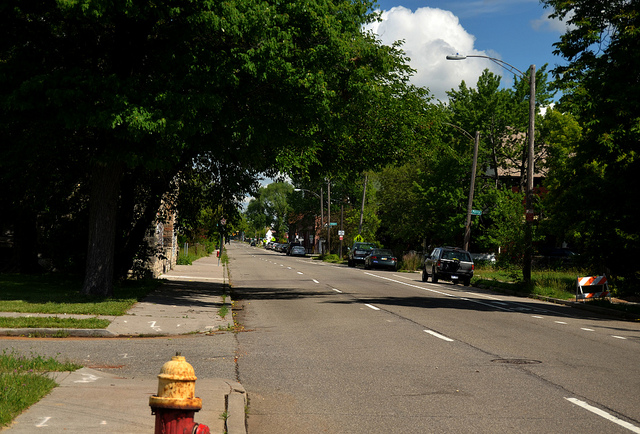
Photo of a street lined with trees in Detroit. Photo by Nic Redhead, Flickr CCi

Evidence shows that trees and green spaces in urban areas offer a number of benefits, such as reducing stress and improving air quality. Despite these benefits, many residents of Detroit refused to allow the city to plant trees in front of their houses during a recent city “greening” initiative. An article appearing in CityLab draws from sociological research to demonstrate how a history of government abuses and lack of inclusivity of communities of color in key decisions explains why many Detroiters had this reaction.

Sociologist Dorceta Taylor published a report in 2014, arguing that white environmentalists make environmental justice projects less effective when they assume they know what is good for a neighborhood. By leaving communities of color out of the planning process, they are not able to anticipate or overcome challenges along the way. This proved true in Detroit. A recent article by Christine Carmichael and Maureen McDonough examined the reasons why Black residents resisted the city’s trees. CityLab reports: “It’s not that they didn’t trust the trees; they didn’t trust the city.”

Carmichael and McDonough found that Black residents were aware of the many benefits of living near trees. However, to some, the trees were a symbol of the city’s unwanted intervention in their lives. Amidst racial tension in the 1960s, the city began clearing trees from Black neighborhoods — ostensibly to combat Dutch elm disease, but some interviewees. Yet, some people believed the city cut down trees to increase police surveillance. This memory triggered their reaction to the modern tree-planting. Carmichael says:

“In this case, the women felt that [after the race rebellion] the city just came in and cut down their trees, and now they want to just come in planting trees. … But they felt they should have a choice in this since they’ll be the ones caring for the trees and raking up the leaves when the planters leave. They felt that the decisions regarding whether to cut down trees or plant new ones were being made by someone else, and they were going to have to deal with the consequences.”

This failed initiative in Detroit highlights the social forces that environmental organizations must consider when working in marginalized neighborhoods. Recruiting volunteers and administrators who come from the communities they are serving (something Detroit did not do) could help improve the process. As CityLab reports:

“[E]nvironmental justice is not just about the distribution of bad stuff, like pollution, or good stuff, like forestry projects across disadvantaged communities. It’s also about the distribution of power among communities that have historically only been the subjects and experiments of power structures.”

Photo of the wall in Nogales that divides Mexico and the United States. Photo by Jonathan McIntosh, Flickr CC

Current pressure for a wall on the United States’ southern border has been a centerpiece in politics and the media, but push for a wall is one recent development in a complex history of border politics. For centuries, the border has been a site for war, conflict, immigration, and trade. A recent article in The Washington Post highlights how these historic events have contributed to defining what the border means today, and how — especially in recent decades — this has led to calls for heightened security and enforcement.

The border itself is a powerful political symbol. According to sociologist Douglas Massey, it is not just

a border but the border, and its enforcement has become a central means by which politicians signal their concern for citizens’ safety and security in a hostile world.”

Recent work by Massey highlights how throughout history this “hostile” world has been defined and composed of dissident actors — drug traffickers, terrorists, communists, or criminals — with politicians using them as political chips to peddle and spin different narratives on how and why we should protect the border.  

This research demonstrates that whether the southern border is an invisible line, physical fence, or wall, it continues to be a symbolic boundary for people who hold a profound fear of those who are non-white or of different cultural backgrounds. For example, recent political positions towards Central American migration to the United States seem to echo historic anti-immigrant attitudes. During the late 19th century, Chinese laborers were banned for decades from immigrating to the U.S. for their perceived cultural and economic threat to American society.

As debates continue over the construction of a southern wall, it is worthwhile to question if anti-immigrant attitudes and fears are haunting reverberations of the past. Recognition of the complex history of the U.S.-Mexico border and its connection to fear of crime and xenophobic attitudes may be a useful starting point so that today’s politics do not become “another brick in the wall” in the history of the border.

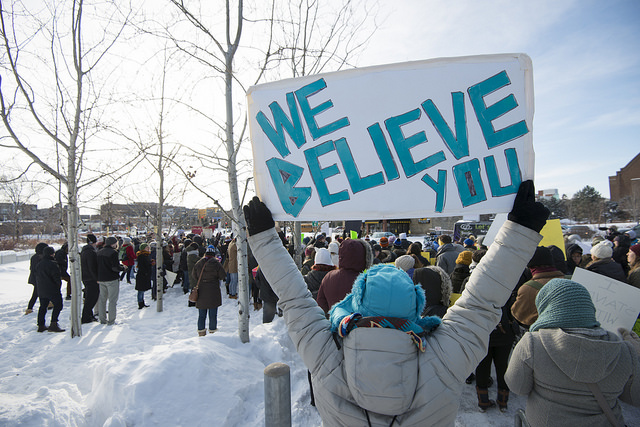
A marcher holding a sign that says, “we believe you.” Photo by Fibonacci Blue, Flickr CC

Since Surviving R. Kelly aired on Lifetime, we’ve seen a rise of activists led by Black women calling for the #MuteRKelly campaign, which dissuades music labels, radio stations, and other music platforms from selling, distributing, and promoting R. Kelly’s music. But despite the recent backlash, fans across the country continue to show their support for the R&B star. While some attempt to separate their feelings about the art from the artist, others dismiss Black women’s claims of R. Kelly’s abusive behaviors altogether. Much of this support comes from other Black R. Kelly fans. The documentary and the subsequent controversy also shed important light on an issue that is often missing from the public sphere: the plight of Black women and girls who experience sexual violence. Saida Grundy’s recent piece in The Atlantic helps us break down how Black support for R. Kelly remains despite the shocking revelations from Black women.

Rape myths have long obscured sexual victimization by suggesting that “real rape” occurs by strangers in a dark alley, women who dress “proactively” and show signs of intoxication “ask for it,” and men are not responsible for assault because they are unable to control their sexual impulses. According to Grundy, Black survivors and victims encounter a distinct set of racialized rape myths both from the broader public and from members of their own racial/ethnic community.

“With racialized rape myths, people compound untrue narratives about sexual assault with their own self-interests. For example, some African Americans might think defending Kelly is a way to push back against the history of false rape allegations from white women against black men — allegations that functioned as assaults on black communities, as they were commonly used by whites to justify the lynching of African American men during the Jim Crow era.”

Grundy echoes work by Black feminist scholars, such as Beth Richie, who argue that Black women and girls experience a “trap of loyalty,” where they are expected to resist racism against Black men by excusing or altogether denying abusive behaviors, even at the risk of concealing and enduring their own abuse. Furthermore, recent reports illustrate how Black girls are viewed as more adult and consequently less innocent than white girls. These myths surrounding innocence create interlocking gendered and racialized messages about Black girls’ and women’s sexuality that suggest they are “fast,” hypersexual, and deserving of men’s and boys’ unwanted advances towards them. In the age of #MeToo, disrupting racialized rape myths and the broader rape culture allows us to understand the race- and gender-specific mechanisms that damage Black girls’ and women’s credibility and impede disclosure and reporting on their experiences with sexual violence.

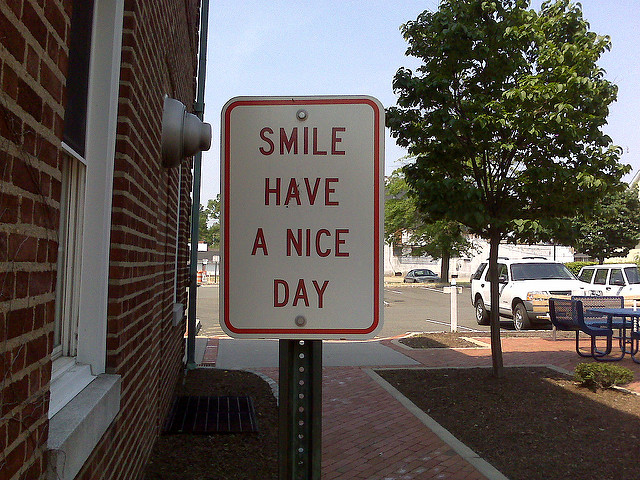
Photo of a sign that says, “smile have a nice day.” Photo by larryc, Flickr CC

As we celebrated Dr. Martin Luther King Jr. last week, it is clear how much of an impact his life and legacy has had on American society. But in many respects, we have failed to achieve much of King’s hope for a more racially equitable and just society. Examples of overt racism are plentiful (e.g.,the recent viral video of white high school students mocking Native American activist Nathan Phillips) and — rightly — garner much attention. However, in a recent op-ed for The Guardian, Robin DiAngelo reminds us that focusing primarily on these overt cases of racism reinforces a common myth among white Americans that racism includes only “isolated and individual acts of intentional meanness.” DiAngelo, a sociologist and a racial equity consultant, points out that niceness is is central to this myth.

When people understand racism only as an individual action, it hides how structural racism operates in our current institutions and society. DiAngelo expands further,

“This definition is convenient and comforting, in that it exempts so many white people from the system of white supremacy we live in and are shaped by. It is at the root of the most common kind of white defensiveness. If racists are intentionally and openly mean, then it follows that nice people cannot be racist.”

For many whites, highlighting their niceness and proximity to people of color is how they distance themselves from racism. For example, a white person will often be quick to point to how many friends of color they have, how they live or work in a diverse environment, or they might even use defensive strategies to deny claims of racism like “but he/she is a nice person.” DiAngelo argues that this “cursory friendliness” does nothing to address racial inequality and the racially segregated lives that white people often lead:

“The racial kinship white people attempt to draw from niceness might be seen as a false or fabricated affinity. Most white people live segregated lives and in fact have no lasting cross-racial relationships. We are in the position to choose segregation and often do. The claims of non-racism that we make are therefore based on the most superficial of shared experiences: passing people of color on the street of large cities and going to lunch on occasion with a co-worker.”

DiAngelo concludes by urging white Americans to move beyond niceness to combat racism and racial inequality. White people must not only acknowledge their white privilege, but also make concerted efforts to

“put what [they] profess to value into the actual practice of our lives. This takes courage, and niceness without strategic and intentional anti-racist action is not courageous.”

Photo of parents cheering on the sidelines by MSC U15 Green, Flickr CC

After the holidays, many parents breathe a collective sigh of relief. The holidays and their many challenges — travel, presents, and time with extended family — are so stressful that they make people wonder whether raising children has always been this hard. A recent The New York Times piece by Claire Cain Miller confirms that parenting has indeed gotten more time-consuming and expensive. Miller draws upon an arsenal of sociological research to illustrate how and why parenting has become so relentless.

Much of the pressure parents feel stems from wanting to pass on advantages to their children — especially since American children today are less likely to be as affluent as their parents. According to Phillip Cohen,

“As the gap between rich and poor increases, the cost of screwing up increases. The fear is they’ll end up on the other side of the divide.”

As a result, parents use “intensive parenting,” a child-rearing style that demands a great deal of their own time and resources. Sharon Haysdescribes intensive parenting as “child-centered, expert-guided, emotionally absorbing, labor intensive and financially expensive.” And according to Jennifer Glass, intensive parenting is rooted in the American view of child rearing as an individual — not societal — task, though it has begun to gain popularity in England and Australia.

But not all parents engage in these efforts equally, nor are they expected to. Jessica Calarco explains that intensive parenting allows affluent white mothers to ensure their children remain advantaged in society. Middle-class black mothers also use intensive parenting strategies, but for different reasons. According to Dawn Dow,

“They’re making decisions to protect their kids from early experiences of racism. It’s a different host of concerns that are equally intensive.” 

The demands of intensive parenting affect mothers’ lives far more than fathers. Liana Sayer’s research on American time use diaries shows that the time women spend parenting cuts into their sleep, time alone with their partners and friends, leisure time and housework. Moreover, while fathers today have increased the amount of time they spend with their children, mothers still spend significantly more.

So, drawing on research by over a dozen sociologists, Miller shows us that we are not wrong to find intensive parenting problematic. Not only does this parenting style disproportionately burden lower income families — and mothers in particular — but we’re not even sure it is effective in passing advantages on to the next generation. By stressing the importance of individualistic approaches to parenting, we fail to seek structural solutions that could ease the burdens of working mothers. In the words of sociologist Caitlyn Collins, intensive parenting “distracts from the real questions, like why don’t we have a safe place for all kids to go when they’re done with school before parents get home from work?”

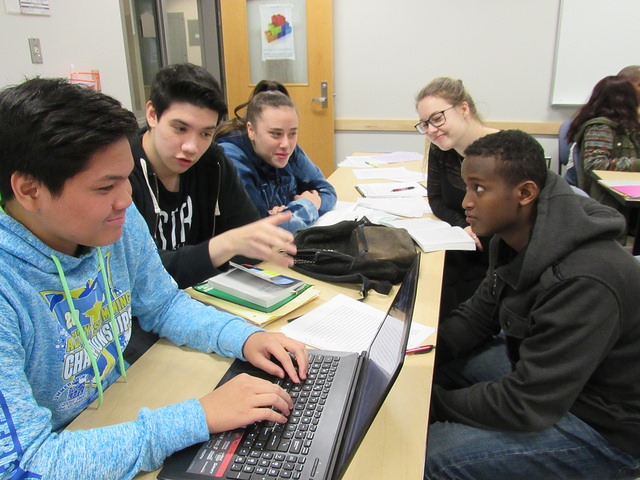
Photo of five students of different races sitting around a laptop. Photo by liz falconer, Flickr CC

The incoming congressional class will be the most diverse in history, including a record number of women of color. Although change is slow in the political realm, the changing face of Congress may reflect the changing face of the United States. The U.S. Census has long predicted that non-Hispanic whites will become a numerical minority, making up less than half of the U.S. population in the not-too-distant future. Recently The New York Times interviewed social scientists to get their reactions to this national “majority-minority” conversation. 

Social psychologists Maureen Craig and Jennifer Richeson recognized that these projections — that whites will no longer make up the majority — spark fear in many white Americans. Consistent with what researchers already know, that groups feel more threatened as their size declines, Craig and Richeson found that white Americans who read about the projections indicated more negativity toward racial minorities.

From his own experience presenting these census projections to others, demographer Dowell Myers observed that progressives were uninterested in finding ways to alleviate fears about this demographic shift. Instead, political progressives heralded these projections as a sign of “demographic destiny” that would inevitably sweep them into power.

Sociologists like Richard Alba question whether the Census is even using the right categories when they project a majority-minority country. Race is particularly difficult to project, considering the definition of race changes over time because it is always situated in a particular context and set of social relations. This leaves researchers with many questions, including whether the Census Bureau should continue to identify mixed-race individuals with both white and other racial backgrounds as non-white, as well as whether whiteness will shift to include current non-white groups. As sociologist Mary Waters concludes,

“The question really for us as a society is there are all these people who look white, act white, marry white and live white, so what does white even mean anymore?…We are in a really interesting time, an indeterminate time, when we are not policing the boundary very strongly.”

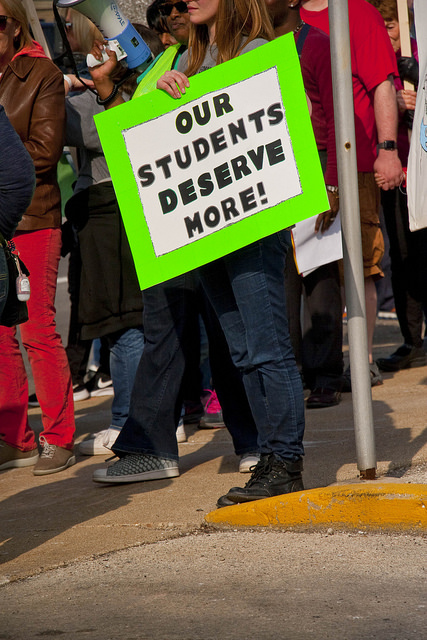
Photo of a protest sign that reads, “our students deserve more.” Photo by Charles Edward Miller, Flickr CC

In 2013, the abrupt closing of fifty Chicago public schools largely impacted people of color in West and South Side neighborhoods. Reasons for closures included under-enrollment and poor performance, but according to Chicago-based sociologist Eve Ewing, there is more to the story. In a recent interview with Morning Shift radio, Ewing describes systemic issues that contributed to under-enrollment, like the demolition of 22,000 public housing units across the city as part of the Chicago Housing Authority’s “Plan for Transformation.”

Subsequent school closings have disproportionality harmed students of color, and while these policies may not be intentionally racist, Ewing argues they reflect persistent structural racism in Chicago. For example, the school closings risk students’ safety, as many are now forced to trek through areas with perilous gang activity to reach their new schools. The emotional impact of school closings can also be devastating, comparable to family separations. Ewing observed close familial relationships between black students and their teachers and classmates, and thus the resulting separation can feel like losing a family member. And for “legacy” students, whose families have attended the same school for generations, the devastation is felt by entire families. To emphasize the severity of these school closings, Ewing makes a powerful connection between historical racism and policies today:

“A principal who was speaking at a school closure meeting, a black woman, stood up and said, ‘I feel like I’m at a slave auction right now.’… And I think that obviously there are many important distinctions between this kind of separation and chattel slavery, but I do think it’s important to think about, for black children, what it means to take them away from situations of stability, where they have deep, meaningful bonds with the adults and the other children in their lives.”

Photo by NCDOTcommunications, Flickr CC

Intersectionality is a term frequently used in many different contexts, from social movements to academic research to everyday speech. A recent article in The New York Times explores how intersectionality — defined as “the complex and cumulative way different forms of discrimination like racism, sexism and classism overlap and affect people” — influences men and women of color in the workplace.

The article draws from a recent non-profit study surveying 1,600 participants in workplaces ranging from corporations to higher education. Most respondents said they were “highly on guard at work,” which often meant they actively repressed traits others might perceive as frightening or intimidating. For example, they arrived early to meetings so they would be seated when others arrived in order to appear less threatening.

While the majority of workers in the study reported this need to be “on guard” to protect themselves against racial and gender bias, the types of stereotypes various groups face are not the same. For example, African-American women tend to face the stereotype of “the angry black woman,” while Latinas face stereotypes about being “too emotional or too wedded to their families.” Sociologist Yung-Yi Diana Pan notes that Asian-Americans are sometimes identified as “being workhorses without creativity” and “passive and acquiescent,” and this may lead to fewer promotions according to a recent report by the Ascend Foundation. 

Part of the problem, according to sociologist Lata Murti, is that women of color are constantly compared to professional white women — the “invisible norm.” So, what is the solution? Latasha Woods, brand manager at Proctor & Gamble argue it starts with leadership:

“We need leadership that truly cares about inclusion — a lot care about diversity, but how do you foster inclusion? People spend a lot of time on what they know the boss cares about. If they see the boss cares about inclusion they will too.”