

New York Times

Alice Wong–writer, disability rights advocate, and 2024 MacArthur Genius–recently passed away at the age of 51. Wong earned a master’s degree in medical sociology from UC-San Francisco in 2004 and is known for her prolific writing on her own experiences of discrimination growing up in Indiana with muscular dystrophy, life-long work amplifying the stories of others, and policy advocacy against laws that overlooked the needs of people with disabilities. In 2014, she founded the Disability Visibility Project, which collected hundreds of oral histories about the lives of disabled Americans. This story was covered by the New York Times, Teen Vogue, and LGBTQ Nation.

Alice Wong

Scott Schieman (Professor of Sociology at the University of Toronto) and Alexander Wilson (Sociology PhD Student at the University of Toronto) wrote an article for The Conversation on whether Canadian workers think AI will displace them. They found mixed opinions. Among Canadians who thought job loss was likely, they found concern over corporate greed and loss of dignity and respect for workers. Others felt more confident that the market would adapt and adjust roles to fit new technologies. “Understanding worker attitudes toward automation is a crucial part of studying AI’s broader impact on work and society,” Schieman and Wilson wrote. “If large segments of the workforce feel threatened or left behind by AI, we risk not just economic disruption but a loss of trust in institutions and technological progress.”

Scott Schieman and Alexander Wilson

Musa al-Gharbi (Assistant Professor at Stony Brook University) spoke at a Center for Expanding Viewpoints in Higher Education event at Tufts University on how liberal elites have gained “a lot more influence over society and culture, but the consequences of that are not what we might have hoped or have expected.” Al-Gharbi described that elites focus on “symbolic change more than substantive change” and that the ways they engage in political action can be off-putting: “During these periods of Awokening, we become much more militant about mocking, demonizing, and censoring people who disagree with us, even for views that we adopted five minutes ago,” he said. This story was covered by TuftsNow.


Musa al-Gharbi

Murat Haner (Assistant Professor  of Criminology & Criminal Justice at Arizona State University), Justin Pickett (Professor of Criminal Justice at the University at Albany), and Melissa Sloan (Professor of Sociology & Interdisciplinary Social Sciences, University of South Florida) wrote an article for The Conversation on U.S. political violence. In the 1970s, the bulk of political violence was aimed at property, now the targets are specific people. In a survey study, the authors found that belief in white nationalism was the strongest predictor for support of political violence and argued that “white nationalism poses substantial danger to U.S. political stability.”


Murat Haner, Justin Pickett & Melissa Sloan

Wisconsin Public Radio interviewed Allison Daminger (Assistant Professor of Sociology at the University of Wisconsin-Madison) about her new book, What’s on Her Mind: The Mental Workload of Family Life. The book examines how partners split “cognitive labor”, or, the mental effort that goes into running a household. This includes “anticipating issues, identifying options, making decisions and monitoring the results.” While most couples in the study aimed for a 50/50 split of household labor, Daminger found that cognitive labor was typically imbalanced. Among heterosexual couples, women tend to take on more cognitive labor.

Allison Daminger

Conservative activist Charlie Kirk was shot and killed at a speaking engagement at Utah Valley University. Ruth Braunstein (Associate Professor of Sociology at John Hopkins University) appeared on WUSA9 to discuss the broader pattern of political violence in the United States. Braunstein commented that political violence has a “tremendous chilling effect on people’s willingness to go into political life, to stand up and speak out for what they believe in.” She also discussed how distrust in political institutions may lead some individuals to violence, which can further erode trust in insituions–a “vicious cycle.” Braunstein also expressed concern to the New York Times that Kirk’s murder could mobilize right-wing groups (including militia organizations): “All it will take is the slightest hint from the political leaders, including the president, but also anyone else, that this is the moment that they’re needed.”

Ruth Braunstein

Laura Garbes (Assistant Professor of Sociology at the University of Minnesota) wrote an op-ed for the Minnesota Star Tribune discussing how ‘elitism’ in public media stems from a lack of public funding. “Due to decades of budget cuts led by Republican administrations, public radio has become reliant on a set of mostly white, affluent donors for its financial survival,” Garbes explains. Programming, then, is catered to donor-listeners, leaving behind working-class audiences.

Laura Garbes

Protests are sweeping across France as a part of the Block Everything Movement–a campaign driven by anger over major cuts to public spending. The movement began online among right-wing voices, but has since been embraced by the political left. Quentin Ravelli (Sociologist at the French National Centre for Scientific Research) discussed the movement’s lack of a clear political identity in an RFI article: “Many movements avoid being labelled left or right. This isn’t just strategic: participants often feel that consensus around economic demands matter more than political allegiance. Urgent issues like public services, wages or inflation are seen as priorities.” The movement is drawing comparisons to the 2018 Yellow Vest Movement. Antoine Bristelle (Sociologist at the Jean Jaures Foundation) commented on the demographic differences to The Gazette: “In the ‘Yellow Vest’ movement, we had a rather vulnerable France that was struggling to make ends meet, a lot of workers, a lot of retirees. Whereas here, in terms of age, it’s many young people [that have] a certain vision of the world where there is more social justice, less inequality and a political system that functions differently, better,” Bristielle said.

Quentin Ravelli

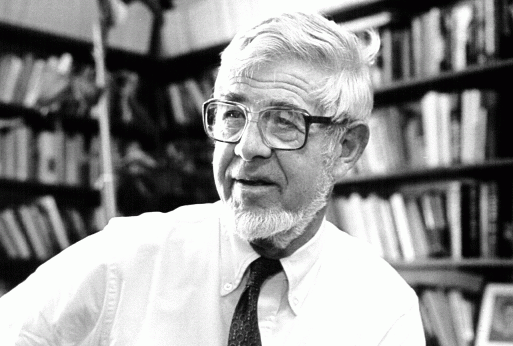
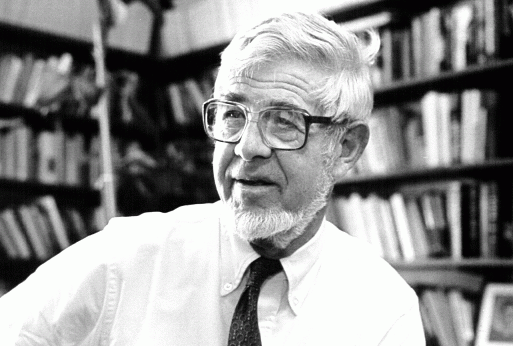
Renowned Sociologist Herbert J. Gans recently passed away at the age of 97. Gans was known for his sociological work on urban and suburban life, social policy, and the news media, including the influential books The Urban Villagers, The Levittowners, The War Against the Poor, and Deciding What’s News. Gans was also a liberal activist–opposing the VIetnam war and supporting freedom of the press–and a proponent for participant observation and publicly-accessible writing. This story was covered by the New York Times, the Washington Post, and ABC News.

Herbert J. Gans

In an interview with Ms. Magazine, Laurie Essig (Professor of Gender, Sexuality, and Feminist Studies at Middlebury College) drew parallels between the dissolving democracies in the U.S. and Russia. Essig noted how masculinity and concerns about gender play into authoritarianism: “[E]very dictator we look at, had anxiety about masculinity. That’s true for Mussolini and Stalin, as well as contemporary leaders. Today, they’ve created this monstrous figure, “gender,” to explain the failure of masculinity. For Donald Trump it’s “gender ideology,” this idea that we’re trying to corrupt the children.” In the podcast project, Feminism, Fascism, and the Future, Essig and colleagues explore these themes across multiple national case studies. Essig also advised that “[p]eople need to get together and create a parallel society in a way where we take care of one another, where we engage in protecting our communities.”

Laurie Essig

In her recent book, Sin Padres, Ni Papeles: Unaccompanied Migrant Youth Coming of Age in the United States, Stephanie L. Canizales (Assistant Professor of Sociology at the University of California- Berkeley) explores legal policies and cultural landscape that shape the lives of undocumented young people in California. She describes how these young people are often exploited in low-paying jobs and vilified for political gain. “If not leverageable for the sake of agenda-setting or even tone-setting to the public, the population is completely forgotten,” Canizales said. “And that really haunts me.” This story was covered by UC Berkeley News.

Stephanie L. Canizales

Craig Considine (Senior Lecturer in Sociology at Rice University) commented: “Pope Francis was the first South American pope in history, and this really shook up the church in a good way. During his papacy, the church became more representative of its actual members as Pope Francis made a sincere effort to reach out to Africa and to Asia and to Latin America, which are three of the epicenters of the Catholic Church.” This was covered by Rice University News and Media Relations.

Landon Schnabel (Associate Professor of Sociology at Cornell University) described how Pope Francis balanced tradition and social transformation: “Pope Francis’ leadership reveals how ancient institutions bend without breaking. His calculated reforms — allowing priests to bless same-sex couples while maintaining traditional marriage doctrine — create breathing room within doctrinal boundaries rather than dismantling them. […] Official doctrine and lived practice now stand in stark contrast. Roughly two-thirds of American Catholics support same-sex marriage despite the Vatican’s continued opposition. In many countries, Catholics regularly use birth control despite official teaching against it. The Church operates at two levels: what Rome proclaims and what the people practice.” This was covered by Cornell News.

Craig Considine and Landon Schnabel

Jessica Calarco (Professor of Sociology at the University of Wisconsin) was interviewed by Salon on the difficulties that progressives face when building political coalitions. While the right–unified by a rejection of governmental solutions–can often agree to block new government programs, the left faces the difficult task of agreeing on what government solutions to pursue. “One thing I always tell my students is that, at least from a sociological perspective, causes imply solutions. When we are looking to solve social problems, first we have to agree that a problem exists,” Calarco stated. “Next they have to agree on where the problem is coming from. Those different understandings point to different possible policy solutions.”

Jessica Calarco

The New York Times ran a story on Trump’s cuts to staff and funding in the Department of Education. Philip N. Cohen (Professor of Sociology at the University of Maryland) commented on how the data collected by the DOE is crucial for not only research on school performance, but also for research on the state of labor markets, the economy, and inequalities in America. “This is bedrock, base-line information for how our society is functioning,” Cohen stated. “It’s a common language — a shared reality we all have.”

Philip N. Cohen

Boom! Lawyered (a Rewire News Group podcast) interviewed David S. Cohen (Professor of Law at Drexel University) and Carole Joffe (Sociologist and Professor of Obstetrics and Gynecology at Advancing New Standards in Reproductive Health (ANSIRH), based at the University of California, San Francisco) about their new book After Dobbs: How the Supreme Court Ended Roe But Not Abortion. Cohen and Joffe discussed potential risks to abortion access and the importance of supporting abortion care advocates. “How come since Dobbs, when everybody expected disaster, the number of abortions actually has risen slightly? Not a lot, but it has risen,” Joffe said. “One big answer to that question is […] the phenomenal networks of people helping people get to abortions. The other answer to that question is the huge influx of money that happened right after Dobbs. The expression often used is rage spending. People were so angry about Dobbs they just gave a ton of money to local funds, to the National Abortion Federation, to Planned Parenthood, to a local clinic.”

David S. Cohen and Carole Joffe

Michael Elliot (Professor of Sociology at Towson University) wrote an article for The Conversation on the sacred nature of Comic-Con for dedicated fans. Elliot describes how, beyond entertainment and escapism, comic-con culture provides fans with a “source of principles” to guide behavior, community and fellowship, and sanctuary (Comic-con “provides space for fans to be themselves, helps them cope with personal struggles, and inspires hope.”).

Michael Elliot

Zeynep Tufekci (Professor of Sociology and Public Affairs at Princeton) wrote an opinion piece for the New York Times on the Trump administration’s slashing of research funding from the National Institutes of Health (NIH). Tufecki highlights that NIH “grants are a crucial reason that America has the most advanced biomedical research infrastructure” and that this decision endangers Americans’ health. “It was nice having the world’s most important, most vital medical research infrastructure,” Tufecki writes. “But enough. To the wood chipper!”

Zeynep Tufekci

Elizabeth Bruch (Associate Professor of Sociology at the University of Michigan) and Amie Gordon (Assistant Professor of Psychology at the University of Michigan) have teamed up to design Revel, a dating app for students at the University of Michigan that doubles as a research tool. While modern dating apps collect a “treasure trove” of relevant data, this data is often inaccessible for researchers or users. Using Revel, Bruch and Gordon aim to examine how people “find opportunities, pick strategies, and learn from mistakes” and why couples choose to stay together or break up. This story was covered by The Pulse.

Elizabeth Bruch and Amie Gordon

The Hong Kong Free Press ran a story on Ruby Lai’s (Assistant Professor of Sociology at Lingnan University) research on Hong Kong’s subdivided flats–living units of approximately 119 sqft. that house over 200,000 people in Hong Kong. “There is an assumption that only the poor live in subdivided flats, but housing precarity and unaffordable housing are problems faced by most people,” Lai said, emphasizing the diversity of residents. Lai also examines how individuals and families transform these constrained spaces into “resilient, functional and liveable abodes.”

Ruby Lai

The New York Times ran a story on how companies are navigating legal risks in response to the Trump administration’s attacks on D.E.I. efforts. Companies simultaneously want to avoid discrimination lawsuits, “Trump’s ire, federal investigations and lawsuits from anti-D.E.I. conservatives.” Musa Al-Gharbi’s (Assistant Professor in the School of Communication and Journalism at Stony Brook University) commented: “D.E.I. programming grew popular because it was responding to real challenges organizations were facing. Basically they’re being told to do nothing about these problems.”

Musa Al-Gharbi

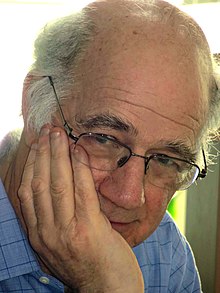
Remembering Michael Burawoy: Last week, renowned British scholar Michael Burawoy passed away at age 77 after he was struck by a hit-and-run driver. Sociologists and others continue to reflect on his legacy in Berkeley Sociology, Verso Books, The Wire, and The Daily Californian.

Michael Burawoy

  • Tressie McMillan Cottom (Associate Professor at the University of North Carolina’s School of Information and Library Science) wrote an opinion piece for The New York Times in the aftermath of the presidential election. “[T]his election was about enthusiasm and diagnoses. The long-term trajectory of our country has not changed. Millions of middle-class people feel working-class. These Americans have no way to describe what is happening to them,” Cottom described. “Nature abhors a vacuum. But political opportunists thrive in vacuums. This election was about who told a better story about the fundamentals without promising anything to fix those fundamentals. That is the sweet spot for an opportunist like Trump and his party. Sell everything, promise nothing. Keep them coming back for more.”
  • Julia Sonnevend (Associate Professor of Sociology and Communications at the New School for Social Research) was interviewed by Public Seminar about her new book Charm: How Magnetic Personalities Shape Global Politics. Sonnevend discussed how political charm is evaluated by (often fragmented) audiences and how the charm of a political leader affects views of their country: “We simply pay more attention to personalities than to institutions, values, or even facts. If you think about the international context, we are often talking about countries Americans know very little about. And when there is a relatable political character, or a character who we really dislike, it is easier to put the country in a box.”
  • Eric Klinenberg (Professor of Social Science at New York University) wrote an opinion piece in the New York Times arguing that there is an “urgent need to make dangerous heat more recognizable.” Klinenberg discusses how, despite the fact that deaths due to heat waves typically outnumber deaths from hurricanes, tornadoes, and floods combined, Americans are “quick to forget” heat waves. Klinenberg argues that major heat waves should be named (like major storms are named, e.g. “Hurricane Katrina” or “Superstorm Sandy”) to help us “recognize it as an enemy and mobilize support for public projects” to avoid future climate disasters.
  • Pesquisa ran an article on homelessness in Brazil, which has grown about 211% from 2012 to 2022. Research from the Institute of Applied Economic Research (IPEA) indicates that the primary reasons for homelessness are financial hardship, broken family ties, and health issues (particularly related to addiction). Marco Antônio Carvalho Natalino (Sociologist at the Institute of Applied Economic Research) explains that “the reason for homelessness influences its duration,” and homelessness due to family or health issues tends to last longer. Fraya Frehse (Professor of Sociology at the University of São Paulo) commented that the spread of homelessness is a global reality.
  • Ahead of the U.S. presidential debate, Tressie McMillan Cottom (Associate Professor at the University of North Carolina’s School of Information and Library Science) joined four other New York Times columnists in an online discussion on the candidates and their potential pathways to winning the election. McMillan Cottom noted that “Trump is a known entity. He does not have to “win” the debate…he has to win the media cycle. His biggest risk is being ineffectual at commanding attention.” For Harris, the “best path to winning is through historic turnout and enthusiasm.” McMillan Cottom emphasized the importance of selling a compelling story to scared, angry voters: “The big story of Trump’s win in 2016 was that voters were angry and experts missed it. … The story in this election is that voters are still angry and we may still be missing it. I spent time talking to female voters in nail salons, hair salons and waxing salons. … The women I talked to in those female spaces are angry and afraid. As one low-information voter told me, she wants someone to look like a fighter.”
  • David Karen (Professor of Sociology at Bryn Mawr) is featured in the recently released film Love 2020. The film is about the 2020 US Open–the first major international event held during the COVID-19 pandemic. Karen commented that it “was a delight to talk with Jacqueline Joseph, the director of the film, about so many things that I’m passionate about: tennis, New York City, the role of sports in our lives, and movements for social justice.” This story was covered by Bryn Mawr News

And Some Bonus Clippings:

  • Arlie Russell Hochschild’s new book, Stolen Pride: Loss, Shame, and the Rise of the Right, was covered by WBUR and the Boston Globe.
  • Sherry Turkle’s interview for Body Electric discussing the effects of AI chatbots on relationships was re-publicized on NPR last week.

Photo by Dan Vitoriano via flickr.com

According to well-worn stereotypes, boys who have sex are “players” or “studs,” while girls who have sex get stuck with nastier labels. But in a recent New York Times editorial, sociologist Amy T. Schalet argues that boys in the U.S. seem to care much more about romance—and avoiding pregnancy and disease—than they did 20 years ago.

Rates for 15-to-17-year-olds who report having sex have dropped since the 1980s, according to the Centers for Disease Control. “And there are virtually no gender differences in the timing of sexual initiation,” Schalet writes.

She offers a few rationales for the change, based on survey data and her own research:

Fear seems to have played a role. In interviewing 10th graders for my book on teenage sexuality in the United States and the Netherlands, I found that American boys often said sex could end their life as they knew it. After a condom broke, one worried: “I could be screwed for the rest of my life.” Another boy said he did not want to have sex yet for fear of becoming a father before his time.

In fact, Schalet writes, boys seems to be more preoccupied with negative outcomes than girls. She suggests these fears grow out of sex education and an awareness of AIDS, while the drive to have sex with another person might be, in part, quelled by access to Internet pornography.

Schalet suggests there could also be a positive reason American boys are hurrying less to have sex. It might be “because they have gained cultural leeway to choose a first time that feels emotionally right. If so, their liberation from rigid masculinity norms should be seen as a victory for the very feminist movement that Rush Limbaugh recently decried.”

Small World
Photo by Steve Ransom via flickr.com

It seems a no-brainer that the internet, social media, and cellphones have made homesickness for migrants a thing of the past. But as historian Susan J. Matt reveals in a recent New York Times op-ed, previous generations have found technology no substitute for home sweet home, and today’s immigrants are no different.

More than a century ago, the technology of the day was seen as the solution to the problem. In 1898, American commentators claimed that serious cases of homesickness had “grown less common in these days of quick communication, of rapid transmission of news and of a widespread knowledge of geography.”

But such pronouncements were overly optimistic, for homesickness continued to plague many who migrated.

Today’s technologies have also failed to defeat homesickness even though studies by the Carnegie Corporation of New York show that immigrants are in closer touch with their families than before. In 2002, only 28 percent of immigrants called home at least once a week; in 2009, 66 percent did. Yet this level of contact is not enough to conquer the melancholy that frequently accompanies migration. A 2011 study published in the Archives of General Psychiatry found that Mexican immigrants in the United States had rates of depression and anxiety 40 percent higher than nonmigrant relatives remaining in Mexico. A wealth of studies have documented that other newcomers to America also suffer from high rates of depression and “acculturative stress.”

Then why does the idea that technology can overcome homesickness persist? Matt cites a pervasive belief about mobility that many hold despite its disappointments.

The global desire to leave home arises from poverty and necessity, but it also grows out of a conviction that such mobility is possible. People who embrace this cosmopolitan outlook assume that individuals can and should be at home anywhere in the world, that they need not be tied to any particular place. This outlook was once a strange and threatening product of the Enlightenment but is now accepted as central to a globalized economy.

Technology plays a role in supporting this outlook.

 The comforting illusion of connection offered by technology makes moving seem less consequential, since one is always just a mouse click or a phone call away.

Further, Matt argues that this illusion of connection may amplify homesickness rather than cure it.

The immediacy that phone calls and the Internet provide means that those away from home can know exactly what they are missing and when it is happening. They give the illusion that one can be in two places at once but also highlight the impossibility of that proposition.

The persistence of homesickness points to the limitations of the cosmopolitan philosophy that undergirds so much of our market and society. The idea that we can and should feel at home anyplace on the globe is based on a worldview that celebrates the solitary, mobile individual and envisions men and women as easily separated from family, from home and from the past. But this vision doesn’t square with our emotions, for our ties to home, although often underestimated, are strong and enduring.


The state of affairs
Photo by Satish Krishnamurthy, satishk.tumblr.com

The U.S. social safety net continues to grab headlines, this week in the New York Times. We’ve noted before the play programs like food stamps are getting in the current presidential campaign. The NY Times article notes that, paradoxically, “Some of the fiercest advocates for spending cuts have drawn public benefits.” Why might this be?

An aging population and a recent, deep recession seem to be at the crux of the issue.

The problem by now is familiar to most. Politicians have expanded the safety net without a commensurate increase in revenues, a primary reason for the government’s annual deficits and mushrooming debt. In 2000, federal and state governments spent about 37 cents on the safety net from every dollar they collected in revenue, according to a New York Times analysis. A decade later, after one Medicare expansion, two recessions and three rounds of tax cuts, spending on the safety net consumed nearly 66 cents of every dollar of revenue.

The recent recession increased dependence on government, and stronger economic growth would reduce demand for programs like unemployment benefits. But the long-term trend is clear. Over the next 25 years, as the population ages and medical costs climb, the budget office projects that benefits programs will grow faster than any other part of government, driving the federal debt to dangerous heights.

As a result, many Americans have benefited from government safety net programs.

Almost half of all Americans lived in households that received government benefits in 2010, according to the Census Bureau. The share climbed from 37.7 percent in 1998 to 44.5 percent in 2006, before the recession, to 48.5 percent in 2010.

Yet many do not realize that it is no longer just programs for the “undeserving poor” that dominate the scene. Rather, it’s programs such as an expanded Earned Income Tax Credit and increasing Medicare costs that have stretched safety net resources.

Medicare’s starring role in the nation’s financial problems is not well understood. Only 22 percent of respondents to the New York Times poll correctly identified Medicare as the fastest-growing benefits program. A greater number of respondents, 27 percent, chose programs for the poor.

Why the misperception? Perhaps it’s because, as political scientist Suzanne Mettler explains in her book, The Submerged State: How Invisible Government Policies Undermine American Democracy, policies in recent decades have turned from more obvious provision of cash benefits to methods such as tax breaks, incentives, and other “hidden” forms of support. As a result, most citizens  have no idea that they rely on the safety net at all.

No doubt politicians, commentators, and scholars will all continue to debate the form and function of the safety net. But everyday Americans aren’t at all sure what’s best to do.

Americans are divided about the way forward. Seventy percent of respondents to a recent New York Times poll said the government should raise taxes. Fifty-six percent supported cuts in Medicare and Social Security. Forty-four percent favored both.

As one Minnesotan profiled in the NY Times story put it, “I’m glad I’m not a politician…We’re all going to complain no matter what they do. Nobody wants to put a noose around their own neck.”