environment

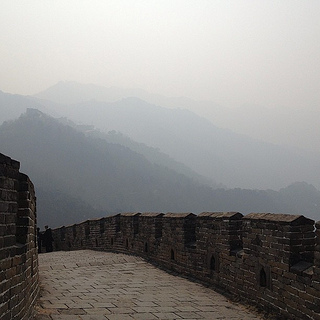
Pollution at the Great Wall of China. Photo by Thomas Galvez via flickr.com.
Smog hangs over the Great Wall in China. Photo by Thomas Galvez via flickr.com.

China is suffering an environmental crisis, and it’s become a health hazard. Using social media, young activists are now disseminating shocking photos and information. Through their lenses, we see Beijing’s air, thick with smog, and rivers lined with hundreds of rotting animal carcasses. For Chinese and world citizens, it seems clear these environmental problems can’t be ignored, and protests have sprung up across China, especially on its Eastern seaboard. In an interview in Dissent Magazine, Jeffery Wasserstrom asks Duke anthropologist Ralph Litzinger to discuss China’s new environmental movement.

One of Litzinger’s most interesting research findings is that there is a major class discrepancy in reacting to the environmental issues:

Much of the publicity about deteriorating air conditions came from a new kind of middle-class activist citizen who took to the streets to monitor the air, posting findings and images on weibo (the Chinese version of Twitter) and other social networking platforms. […]But head out into the outer rings roads of Beijing, where the poorest of Beijing’s migrants and residents live and work, and you experience a very different situation. You see fewer people wearing masks, and hear much less complaining about the air. It is not that migrant and urban fringe communities in Beijing don’t care about health and environmental issues; it is just that they haven’t received the same kind of attention that the middle-class urban resident has received.

In China, the middle and upper classes are able to assess their environmental situation and adapt. They may shop for organic foods, build protection from the poisonous air, stay home from work or school on bad air days, or even leave the country. The poor are merely left to brave their new, toxic environment—at least until their richer countrymen make major changes.
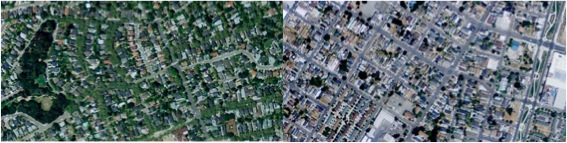
According to a recent article on treehugger.com, you can spot income inequality from space. Yes, you read that correctly. If you look at the pictures below, you should be able to spot a clear difference between the two neighborhoods.

Piedmont and Oakland, CA (Courtesy Per Square Mile, Public Domain Photos)

Pictures can say a thousand words, but these can be summed up pretty quickly.  Put simply, more affluent communities can afford more space for trees. They also place more value on growing and maintaining them.

In fact, according to Tim DeChant, Ph.D. in Environmental Science, Policy, and Management and creator of Per Square Mile,

for every 1 percent increase in per capita income, demand for forest cover increased by 1.76 percent. But when income dropped by the same amount, demand decreased by 1.26 percent… The researchers reason that wealthier cities can afford more trees, both on private and public property. The well-to-do can afford larger lots, which in turn can support more trees. On the public side, cities with larger tax bases can afford to plant and maintain more trees.

These trees also reinforce inequalities by providing shade, improving the air quality, and even improving the mental health of those around. As the article notes, “[I]t all makes a pretty powerful argument in favor of tree-planting initiatives in lower income neighborhoods.”

HBO Weight of the Nation Image
The promotional image for HBO's documentary series "The Weight of the Nation."

While it’s still hotly debated whether obesity is, in fact, a health crisis, in today’s New York Times, one-time food critic Frank Bruni considers recent obesity research in evolutionary science, medicine, public health, and beyond, concluding that it will require society-level change if we are to stem “a near inevitable tide.” (See also his blog post from today, “The Girth of the Globe,” which discusses Bruni’s perceptions of American dietary habits in a larger context.) The Centers for Disease Control, Bruni writes, now considers about two-thirds of Americans overweight or obese, but “Our current circumstances and our current circumferences may in fact be a toxically perfect fit.”

This is to say, learning to perfect agriculture in abundance has created “plump savings accounts of excess energy” in both our grain silos and our love handles “for an imagined future shortage that, in America today, doesn’t come.” Bruni interviews John Hoffman, an executive producer on HBO’s forthcoming documentary series “The Weight of the Nation,” who tells him that “We’ve only known a world of plenty for maybe 100 years. Our biological systems haven’t adapted to it.” And quoting from Michael L. Power and Jay Schulkin’s book The Evolution of Obesity, Bruni adds, “We evolved on the savannahs of Africa. We now live in Candyland.”

Bruni goes on in his op-ed to consider how one problem in fighting obesity is that we must eat:

“When it comes to smoking or drinking, people generally have to go cold turkey,” notes David Altshuler, an endocrinologist and geneticist, in the documentary. “But fundamentally, we have to eat.” Every meal is a… feat of calibration. “We underestimate how hard it is to change your behavior not once—not for a week or a month until you’re cured—but to change it every day for the rest of your life,” says Altshuler.

In conclusion, Bruni writes we must understand this paradox, cease to vilify the obese, and “rethink and remake our environment much more thoroughly than we seem poised to do.” This may, perhaps, be true well beyond Americans’ own equators.

Photo "Climate Change Refugees" by Tavis Ford via flickr.com

Scientists often assert that climate change is a matter of  empirical evidence, not belief.  But, The Guardian’s Adam Corner notes that decades of social scientific research says that skepticism about climate change is primarily due to beliefs, not a misunderstanding of the science (though there’s certainly misunderstanding as well).

 …..in studies that have asked who is sceptical about climate change and why, we find not a story about scientific ignorance, but a link between social attitudes, cultural beliefs and climate change scepticism. The evidence is starkest in the US , but similar patterns are found elsewhere too: older, white, conservative men tend to be more sceptical about climate change.

Corner is also a research associate at Cardiff University, and in a paper he recently published with several colleagues, he asked what would happen when two groups of people—one group comprised of people who were skeptical about climate change and the other group comprised of people who were not—read the exact same information about climate change in newspaper editorials.  Overall, they found that the two groups of people evaluated the information differently, attributing different judgements about persuasiveness and reliability of the information.

In social psychology, this phenomenon – “biased assimilation” – is well known, and no one is immune from it, so both sceptics and non-sceptics rated the editorials in line with their existing beliefs. The critical difference, of course, is that those who were not climate sceptics had the weight of empirical evidence on their side.  What this experiment illustrates, though, is that “belief” in climate change is very much what matters. Without belief in climate change, scientific evidence simply bounces off. And it is social views and cultural beliefs that predict climate change denial, not people’s level of knowledge about climate science.

Does this mean that people fighting global warming should give up?  Corner says “absolutely not,” though he asserts that we cannot look only to environmental science to provide an answer to a problem that is also social in nature.


True/Slant recently parodied how reporting on the oil spill might look quite different “if sociologists wrote the news instead”:

Absent from the dialogue surrounding the Deepwater Horizon oil spill, which began on April 20, 2010 following an explosion that killed eleven workers, are the roles of class, race and especially gender. Due to the environmental devastation wrought by the catastrophe, which is likely to fall heaviest on the working poor, it is understandable that attention is largely focused on efforts to plug the oil well undertaken by British Petroleum, a corporation founded in imperial Britain to exploit the oil resources of people of color.

Read the rest.

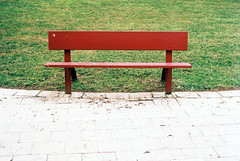
F1000011What could decorative rocks and park benches have to do with sociology? The San Francisco Chronicle suggests one possibility:

For Jeffrey Miller, landscape architecture is more than just plants, waterfalls and decorative rocks. For Miller, the founder of San Francisco’s Miller Company Landscape Architects, it’s about uniting living spaces and bringing people together.

“My impetus to be a landscape architect came out of a question – how to design social and public space so that there were better relationships between people,” he said. “It wasn’t a nature-based beginning, it came from more of a sociological perspective.”

Since forming Miller Company in 1980, the former sociology student and filmmaker has been involved with some of the more dramatically landscaped residential communities in the Bay Area.

Miller applies his sociological imagination to landscaping by envisioning public spaces as opportunities for social interaction and connection, especially in big cities.

Ultimately, Miller realizes that the outdoor space of a development is almost always larger than the interior space, and what you do with that is as important as creating comfortable living rooms and spacious kitchens.

“The largest space that we have with these projects is everything that’s outside of the buildings,” he said. “So the care and design of the world outside of buildings is tremendously important to the way we live, especially in urban places. This is kind of our public living room – what we have outside – and the more we can create sociable environments for communities coming together, the better social environment we’re going to have.”

The Sydney Morning Herald discusses the Copenhagen climate talks:

COP15 UNFCCC Climate Change - Opening Ceremony

Polls have suggested that more than 80 per cent of Australians accept the fact of man-made climate change, and more than 70 per cent of people around the world want governments to give it greater priority.

With such a consensus, you would think we would all be on red alert, citizens and elected officials mobilised to do whatever necessary.

Yet global support for action has been described as “a mile wide but an inch deep” (a phrase first used to describe support for foreign development assistance). The majority may be concerned, but that’s where it stops.

Here comes the sociology:

Sociologists wouldn’t be surprised about what, in many ways, is classic “tragedy of the commons” inaction. The late American sociologist, Garrett Hardin, described the ecological damage done when herdsmen sharing pasture act in their own self-interest by putting too many cattle on the land, thereby destroying it for everyone, including themselves. In the case of climate change, shared ownership of the planet has to metamorphose into a sense of shared responsibility or we all stand to lose.

In Hardin’s pasture, it would be understandable if more were expected from the herdsman with the greatest number of cattle — in our case, the countries responsible for most emissions.

But there are sociological factors working against a sharing of responsibility. Countries fear they may end up taking too many risks; that the cost to them may be disproportionate; that “free-riders” will avoid doing anything. Such fears have dampened the political will to act on a threat viewed as global rather than national.

Moving ahead…

Hardin’s solution to the commons problem was ‘mutual coercion, mutually agreed upon by the majority of the people affected”. But macro-level measures such as emissions targets, carbon taxes and cap-and-trade schemes may ultimately depend on changing personal attitudes and behaviour.

It’s all about hearts and minds. Leaders with foresight can legislate, but the biggest change will come if they can bring the people along with them; a shift in the public mindset inevitably reinforcing change in government and business.

The article also discusses the pyschology of climate change, so read more.

No doggie bagsIn the wake of Thanksgiving, Digital Journal describes a new twist on the problem of food waste.  First, the context of food waste in the US:

Three researchers from the Laboratory of Biological Modeling, National Institute of Diabetes and Digestive and Kidney Diseases, Bethesda, Maryland, United States of America, recently published a study that confirms the unrestrained waste of food in the United States.

Their findings are shocking: “We found that US per capita food waste has progressively increased by ~50% since 1974 reaching more than 1400 kcal per person per day or 150 trillion kcal per year. Food waste now accounts for more than one quarter of the total freshwater consumption and ~300 million barrels of oil per year.”

The article highlights a recent sociological insight into the fate of this wasted food, from research by Cornell sociologists Jeffery Sobal and Thomas A. Lyson, and Mary Griffin of the Arnot Ogden Medical Center:

Their study quantified food waste in one U.S. county in 1998–1999. They identified three options for waste food –donation, compost or landfill. The vast majority of food waste in the United Sates goes straight to landfill. According to their study, “Less than one-third (28%) of total food waste was recovered via composting (25%) and food donations (3%), and over 7,000 tons (72%) were landfilled. More than 8.8 billion kilocalories of food were wasted, enough to feed county residents for 1.5 months.”

While many regions worry about malnutrition and famine residents of most parts of the the United States need to worry about the deleterious environmental impacts their gargantuan waste of food products is having.

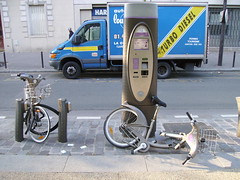
In 2007, Paris initiated a bike-sharing program to  provide “an inexpensive, healthy and low-carbon alternative to hopping in a car or bus”. The program purchased 20,600 specially-made bicycles, 80 percent of which have now been vandalized or stolen. The New York Times reports: Freeride

“The symbol of a fixed-up, eco-friendly city has become a new source for criminality,” Le Monde mourned in an editorial over the summer. “The Vélib’ was aimed at civilizing city travel. It has increased incivilities.”

The heavy, sandy-bronze Vélib’ bicycles are seen as an accoutrement of the “bobos,” or “bourgeois-bohèmes,” the trendy urban middle class, and they stir resentment and covetousness. They are often being vandalized in a socially divided Paris by resentful, angry or anarchic youth, the police and sociologists say.

A sociologist comments:

Bruno Marzloff, a sociologist who specializes in transportation, said, “One must relate this to other incivilities, and especially the burning of cars,” referring to gangs of immigrant youths burning cars during riots in the suburbs in 2005.

He said he believed there was social revolt behind Vélib’ vandalism, especially for suburban residents, many of them poor immigrants who feel excluded from the glamorous side of Paris.

“It is an outcry, a form of rebellion; this violence is not gratuitous,” Mr. Marzloff said. “There is an element of negligence that means, ‘We don’t have the right to mobility like other people, to get to Paris it’s a huge pain, we don’t have cars, and when we do, it’s too expensive and too far.’ ”

Despite these setbacks, the bike-sharing will continue:

Still, with more than 63 million rentals since the program was begun in mid-2007, the Vélib’ is an established part of Parisian life, and the program has been extended to provide 4,000 Vélib’s in 29 towns on the city’s edges.

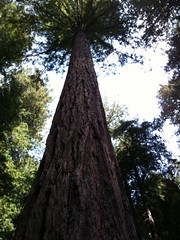
Redwood, Muir Woods

The BBC World Service Program, The Forum, ran a segment this weekend featuring sociologist Diego Gambetta…

About the program:

This week we take a trip into real and imagined dystopian worlds…

We travel to the future to meet the environmentally friendly humanoids from Canadian novelist Margaret Atwood’s latest book, “The year of the Flood”. She asks whether an environmental religion can prevent the extinction of the human race as we know it, or whether it would accelerate our evolution into a new, unrecognisable species.

The British opposition security minister Baroness Pauline Neville-Jones argues that the right balance needs to be struck between privacy and the efficiency of the state.

And sociology Professor Diego Gambetta peers down into the underworld to crack the codes and signals of criminal communication.

We discuss how we modify our bodies and our communication in order to protect our planet and evade the state, both today and in a possible dystopian future.

LISTEN HERE.