economics

The Los Angeles Times ran a story this week about a new study that details the persistence of negative racial stereotypes, reporting that “Changes in social standing such as falling below the poverty line or going to jail made people more likely to be perceived as black and less likely to be seen as white,” according to the researchers.

In a long-term survey of 12,686 people, changes in social circumstances such as falling below the poverty line or being sent to jail made people more likely to be perceived by interviewers as black and less likely to be seen as white. Altogether, the perceived race of 20% of the people in the study changed at least once over a 19-year period, according to the study published today in the Proceedings of the National Academy of Sciences.
Changes in racial perceptions — whether from outside or within — were likely concentrated among those of mixed ethnicity, researchers said.
From the sociologists’ mouth…
“Race isn’t a characteristic that’s fixed at birth,” said UC Irvine sociologist Andrew Penner, one of the study’s authors. “We’re perceived a certain way and identify a certain way depending on widely held stereotypes about how people believe we should behave.”  

Penner and Aliya Saperstein, a sociologist at the University of Oregon, examined data from the federal Bureau of Labor Statistics’ National Longitudinal Survey of Youth. Though the ongoing survey is primarily focused on the work history of Americans born in the 1950s and 1960s, participants have also provided interviewers with information on a variety of topics, including health, marital status, insurance coverage and race.

Even more surprising…
The effect has staying power. People who were perceived as white and then became incarcerated were more likely to be perceived as black even after they were released from prison, Penner said.  

The racial assumptions affected self-identity as well. Survey participants were asked to state their own race when the study began in 1979 and again in 2002, when the government streamlined its categories for race and ethnicity.


Read the full story.
Read the previous post on this work from the Crawler. 

Skyline Manhattan-4Earlier this week an article in the New York Times reported on new findings that New York City is becoming increasingly diverse… according to recent Census data. The Times reports that “since 2000, the number of young children living in parts of Lower Manhattan has nearly doubled. The poverty rate declined in all but one New York City neighborhood… A majority of Bronx residents are Hispanic. And the number of white people living in Harlem more than tripled, helping to drive up median household income there by nearly 20 percent — the fourth-highest jump in the city.”

These latest findings are the result of new detailed demographic data for smaller areas (district) and the combination of three years of surveys. This work on trends related to race, ethnicity, and education constitutes some of the clearest statistical evidence available. 

The sociologist weighs in…

The latest results [on housing costs, discussed in the article] represent a three-year rolling count by the American Community Survey, a continuing profile of the country compiled by the Census Bureau, from 2005 to 2007.

“It was taken on the eve of a downturn,” said Andrew A. Beveridge, a sociologist at Queens College, who analyzed the results for The New York Times. “There’s been a shift in the cities, but can it sustain itself? The increase in children in Manhattan, for example, is fueled by the fact that the parents have a lot of money. But that is tied to the financial industry, directly or indirectly.”

Read more.

See the changes mapped by the Times.

KCBS, a California-based radio station, ran a story this past weekend that featured the work of sociologist Shila Katz, who has worked with the Obama transition team on issues surrounding families on welfare.

The station reports:

When Shila Katz sits down with President Elect Obama’s transition team, she has a message to get across: “Higher education can really be the key to higher wages that will support a family.”

Katz, an assistant professor of sociology at Sonoma State University, has done research about education as a way to get from welfare to work. “Mothers on welfare who are pursuing higher education here in the Bay Area, [who] earn associate degrees and bachelors degrees, find jobs at wages that they never need welfare again.”…“We need to provide welfare services that are actually supportive and will help people get into jobs that will earn wages so that they can support their families and higher education is the key to that.”

Katz worked on the Obama campaign and says that now is the time to enact policies that show what his values are.

LISTEN TO THE PODCAST HERE.

IMG_4299Sociologist Juliet Schor wrote an opinion piece about holiday shopping that ran in the Los Angeles Times this weekend. The Boston College sociology professor urges us to “turn away” Black Friday and Cyber Monday

She writes:

In fact, reining in holiday spending is a message some have been broadcasting for a while. Adbusters, with its Buy Nothing Day, begun in 1992, urges consumers to boycott Black Friday by refusing to purchase anything on the day after Thanksgiving. Performance artist the Rev. Billy Talen and his Church of Stop Shopping target the excesses of the season. The organization I helped to found, the Center for a New American Dream, helps people simplify the holidays by promoting socially responsible gifts, alternative gift fairs and spending time with family and community. 

These and many other groups have long recognized that the consumer binge was unsustainable, financially and environmentally. It has been depleting our savings, to be sure, but also degrading the atmosphere, destroying ecosystems and undermining the potential of the planet to support life in all its magnificent forms. Ecological footprint analysis reveals that by the late 1970s, humans had begun to draw down stocks of “natural capital” — that is, degrade the Earth’s ecosystems. We’re turning arable land into deserts, transforming ocean areas into chemically induced dead zones and heating up the climate. 

The U.S. holiday season, with its traditional excess, has long been an outsized part of that decline. Roughly a quarter of annual spending, garbage and ecological impact occurs between Thanksgiving and New Year’s. Measured in carbon alone, that represents five tons of emissions for each American. 

Read the full commentary.

Reading over the shoulderA Newswise press release posted on Friday about a study from University of Maryland sociologists has hit the headlines of papers around the world including the UK, India, and Bulgaria as well as the United States. The new study suggests that unhappy people watch more television, while happy people spend more time reading and socializing. The investigators at the University of Maryland analyzed three decades of data from time-use studies and social attitudes surveys (nationally representative). Their study indicates that spending more time watching TV contributes to happiness in the moment, but may result in fewer positive effects in the long term.

“TV doesn’t really seem to satisfy people over the long haul the way that social involvement or reading a newspaper does,” says University of Maryland sociologist John P. Robinson, the study co-author and a pioneer in time-use studies. “It’s more passive and may provide escape – especially when the news is as depressing as the economy itself. The data suggest to us that the TV habit may offer short-run pleasure at the expense of long-term malaise.”

Robinson suggests that we might see a significant increase in TV viewing over the coming months and years as the economy worsens…

“Through good and bad economic times, our diary studies, have consistently found that work is the major activity correlate of higher TV viewing hours,” Robinson says. “As people have progressively more time on their hands, viewing hours increase.”

But Robinson cautions that some of that extra time also might be spent sleeping. “As working and viewing hours increase, so do sleep hours,” he says. “Sleep could be the second major beneficiary of job loss or reduced working hours.”

Read the full story.

Respect
Reuters reported yesterday on how the downturn in the economy is a ‘double whammy’ for police in many cities as they face budgets cuts while they simultaneously brace themselves for a rise in burglaries, robberies and theft.

Although there has long been debate over the connection between crime and the economy, most of the criminologists, sociologists and police chiefs interviewed by Reuters forecast a rise in crimes in certain categories in the coming months as the United States heads deeper into recession territory.

Crime has increased during every recession since the late 1950s, said Richard Rosenfeld, a sociologist at the University of Missouri-St Louis.

Those interviewed stressed they were not talking about an increase in overall levels of crime, which have been falling in the United States since the 1990s, but an uptick in opportunistic crimes like theft and burglary. They say most crimes will still be committed by career criminals but that others in the ranks of the newly unemployed could become drawn in for a variety of reasons.

Reuters also draws upon the work of another sociologist to help explain the potential impact of budget cuts on urban crime…

Lesley Williams Reid, a sociologist at Georgia State University who has studied urban crime, said any cuts to police budgets would be bad news, particularly if the economic downturn is prolonged and more people become unemployed.

“I don’t want to add to a culture of fear, but there is a clear reason to be worried about how this is going to affect crime rates,” she said.

Read more from Reuters.

I recently discovered a series on Chicago Public Radio which features reports from Greg Scott, a sociology professor and documentary filmmaker. 

The most recent installment explores the daily lives of women working as prostitutes on Cicero Avenue in Chicago’s West Side. Scott’s story paints a vivid picture of the complex relationship between sex and pride for these women…

Listen to ‘Women of the Brickyard’ here.

For more of Scott’s stories, look here.

Left screenThis Sunday’s New York Times ran a piece titled ‘Overfeeding on Information’ about our obsession with the news, especially during such a closely contested presidential election and in the midst of an economic crisis.

The Times describes this compulsion for constant updates:

This explosion of information technology, when combined with an unusual confluence of dramatic — and ongoing — news events, has led many people to conclude that they have given their lives over to a news obsession. They find themselves taking breaks at work every 15 minutes to check the latest updates, and at the end of the day, taking laptops to bed. Then they pad through darkened homes in the predawn to check on the Asian markets.

Sociologist Eric Klinenberg is asked to weigh in on this trend…

ERIC KLINENBERG, a sociology professor at New York University, said people are unusually transfixed by news of the day because the economic crisis in particular seems to reach into every corner of their lives. Usually, he added, people can compartmentalize their lives into different spheres of activity, such as work, family and leisure. But now, “those spheres are collapsing into each other.”

And the news is not just consequential, but whipsaw-volatile. Financial markets swing hundreds of points within an hour; poll numbers shift. This means that news these days has an unbelievably short shelf life, news addicts said. If you haven’t checked the headlines in the last half-hour, the world may already have changed.

And commentary from a psychologist…

For others, information serves as social currency. Crises, like soap operas or sports teams, can provide a serial drama for people to talk about and bond over, said Kenneth J. Gergen, a senior research psychologist at Swarthmore College who studies technology and culture. “It gives us the stuff that keeps the community together,” he said. And for those whose social circles think of knowledge as power, having the latest information can also enhance status, Dr. Gergen said. “If you can just say what somebody said yesterday, that doesn’t do the trick,” he said.

Read the full story.

IMG_1579The Christian Science Monitor reported this morning on the enduring signs of US power despite the economic crisis. Many people seem panicked about America’s status as a superpower, so the Monitor investigated scholarly opinions as to whether ‘the American century’ is over. 

Sociologist Immanuel Wallerstein brings his take to this coverage…

Still, what seems clear is that the experience of the Bush years, now drawing to a close amid the worst economic calamity in eight decades, have bolstered those who long predicted a clipped American eagle. “What George Bush did was turn a slow decline into a precipitous one,” says the noted Yale University sociologist Immanuel Wallerstein, who has been predicting the end of the American empire since the 1980s.

“We’ve had two standout factors: the Iraq war, which not only demonstrated but actually accelerated this decline in power, and then the way this president put the American government in such deep debt,” Mr. Wallerstein says. “What we see playing out before us is the culmination of these actions.”

The Monitor concludes….

But for the moment, it’s the financial crisis that is providing a gauge of America’s enduring leadership capacity. With many economists citing international coordination as key to righting the global economic ship, one test will come Friday when finance ministers of the world’s seven major economies meet in Washington.

Read more.

L1030439

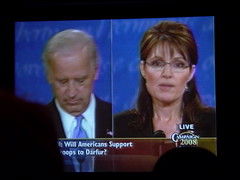
Eleanor Clift of Newsweek, has recently written about how vice-presidential candidate Sarah Palin is reigniting the culture war as her ‘everywoman’ act plays well with audiences. She suggests that this might indicate that the GOP will try to once again paint Barack Obama as an elitist.

In her article Clift included commentary from sociologist Todd Gitlin, who spoke at a Pew Forum discussion in Washington as to whether the cultural war will have an impact come November…

Todd Gitlin, a professor of journalism and sociology at Columbia University, speaking from the progressive side, said the culture war always matters, but that it may not be decisive, with economic issues making it harder for Republicans to get traction on lampooning Obama as an elitist, in the way they turned John Kerry into a windsurfing Frenchman. Gitlin described the presidential election as a “quadrennial plebiscite of who we are,” with Americans casting their vote for the candidate that best embodies who we are as a nation.

Newsweek’s commentary on the vice-presidential candidates in this culture war…

Nobody wants to be an elitist. In politics, it’s a deadly label. What we saw in Thursday night’s debate were two competing strains of populism. Biden, the Irish-Catholic kid from Scranton, represents Main Street populism, the people against the powerful, anti-corporatism, little guy kitchen-table values. Palin is wooing the same working-class constituency that could decide the election in battleground states like Ohio and Pennsylvania with her pro-gun, family and religious down-to-earth values.

Read more here.