

diversity

Rebecca Hanson (Professor of Sociology at the University of Florida), David Smilde (Professor of Sociology at Tulane University), and Verónica Zubillaga (Sociologist and Co-Director of the Network for Activism and Research for Coexistence) wrote an article for the New York Times in response to the Trump administration’s deportations of Venezuelan men to El Salvador. Hanson, Smilde, and Zubillaga note that the Venezuelan gang Tren de Aragua lacks organizational power and political aspirations in the U.S.: “Organized crime is far less portable than people usually think. It typically involves control of illicit markets, which in turn depends on relationships with local people and officials. These networks are not easily transferable and limit mobility.” The authors challenge these inhumane deportations: “The mass criminalization, arbitrary detainment and violation of due process that have characterized the Trump administration’s actions so far have echoed some of the tactics of the Venezuelan regime many of these young men presumably fled from. It reduces U.S. credibility and emboldens authoritarians everywhere.”

Rebecca Hanson, David Smilde, and Verónica Zubillaga

Oneya Fennell Okuwobi (Assistant Professor of Sociology at the University of Cincinnati) wrote an article for Salon highlighting the unintended consequences of diversity initiatives–in particular, that they tend to benefit corporations, not employees. Okuwobi explains how many workplaces engage in “diversity displays,” focusing on external appearances. “While workplaces receive the bulk of benefits, employees of color receive the burdens of upholding the image of diversity, with serious costs in terms of additional work, questions about our capabilities, and the need to fit the appearance of diversity that our workplaces desire.” Okuwobi writes more on this topic in her new book, Who Pays for Diversity: Why Programs Fail at Racial Equity and What to Do About It

Oneya Fennell Okuwobi

Lucius Couloute (Assistant Professor of Sociology at Trinity College) wrote an article for The Conversation on how U.S. parole systems contribute to recidivism. Couloute argues that although parole was “originally designed to help those convicted of crimes reintegrate into society – through mentorship, supportive services and other resources,” it now serves as a system of punitive surveillance that creates “hidden traps rather than pathways to success.”


Lucius Couloute

Lucius Couloute (Assistant Professor of Sociology at Trinity College) wrote an article for The Conversation on how U.S. parole systems contribute to recidivism. Couloute argues that although parole was “originally designed to help those convicted of crimes reintegrate into society – through mentorship, supportive services and other resources,” it now serves as a system of punitive surveillance that creates “hidden traps rather than pathways to success.”The New York Times ran an article on how I.V.F. technologies may be changing the way we view and relate to embryos. Time-lapse microscopy, a technology that has been widely used since the early 2010s, allows for observation of embryo developments. Many clinics share this video footage with patients on the day of their embryo transfer, before they know if the transfer was successful. The article cites research from Manuela Perrotta (Sociologist at the Queen Mary University of London), finding that some clients experience a deep connection with the video footage. “​​I felt like it was, it was a baby,” one patient told Perrotta and a research co-author. “It sounds really weird, but it felt like I was looking at a potential baby there, and watching it move and do all the stuff, and I just looked, it looked — I know it wasn’t just cells for me.”

Manuela Perrotta and Lucius Couloute

This week, Christine L. William’s (Professor of Sociology at the University of Texas) work on workplace inequality was featured in a question on Jeopardy!: “Similar to a barrier to women’s rise, this ‘escalator’ coined by sociologist Christine Williams invisibly lifts men.” This story was covered by the ASA.
Christine L. William

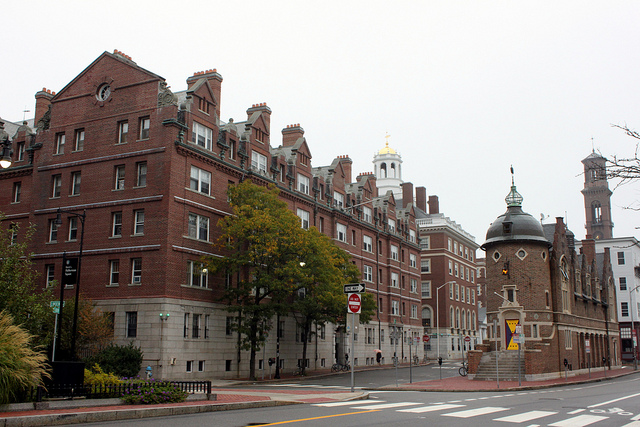
Photo of a large university building. Photo by Prayitno, Flickr CC

The high-profile lawsuit filed against Harvard University has reignited debates about race, college, and inequality. The plaintiffs claim that admission practices at Harvard have led to discrimination against Asian-Americans, but their arguments reflect a long line of litigation that claims such practices have led to discrimination against whites. A key point that gets lost in this debate is the pursuit of diversity in college student bodies, which colleges highlight as essential to their students being able to compete in the globalizing, modern world. In a recent article in The Washington Post, Anthony Chen and Lisa M. Stulberg discuss how the pursuit of diversity has a long history in higher education.

The use of race in admissions policies is often linked to the famous Supreme Court case Bakke v. University of California in 1978. There, the Court ruled in favor of universities’ right to consider applicants’ race in admissions as part of a holistic attempt to increase diversity at campuses. This case set the precedent for a diversity rationale in race and admissions, but Chen and Stulberg contend that such frameworks date back even further. They name several notable university figures in mid-20th century America who discussed diversity as an important part of a college experience, such as Harvard’s dean of admissions William J. Bender in 1961 and City College psychologist Kenneth B. Clark, who highlighted the benefits of diversity and multiracial environments in an era were several colleges still practiced racial segregation.

This discussion of the educational benefits of diversity — as well as corresponding changes in admissions practices at some colleges — dates back to at least the 1960s. Yet, Chen and Stulberg argue these ideas are still relevant for society today:

“The world is a big place full of people who are different from one another, and going to a school with a diverse study body is one of the best ways to prepare for it. That common-sense lesson from American history is still worth remembering today.”

Photo by NCDOTcommunications, Flickr CC

Intersectionality is a term frequently used in many different contexts, from social movements to academic research to everyday speech. A recent article in The New York Times explores how intersectionality — defined as “the complex and cumulative way different forms of discrimination like racism, sexism and classism overlap and affect people” — influences men and women of color in the workplace.

The article draws from a recent non-profit study surveying 1,600 participants in workplaces ranging from corporations to higher education. Most respondents said they were “highly on guard at work,” which often meant they actively repressed traits others might perceive as frightening or intimidating. For example, they arrived early to meetings so they would be seated when others arrived in order to appear less threatening.

While the majority of workers in the study reported this need to be “on guard” to protect themselves against racial and gender bias, the types of stereotypes various groups face are not the same. For example, African-American women tend to face the stereotype of “the angry black woman,” while Latinas face stereotypes about being “too emotional or too wedded to their families.” Sociologist Yung-Yi Diana Pan notes that Asian-Americans are sometimes identified as “being workhorses without creativity” and “passive and acquiescent,” and this may lead to fewer promotions according to a recent report by the Ascend Foundation. 

Part of the problem, according to sociologist Lata Murti, is that women of color are constantly compared to professional white women — the “invisible norm.” So, what is the solution? Latasha Woods, brand manager at Proctor & Gamble argue it starts with leadership:

“We need leadership that truly cares about inclusion — a lot care about diversity, but how do you foster inclusion? People spend a lot of time on what they know the boss cares about. If they see the boss cares about inclusion they will too.”

Photo by Art01852, Flickr CC

U.S. census estimates indicate that babies of color are now the majority and that by 2020, the majority of children under 18 will be non-white. Despite this growing diversity, many parts of the United States remain deeply segregated by race. A recent article in the Washington Post draws on U.S. census data and insights from sociologists Michael Bader, Kyle Crowder, and Maria Krysan to visually depict and explain the persistence of residential segregation in the United States.

Bader points out that the persistence of segregation is tied to the history of slavery, Jim Crow, and redlining practices against Black communities. Cities that have large African American populations, like Chicago and Detroit, have entrenched patterns of segregation. However, Krysan and Crowder argue in their book that housing policies and practices do not alone reproduce segregation. Daily routines and connections to others can also result in inequalities. As Krysan describes,

“We don’t have the integrated social networks. We don’t have integrated experiences through the city. It’s baked-in segregation, [Every time someone makes a move they’re] not making a move that breaks out of that cycle, [they’re] making a move that regenerates it.”

On the other hand, diversity in many suburbs has increased over the past decades. The D.C. metro saw a 300 percent increase in Hispanic American and a 200 percent increase in Asian American populations from 1990 to 2016. Bader connects this diversity in the suburbs to policy, arguing that both lower housing costs and the implementation of the Fair Housing Act helped to circumvent segregation,

“A lot of those areas were developed after the Fair Housing Act was implemented…If you’re building housing and you’re subject to the Fair Housing Act, you shouldn’t have, in those particular units, the legacy effects of segregation.”

While policy cannot address all residential segregation, it may lessen its reach.

Black Panther actress Lupita Nyong’o at the 2017 San Diego Comic Con International. Photo by Gage Skidmore, Flickr CC

It’s no surprise that Hollywood could do better in terms of diversity. But it might be surprising that diversity in all aspects of filmmaking pays off, literally. A recent article from NPR discusses Darnell Hunt‘s annual Hollywood Diversity ReportThe report finds a “mixed bag” for people of color attaining key roles in the industry. People of color are incredibly underrepresented in positions like talent scouts, directors, and lead roles.  This underrepresentation is especially disconcerting when nearly half of the U.S. population is comprised of people of color, and yet the industry remains predominantly White and male.

Hunt and his team also found that diverse films and TV did extremely well in 2016, and that people of color were the top consumers of ticket sales for many major films that year. In other words, more diversity may mean more monetary payoff. Hunt points to Black Panther as a groundbreaking example in the industry.

“[Black Panthersmashed all of the Hollywood myths that you can’t have a black lead, that you can’t have a predominantly black cast and [have] the film do well. It’s an example of what can be done if the industry is true to the nature of the market. But it’s too early to tell if Black Panther will change business practices or it’s an outlier. We argue it demonstrates what’s possible beyond standard Hollywood practices.”

In short, the success of diverse films should not be underestimated, and it seems to be in Hollywood’s best interest to increase diversity both on screen and behind the camera.

Photo by Wonder woman0731, Flickr CC

The goal of increasing “diversity” has become a common focus in university admissions, meaning strengthening the presence of underrepresented minorities within the student body. This kind of rationale also appears in businesses and government, with rhetoric that emphasizes how diverse groups can be more productive and innovative. In essence, most see pursuing diversity as a good thing because of the benefits of diversity.

That said, researchers question whether “diversity” policies and programs really overcome existing racial inequalities, and some argue that organizations are more interested in boasting about their diversity than they are in actually increasing minority representation. Ellen Berrey has researched the meaning and use of the word “diversity” in a variety of sites. Her research, as described in The New Yorker, suggests that touting the benefits of diversity can have an unintended consequence: glossing over issues of inequality, exclusion, and discrimination. As an example, Berrey describes an investigation of diversity in a Fortune 500 company,

“The diversity-management program functioned mainly as a surreal exercise in internal branding, entirely separate from the legal department (which handled claims of discrimination). So-called diversity managers worked to foster an “inclusive” environment, but they seemed to spend much of their time “reiterating the good that would come from diversity,” as a way of justifying their own positions.”

The New Yorker article also discusses research by Natasha Warikoo, who examines the ways that white students at Ivy League colleges describe diversity on campus. Their accounts point to what Warikoo calls “the diversity bargain” — white students accept the existence of racialized admissions programs with the expectation that students from different racial and ethnic backgrounds will expose them to new ideas, cultures, and experiences. In general, these researchers find that “diversity” rhetoric often misses the bigger picture of continued racial inequality in the United States.

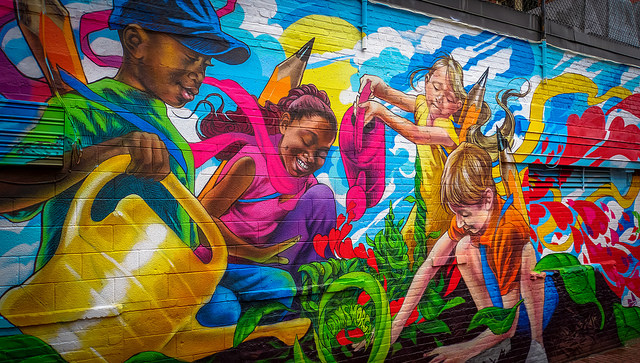
Photo by Ted Eytan, Flickr CC. Mural by Anieken Udofia in Adams Morgan Neighborhood, Washington, DC

“White flight” describes the uncomfortably common phenomenon in the mid-to-late 20th century wherein whites would quickly move out of a neighborhood once blacks started moving in. This would often lead to neighborhoods that were mostly-white, but quickly ended up mostly-black. Today, American neighborhoods are not as mono-ethnic as they once were, and the picture has expanded beyond blacks and whites to other populations, such as Latinos and Asians.

That said, however, segregation within neighborhood contexts is still present. A recent article in Slate detailed research showing that at the aggregate level, neighborhoods and residential areas are becoming more diverse in the U.S. However, this diversity does not necessarily mean that multicultural, cross-racial social relationships are thriving. Derek Hyra conducted research in parts of Washington, D.C. and found that even in a diverse neighborhood, people’s social associations—such as choice of church, schools, and restaurants—is often in a mono-ethnic context, leading to microsegregation or “diversity segregation.” 

This isn’t to necessarily suggest, however, that diverse neighborhoods have no potential to become more integrated.  Camille Z. Charles tells Slate that consistent exposure and contact with people of different races can foster integration. Places like public schools and community centers provide the opportunity for these kinds of relationships to develop and lead to diverse neighborhoods where people have diverse friends. Charles explains,

“We are often friendlier with people we actually interact with. We do find there is lasting benefit to that, which is why we think it is important to have [diversity] in schools because kids spend so much time in classrooms and on school campuses.”

Photo by Logan Ingalls, Flickr CC

A recent article in the Washington Post points out that Trump’s Cabinet holds fewer advanced degrees than any first-term Cabinet in the last 24 years, and is the least diverse of the last three administrations. Interestingly, the only two minorities that Trump has chosen are more educated than their white counterparts. This a classic example of minorities in America being expected to have more qualifications than whites, as explained by economist Darrick Hamilton, who says,

“Rarely will we find an example of an uncredentialed black person in an elite position … That black person is usually certainly qualified, if not overqualified, with regard to their education.”

Furthermore, education alone is not sufficient. Duke professor of public policy, William Darity, explains that education cannot close the huge wealth or unemployment gap between blacks and whites. Thus, according to sociologist Tressie McMillan Cottom, “African Americans have to be overeducated to be underemployed.”

During the election, Trump fared well among people without a college education. In fact, Obama’s administration was criticized by conservatives for being full of people with advanced degrees from elite universities, illustrating a negative shift in how people perceive those who are highly educated.  The fact that Trump’s cabinet is one of the least educated is not surprising considering campaign rhetoric and American political attitudes. Cottom continues,

“As higher education has become more accessible to more diverse groups of people, the general population has become more distrustful of education and expertise. They think there must be something suspect about education, because how great can Harvard really be if someone like Barack Obama got there?”

Photo via Scripps National Spelling Bee, Flickr CC
Integrated kids become integrated adults. Photo via Scripps National Spelling Bee, Flickr CC.

Nearly 20 years have passed since Beverly Daniel Tatum released her groundbreaking book, Why Are All the Black Kids Sitting Together in the Cafeteria: And Other Conversations about Race. In it, she examines how and why black youth often segregate themselves in middle and high school, arguing that engagement in meaningful conversations about race can help deconstruct such racial barriers. While many may have lost hope in the Civil Rights-era dream of school integration, today, new sociological research demonstrates the importance of integration and the positive long-term effects it provides for working adults. A recent article in The Atlantic reveals that students who attend racially diverse high schools are more likely to work in diverse employment settings.

Adam Gamoran, Sarah Barfels, and Ana Cristina Collares tracked over 10,000 black and white high school students during the 1980s and 1990s, then recorded the racial make-up of their current work environment. White and black students who attended predominantly white schools were more likely to work in predominantly white work settings. Regardless of the various methods behind the integration (including busing and neighborhood development), the students from racially diverse high schools were more likely to work today with a diverse group of coworkers. The authors suggest that “Interactions with a diverse student body may mean that individuals are more likely to live in communities that are more diverse, or [are] more willing and comfortable in racially diverse settings later in life.” While they are reluctant to conclude that attending a diverse high school or working with diverse coworkers will eradicate the economic and social disparities of life in the U.S., it is safe to say that both provide a strong step in the right direction.

Photo by brandbook.de, cropped. Flickr CC.

In many fields—especially those that require more degrees or a longer resume—diversity remains a lofty goal. Claire Jean Miller writes in the New York Times that some unconventional thinking may help make that goal a reality, suggesting the practice of “blind hiring,” wherein those who review employment criteria are unable to see prospects’ race, gender, or similar factors.

Miller looks to research from sociologists Maya A. Beasley (University of Connecticut) and Lauren Rivera (Northwestern University). One of the more common reasons cited for companies’ lack of diversity is that there are not enough minorities and women in the “pipeline” who have sufficient skills or qualifications. Beasley’s research shows, however, a greater amount of people with those qualifications are minorities or women. Rather than overt discrimination in the hiring process, Rivera sees companies stressing “fit” and, in this way, contemporary employment is more like finding a romantic partner. A match between leisure activities and hobbies is a strong predictor of who gets hired where; because those factors are inherently raced and gendered, organizations that are disproportionately white and/or male are likely to stay that way.

“Blind hiring” means shifting early hiring processes to consider skill first. For example, after facing litigation for its historically disproportionately white male ensemble, the Boston Symphony orchestra moved to blind auditions, putting aspiring orchestra members behind a screen while they played. The new procedure led to a demonstrably more diverse orchestra. In tech, blind hiring might mean critiquing applicants’ code or software before examining their resume. Though this idea clearly can’t be applied to all fields with equal ease, blind hiring might let us see workplace diversity.