climate change

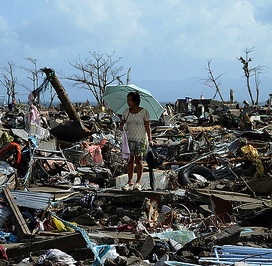
The aftermath of Typhoon Haiyan in the Philippines. Photo by Jordi Bernabeu
The aftermath of Typhoon Haiyan in the Philippines. Photo by Jordi Bernabeu via flickr.com

With death toll rising from the devastating typhoon in the Philippines this week, it seems that we’re constantly being reminded of the destruction of natural disasters, especially for rural and poor areas. Rural communities can be difficult to reach in times of environmental chaos, and poorer regions don’t always have the resources to cope with a crisis. When city services shut down or relief aid doesn’t come through immediately, community members band together to manage the aftermath of the disaster as best they can.

Sociologist Eric Klinenberg believes that community resources including “public places from libraries to mom-and-pop shops and coffee shops” can influence the outcomes of a crisis by providing the community the familiarity and support they need. In researching one such disaster, the 1995 Chicago heat wave, Klinenberg found that the residents of neighborhoods with more social infrastructure—like libraries and coffee shops—fared much better during the heat.

Those resources so dramatically improve the quality of our life on a regular day, but when there’s a heat wave or a hurricane or some other disaster, they can make the difference between life and death. In the Chicago heat wave, they did.

These types of social infrastructure benefit communities beyond times of crisis, according to Klinenberg who argues,

The nice thing about investing in climate security through social infrastructure is that the residual benefit is that we could dramatically improve the quality of life in these places all the time regardless of the weather. And it’s that kind of intelligent design that we desperately need at this moment.

Picture 2


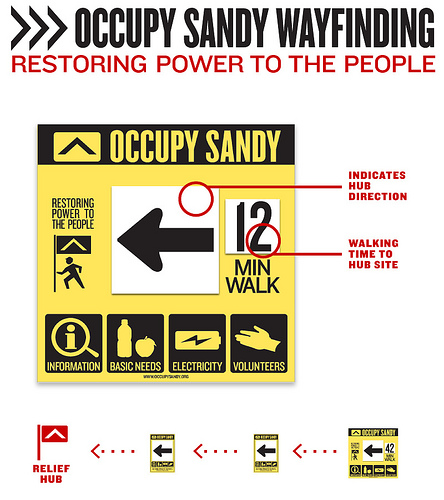
In the wake of Superstorm Sandy, Occupy Wall Street shifted its efforts to neighborhood-level storm relief. Image via Daniel Latorre via flickr.com.

Like Hurricane Katrina and other natural disasters affecting urban areas, Superstorm Sandy reminded many that U.S. cities are unprepared for the effects of climate change. According to sociologist Eric Klinenberg in a recent issue of The New Yorker, the U.S. lags far behind other countries in “climate-proofing,” or investing in infrastructural developments that will protect cities and their inhabitants from increasingly-severe natural disasters and rising water levels.

Beyond investing in physical infrastructure, preparing for and surviving climate change, Klinenberg writes, will involve “recognizing the importance of social infrastructure: the people, places, and institutions that foster cohesion and support.” Harvard sociologist Robert J. Sampson has emphasized the importance of strong social ties during natural disasters. In their research on the 1995 Chicago heat wave that killed over 700 people, Klinenberg and Sampson found that neighborhoods with a strong sense of community and many churches and civic organizations—neighborhoods where people look out for one another—fare better when disaster strikes.

Although infrastructure investment and development play a major role in mitigating the effects of climate change, it may well prove that “civil society will ultimately determine which people and places will withstand the emerging threats from climate change.”

Photo "Climate Change Refugees" by Tavis Ford via flickr.com

Scientists often assert that climate change is a matter of  empirical evidence, not belief.  But, The Guardian’s Adam Corner notes that decades of social scientific research says that skepticism about climate change is primarily due to beliefs, not a misunderstanding of the science (though there’s certainly misunderstanding as well).

 …..in studies that have asked who is sceptical about climate change and why, we find not a story about scientific ignorance, but a link between social attitudes, cultural beliefs and climate change scepticism. The evidence is starkest in the US , but similar patterns are found elsewhere too: older, white, conservative men tend to be more sceptical about climate change.

Corner is also a research associate at Cardiff University, and in a paper he recently published with several colleagues, he asked what would happen when two groups of people—one group comprised of people who were skeptical about climate change and the other group comprised of people who were not—read the exact same information about climate change in newspaper editorials.  Overall, they found that the two groups of people evaluated the information differently, attributing different judgements about persuasiveness and reliability of the information.

In social psychology, this phenomenon – “biased assimilation” – is well known, and no one is immune from it, so both sceptics and non-sceptics rated the editorials in line with their existing beliefs. The critical difference, of course, is that those who were not climate sceptics had the weight of empirical evidence on their side.  What this experiment illustrates, though, is that “belief” in climate change is very much what matters. Without belief in climate change, scientific evidence simply bounces off. And it is social views and cultural beliefs that predict climate change denial, not people’s level of knowledge about climate science.

Does this mean that people fighting global warming should give up?  Corner says “absolutely not,” though he asserts that we cannot look only to environmental science to provide an answer to a problem that is also social in nature.