
Wikipedia

As I try to get out from under the mass of “green books” (the blue book is a casualty of campus greening efforts), I thought I’d give a shout to my Race, Multiculturalism and Politics students at California Lutheran University. I’m a pretty mild mannered person in general, but for some reason, I often perform “high wire acts” with untested assignments.

This semester, I asked my Race classes (mostly first-semester freshmen) to create Wikipedia entries for books from the suggested readings section of my syllabus. I was a bit nervous about this assignment. Particularly as students began coming to me reporting that the “the crowd” on Wikipedia had decided to delete their blog entries.

wikipedia logo

Today, some of my students presented their Wikipedia pages, and I was blown away. Other than the occasional typo here or akward sentence structure there, they exceeded my wildest expectations. Here are two examples:

Wikipedia page for Multiculturalism Without Culture, by Anne Phillips
Wikipedia page for Unequal Childhoods by Annette Lareau

I was impressed with my students ability to synthesize pretty heady stuff. I wonder how presenting material in such a public forum changed the work product. Has anyone given a similar assignment? How did it work out? I was stunned by the zeal with which many of the students approached this project. I’d love to hear your thoughts.
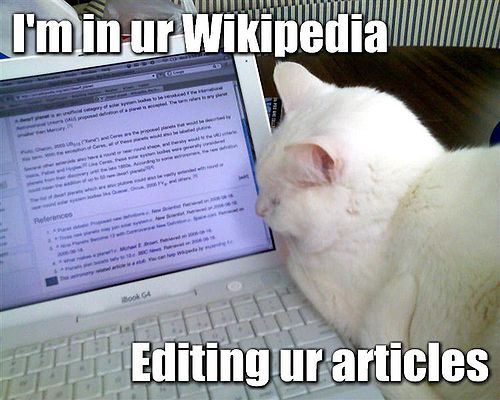
 

Lolcat
Lolcat

Earlier, I referenced this Wired article from last year on WikipediaScanner.  The site tracks edits of Wikipedia entries to known IP addresses within firms and organizations.  Wired has compiled a list of notable “salacious” edits from the past.  Here’s a news story discussing the PR and search engine optimization (SEO) implications of WikipediaScanner.


Vandalism And Wikipedia – 

While most edits are innocuous, some raise eyebrows.  

I’m interested in this because I feel that transparency will be increasingly important as Web 2.0 develops and we shift to 3.0, 4.0, etc.  Some of the things I’m working on is the implications of anonymity in social media and how it relates to business/organizational practice.  Some issues that aren’t well defined are:

  • Policies regarding transparency versus secrecy (open source versus Apple)
  • Managing public perceptions and organizational attitudes towards risk
  • What are the proper features/applets (materialities of communication) that foster “collaboration and community” across different contexts?  Should these be staged?
  • What are the preconditions for online communities be self-regulating?
  • Nuances of online community culture self-reproduction

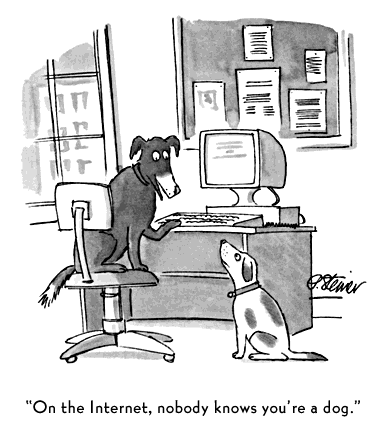
While anonymity and fluid identity was prevalent in Web 1.0, back when nobody knew you were a dog:

in Web 2.0, users are seeking the experiences of the 4Cs: conversation, community, commons, and collaboration.  I think in many instances that transparency facilitates the 4Cs through building social capital and trust.  Additionally, communitas and shared meaning systems, as well as the materialities of communications (applets, features, etc.), also foster/enable the experiences/practices in the 4Cs, but I don’t think all of these are invariant preconditions in all contexts.  

What are your thoughts on transparency?