
UK politics

This news out of the UK this week seems familiar for Canadian observers: “Labour could be ruined by proposed cap on political donations.” Limits on political party donations are being looked at in Britain at the moment and Labour would suffer the most if a cap were to be brought in to the system:

Labour could face financial ruin under plans being developed to cap the biggest donations to political parties, a Guardian analysis shows.

The independent standards watchdog is said to have agreed to recommend a new limit on donations, introducing an annual cap with figures ranging from £50,000 to £10,000 being considered. Such a move, in an attempt to clean up political funding, would end the six- and seven-figure donations to the Labour party from its union sponsors, as well as the Tories’ reliance on the richest city financiers.

An analysis of five and a half years’ worth of donations to the parties reveals the move would most dramatically affect Labour’s funding base. If the £50,000 limit had been in place over the period, Labour’s donations would have been reduced by 72%, the Conservatives’ by 37% and the Liberal Democrats’ by 25%.

A source close to the Committee on Standards in Public Life, which has been reviewing the party funding system and is due to report in October, said it was trying to find a way to impose a cap without bankrupting any one party.

Now that’s good of them to try to avoid “bankrupting” any one party! The Brits are so civilized. No such considerations in play in Canada where our Conservatives have begun to dismantle our public subsidies of political parties and which could have grave financial consequences for the other parties.

There is a minority government situation in place in the UK though and the Lib Dems are saying no dice to such a change that would bring severe consequences for one party:

A Liberal Democrat spokesman insisted that the coalition would not impose a deal on the parties. “The history of party funding reform is littered with corpses. You have to do it in consultation with the other parties,” the spokesman said.

Yes, ideally. It detracts from the self-interested partisan taint of going it alone, particularly when certain parties’ interests are placed above others.

A publicly funded system is being considered as well although with Britain’s hyped up austerity mood, it’s not clear that a public system could be sold or that the Tories would want any part in selling it. The argument could well be made, however, that at such times it’s even more imperative to have a system free from moneyed influences.

Something to watch, to see what they come up with for comparison’s sake and for possible future reform in Canada in particular (the Harper Conservatives won’t be in government forever). Presumably it will not proceed with the result being forecast, with Labour taking the brunt of the reform’s fallout given the Lib Dem pledge. But we do know that irrespective of how integral many of us view viable political parties to our democratic health, that sentiment doesn’t necessarily prevail when matched up against partisan opportunism.
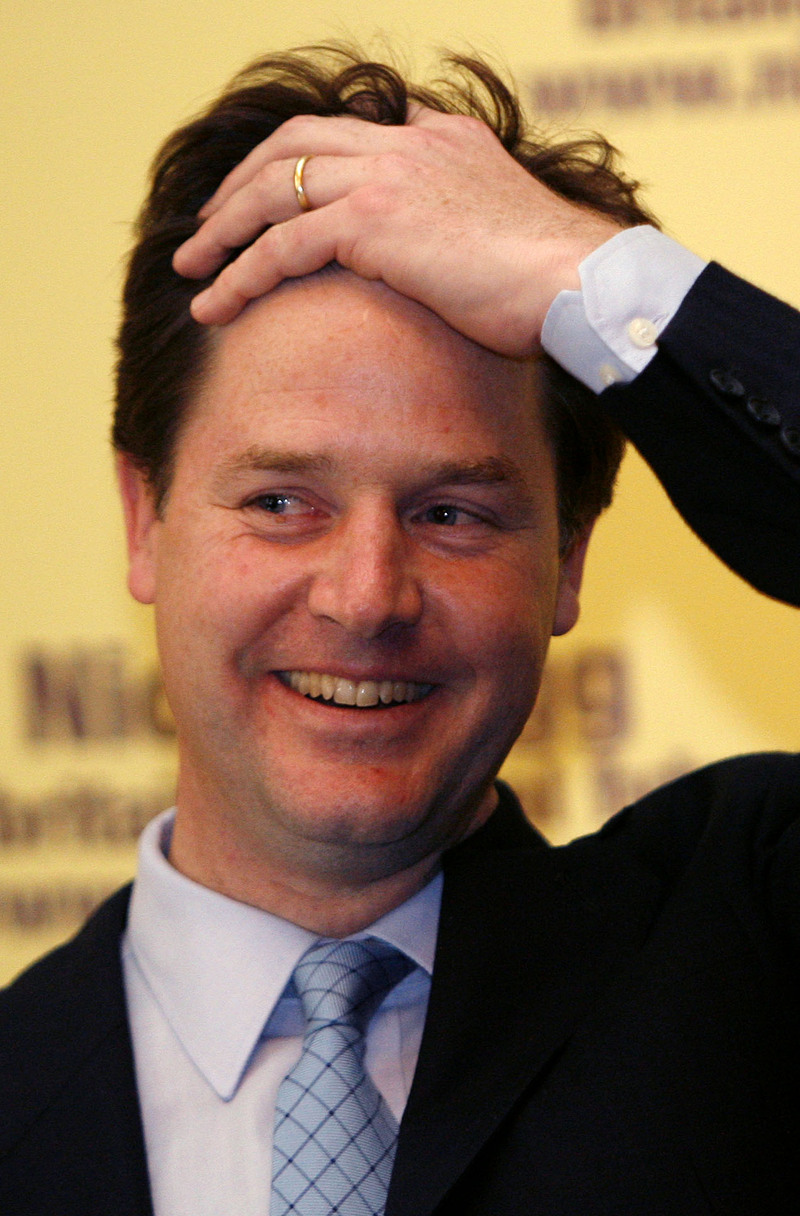
Nick Clegg, Leader of the UK Liberal Democrats

I wish I could take credit for the headline, but credit must go to Anne Perkins of The Guardian-UK. Earlier today, Labour leader Gordon Brown tendered his resignation to the Queen after it looks like the Liberal Democrats and the Conservatives are close to striking a deal. This would hand the Prime Minister spot to Tory leader, David Cameron, in a coalition that will have a majority of the seats in Parliament. Six months ago, Clegg had not many good things to say about the Tories::

“If progressives are to avoid being marginalised by an ideologically-barren Conservative party, bereft of any discernible convictions other than a sense of entitlement that is now their turn to govern, then the progressive forces in British politics must regroup under a new banner.”

I’m curious what this coalition will look like, given how a Lib-Con coalition will make for some strange bedfellows. Indeed, Anne is right, as the Conservatives won’t just be holding hands with the Lib Dems, but sharing power and cabinet seats.

I’m not against coalitions or parties changing their stances on issues, as I’ve blogged about earlier today on rhizomicon. Where things get dicey is keeping the coalition together and making sure the voters in the MP’s constituencies are on-board. Also, Perkins points out that such coalitions are rare and usually occur under dire circumstances::

“In Westminster history, coalition has always been about demonstrating unity in crisis, leading by example in a response to war or national disaster. Times are hard; the economic situation is bleak. But we are not living in a time of national catastrophe. At least not yet.”

On the web, pundits, journalists, and commentors on news sites are shouting “sellout” on the part of Nick Clegg and David Cameron. While the specifics aren’t out, the rumour mill is that the Lib Dems made concessions on::

  1. Immigration amnesty
  2. Defence policy & Trident
  3. Closer ties to Europe

Will these be dealbreakers to Lib-Dem MPs, who still need to ratify the deal, and those who supported them? The Lib-Dems were a platform of change and while a coalition implies concessions on both sides, will a Lib-Con coalition leave a bad taste in the mouths of many?

David Cameron doesn’t need the support of his party, but I question how hard-line conservatives will perceive this power sharing arrangement.

Song:: Selecter-‘Selling Out Your Future’

Twitterversion:: UK Lib-Con coalition imminent, but as Ann Perkins says “not a marriage of convenience but actual sex” #ThickCulture @Prof_K

This is video circulating that might turn into a meme, but it’s not that exciting. It involves a right-wing candidate for Parliament in the UK getting into an altercation with local South Asian youths. The British National Party candidate, Bob Bailey, made a reference to the youths as “robbers” that caused them to come over. After some words, one of them spat at Bailey and a scuffle ensued. It looks like nobody was hurt and just some egos got bruised.

I’m not sure if the youths even knew who Bailey was, but his views might explain his interest in engaging them. Last June, Bailey went on the record stating his concerns about Islam, how the “British” birth rate is below the Islamic birth rate in the UK, and his looking out for the white indigenous population of Britain {go to 1:33 to see Bailey in an interview-via Iranian PRESS TV}::

Bailey lost the election and finished in 4th. place. The Conservatives won the outer east London constituency of Romford.

Song:: The Specials-‘Simmer Down’

Twitterversion:: British National Party candidate taunts S.Asian youths, gets spat on, & a scuffle ensues—a perfect YouTube moment. @Prof_K

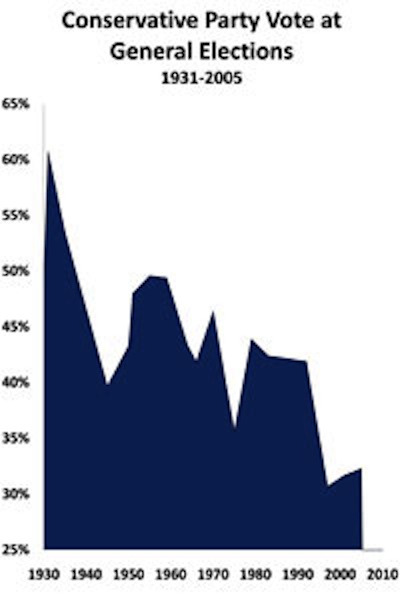
I’ve been following the 2010 UK election which is tomorrow. I saw this John Ross article on the long-term Conservative decline in the UK. The Tories are likely to have the most seats after tomorrow, have a shot at getting a majority of the seats, and the bookies are expecting a Conservative victory. Nevertheless, even if the Conservatives get the expected 35-40% of the national vote, the overall trend is downwards. The Thatcher-Major era in the 80s and 90s saw Conservative support only in the low 40s. Ross notes that the recent rise of Labour since 1997 has a lot to do with the Tories being unpopular.
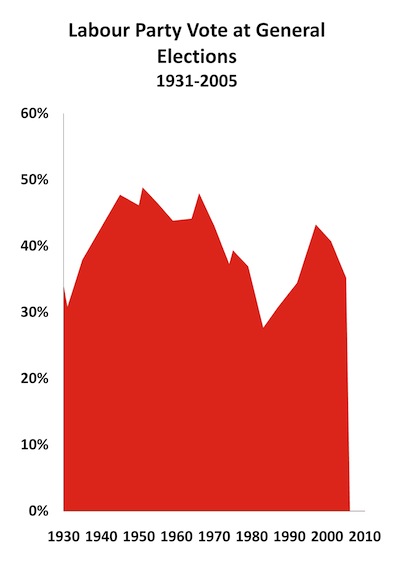
Also of interest is the rise of the Liberals/Liberal Democrats::
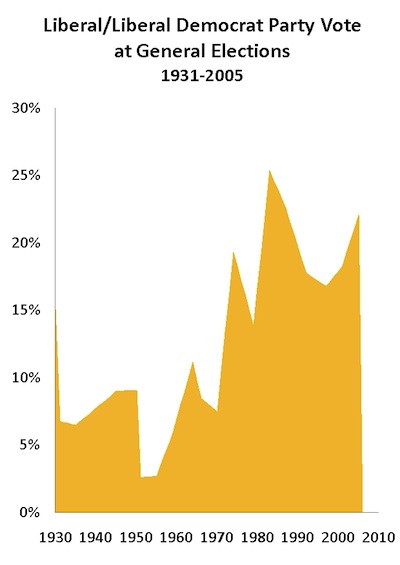
Just like the current situation in Canada, the electorate is fragmented and the major parties are having a hard time gaining support.
Twitterversion:: Graphs by John Ross show decline trend in UK Tory support since 1930. Labour seesaws & Liberals trend up. @Prof_K

Song:: The {English} Beat-‘Stand Down Margaret’ – Reference to Margaret Thatcher, Tory UK PM, 1979-1990

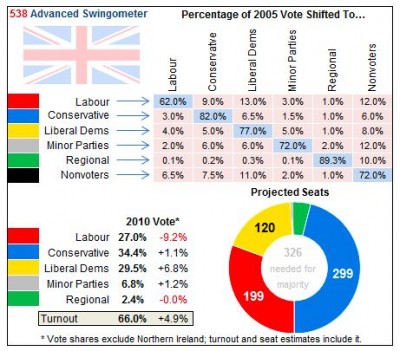
Nate Silver's 2010 UK Elections Prediction, fivethirtyeight.com

Above are the predictions for next week’s UK parliamentary election by fivethirtyeight.com, in collaboration with The Guardian. The Guardian doesn’t expect a radical shift from these numbers and the big question is whether the Conservatives will get a majority of seats.

The methodology behind the predictions is being challenged by psephologists adhering to the uniform swing hypothesis, in what Nate Silver calls a nerdfight. The uniform swing hypothesis states that if a party finishes x points behind their standing in the previous election, their share of the vote will decline by x points in each constituency.

“The uniform swing has its proponents, and it has the virtue of being fairly easy to calculate. But, most recent elections in the United Kingdom have not been all that dramatic, with fairly minor shifts in the vote between Labour and Conservatives. The last time that there was something resembling a ‘wave’ election — in 1997 when Labour, under Tony Blair, leaped forward from 34 percent of the vote to 43 — the uniform swing would have underestimated their gains by about 25 seats, and underestimated Conservatives’ losses by 40. And that election did not feature — as this one does — a third party like the Liberal Democrats who were polling right in line with, and often ahead of, the other two.” [*]

Nate does a good job of responding to a critique of his methodology and explaining how uniform swing is still a hypothesis. I like the granularity of the fivethirtyeight.com methodology and agree with Silver’s assertion that not all constituencies will respond uniformly to the political zeitgeist. I’ve explored second choices and the use of social network analysis in order to get a better sense of where the political zeitgeist is and I’m wondering how this could add more fine-tuning to prediction models.

Song:: Billy Bragg-‘Waiting for a Great Leap Forward’

Twitterversion:: New fivethirtyeight / Guardian election seat predictions for UK elections & “nerdfight” over uniform swing. @Prof_K

I found this YouTube video from the UK to be interesting, as it shows a young person trying to sort out politics and questioning democracy in light of the media and capitalism. The video description by Annika sets up the current situation in the UK {from 2 January 2010}::

“Only 76% of Brits bother to vote. Even worse, only 54% of Americans vote.

The present Parliament which first met on 11 May 2005 is scheduled to expire at midnight on 10 May 2010. The next United Kingdom general election is due to take place on or before Thursday 3 June 2010. The governing Labour Party will be looking to secure a fourth consecutive term in office and to restore support lost since 1997. The Conservative Party will seek to regain its dominant position in politics after losses in the 1990s, and to replace Labour as the governing party. The Liberal Democrats hope to make gains from both sides; although they too would ideally wish to form a government, their more realistic ambition is to hold the balance of power in a hung parliament.”

The distrust of the institutions of political parties is an issue in the US, Canada, and the UK, which causes Annika to discount the rhetoric, as well as the spin by the institution of the media. My concerns are that the political institutions and infotainment are turning people off of politics.

While the use of social media, such as YouTube and what Annika is doing, can decentralize information dissemination and foster dialog, does the attention economy bring us right back to large numbers of people going to “destination websites” and what does this do to the signal-to-noise ratio? Also, how can social media be used to foster civil discourse and the exchange of ideas, as opposed to shouting at each other?

While some may think Annika’s thoughts about democracy to be rather cynical, I think it’s a good point of departure for politicians to address the issue of why democracy does matter despite the influence of media and capitalism that can serve to make citizens feel as though it doesn’t. Particularly in the midst of the Big Recession, where government is the bearer of bad news regardless of ideological leaning.

Twitterversion:: Politics & distrust of political parties and media’s influence. Can democracy be made salient? Can true dialog be fostered by social media? #ThickCulture @Prof_K
Song:: Sparklehorse-‘Getting It Wrong’

Earlier in the month, I blogged about the forthcoming UK elections and on Rhizomicon, I blogged about the first-ever debate of the party leaders. In the first debate, the leader of the third-party challenging Liberal Democrats, Nick Clegg, made a strong showing. The above video is about the second debate held in Bristol on foreign affairs. Both Labour {Gordon Brown} and the Conservatives {Nick Cameron} made a point of attacking Clegg, in a bid to undermine support for the Liberal Democrats and increase the chance of obtaining a majority by winning swing ridings constituencies {districts}. Clegg seemed to hold his own. The recent polls are such that an outright majority is unlikely, unless the LibDems collapse between now and 5 May. This means that a hung Parliament is likely. The last debate will be on 29 April in the Midlands on economic policy. Get your popcorn ready. Canadians can watch on cable or online at CPAC. The other debates are archived on the link. Post a comment if you can watch them in the US or wherever you may be outside of Canada.

Twitterversion:: Second UK Debate has LibDem Nick Clegg hanging tough against Labour & Tories. Hung Parliament increasingly likely. #ThickCulture @Prof_K

Song:: The Jam-”A’ Bomb in Wardour Street’

Gordon Brown, Prime Minister UK, Labour Party

I read several articles about a Tory surge in the polls in the UK, but this Guardian article says it might be overplayed. Brown dissolved Parliament and an election has been set for 6 May, a mercifully short election season, when compared to the US. Labour, in power since 1997, back in the heady days when Tony Blair was the face of a new Labour party, ending the 18-year run of the Conservatives. I’ve read that after 18 years in power, the tories were in disarray and parallels have been drawn between the Thatcher-Major era and W’s 2000-2008 presidencies.

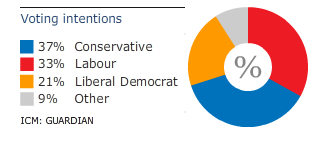
Labour is saddled with a sagging UK economy and the public is tired of politicians and being perceived as an outsider will be beneficial. The economy is the major issue, although immigration, unemployment, and the deficit are also issues voters care about. The overall voting intent paints a grim picture, but the election will hinge upon what happens in the ridings and which party gets a majority of seats::

If no party gets a majority, the result will be a hung parliament and parties working in coalitions, which some say makes investors uneasy and can make enacting economy-fixing policy difficult. This article echoes these sentiments and interprets the polls as pointing to a hung Parliament.

The expectation is the election to be hotly contested and there will be American-style televised debates for the first time. There will be three themed debates in different parts of the country. Frontrunners typically eschew elections. Since Labour is behind in the polls, allowing debates may allow Labour to redefine itself and come across as “outsiders” out to reform government. The scuttlebutt says that Conservative Leader, David Cameron, has a winsome manner in the spirit of Blair, with a message of compassionate conservatism. {The Conservatives have tried to shed the reputation of being “nasty” and have embraced gays, women, and ethnic minoriries, at least at the surface.} Brown has the reputation of being scholarly and a tad dry. This may remind Canadians of Stéphane Dion, the immediate-past Liberal Leader.

Without digging deep into the poll numbers, my 40,000′ take is the winner will be the party who appears most credible with the economy. The financial crisis stung the UK and rank-and-file workers are still fuming about “fat cats”. Given this, a Keynesian approach {addressing unemployment} in concert with finance reform should give Labour quite a bit of mileage. Both the Labour and Conservative parties supports involvement in Afghanistan, which may be increasingly tough sells, given domestic spending and deficit concerns.

Update {6 April 2010, 6:10PM EDT}:: My blog post on rhizomicon has video clips of PMQs, where Cameron and Brown are going toe-to-toe in a Q&A.

Twitterversion:: @gordonbrown’s Labour {UK}, in for a fight with upcoming elections against David Cameron’s @conservatives#ThickCulture @Prof_K

Song:: George Michael-‘Shoot the Dog’ {2002}, backstory here.