
South Asian

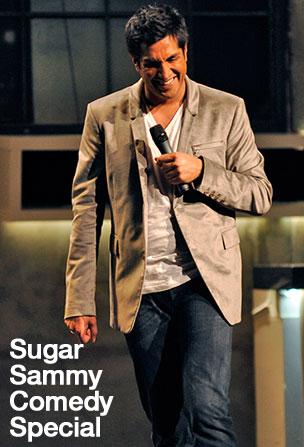
Montréal comic, Samir Khullar AKA "Sugar Sammy", www.themovienetwork.ca

Notes from north of 49ºN

“Sugar Sammy” is an Indo-Canadian comic with a cultural studies degree from McGill who wants to portray the visible minority experience in Québec. While getting some acclaim in the anglophone realm and even had had a HBO special, the multilingual Sammy {who speaks Hindi, Punjabi, English, and French}, was up for an Olivier award for Québec humour.

A few weeks ago, I blogged about a Wind Mobile ad airing here in Canada that uses cultural stereotypes of south Asians as a part of its humour.  In that post, I brought up the Apu “problem”, where a Simpson’s character also uses cultural stereotypes to get laughs and to shill for 7-11 with a promotional tie-in in 2007. In this stand-up clip, Sammy goes after Apu and how it’s voiced by a non-South Asian {Hank Azaria} and how media portrayals of South Asians tend towards the weird {go to 3:05}::

While using race as fodder for comedy is nothing new, there’s arguably more room for alternative cultural narratives, particularly with the proliferation of social media. Sammy’s experience of being Indian in a francophone region of a predominantly anglophone country is a story of confluences of culture, politics, and power. In Québec, Bill 101/Loi 101 is the law of the land, where the primary language of instruction in the province is French, as part of attempts to make French language the norm in the province.

Mr. Khullar delivers his routines in flawless French, the result of being streamed into French school along with all the immigrant children in his multicultural neighbourhood of Côte-des-Neiges in Montréal. At the time, the lack of choice wasn’t a big hit in the Khullar household.

But today, the thirtysomething comic acknowledges it’s given him his chance at succeeding on home turf.

‘I’m a child of Bill 101,” he says. “I’m happy I went to French school, because my French wouldn’t have been this good. The more languages I speak, the more people I reach.'”

Sammy’s jokes hit themes where many anglophones would fear to tread—at least in front of an audience at a comedy show. He touches on the cultural stereotypes of the Québécois, but he can do so in perfect French::

video [French]:: “Les Québécois” skit, nominee for Olivier Award

While it may seem like a double-standard that Sammy can poke fun of cultural stereotypes of the Québécois and it seems offsides that the dominant culture poke fun of the South Asian stereotypes, one could say it’s a matter of the dynamics of cultural power and which group has it. Arguably, Sammy gets away with his comedic critiques with respect to Québec audiences because {1} he’s not anglo—i.e., he’s not a member of the dominant anglophone Canadian culture that many in Québec see as hegemonic and {2} he speaks perfect French.

Sammy didn’t win the Olivier award, but you’d be hard-pressed to know that if you just followed the anglophone press. I had to dig deep and use my rudimentary French to find the winners on the Radio-Canada {French CBC} site.

When it comes to comedy in Canada, I think it’s safe to say there’s one safe target no matter who you are. Americans. Of course, this a topic for another blog.

Song:: Malajube-‘St. Fortunat’

Twitterversion:: [blog] Multilingual Indo-Canadian comic Sugar Sammy negotiates cult. boundaries in post-Bill/Loi 101 Quebec #ThickCulture @Prof_K

Notes from north of 49ºN

A shorter, more applied version of this appears on rhizomicon.

The above Wind Mobile commercial is for a Canadian cellphone carrier, competing with the big three, Bell, Rogers, and Telus. The humour is derived from characterizing the major wireless carriers as entities that turn a nominal charge into a much larger one with extra fees and charges. Another facet is the use of a South Asian hot dog vendor to make the point, using an accent and cultural stereotypes familiar in North America. The South Asian-Canadian population was 4% of the population in 2006, categorized as visible minorities., i.e., visibly not one of the majority race in a population.

Is this Wind commercial offensive?

This reminds me of a 2007 Guardian UK piece by Manish Vij criticizing the use of The Simpson’s character of Apu Nahasapeemapetilon by 7-11 as part of a tie-in promotion.

“Apu is quite a unique character on The Simpsons. Unlike the show’s parodies of policemen and Irish-Americans, he’s the only character to mock a small American minority relatively unknown in the mainstream, and he’s by far the most visible immigrant. For desis (South Asians) growing up in America, just one eighth as concentrated and visible as in the UK, Apu shadowed us at every turn. Until the rise of American Idol chanteur Sanjaya Malakar, Apu was the most widely-known Indian after Mahatma Gandhi. And he has that fake Peter Sellers simulacrum of an Indian accent: Apu’s voice Hank Azaria, a Greek-American, is a brown man doing a white man doing a brown man.

To be sure, Apu has many redeeming qualities: a loving wife, passive-aggressive cunning, and a Ph.D. Culture-vulture Simpsons fans have felled entire forests in arguing that he’s a parody of a stereotype, rather than the stereotype itself. But the plain fact is that most viewers are laughing at Apu, not with him. They’re enjoying the simple pleasures of a funny, singsong brown man with a slippery grasp of English.”

Manish states that not all South Asians were against the promotion, but quotes a post on an online 7-11 franchise forum::

“This is an absolute embarrassment for our company… The vast majority of franchisees are immigrants… [A]ccepting our portrayal of Apu is nothing less [than] accepting the images portrayed years ago in the US of black people with very black faces, big lips and white teeth… [T]hat image is considered racist, so does Apu [seem] to me… I cannot imagine any store willing to rebrand to Kwik-E-Mart even for a day… I am not proud to be part of this promotion.”

Some commenters on the Guardian’s site and elsewhere this was discussed were quick to say the reaction is overly-PC and that The Simpsons have poked fun of the Scots with Groundskeeper Willie.

It’s easy to get into pissing matches about who one can and cannot make fun of in a post-racial world, isn’t the real issue about cultural power, privilege, and dominant and dominated positions? Does the rise of black cultural power in the US explain why outrageous stereotypes and iconography are now taboo? While some may eyeroll at complaints by groups that point out racism as overly-PC, isn’t protesting/complaining one means of how cultural power is obtained/negotiated?

The problem is that the stereotypes often serve to reinforce unflattering or negative attitudes towards a stigmatized outgroup. So, in Harold and Kumar Go to White Castle {2004}, despite Kumar being an upper-middle class medical school candidate who speaks perfect English without an accent, local thugs use cultural power to harass him with the taunt,”thank you, come again.” Later in the film, Kumar used the taunt ironically right back at his harassers::

The lines of cultural power and privilege can get blurry. Media and advertising infuse meaning and shape attitudes, but what’s a marketer/advertiser to do? The use of stereotypes is meant to increase the efficacy of the communication, i.e., ideally the content resonates more with the audience. On the other hand, should marketers and advertisers steer clear of using stereotypes in a non-ironic way, in order to protect the brand from being labelled as insensitive? Some might say that those who take offense need to “get over it,” but before someone goes on the record as saying that, perhaps they should ask themselves how much cultural power they have.

Twitterversion:: Wind Mobile hotdog cart ad in Canada uses stereotypes to make a humourous pt. Is it offensive or benign? #ThickCulture @Prof_K

Song:: M.I.A. -‘World Town’