racism

Screencap of  Audra Shay's Facebook page

Screencap of Audra Shay's Facebook page

Last week, the Young Republicans got into a dustup over yet another Facebook flap.  This spring, we discussed how Facebook derailed an NDP candidate to provincial office in British Columbia, when the BC-Liberal opposition got wind of “racy” photos posted.  In this incident, there’s differing opinions which are arguably representations of fragmentation in the Republican Party.  According to the DailyBeast, it started with Audra Shay, vice chairman of the Young Republicans hosting a discussion on Wal*Mart endorsing Barack Obama’s health care plan.  Things unravelled when an “Eric S. Piker” made racially charged comments using the word “coon,” another ThickCulture topic from the spring {See above}.  Audra agreed with the statements, adding a LOL.

Subsequently, there were others criticizing these remarks, Cassie Wallender {a national committeewoman from the Washington Young Republican Federation} and Sean Connor {chairman of the D.C. Young Republicans}.  While these critics were “de-friended” by Audra, “Piker,” for the time being, remained a “friend.”  On Thursday, a black Republican activist, Lenny McAllister condemned these remarks and prior statements by Shay::

YouTube Preview Image

McAllister references a culture war going on in the Republican Party and regarding the racially charged remarks going around, he stated “You can cover cyanide with chocolate, but you still can’t call it candy.”

Her own recounting of the events, possible unaware of the screencap, paint a different picture of the events.  In her statement on 3 July, Shay went on to denounce the remarks and attributed the dustup to her political enemies capitalizing on an opportunity.  Irreparable damage may have already been done, as her upcoming bid to be Young Republican chairman may have been derailed.  

I’m not going to engage in any admonishing finger-waving on the dangers of social media, a bete-noire of mine.  I think this is beyond a matter of “political correctness” or freedom of speech issues and do reflect a growing divide between moderates and a more divisive fringe.  Indicative of this is how moderates are often criticized as being RINOs, Republicans-in-name-only, who are not sufficiently conservative. The RINO label was thrown at Wallender by Shay supporters after her criticism of the racial remarks.  In order for Republicans to move forward, they will have to deal with these issues head-on.  Will they use social media to do this?

Twitterversion:: #YoungRepublican schism over racially-charged #Facebook flap. Indicative of a larger #CultureWar within the party?  @Prof_K

Song:: Space Oddity (1990 Digital Remaster) – David Bowie


ishr-burka-1

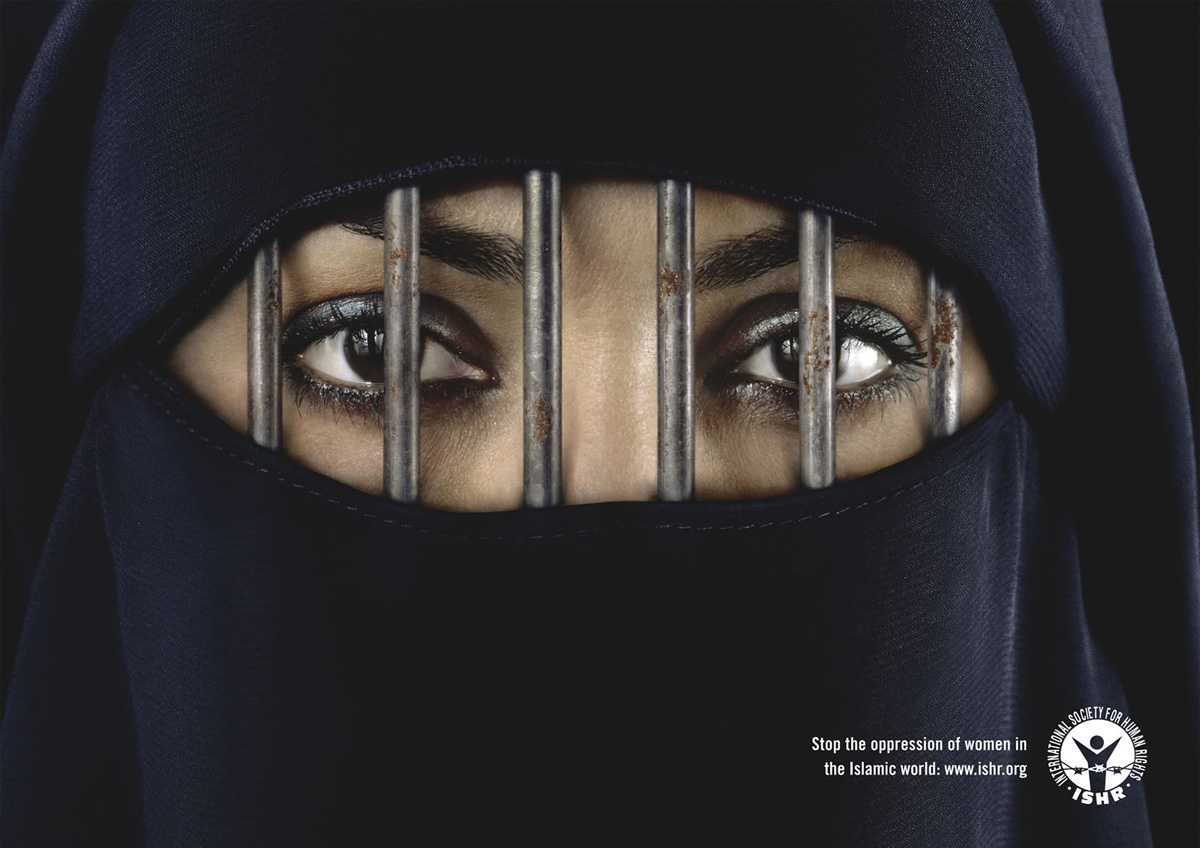
The conservative French president, Nicolas Sarkozy, has expressed concern that the burqa is subjugating women in France.  Addressing both parliamentary houses in the Palace of Versailles::

“The burka is not a sign of religion, it is a sign of subservience…It will not be welcome on the territory of the French republic.”

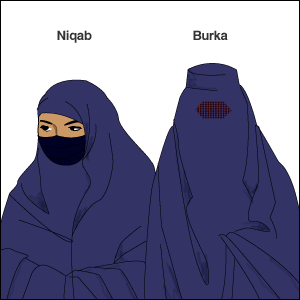
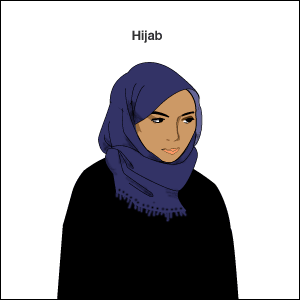
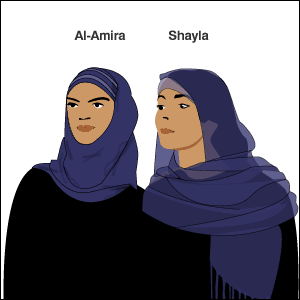
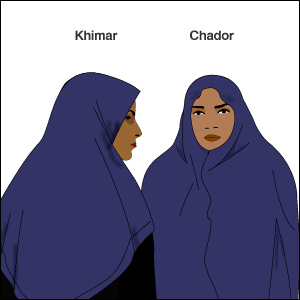
The BBC clarified the different types of Islamic headscarves {below}.  Sarkozy emphasized that this isn’t about disrespecting Islam and a group of cross-party French legislators are interested in examining whether women wearing the burqa is undermining French secularism and also whether womem wearing the veil are doing so voluntarily.

The French government banned the Islamic headscarf and other conspicuous religious symbols in 2004 although within the government, there is no consensus on the issue.  In the US, somehow I think that no matter how hard the polygamy and abuse angles are pushed, there won’t be any bans on FLDS garb.

Last year, the Urban Affairs minister, Fadela Amara, born in France to Algerian parents, has been a harsh critic of the burqa.  A feminist who has fought racism for decades, Amara grew up in one of the rough banlieues of Paris, knowing the often ugly intersections of race, culture, and gender.  After a 2008 court case case denying a Moroccan woman citizenship was upheld, Amara said she supported the ruling, in the hopes that it would  dissuade fanatical Islamic followers from imposing the burka on their wives.  In an interview with Le Parisien, she said::

“The burka is a prison, it’s a straitjacket”

“It is not a religious insignia but the insignia of a totalitarian political project that advocates inequality between the sexes and which is totally devoid of democracy.”

This brings up an interesting issue, since banning clothing has been associated with anti-immigration politics throughout Europe.  The fact of the matter is that if France decides to move towards a banning of the burqa, some argue this is likely to limit radical Islamic women’s freedom even more, as men may not allow them out at all.

Barring the possibility of some celebrity starting a burqa trend, i.e., secularizing it, such a ruling would be in conflict with the French concept of laïcité , a variant of the concept of the separation of church and state.  More subtle is an idea that banning the burqa does symbolic violence to the “other.”  Pierre Bourdieu notes in Distinction how subjugation and control are manifested in the everyday::

“…the social relations objectified in familiar objects, in their luxury or poverty, their ‘distinction’ or ‘vulgarity’, their ‘beauty’ or ‘ugliness’, impress themselves through bodily experiences which may be as profoundly unconscious as the quiet caress of beige carpets or the thin clamminess of tattered, garish linoleum.”

The Islamic veil has been isolated and socially categorized.  The attention given it has stigmatized it.  Ironically, within extreme Islam, it has its own symbolic baggage, particularly as it crosses national borders.  While scrutiny of the Islamic veil can foster a political agenda by conservatives and a feminist agenda, is doing so through such symbolic violence the best way to institute social change?

Twitterversion:: #Burka under fire in #France. #Sarkozy and #feminists meeting in anti-extreme Islam common ground? #feminism #Bourdieu http://url.ie/1wt4 #feminism @Prof_K

Niqab/Burqa:: niqab is a veil for the face that leaves the area around the eyes clear. However, it may be worn with a separate eye veil. burka is the most concealing of all Islamic veils. It covers the entire face and body, leaving just a mesh screen to see through.

Hijab:: regarded by many Muslims as a symbol of both religion and womanhood, come in a myriad of styles and colours.

Al-Amira/Shayla:: al-amira is a two-piece veil.  shayla is a long, rectangular scarf popular in the Gulf region. It is wrapped around the head and tucked or pinned in place at the shoulders.
Al-Amira/Shayla:: al-amira is a two-piece veil. shayla is a long, rectangular scarf popular in the Gulf region. It is wrapped around the head and tucked or pinned in place at the shoulders.

Khimar/Shador:: khimar is a long, cape-like veil that hangs down to just above the waist. It covers the hair, neck and shoulders completely, but leaves the face clear.  The chador, worn by many Iranian women when outside the house, is a full-body cloak. It is often accompanied by a smaller headscarf underneath.
Khimar/Shador:: khimar is a long, cape-like veil that hangs down to just above the waist. It covers the hair, neck and shoulders completely, but leaves the face clear. The chador, worn by many Iranian women when outside the house, is a full-body cloak. It is often accompanied by a smaller headscarf underneath.


Song:: La Danse Des Negresse Vertes – Les Negresses Vertes