politics

This is the second instalment of a three-part series of posts on the media:

  1. Media & the Selective Outrage Machine
  2. The Culture War Is Not Really Taking Place
  3. The Big Hit:: CBC v. The Canadian Cancer Society

My last post was the media’s role in creating a dramaturgical stage of manufactured outrage that’s affecting how people behave within institutional contexts. This post is about media manufacturing a reality by presenting stylized facts and selectively using the “culture war” to do it. While partisan punditry becomes increasingly popular, I would argue that what’s bound to evolve is a news positioning that’s market-driven in more ways than one. The free market is reified and deified, but in a way that’s meant to appeal to advertisers {subscribers and pageviews} and consumers {an economic orthodoxy based on neoliberal views or views positioned as such}. The market is both subject and object. A media culture war has already emerged along specific faultlines, with “code” used by the combatants to frame the rhetoric on both sides. And, it is a war. There’s no room for civil discourse on the battlefield, but perhaps more aptly, there’s no patience for it.

Given the recent News of the World scandal, journalists are getting scrutinized for their ethics, but aren’t the nefarious and illegal tactics allegedly used by NoW the logical progression in an era of extreme coverage that’s meant to evoke visceral reactions and tap into raw emotions? I would argue, in the vein of Jean Baudrillard’s The Gulf War Did Not Take Place, that the institution of journalism helps to construct a configuration of society, often based upon, for example, lurid details, scandal, fail, and the polarities of the culture war. Currently, the drawn battle lines tend to cleave along political party affiliations::

  • rural regions/suburbs v. cities
  • social & cultural programmes v. market fundamentalism
  • traditionalism v. progressivism
  • fiscal conservatism v. “tax and spend”
  • multiculturalism v. “anti-political correctness”
  • Pro-immigration v. xenophobia
  • Pro choice v. pro life
  • Marriage is between “Adam & Eve” v. “Adam & Steve”
  • Unions v. management

Canadians will be subject to another divide::

  • Québec v. ROC (rest of Canada)

You get the picture. The idea is to exploit wedge issues by fostering controversy. But, the culture war isn’t really taking place—we seeing is a media manufactured manifestation of it and what we know about the opposing position is a fiction created by media rhetoric that places the values of those who don’t share our views as on a different planet. A few select juicy quotes here or a controversial soundbite there serve as empirical truth of what’s going on. After all, how many people know that the post-Katrina violence in the Superdome & Convention Center were vastly overstated? I would hazard to guess that many who heard the initial stories of anarchy in the Big Easy in the wake of the storm still have the perception that the city decended into a Hobbesean state akin to the Lord of the Flies. Of course, how this is framed means that cultural logics can be cued without saying anything outright, which is part of the theatrics.

I would argue that this use of the culture war will evolve into a more complex mapping that transcends traditional party lines, in both the US and Canada. In this current era, journalism isn’t rewarded for reporting on the issues, but for shaping and manufacturing them in an often desperate attempt to garner subscriptions and pageviews. Something may start as “grassroots” or may “go viral”, but as soon as the media gets a hold of it, it morphs into a piece of an agenda. You can blame it on the 24/7 news cycle and the rise of infotainment that successfully monetized the “news”, but it doesn’t matter; the genie is out of the bottle. The culture war is perfect fodder to whip readers into a frenzy by presenting the extremes and those across the divide as a polar opposite, while constructing a reality that may not even exist. This works by tapping into our values and attitudes and framing stories to get maximum polarity. It’s an economic imperative for the business model.

The above list of culture war wedge issues isn’t a continuum in practice; it’s binary. The opposing view is characterized as a polar opposite, often with inflammatory rhetoric. This is exacerbated by the fact that the public is less interested in news on a purely factual basis, particularly in the realm of politics and the economics, given the attention economy {the scarce commodity is our time}. We often seek information that’s been pre-digested in a manner most palatable to us. The function of news media now is to present the extraordinary with an emphasis on the sensational. The “cultural products” of the news media are soundbites and sexy attention grabbing headlines, increasingly important as Internet headlines can persuade and “inform” without even being clicked on.

Up in Canada, while many media outlets will stoke the fires of the culture wars, merely invoking the term invites criticism. When pollster Frank Graves of EKOS used it last year to identify a strategy for the Liberals, all hell broke loose. After all, why would anyone want to bring the ugliness of US-style politics to Canada? Well, the truth of the matter is that the news media has much to gain from the culture war and the class war that’s nested within it, but don’t want to ever get caught promoting it. Graves’ great crime was putting a possible strategy out there that could  be used against the Conservatives that some construed as distasteful::

“I told them that they should invoke a culture war. Cosmopolitanism versus parochialism, secularism versus moralism, Obama versus Palin, tolerance versus racism and homophobia, democracy versus autocracy. If the cranky old men in Alberta don’t like it, too bad. Go south and vote for Palin.”

The “controversy” of Graves’ statement was manufactured and used as evidence of his partisanship, but it’s hardly shocking. Graves wasn’t talking about anything new in terms of Canadian political marketing, he just dared to put it out there in such stark terms. He unmasked the great Oz and violated the social compact by showing how the persuasion sausage is made.

The US is more accustomed to journalists, pundits, and politicians invoking the culture war and I would argue that the heated rhetoric dividing the left and the right is a product of the media manufacturing realities so that groups become extreme caricatures. Underlying all of this right now is a general uneasiness of the future of the middle class and partisan rhetoric is shaping a class war by using the culture war.

Canada has a few journalists who are exemplars of what I see as the future of this trajectory. What might this future be? Look to journalistic statements in magazines like Maclean’s magazine {a Canadian weekly} and by journalists like its national editor, Andrew Coyne and his ilk, e.g.Margaret Wente, are couched in false dichotomies with the volume turned to 11. The emphasis is on commentary, as opposed to hard news, but there’s a sly twist. Journalists like Coyne and Wente position themselves as iconoclasts that defy partisan lines, but know how to sniff out controversy and milk it for all it’s worth. They would scoff at this idea they’re exploiting the culture war, which is also part of the shtick. In this era of social media and conversations, Coyne prefers to use all media at his disposal {Maclean’s, Twitter, CBC-‘At Issue’ panelist on The National} like a megaphone aimed at the masses and that’s too bad. What’s lost is nuance and real dialogue. What this brand of journalism does is foster people shouting at each other, because, after all in a Charlie Sheen world, it’s about the winning—and the drama. The name of the game is staying relevant and Coyne and Wente are making a play with their centrist, iconoclastic approach. It would be brilliant if it weren’t so utterly sloppy in its execution, but I’ll be blogging more about this in a future entry. The result is that it’s hard to take either Coyne or Wente seriously.

My lament for what’s lost with this journalistic divisive theatre is somewhat half-hearted because what else should we expect when the fourth estate is tied to business models and financial imperatives? George Monbiot, in his “A Hippocratic Oath for Journalists”, makes some interesting observations in the wake of the NoW scandal::

“Journalism’s primary purpose is to hold power to account. This purpose has been perfectly inverted. Columnists and bloggers are employed as the enforcers of corporate power, denouncing people who criticise its interests, bullying the powerless. The press barons allowed governments occasionally to promote the interests of the poor, but never to hamper the interests of the rich.”

Monbiot’s words may sound a bit strong, but given that journalism is a business trying to keep its head above water these days, it makes perfect sense that the institution will use whatever means to ensure its own survival. I agree that journalism’s function these days is anything but holding power to account and would argue that most of the time it has functioned as chief architect in the fabrication of an elaborate cultural reality—a simulacrum embedded within media economics.

There is room for pushback. Big media are subject to the constraints of mass markets and by ultimately who pays the bills, i.e., the consumer and advertisers. Technology can enable a cost-effective end-run around the prefab strategies and canned approaches that are more about marketing than news. The target market being people wanting in-depth analysis, as opposed to dramaturgical showmanship. In essence, the long-tail of news. The Economist noted back in 2006 that hard-hitting journalism won’t die and there will be a market for it, but I would argue that in order to serve the journalistic function of holding power to account, alternative models will need to offer substance over infotainment. Ironically, it may well be the mainstream media and its reality distortion machine to produce the future that serves to create a consciousness that rejects it. What could possibly break the bonds of the news-consumption cycle? Prolonged economic doldrums that sow the seeds for a bona-fide class war, not an imagined one.

Twitterversion:: [blog] How the culture war “isn’t” really taking place & how angry “iconoclastic centrism” is journalism’s next big thing @Prof_K @ThickCulture


While a rational comprehensive approach to policy is now seen as naiive in explaining how policy is decided upon, only now are we really delving into the role of emotions in policy making…..good times in my discipline.

Miller-McCune, our neighbors to the immediate north, have a nice summary of recent research on the role of anger in mobilizing voters. As one of the scholars summarized puts it:

Anger gets people engaged…. There’s a tendency among scholars and others to say that things like negative advertising are bad. But our paper points out that negative emotions like anger can bring people out and get people more involved. So the consequences aren’t all bad.

This gets us to a key tension in civic engagement. We want people to participate in politics, but we don’t spend much time thinking about how they should participate. All the efforts aimed at GOTV efforts (here’s a good local example) presume that voters know their interests and automatically express them when they go to vote. But I question whether a politics driven by outrage and anger produces good policy outcomes.

The great challenge is to get politics to be about other emotions. While anger has its place, it is not the only, or even the best emotion to employ when thinking about public life. I think the central conceit of representative democracy whereby the “best and the brightest” filter out the passion and anger of the masses through deliberation and compromise has its value, but a core downfall is that it doesn’t place much obligation on citizens to be reasonable or civil.

In that case, how do you introduce these other emotions into civic life. For example, how do you talk about a “politics of love” without sounding like some sort of irrelevant crunchy peacenik. It is here where public life is at its most partriarchal. The only allowable feelings to express in public discourse are traditionally masculine ones. But we know from life that anger has to be controlled or kept in check. We don’t seem to hold those same standards in public discourse. Instead suggesting and anger towards government is good and a sign of “caring” about civic life. If anger and stress have negative health effects on the body, it’s possible that they also have negative health effects on the body politic.

If you have the time this weekend, there is a very worthwhile video at the Milken Institute site from a conference held this week. The session linked to was titled, “The Attention Deficit Society: What Technology Is Doing to Our Brains,” where four expert speakers addressed this subject matter:

Put down the iPad and pay attention: Technology may be rewiring your brain. Scientists say our ability to focus is being undermined by Twitter feeds, smartphones and other digital distractions. Many experts believe excessive use of technology can make users more impatient, impulsive, forgetful and even narcissistic. It may reduce the ability to process information and think deeply and creatively. Distracted drivers have become a menace on the roads. Even worse, tech-obsessed parents spend less quality time with their children, causing not only hurt feelings but potentially stunting a child’s vocabulary and development. At the same time, studies show Internet users are more efficient at finding information, and gamers develop better visual acuity. Is the technology that was intended to make us more productive actually dumbing us down? Is its use in the classroom counterproductive? How does it change our culture and society in general?

That our brains are adapting to the constant use of technology is the contention of the first panellist, Nicholas Carr. Doesn’t sound like rocket science when you put it that way, it sounds like common sense but I’m not sure how much time people actually spend thinking about how they are using their own technology – smart phones, iPads, iPods – and how it is really changing their lives and their own capacities. It is very intriguing to hear the entire panel speak about the issues set out above. One of the other professors on the panel is presently living in the dorm rooms at Stanford to observe the way students are using technology. The MIT professor is fascinating.

If you have time for it, even part of it, it’s a good one. Our politics are affected by the way people are living with, using new technologies and getting changed by them. Anyone interested in crafting policies and messages going forward might be interested in giving it a look.

(h/t)

Worth a read today in its entirety, here is the beginning of Lakoff’s weekend piece on Conservatives and what is at stake in the Wisconsin conflict:

–Dedicated to the peaceful protestors in Wisconsin, February 19, 2011.

The central issue in our political life is not being discussed. At stake is the moral basis of American democracy.

The individual issues are all too real: assaults on unions, public employees, women’s rights, immigrants, the environment, health care, voting rights, food safety, pensions, prenatal care, science, public broadcasting, and on and on.

Budget deficits are a ruse, as we’ve seen in Wisconsin, where the governor turned a surplus into a deficit by providing corporate tax breaks, and then used the deficit as a ploy to break the unions, not just in Wisconsin, but seeking to be the first domino in a nationwide conservative movement.

Deficits can be addressed by raising revenue, plugging tax loopholes, putting people to work, and developing the economy long-term in all the ways the president has discussed. But deficits are not what really matters to conservatives.

Conservatives really want to change the basis of American life, to make America run according to the conservative moral worldview in all areas of life.

Paul Krugman wrote on Monday about the power play that is at work in Wisconsin in trying to bust the unions:

In principle, every American citizen has an equal say in our political process. In practice, of course, some of us are more equal than others. Billionaires can field armies of lobbyists; they can finance think tanks that put the desired spin on policy issues; they can funnel cash to politicians with sympathetic views (as the Koch brothers did in the case of Mr. Walker). On paper, we’re a one-person-one-vote nation; in reality, we’re more than a bit of an oligarchy, in which a handful of wealthy people dominate.

Given this reality, it’s important to have institutions that can act as counterweights to the power of big money. And unions are among the most important of these institutions.

You don’t have to love unions, you don’t have to believe that their policy positions are always right, to recognize that they’re among the few influential players in our political system representing the interests of middle- and working-class Americans, as opposed to the wealthy. Indeed, if America has become more oligarchic and less democratic over the last 30 years — which it has — that’s to an important extent due to the decline of private-sector unions.

And now Mr. Walker and his backers are trying to get rid of public-sector unions, too.

There’s a bitter irony here. The fiscal crisis in Wisconsin, as in other states, was largely caused by the increasing power of America’s oligarchy. After all, it was superwealthy players, not the general public, who pushed for financial deregulation and thereby set the stage for the economic crisis of 2008-9, a crisis whose aftermath is the main reason for the current budget crunch. And now the political right is trying to exploit that very crisis, using it to remove one of the few remaining checks on oligarchic influence.

So will the attack on unions succeed? I don’t know. But anyone who cares about retaining government of the people by the people should hope that it doesn’t.

For more background on this conflict, see Ezra Klein on the budget impact of the Governor’s tax cuts and this piece on the billionaire Koch brothers backing the Governor’s anti-union moves.

This is clearly an epic political battle playing out in Wisconsin with national implications for the U.S. Similarly, the conflict may prove instructive for Canada, also facing a very large budget deficit and presently led by a very right wing federal leader who likely sees similar opportunities to exploit as the nation will have to start grappling with that deficit in coming years.

While Sarah Palin’s recent use of “refudiate” twice would be a double facepalm moment for most politicians, perhaps she gets a bye because of her folksy patois. I do think she’s self-conscious of appearing none-too-smart and rather than just shrugging these things off, she gives them too much play, which is more fodder for the press and pundits. Of course, this keeps her in the limelight even more. While I think that might be shrewd for being a political celebrity of sorts, I think all of this self-consciousness undermines her credibility as a potential political candidate to an important demographic—educated suburban/urban moderates and independents.

This reminds me of the old Fox show In Living Color and Damon Wayans’ character, Oswald Bates, full of his own unique patois::

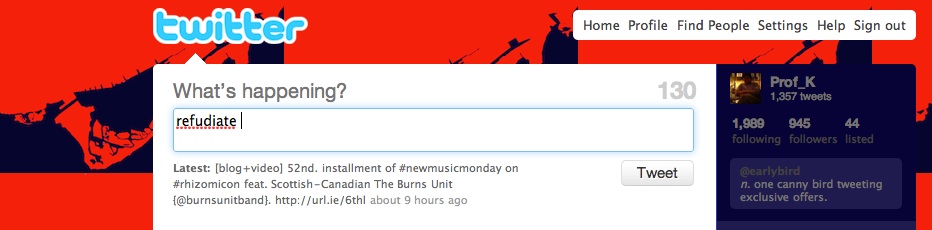
Just in case anyone cares, if you type in “refudiate” in Twitter…

there is a spellcheck that lets you know you’re in neologism territory…or are just misspelling words.

Song:: The Stills-‘Lola Stars & Stripes’ {lyrics}

Twitterversion:: [blog] Sarah Palin’s “Shakespearean” neologism of “refudiate” reminds me of an old Damon Wayans character. #ThickCulture @Prof_K

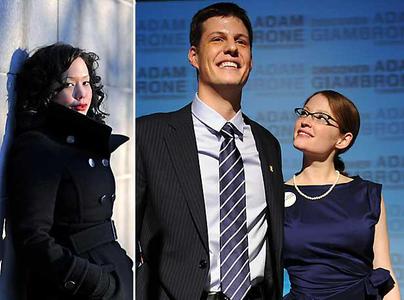
Mayoral hopeful Adam Giambrone and partner Sarah McQuarrie are seen at left; at right, Kristen Lucas. From Toronto Star.

Notes from North of 49ºN

This morning, the city of Toronto awoke to a mayoral candidate sex scandal that is likely to have zero effect on the outcome, given the strength of the frontrunner, George Smitherman. The Toronto Star had an article on how a woman came forward with text messages of a sexual nature and allegations that she had an affair with mayoral candidate Adam Giambrone, the Toronto Transit Commission chairman and City Councillor. Giambrone has a long-time girlfriend, Sarah McQuarrie. The article was full of lurid details, reminding me why I think of the Star as a bastion of hack journalism and often poorly-written articles. In the article, Adam called it a lapse in judgement and apologized to those close to him for the embarrassment his actions will cause them.

What I find interesting is not just how this story plays into the routine morality play of political sex scandals, but also how the press frames them. The above photo was in an article posted within the last 90 minutes on the Star, reporting that Giambrone is staying in the mayoral race. I found it interesting that the photo had images of “the couple” in clean-cut political mode, contrasted with “the other woman,” complete with low-cut blouse.  Here’s the photo from the story that ran this morning, echoing more of the same::

Kristen Lucas, left. Adam Giambrone & Sarah McQuarrie, right. Carlos Osorio, Toronto Star Staff

The Toronto Star might think I’m full of it {along with others}, but I think these photos are meant to reinforce, with a visual rhetoric, a specific normative political narrative with the intent of selling papers and fueling pageviews. WJT Mitchell wrote about “what do pictures want?” a few years back. These images attempt to simultaneously evoke an emotional response from us along with a judgment, as well as reinforce a narrative of our politicians.

The Torontoist had a good point by saying that this story is telling of our political culture.  They also question the correlation between one’s private life and the ability to be a good public servant. I have no idea what the truth is in this story, but I have three points to make::

  1. If politicians are to be held to a high moral standard, why not all persons in positions of power? If a boss has an affair, should that be unequivocal grounds for termination?
  2. Doesn’t this scrutiny of politician’s private lives, given how technology is eroding privacy, set a precedent for all of our lives to be potentially in the public sphere?
  3. Doesn’t this scrutiny incentivize more bad behaviours, as in the case of John Edwards who not only had an affair, but went to great lengths to cover it up.

Does this preclude a mainstream politician who is a “player” or polyamorous? I think it does. And the Star will ensure we get out collective fill of any lurid details or allegations of “deviance” to express our collective outrage, just like in Victorian times, when “smut” was published as a cautionary warning—and make fistfuls of cash.

Update {10 February 2010, 8:39a EST}::

Giambrone admitted to more affairs and politicians are going on record expressing shock, dismay, and calling for his withdrawal from the mayoral race. It looks like the Toronto Star wasn’t the only one interested in sexy pictures. There was just differences on the definition of sexy. Here’s an excerpt from today’s Globe & Mail::

“At first, Ms. Lucas seemed eager for more exposure. She sent several photos of herself to a local gossip website yesterday morning because she disliked the portraits that appeared in the Star, according to David Robert, manager of drinktheglitter.com. “She wanted sexy pictures of her to be out there,” he said. “She’s like, ‘They’re going to get out anyways.’ “ But she shrank from attention as interest in the scandal swelled. Ms. Lucas swiftly deleted her Facebook and Twitter pages. Mr. Robert said she also disconnected her phone number and shut herself inside her house in East York to escape the media swarm.

“I think this is crazy for her,” he said. “But, my god, I mean, [yesterday] morning she sent Canada’s highest-rated gossip site 10 pictures of herself.”

Twitterversion:: Blog: Trending topic #Giambrone dustup in #Toronto. Star reciting familiar verbal/visual tropes to make $$. #ThickCulture @Prof_K

Song:: The Wedding Present-“Unfaithful”

Notes from North of 49ºN

This is a follow-up post to:: Postcolonial Canada, National Identity, & the Nature of Hegemony :: The Trajectory of Canada. This post will focus on the political implications of the current postcolonial circumstance.

Around Canada Day last summer, I talked about the role of media in terms of nation and globalization. I was contemplating the concepts of “nation” and “citizen” within the sphere of North American capitalism. If nation doesn’t matter, do we just become consumers?

In my last post, I echo these ideas, but derived my thoughts on the “fuzziness” of Canadian identity by rooting it in its postcolonial circumstance. The concept of Canada as a nation is problematized by its history and trajectory; going from a colony of Britain with a sizeable minority culture {Québec} to being a next-door neighbour to a superpower. This isn’t to say that Canada has no identity. Ask “Joe” from the classic I Am a Canadian Molson ads series.  This one is titled “Rant”::

While within the context of the cultural product of advertising, I find the ad interesting, as it plays upon the notion of Canada as stereotyped and misunderstood by its powerful neighbour to the south. It juxtaposes Canada by delineating what it is not—the United States. The ad inspired several parodies, including this one from a Toronto radio station titled, “I Am Not Canadian”, which illuminates stereotypes of Québec. At any rate, I think there is a Canadian identity, but I’m not sure how unified it is across the country.

Perhaps one of the products of fuzzy identity is a steady trend of increasingly decentralized federalism since WWII. This set the stage for the rise of regionalism, perhaps starting with Québec opting out of federal programmes. Decentralized federalism also means that Canada as an institution will have less and less meaning over time. Pragmatically, it opens the door up for political gridlock::

“There is disagreement not only between the provinces and the federal government, but also among the provinces themselves. Canadians are losing patience with the endless cacophony. They want high-quality services, delivered in ways that are transparent so that they can track results. They are pragmatists. Fix it, they demand. When it doesn’t get fixed, they grow impatient with institutional gridlock.” [1]

Perhaps a product of this impatience is tuning out. Canadian voter turnout has been the lowest it’s been in 100 years, in the low to mid 60s the 00s and dipping to 58.8% in 2008.  Moreover, decentralized federalism could explain the fragmentation of politics we’ve seen of late, which I’ve blogged about over on Rhizomicon, characterized by 35% of the popular vote not going to the major parties. Decentralized federalism forces much of the national political discourse on domestic issues to focus on the provincial or regional implications of policy.  One of my observations is the rise of regional politics in Québec and the West.

Here’s a map of the 2000 federal election, before the Progressive Conservatives and the Reform/Canadian Alliance parties merged to form the Conservative Party of Canada in 2003, but after the formation of the Bloc Québecois in 1991::

Canadian Federal Election Map, 37th. General Election, 27 November 2000

In the West, the Canadian Alliance {green} won 66 of 301 seats in Parliament, while in Québec, the Bloc Québecois {light blue} won 38 seats.  The predecessor to the Canadian Alliance , the Reform Party, was a socially and fiscally conservative populist party that had the bulk of the support in the western provinces of Alberta and British Columbia, making inroads into Saskatchewan and Manitoba.  Its policies and rhetoric were, at times, very divisive and anti-Québec, as evident in this ad campaign from the prior election in 1997::

“[Preston] Manning and Reform were roundly criticized by the other candidates when they ran an ad saying politicians from Québec had controlled the federal government for too long.

Chretien [Liberal Party leader], Charest [Progressive Conservative leader] and Duceppe [Bloc Québécois leader] are all from Québec, and the prime minister of Canada for 28 of the last 29 years has hailed from the province. Still, the assertion led to denunciations of Manning as ‘intolerant’ and a ‘bigot,’ though it seemed to play well in his Western base.” [2]

The Reform “style” members of Parliament of the Conservative Party, who are primarily in the West, have effectively formed a Western “Bloc,” as some argue that the policies of the Conservative Party are heavily influenced by the Reform wing. additionally, the Conservative Party has less of a stake in federalism, which frees them to serve regional interests.

Where does this leave Canada in term of its future trajectory? I don’t see identity formation occurring overnight and I see the likelihood of increased political fragmentation based on region and ideology {given the rise in support of the New Democrats and the Greens since 2000}. In light of this, it may be time to think about more centralized federalism, but the challenge will be how to configure it without a serious crisis at hand. On the other hand, what about leadership? Does strong leadership with results give the electorate meaning, a sense of identity, and increased civic engagement?

Twitterversion:: Thoughts on rising politics of region in Canada, stemming fr.”fuzziness” on concept of Canada as a nation #ThickCulture http://url.ie/4r5l #ThickCulture @Prof_K

References::

[1] Stein, Janice G. (2006) “Canada by Mondrian: Networked Federalism in an Era of Globalization.” Banff Forum. Accessed 24 January 2010, http://banffforum.ca/common/documents/Reading_polit_sust_stein.pdf

[2] CNN (1997)  “Canada poised for vote that may deadlock parliament”.  Retrieved 21 January 2010, from http://www.cnn.com/WORLD/9706/01/canada.elex/index.html

Screencap of  Audra Shay's Facebook page

Screencap of Audra Shay's Facebook page

Last week, the Young Republicans got into a dustup over yet another Facebook flap.  This spring, we discussed how Facebook derailed an NDP candidate to provincial office in British Columbia, when the BC-Liberal opposition got wind of “racy” photos posted.  In this incident, there’s differing opinions which are arguably representations of fragmentation in the Republican Party.  According to the DailyBeast, it started with Audra Shay, vice chairman of the Young Republicans hosting a discussion on Wal*Mart endorsing Barack Obama’s health care plan.  Things unravelled when an “Eric S. Piker” made racially charged comments using the word “coon,” another ThickCulture topic from the spring {See above}.  Audra agreed with the statements, adding a LOL.

Subsequently, there were others criticizing these remarks, Cassie Wallender {a national committeewoman from the Washington Young Republican Federation} and Sean Connor {chairman of the D.C. Young Republicans}.  While these critics were “de-friended” by Audra, “Piker,” for the time being, remained a “friend.”  On Thursday, a black Republican activist, Lenny McAllister condemned these remarks and prior statements by Shay::

YouTube Preview Image

McAllister references a culture war going on in the Republican Party and regarding the racially charged remarks going around, he stated “You can cover cyanide with chocolate, but you still can’t call it candy.”

Her own recounting of the events, possible unaware of the screencap, paint a different picture of the events.  In her statement on 3 July, Shay went on to denounce the remarks and attributed the dustup to her political enemies capitalizing on an opportunity.  Irreparable damage may have already been done, as her upcoming bid to be Young Republican chairman may have been derailed.  

I’m not going to engage in any admonishing finger-waving on the dangers of social media, a bete-noire of mine.  I think this is beyond a matter of “political correctness” or freedom of speech issues and do reflect a growing divide between moderates and a more divisive fringe.  Indicative of this is how moderates are often criticized as being RINOs, Republicans-in-name-only, who are not sufficiently conservative. The RINO label was thrown at Wallender by Shay supporters after her criticism of the racial remarks.  In order for Republicans to move forward, they will have to deal with these issues head-on.  Will they use social media to do this?

Twitterversion:: #YoungRepublican schism over racially-charged #Facebook flap. Indicative of a larger #CultureWar within the party?  @Prof_K

Song:: Space Oddity (1990 Digital Remaster) – David Bowie


The Cisco Fatty meme served up a cautionary tale for all the denizens of Web 2.0.  It might be me, but I think people need to lighten up.  The  Andrews v. FedEx incident is a good example highlighting this need.  In this one, a VP tweeted this candid gem on his impressions of Memphis, where FedEx headquarters are located::

“True confession but i’m in one of those towns where I scratch my head and say ‘I would die if I had to live here!'”–James Andrews

The FedEx employees were outraged.  Didn’t this clown hear the Cher cover of this Marc Cohn song?  How dare someone insult fair Memphis!  Here’s a response sent upstairs to FedEx management::

“Many of my peers and I feel this is inappropriate. We do not know the total millions of dollars FedEx Corporation pays Ketchum annually for the valuable and important work your company does for us around the globe. We are confident however, it is enough to expect a greater level of respect and awareness from someone in your position as a vice president at a major global player in your industry. A hazard of social networking is people will read what you write.”

The rest is predictable.  Finger-wagging by bystanders admonishing Andrews, an apology, and a statement by FedEx saying they are “moving on.”  Commentors on the story nailed it, in my opinion, by noting how this is a tempest in a teapot::

“People who live in small cities are always trying to prove something. They exhibit irrational pride for their little slice of nowhere. Seriously. Who cares? If James said he would die if he had to live in LA, no client would even take notice. Of if they did notice they certainly wouldn’t care. They definitely wouldn’t ship it to a gaggle of senior leaders at both companies. But talk about Memphis…..and it’s ON.”–Adrants commenter

“James Andrews had to fly into Memphis yesterday for a client meeting with FedEx, and observed, correctly, that Memphis is a hellhole…

James Andrews will never make the mistake of being honest again.”–Gawker commenter

Enough of this boring stuff, what about a political candidate with “embarrassing” Facebook photos on a private page.  Now we’re talking.  Ray Lam, a 22 year old NDP {far-left party} candidate for local office in British Columbia {False Creek-Vancouver} had the photo below surface.

bc-090422-ray-lam-facebook
Ray Lam, Ex-NDP BC Candidate-False Creek, 4 years ago at a Pride event

Lam resigned his candidacy.  Of course, let the media circus begin, along with the finger-wagging and admonishments.  The fact of the matter is that the photos of the openly gay candidate were from 4 years ago and from a campy Pride celebration.

The BC Liberals {centre-left party} were quick to jump on this Facebook faux-pas.  His opponent, Mary McNeil was shocked and outraged.  She made a statement sent to media outlets, which, of course, contained links to the Facebook photos.   In her statement, she said, “…These photos are offensive and demeaning. I’m surprised that Carole James and her NDP caucus think these photos are acceptable.”

The British Columbia Liberal Leader, Gordon Campbell was quick to point out::

“This was public information. It was on the NDP website and they have some responsibilities in terms of that. … They were totally inappropriate pictures and the NDP has some questions to answer for.”

Good point, Gordon.

Oh, wait, remember your Maui mugshot for that pesky 2003 DUI::

CRIME-Premier-Charged
BC Premier #03-02659

No resignation for a DUI, a situation which could have endangered the lives of himself and others, but there MUST be consequences for risqué photos.

In my mind, there are two issues.  (1) Do the private lives of politicians really matter?  If so, (2) the nature of Web 2.0 and subsequent iterations will make sure all dirt will have its day.  I’m not 100% sure what was on Lam’s Facebook page, but I do know the technology poses challenges for managing perceptions, as one can get tagged in photos by others.

Should we get over it?  Are we degenerating into a culture of optics?  We can say that issues of values and character matter, but are we just setting up a situation where only the squeaky clean can withstand the scrutiny in media singularity.

I guess Edgar Friendly would never make it as a politician.

In the continuing effort to tweak my blog posts to suit my narrow interests, I’m starting a section where I briefly summarize a text or article of which I’ve read a part but would like to read more. I’m starting with Chiara Bottici’s A Philosophy of Political Myth.

Why read more?

Bottici takes on a challenge in political science by exploring the distinction between myths and other aspects of language (symbols, stories, etc.) In my field of public policy there are numerous conceptual terms out there that roughly correspond to myths, narratives and symbols — causal stories, generative frames, narratives, etc. I actually wrote a comps question about this years ago and hope to someday dust it off and build on it (dream on, me!). Two passages in the sample chapter of Bottici’s book that provide, if not conceptual clarity, then food for thought. One is defining myth as linked to a purpose, or a specific explanation of how the world works. In this view, myths are used to make sense of the world.

In order to work as a myth, a narrative must always answer a need for significance (Bedeutsamkeit). If it cannot do so, it simply ceases to be a myth (Blumenberg 1985).

She then goes on to counterpose this instrumental view of myth with a view informed by Wittgenstein’s view of language (of which I admit I’m entirely ignorant).

Following Wittgenstein’s philosophy of language, it may be said that to interrogate myths from the standpoint of their true or false account means to assume too limited a view of what human language and meanings are about: human beings are ceremonious animals, who, with their language, perform innumerable actions that are not based on any hypothesis about the constitution of the world (Wittgenstein 1979).

It seems as if much of our work accepts the former definition of myth rather than the latter. But at what price? Do we run the risk of reifying myths and attaching a convenient language to them when in actuality they are experienced differentially by those who adopt them (and in ways that social scientists really can’t do much with). Are the myths adopted after 9-11 less about trying to explain how the world works and more an elaborate performance intended to reduce anxiety? How does that change the way we study frames? narratives?

I need to read more.