Ontario

MaRS, College Avenue nr. University, Toronto, ON

The province of Ontario is increasing funding for 6,000 graduate students in high demand areas such as engineering, health, and environmental sciences. Dalton McGuinty’s Liberal government is set to increase funding for 60,000 total students by 2015-2016.

I think this is a step in the right direction for Ontario and Canada to address the innovation and productivity gaps that plague the economy. AnnaLee Saxenian, author of Regional Advantage, examined the innovation clusters of Silicon Valley and Route 128 in Massachusetts. Historically, both are areas with strong technical universities that were generously funded during the Cold War, but what emerged in California was a culture of innovation.

“In the 1970’s both the Route 128 complex of Boston and the Silicon Valley were centers of high technology industry, but by the 1980’s the Route 128 area was stagnating while the Silicon Valley, after experiencing economics shocks, was moving ahead to become the unchallenged global leader in high technology. The difference in the two areas was not in resources or location but in their commercial culture. Route 128 firms tended to be insular and proprietary, whereas the Silicon Valley firms were open and linked by social and economic networks which enabled them to adjust to the vissitudes of market shifts.”

In today’s Toronto Star, an article on a Toronto Board of Trade report cited a need for increased regional coöperation among the economic development entities in the Greater Toronto Area. The report cites the regional transportation planning of Metrolinx as an exemplar of regional planning. I think there’s a tremendous opportunity for the development of Toronto as an innovation cluster, but I think the big challenge won’t be in terms of funding, but in terms of creating an innovative localized culture that permeates the regional institutions, including government, higher education, hospitals {in medicine and healthcare}, and business. So, I can see the Ontario Liberals touting plans to integrate their higher education policy with one for regional innovation incubation. The MPP for Toronto Centre, Glen Murray, is the Minister for Research and Innovation, which runs the Ontario Network of Excellence (ONE). One on the ONE members is MaRS, an organization designed to bridge science, government, and business, which the Ontario Liberals have committed funding to::

“To continue to foster that environment, Murray announced a $2.25 million commitment over the next three years for MaRS so that it may continue its mandate to foster innovation in Toronto by harnessing expertise from across academic and business sectors to aid in launching and developing companies. MaRS will become one of 14 centres in the province-wide ‘Network of Excellence’ being built to foster innovation.”

Toronto is a confluence of different types of capital and global flows, with high levels of educational attainment, being a landing area for immigration, serving as a financial centre, and being a hub for the culture industries. What I’ve been reading is that much of Canada’s innovation occurs in extraverted industry clusters, which would tend to dilute regional advantages that take advantage of localized networks. The exception being the entertainment and culture industries. What I don’t know is what the business culture is like in innovative sectors in Ontario–is it more like California {informal, open, networked, greater mobility} or Massachusetts {formal, closed, hierarchical, and path dependent} in the 70s and 80s? The stakes are high, given the state of the economy and hopes pinned on innovation for future growth in GDP and jobs, which Murray is keenly aware of::

EKOS Federal Voting Intent Poll, 4 March 2010

Notes from North of 49ºN

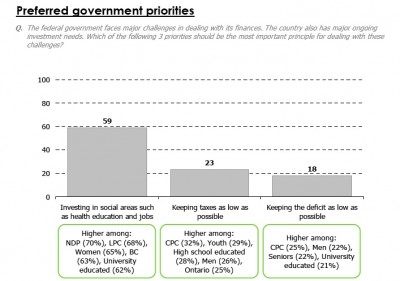
This EKOS poll was before Prime Minister Harper’s throne speech {the name of which brings out the eternal 10-tear old in me} and before the release of the federal budget.

Lower taxes? Controlling the deficit? Nope. Social investment, in areas like health, education, and jobs.

Over a month ago, I analyzed the Canadian federal voting landscape and came to the conclusion that a huge risk for Harper and the Conservative Party is poor performance in Ontario. What Ontarians want is pretty much on par with the nationwide numbers above and the Conservatives have closed the gap in the polling numbers in the province at 34.9%, compared to the Liberals at 38.0% and the New Democrats at 14.3%.

The Finance Minister Jim Flaherty noted last week that the Conservative’s budget is focusing on reducing corporate taxes to make Canada more attractive for business along with deficit reduction. He acknowledged the 8.3% unemployment rate, lower than the double digits in the US, and announced $178M CAN for job sharing agreements and youth employment.

Harper also ended a study to change the Canadian anthem, “Oh Canada” to a more gender neutral version reflecting the 1908 poem that it is based on. The current line, “True patriot love in all thy sons command,” while the poem has the line ,“True patriot love thou dost in us command.” According to an Ipsos Canwest poll, the Conservatives and Liberals were statistically tied in their support by women.

The Conservatives are in the drivers seat but on thin ice. The policy emphases in the budget are risky, in my opinion, particularly given Ontario’s higher than the national average unemployment rate of 9.2% last month.  The anger over proroguing has melted like so much Whistler slush. The Liberals have an unpopular leader in Ignatieff and the Dippers have a relatively popular leader of a relatively unpopular party.

Twitterversion:: What Canadians want: investment in social areas. Harper & Conservatives in driver’s seat but on thin ice. #ThickCulture @Prof_K

Song:: Five Iron Frenzy-“Oh Canada”

"A different kind of compan. A different kind of car?" ~Saturn tagline 1990s
"A different kind of company. A different kind of car"? ~Apologies to Saturn tagline of the 1990s

Notes from North of 49ºN

It’s not often I agree with Tom Friedman, but last fall when I was preoccupied with the US general election, teaching, and associate directing a center, he was advocating not just a bailout, but a green buildup.  He quoted Van Jones, author of The Green Collar Economy::

“It’s time to stop borrowing and start building. America’s No. 1 resource is not oil or mortgages. Our No. 1 resource is our people. Let’s put people back to work — retrofitting and repowering America. … You can’t base a national economy on credit cards. But you can base it on solar panels, wind turbines, smart biofuels and a massive program to weatherize every building and home in America.”

Friedman was in favour of attaching green strings to bailouts, an idea I think warranted further study, at the very least.  Fast forward 9 months and focus on the province of Ontario, where at the federal level, the Conservatives {Stephen Harper}, and at the provincial level, the Liberals {Dalton McGuinty}, jumped on the US bailout bandwagon to a tune of $9.5B or $10.9B Canadian.  This is in addition to the Obama administration’s $49.8B.  The combined US and Canadian bailouts are worth 130 times the present value of GM.  Here’s what both Harper and McGuinty had to say about this::

“We had to save it all or have zero forever,”

–Stephen Harper, Prime Minister of Canada

“The alternative would have been a devastating blow to Ontario families and communities.”

–Dalton McGuinty, Ontario Premiere

The troubles in the industry are not new news and CBC has a chronology of layoffs.  I’ve alluded to this bailout before and the scant jobs it will save, but here are the specifics in terms of the Canadian GM assembly line::

“At present GM Canada has 12,000 hourly and salaried employees, but that number is expected to shrink to about 5,500 over the next couple of years. About 1,100 of the new total is expected to be salaried jobs, which are unrelated to assembly operations. That means Ottawa and the Ontario government are together spending an unprecedented $2.1 million for each assembly job at GM Canada they hope to save.”–Time, 1 June 2009

It’s likely that GM suppliers will also be affected, a $7.2B industry employing 45,000 workers, but it is unlikely that all these jobs are at risk.  While Canada accounts for about 19.4% of North American production, Canadian cost advantages have been eroded by a stronger Canadian dollar, a weakened US union in the UAW, and strong and strategic bargaining by the Canadian Auto Workers union.

While the situation looks gloomy for manufacturing in Ontario, quite a few are banking on green jobs.  So much so that St. Clair College has a 2-year green jobs programme and the province has a commitment to clean energy.  Currently, the province gets 25% of its electricity from coal, but wants to shut down all of its coal plants by 2014.  The province is hoping to convert some of the plants to carbon-neutral biomass, although the yields will be lower.  The slack will need to be picked up by alternatives, with greener options being wind and solar.  Ontario’s Climate Change Action Plan calls for greenhouse gas emission reduction to 6% under 1990 levels and the new Green Energy Act is meant to protect the environment, regulate, and spur investment in green technologies.

Policy & Innovation:: The California Example

The PPIC has a report on the effects of California’s Zero-Emissions Vehicle {ZEV} mandate, particularly in the 1990s and early 2000s.  During this time, the California government, through the Air Resources Board {CARB} initially set in 1990 requirements that by 1998 that 2% and by 2003 that 10% vehicles sold in California would be ZEV.  Suffice it to say, concessions were made over time, but the original mandate set the wheels in motion for innovation.  The effects of the program were::

  • The policy spurred patents in near-term technologies
  • CARB arguably responded to technological changes when revising the program
  • Technological spillovers resulted in a greater number of indirect  innovations
  • Increased market development for emerging technologies
  • Broadened design parameters
  • Lower emissions in California

The program, albeit complex and not without politics and controversy, shows how policy can help to shape market-based activity in ways that would not occur otherwise.

Ontario:: Good Money After Bad

While not surprising, Canada and Ontario should have considered asserting themselves more, rather than caving to bailout pressure.  Why not move forward to develop policies that help transition away from declining industries and in-line with over provincial objectives?, e.g., environmental and energy.  How I see it is that the US and Canada are bailing out a company the capital markets have little faith in and now face the daunting task of rebuilding with a new CEO, “Big Ed,” who has a reputation for being an empire-builder.  I question having an empire-builder in charge of a company needing to be leaner, a company needing to reinvent itself overnight.  Let’s hope he indeed  “learns something about cars,” and doesn’t make mistakes like this one, the old CEO Rick Wagoner copped to:: “axing the EV1 electric-car program and not putting the right resources into hybrids. It didn’t affect profitability, but it did affect image.”

While there have been debates on whether or not the US needs an auto industry {NY Times} and criticisms abound, such as this one on how GM betrayed our trust, Canada is nevertheless a 12% equity shareholder.  This creation of a capitalist-state joint venture opens up a huge can of worms, as which interests will prevail and how to balance autonomous management and control versus paternalism?  I think the answers are in economic sociology, a topic for a future post.

Song::Canada” – Low

Video::

Twitterversion:: #Canada #bailout of #GMfail =more #fail ? Can #Ontario still dvel #greeneconomy & innov.w/enviro&energy policy objctves? http://url.ie/1wdt  @Prof_K

Notes from north of 49ºN.

I now live in a relatively small country, ranked 36th. in population, at 33.7M {versus 306.7M in the US}, but in the top 10 in terms of economies with a GDP of $1.3T {#9 ranking}, versus 13.8T for the US {#1 ranking}.  I mention this, as I wonder about scale and innovation, i.e., can smaller countries effectively compete in technology in a global environment?  One of my interests in innovation is biotechnology, a “new economy” area focusing on better outcomes for “health, the environment, and for industrial, agricultural and energy production.”  Advances in genetics are creating a race for companies and countries, with the idea of dominating the biotech field in order to enjoying profits and prosperity.

Last summer, I saw on a Canadian network a segment on how Canadian government investments in biotech were getting bought up by US firms, implying that the relatively small Canadian government was, in part, subsidizing innovations flowing south of the border.  The Matthew effect kicks in, as rich get richer and the poor get poorer, given that Canadian firms were being snapped up by US firms with deep pockets, transferring value southward.  According to a Globe & Mail article {click on license option}, another issue is that Canadian venture capital is lacking, so Canadian biotech firms often are capitalized by US venture capital firms that like to keep close tabs on operations and encourage offices/operations in the US.

Well, is Canada even a player in this biotech area?

biotechoecd

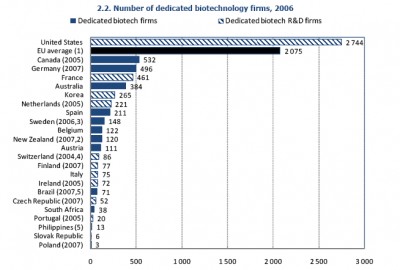
According to 2006 OECD data, Canada is a player in terms of the number of firms {532}, the number of patents {ranked #6 in 2004}, and revenues {$83M}, along with an 11% compound annual growth rate {CAGR} of revenues from 1999-2005.

Given how collaboration and capital are now global, does it even matter where innovations are incubated?  A study by Bagchi-Sen & Scully {2004} is illuminating.  They divide biotech forms into two categories:: high R&D intensity and low R&D intensity.  Each has a different take with respect to strategies within the context of globalization::

  • High R&D Intensity:: Ties to local universities/Canadian researchers & collaboration with pharmaceutical companies, but desire global capital inflows.  Prototypical firm is in health theraputics.
  • Low R&D Intensity:: Emphasis on local production and development of Canadian market.  Focus on strategic alliances with foreign firms.  Prototypical firm is in diagnostics or agricultural biotech.

In terms of innovation policy, this brings up interesting food for thought for Canadian politicians in light of this recession.  Thanks to Barack Obama, Canada’s large neighbour to the south is pumping $21.5B of stimulus towards science and technology, which begs the question, how will this affect Canada?

It makes sense that Canadian policy would encourage the projects of low-intensity R&D firms with ties to the US, as these firms:: may be able to capitalize on relationships with stimulus-receiving firms, will develop innovations for the Canadian market, and will be focused on local Canadian production and manufacturing.  The high-intensity R&D firms could use funding {hint:: even more than $1B+CAN stimulus} that focuses on spurring innovations and the building of a sustainable base of Canadian talent and resources.  Dalton McGuinty’s {Liberal Premiere} efforts in Ontario might be a step in the right direction, but I’m not seeing clearly how this all fits together with an economic recovery plan.  Biotech. is not without risks, particularly with respect to agricultural biotech, which consumers are uncertain of.  Activists have alerted consumers with terms like “Frankenfood” for genetically-modified organisms {GMOs} and Monsanto’s lawsuits against journalists and farmers don’t help the cause.  So, maybe ag. biotech is a lose, but developing Canadian competitive advantage in innovations, in terms of other forms of biotech, nanotechnologies, clean energy, and green collar jobs, may provide fertile terrain for politicians and policymakers.

Well, enough of this talk of the “new economy” of biotech and innovations, what about the old economy, still prevalent in many parts of Canada?  Globalization has drawn Stephen Harper’s {Prime Minister} Conservative government into bailout fever to the tune of $9.5B, in order to secure that 16% of GM’s production remains in Canada.  This includes $3.1B that the Province of Ontario ponied up by Dalton McGuinty’s government.  Unfortunately, this might only save 4,400 jobs, after projected layoffs, according to CBC::


Given how the Tories and the Grits have played their cards in this {along with playing a current game of Federal “chicken”}, I see an opportunity for the NDP to make inroads with their platform based on developing new technologies and saving jobs.  Alas, more on “GMfail” and job losses in Canada in a future post.

So, it looks like nation matters, but in a global milieu.  Nothing surprising.  If you were to advise Canadian politicians, should new technologies {e.g., biotech, green, energy} be developed more aggressively {or at least explored} and does it make sense to commit billions to save jobs with an untested GM restructuring?

Twitterversion:: #newblogpost How should Canada compete {bio}tech, given globalzatn, US domnce, & recession? #GMfail bailout, good idea? http://bit.ly/18bBq8 @Prof_K

Song:: Genetic Engineering – Orchestral Manoeuvres In The Dark

Video::