Notes from north of 49ºN

EKOS Federal Voting Intent Poll, 4 March 2010

Notes from North of 49ºN

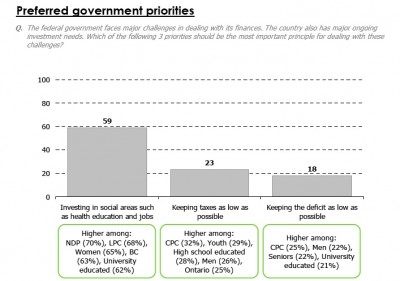
This EKOS poll was before Prime Minister Harper’s throne speech {the name of which brings out the eternal 10-tear old in me} and before the release of the federal budget.

Lower taxes? Controlling the deficit? Nope. Social investment, in areas like health, education, and jobs.

Over a month ago, I analyzed the Canadian federal voting landscape and came to the conclusion that a huge risk for Harper and the Conservative Party is poor performance in Ontario. What Ontarians want is pretty much on par with the nationwide numbers above and the Conservatives have closed the gap in the polling numbers in the province at 34.9%, compared to the Liberals at 38.0% and the New Democrats at 14.3%.

The Finance Minister Jim Flaherty noted last week that the Conservative’s budget is focusing on reducing corporate taxes to make Canada more attractive for business along with deficit reduction. He acknowledged the 8.3% unemployment rate, lower than the double digits in the US, and announced $178M CAN for job sharing agreements and youth employment.

Harper also ended a study to change the Canadian anthem, “Oh Canada” to a more gender neutral version reflecting the 1908 poem that it is based on. The current line, “True patriot love in all thy sons command,” while the poem has the line ,“True patriot love thou dost in us command.” According to an Ipsos Canwest poll, the Conservatives and Liberals were statistically tied in their support by women.

The Conservatives are in the drivers seat but on thin ice. The policy emphases in the budget are risky, in my opinion, particularly given Ontario’s higher than the national average unemployment rate of 9.2% last month.  The anger over proroguing has melted like so much Whistler slush. The Liberals have an unpopular leader in Ignatieff and the Dippers have a relatively popular leader of a relatively unpopular party.

Twitterversion:: What Canadians want: investment in social areas. Harper & Conservatives in driver’s seat but on thin ice. #ThickCulture @Prof_K

Song:: Five Iron Frenzy-“Oh Canada”
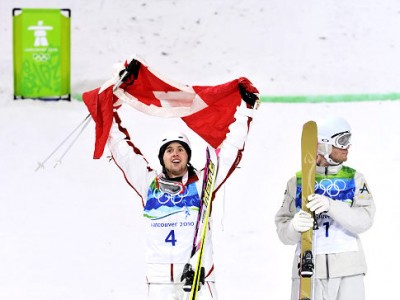
Vancouver Olympics Freestyle Skiing Gold Medal Winner, Alexandre Bilodeau

Notes from north of 49ºN

I’ve been immersed in Canadianess on several fronts this week. There’s the Vancouver 2010 Olympics, of course, and I went to an innovation talk by the CEO of Porter Airlines, an emerging Canadian success story, at MaRS here in Toronto.

I’ve heard about some backlash about Canada’s “Own the Podium” programme, which I’ve dubbed “pwn the podium,” but I find the whole spectacle fascinating. The first Olympics I remember, which will date me, is Montréal-1976. I remember watching, on a B&W TV in the kitchen, Nadia Comăneci dazzle the world, as well as Gilda Radner’s impersonation of her on Saturday Night Live. I remember the US hockey gold medal in 1980 and the US-led boycott of the summer games in Moscow. I was in Westwood near UCLA during the 1984 Olympics in LA and still recall the pastel iconography and the feel-good pervasiveness that just didn’t jive with my own brand of teenaged angst. Over the years, I’ve followed the Olympics, as I’m interested in spectacle in the Debord sense, but not soooo cynically. So much hinges on the dramas, albeit often hyped by the media. Although, the story of the first Canadian to win gold on Canadian soil, Alexandre Bilodeau, is quite compelling. Alexandre took up skiing, as his mom wanted her kids to take up a more family-oriented sport, which could include his older brother with cerebral palsy, Frédéric.

The coverage of the Olympics is a perfect example of mediascapes, as described by Arjun Appadurai::

“‘Mediascapes’, whether produced by private or state interests, tend to be image-centered, narrative-based accounts of strips of reality, and what they offer to those who experience and transform them is a series of elements (such as characters, plots and textual forms) out of which scripts can be formed of imagined lives, their own as well as those of others living in other places.”

So, what made me laugh out loud was Salon.com reporting they got hammered for the snarky remarks made by writers on their site on articles on the Olympics . Oh, Salon, desperately trying to be relevant by stirring the pot, which I find it often does with gendered issues—oh cruel fates, why can’t Roman Polansky get arrested monthly?! Salon writers are like ironic hipsters who aren’t quite clued in to how planting “tongue-in-cheek” with one’s writing doesn’t preclude you from looking like an idiot for missing the forest for the trees.

Heather Havrilesky and Steve Almond both poked fun at Vancouver Games. Heather’s “D’oh, Canada!” piece was a play-by-play on how the opening ceremonies were cheesy, boring, and with poor production values—a colossal fail. She ends with a reiteration of her take on how the bland NBC is, along with how they are complicit in not accurately depicting the ceremonies as an embarrassing mess::

“And do Costas and Lauer acknowledge what a big mess it is? Hell, no. Instead they’re happily prattling along as Wayne Gretsky rides to the real outdoor Olympic cauldron in the rain. Why didn’t they just have one cauldron? Sadly, this outdoor one looks just like the malfunctioning heap inside.

Oh, Canada. You may among the friendliest and most welcoming people on earth, but sometimes friendliness, politeness, and “making it be” just isn’t enough.”

Almond went through the various gaffes and SNAFUs of the first few days of the games. Bitch bitch bitch. He concludes with this trenchant observation::

We’re really sorry it had to go this way, Canada. We love your health care system and your uncomplaining tolerance of sub-freezing weather and your almost freakishly low-key attitude. But when it comes to mindless, over-hyped spectacles of late model capitalist excess, you should probably leave the driving to us.

While NBC provides a mainstream mediascape, Salon is providing a cynical, urban-liberal hipster variant, slathered in a fatty gravy of pseudointellectualism and punctuated by cheese curd five-dollar-turns-of-phrase, like so much poutine.

In my opinion, this is nothing to get in a lather about, since it’s so utterly predictable. Mediascapes are all about persuasion, promotion, and, in Salon’s case, pageviews. Their depiction of Canada as bumbling bumpkin cousins to the north is really just the flipside of NBC’s mainstream message of pro-US feelgood candy. Hand in glove. I can just hear George Peppard say, “I love it when a plan comes together.”

Salon should have more compassion for Canada. Salon has spent 15 years trying to be an über-hip West coast New Yorker, but are still just bumbling bumpkin cousins to the West.

BTW:: The idea that Canadians are polite. Ha! It’s another myth.

Twitterversion:: Salon.com pwned 4 snarky #Olympics articles. Urban uberhipster liberalism just flipside 2 mainstream NBC feelgood candy. @Prof_K

Song:: The Smiths-“William It Was Really Nothing”

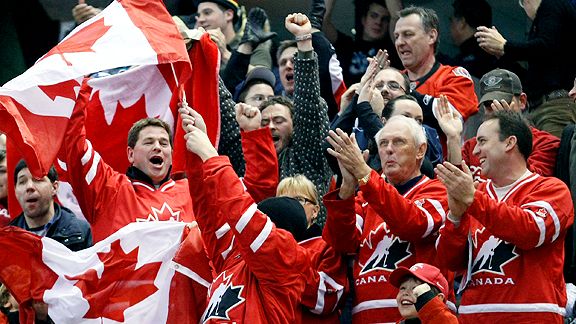
Canadian Olympic Hockey team celebrating victory in Salt Lake City, 2002

Notes from North of 49ºN

Charles McGrath in the NY Times wrote a curious and annoying piece on Canada’s quest for gold in the upcoming Winter Olympics in Vancouver {HT: LinnyQat}. I thought his characterization of Canada to be a collection of what I call “university-educated” stereotypes complete with quotes of Canadians, such as Margaret Atwood, that make the country sound like a nation of self-loating and self-deprecating sots. It’s articles like this that remind me that the New York Times often is a purveyor of moderately well-written naval gazing with all the right references to make it seem legit.

I’ve written blogs on Canada’s postcolonial experience, as well as how a trajectory of regionalism may be at play. Reading McGrath made me think about my own blogs. He thinks he’s stumbled on a new Canadian consciousness that cares about Olympic medals that’s out of place in the zeitgeist of the nation::

“They want to rewire the national mind-set and come away with not just a couple of golds but the most medals over all. They have dedicated roughly $118 million to enhancing the performance of Canadian athletes, and have financed something called the Top Secret project, in which teams of scientists have been studying the various winter sports in hope of gaining a technological edge.

The organization in charge of improving Canada’s medal performance has the un-Canadian-sounding name Own the Podium, and its chief executive, Roger Jackson, said: “We’ve never been pressured before to perform to a stated goal. Thirty medals or more is what we’re hoping for this time. I think we can get those.”

Talk like this, so nakedly ambitious, makes some Canadians uneasy. Theirs is a vast country that in many ways is run like a small town, with small-town values, and it has a highly developed culture of modesty, if not a collective inferiority complex. The athletic record in general is a little underwhelming, and some Canadians think that is because their countrymen prefer that, considering a good effort just as valuable as a trunkload of trophies, maybe better.”

McGrath is sounding like an American version of Andrew Cohen in The Unfinished Canadian. While I’ve argued that Canadian identity may be “fuzzy,” that has more to do with its sheer size, distinct regions, and relatively small population. Never underestimate the power of sports to galvanize a sense of identity, as evident in the recent film Invictus::

What McGrath fails to parse is the effects of capitalism and of culture. Hockey galvanizes Canada, solidifying an identity that may be fuzzy. It’s not that Canadians are OK with losing, as McGrath implies, it’s question of economics.  It looks like Canada is willing to invest in its teams and I’ll bet a box of Timbits that if Canada wins medals, there won’t be a collective national sheepishness over the feat. Canadians don’t fear winning, it’s just that Canadian capitalism, to date, hasn’t fostered it. It looks like that’s changing.

The Canadian embracing of funding the medal count may not be without controversy. The Olympics have their detractors because of the astronomical costs involved. So, Canadians may like winning, there may not be a collective willingness to finance it at stratospheric levels.

Some may argue that if Canadians are so into hockey, why did they let the sport become Americanized and lose the Winnipeg Jets and Québec Nordiques in the process? It’s all about capitalism. I’ve blogged about the NHL on Rhizomicon and while the NHL has tried to expand heavily in the US to vie for the sports entertainment dollar, it’s the Canadian fans that are making the Canadian teams the top revenue generators.

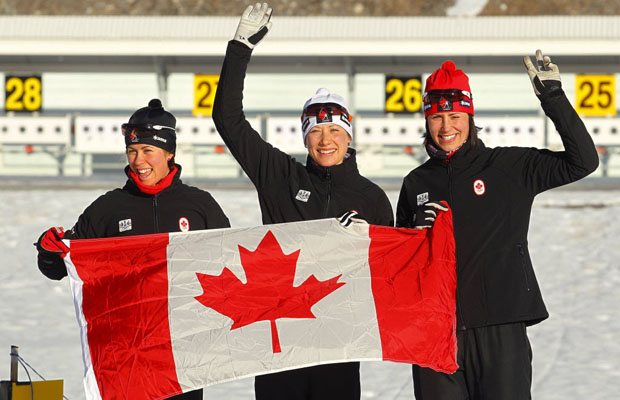
Unfortunately, given scarcity of resources, the Canadian biatheletes are out in the cold, i.e., no corporate sponsorships. So, I’ll give them a shout out::

In this file photo, Megan Imrie (L), Zina Kocher (C) and Rosanna Crawford celebrate getting their Team Canada jackets and being named to the 2010 Canadian Olympic biathlon team at the Canmore Nordic Centre in Alberta. Photograph by: Todd Korol, Reuters

While Zina Kocher is a World Cup bronze medalist from the 2006-7 season, the funding just isn’t there for the biathlon.

Here’s a response to the NY Times pirce from the Toronto Star, which is pretty funny::

“We started talking about what we’re hoping for at the Olympics.

Ned said he hoped Canada would win so many fourths that they’d have to make a special new medal. Maybe a nickel medal. With a beaver on it. But not a cocky-looking beaver. Just a plain work-a-day beaver. We could hand them out after all the foreigners leave – so that no one feels left out.

I said I hoped we might sweep the fourths and fifths. And the odd sixth. But Ned shook his head at me, and I felt awful for a few minutes. And then ashamed of feeling awful.

But it was exciting to talk this way. Maybe the most exciting thing we’ve talked about since they (whimper) let Wayne drift away into that heaven-on-Earth they call California.”

Twitterversion::  NYTimes #fail confuses Canadian culture with capitalism re: Olympic medal push. Hilarious response in #Toronto Star. @Prof_K

Song:: The Besnard Lakes {Montréal, QC} -“Albatross”

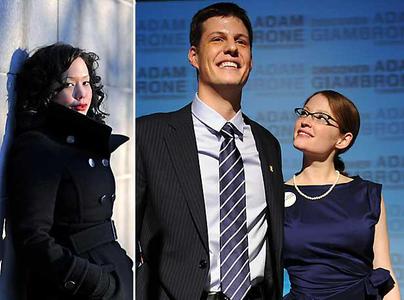
Mayoral hopeful Adam Giambrone and partner Sarah McQuarrie are seen at left; at right, Kristen Lucas. From Toronto Star.

Notes from North of 49ºN

This morning, the city of Toronto awoke to a mayoral candidate sex scandal that is likely to have zero effect on the outcome, given the strength of the frontrunner, George Smitherman. The Toronto Star had an article on how a woman came forward with text messages of a sexual nature and allegations that she had an affair with mayoral candidate Adam Giambrone, the Toronto Transit Commission chairman and City Councillor. Giambrone has a long-time girlfriend, Sarah McQuarrie. The article was full of lurid details, reminding me why I think of the Star as a bastion of hack journalism and often poorly-written articles. In the article, Adam called it a lapse in judgement and apologized to those close to him for the embarrassment his actions will cause them.

What I find interesting is not just how this story plays into the routine morality play of political sex scandals, but also how the press frames them. The above photo was in an article posted within the last 90 minutes on the Star, reporting that Giambrone is staying in the mayoral race. I found it interesting that the photo had images of “the couple” in clean-cut political mode, contrasted with “the other woman,” complete with low-cut blouse.  Here’s the photo from the story that ran this morning, echoing more of the same::

Kristen Lucas, left. Adam Giambrone & Sarah McQuarrie, right. Carlos Osorio, Toronto Star Staff

The Toronto Star might think I’m full of it {along with others}, but I think these photos are meant to reinforce, with a visual rhetoric, a specific normative political narrative with the intent of selling papers and fueling pageviews. WJT Mitchell wrote about “what do pictures want?” a few years back. These images attempt to simultaneously evoke an emotional response from us along with a judgment, as well as reinforce a narrative of our politicians.

The Torontoist had a good point by saying that this story is telling of our political culture.  They also question the correlation between one’s private life and the ability to be a good public servant. I have no idea what the truth is in this story, but I have three points to make::

  1. If politicians are to be held to a high moral standard, why not all persons in positions of power? If a boss has an affair, should that be unequivocal grounds for termination?
  2. Doesn’t this scrutiny of politician’s private lives, given how technology is eroding privacy, set a precedent for all of our lives to be potentially in the public sphere?
  3. Doesn’t this scrutiny incentivize more bad behaviours, as in the case of John Edwards who not only had an affair, but went to great lengths to cover it up.

Does this preclude a mainstream politician who is a “player” or polyamorous? I think it does. And the Star will ensure we get out collective fill of any lurid details or allegations of “deviance” to express our collective outrage, just like in Victorian times, when “smut” was published as a cautionary warning—and make fistfuls of cash.

Update {10 February 2010, 8:39a EST}::

Giambrone admitted to more affairs and politicians are going on record expressing shock, dismay, and calling for his withdrawal from the mayoral race. It looks like the Toronto Star wasn’t the only one interested in sexy pictures. There was just differences on the definition of sexy. Here’s an excerpt from today’s Globe & Mail::

“At first, Ms. Lucas seemed eager for more exposure. She sent several photos of herself to a local gossip website yesterday morning because she disliked the portraits that appeared in the Star, according to David Robert, manager of drinktheglitter.com. “She wanted sexy pictures of her to be out there,” he said. “She’s like, ‘They’re going to get out anyways.’ “ But she shrank from attention as interest in the scandal swelled. Ms. Lucas swiftly deleted her Facebook and Twitter pages. Mr. Robert said she also disconnected her phone number and shut herself inside her house in East York to escape the media swarm.

“I think this is crazy for her,” he said. “But, my god, I mean, [yesterday] morning she sent Canada’s highest-rated gossip site 10 pictures of herself.”

Twitterversion:: Blog: Trending topic #Giambrone dustup in #Toronto. Star reciting familiar verbal/visual tropes to make $$. #ThickCulture @Prof_K

Song:: The Wedding Present-“Unfaithful”

Notes from North of 49ºN

The above video from YouTube does a decent job of explaining what the big issue in Canada is at the moment, Prime Minister Stephen Harper’s proroguing of Parliament. Proroguing? It may seem like a Sarah Palinism, as in “pro-rogue”, but it’s a suspension of Parliament without dissolving it. Harper, a Conservative, prorogued Parliament last year when the other parties were threatening to form a coalition of New Democrats, Liberals, and the Bloc Québécois. This time around, Harper was being asked tough questions by Parliamentary committees about what his government knew about the torture of Afghan detainees after they were turned over to Canadian Forces. On 30 December, the Governor General, upon Harper’s request, prorogued Parliament until 3 March 2010, killing all bills and suspending all committees. The official reason given was the economy, but nobody bought it.

There were two major results::

  1. A grassroots effort using social media mobilized sizeable protests across Canada
  2. The Conservatives have lost ground in the public opinion polls and are in a statistical dead heat with the Liberals

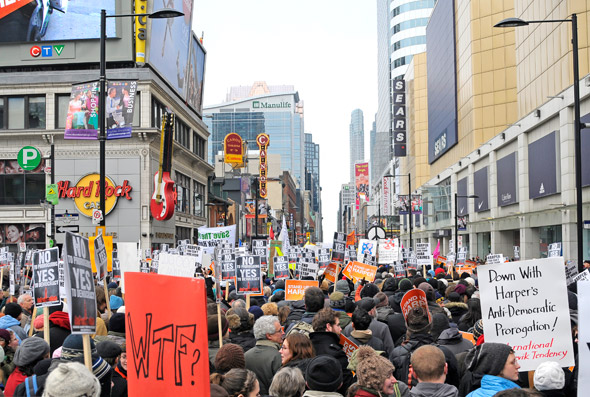
On Facebook, a group for Canadians Against Proroguing Parliament has amassed 219,600 members {28 January} and last Saturday nationwide protests were organized. Here in Toronto, a sizeable crowd assembled downtown::

CAPP Protest 23 January, Yonge St. looking south of Dundas at Eaton Centre

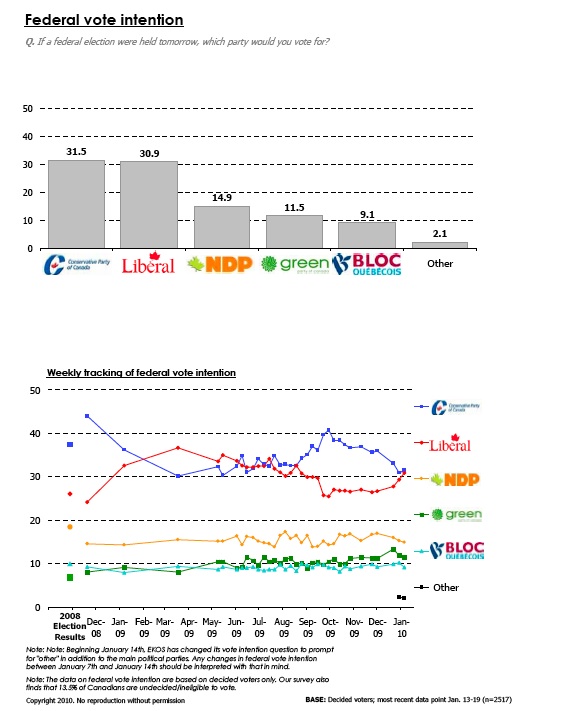
The prorogation of Parliament is viewed by many as anti-democratic {See Rick Mercer’s opinion piece in the Globe & Mail}, although Harper has supporters of his decision. For the time being, anti-Conservative momentum has picked up the pace and support for the Liberals has increased—at the expense of the NDP, Greens, and Bloc.

EKOS Federal Opinion Poll Results:: 4oth. General Election—Mid-January 2010

It’s over a month until Parliament reconvenes. It will be interesting to see if the anti-Conservative sentiments will weather the Winter Olympics in Vancouver and any possible coherent response by Harper. Upon Parliament reconvening, I’m not sure if an election will be triggered. A weakened Harper that’s ready to deal may do more long-term damage to the Conservatives. I’ll be blogging on Rhizomicon within a few days on my detailed analysis of the EKOS poll data, which should make the Liberals a bit cautious about another {expensive} election in the near future.

Twitterversion:: Harper’s proroguing triggered Facebook mobilized protests.EKOS poll:: Grits surging @ expense of Tories,Greens,NDP,& Bloc. @Prof_K

Notes from north of 49ºN

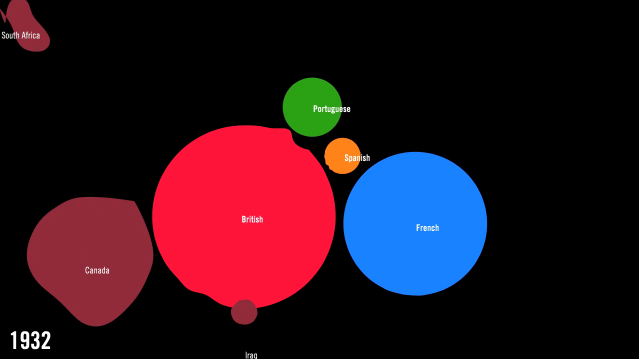
José’s post from late November, Exploding Empires, got me thinking about Canada’s postcolonial experience.  While the remnants of the British empire linger with political structures {including the viceregal Governor General} and the Queen on the money, before 1663 most of Canada was a part of New France.  If the Battle of the Plains of Abraham and the siege of Québec City went differently, it would have been interesting to see the trajectory of Canada, if New France stayed under French control or if there was a long protracted war with Britain.  That’s neither here nor there, but the reality is that Canada does have the legacy of being a part of the British empire, while arguably subjugating the First Nations and francophone Québec, which I’ll come back to later.

So, in 1867, Canada became a Dominion in the British Commonwealth with its own Prime Minister, Sir John A. MacDonald {who is on the $10 bill}. This was a trend with its “white settler” colonies. In 1931, The Statute of Westminster made the Canadian Parliament independent of British control and Canada ceased being a colony.  Nevertheless, there were and are ties to Britain. In fact, during WWII, many of the archives for Canada were destroyed in the Battle of Britain, which were housed in London, England, not Ottawa.

The relationship between Canada and Britain has shaped Canada’s character.  The obvious way to characterize the relationship is one of parent and child, but how to characterize it further? Canada as the abused Cinderella? Benign neglect? For decades, the British sought to assert imperial authority and reduce the influence of popular control of the government, which was viewed as a precursor to the American revolution [1]. Once British control began to wane, the rapid industrialization of the United States resulted in a dominant cultural and economic power at Canada’s doorstep.  Many argue that Canada traded one hegemon for another. Many Canadian writers, including Margaret Atwood, saw this pattern and sought to “decolonize” Canada, but what exactly does that entail?  What does a decolonized Canada look like? Is a strong national identity required?

The simmering legacy of the ghost of an old colonialism, i.e., New France, along with First Nations and immigrant communities, serve to further complicate matters by generating tensions from within.   Québec, a province with about 23.9% of the population where 40% of its residents support some form of sovereignty for Québec.  Urbanist Jane Jacobs around 1979-80 even went as far to say::

“Montréal cannot afford to behave like other Canadian regional cities without doing great damage to the economic well-being of the Québécois. It must instead become a creative economic centre in its own right… Yet there is probably no chance of this happening if Québec remains a province.” [2]

Despite hundreds of years passing since the Battle of the Plains of Abraham, there is definitely a strong francophone cultural identity in Québec and a resurgence of separatist politics enabled by the Quiet Revolution/Révolution Tranquille of the 1960s.

Add to the mix, globalization and the resultant Appaduraian flows of financial capital, human migration, media, ideologies [3, 4], and brands [5].

I feel all of these four factors::

  1. Historical trajectory of British colonialism
  2. Proximity to US cultural {media} and economic forces
  3. The subjugation of francophone culture under a trajectory of British colonialism
  4. Current state of globalization with flows of people, media, capital, ideologies and brands

serve to strongly decentre the very concept of Canada and Canadian identity, i.e., Canada as an “imagined community” in the Benedict Anderson sense [6]. Extending Anderson’s ideas about print capitalism being critical in defining the concept of nation, I would argue that Canadian identity is being undermined because of the dominance of US media, particularly film, television, and Internet content. I’ve argued for increased funding of the CBC and I feel it can and should play a role in defining nation.  This post isn’t meant to be an accusation or to sound an alarm, but open up a dialogue about the future trajectory of Canada.

If Canadian identity is indeed decentred, doesn’t this imply a fuzziness in people’s meaning systems regarding Canada and does this fuzziness lead to less resistance of hegemonic forces?  Does any of this even matter?  Aren’t these just market forces in action?  Antonio Gramsci says hegemony requires acquiescence [7], but as global consumers, aren’t we all willing to submit to hegemony if it strikes our fancy?  Sweet, glorious hegemony. Hasn’t China proven that global consumers are willing to purchase in ways that are detrimental to their own economies?

I think national identity matters, as does resistance to hegemonic forces.  Identity matters, as a shared sense of communitas and comradeship should guide policy and everyday actions. Citizens should derive meaning from the institution and social construction of nation. Resistance to hegemony matters, as this allows for culture to remain dynamic by allowing its redefinition, rather than continually self-replicating in the same fashion in the style created by the powers that be, i.e., the corporation and the state.

My next blog post will extend these ideas to Canadian politics.

Twitterversion:: Thoughts about “postcolonial” Canada given its relationships with Britain, USA, & Quebec. Interplay b/t media & identity. http://url.ie/4q9t @Prof_K

Song:: Weakerthans-“One Great City”

References

[1] Smith, Simon (1998). British Imperialism 1750-1970. Cambridge University Press. ISBN 052159930X.

[2] Philpot, R. (2006) “She Stayed Creative Until the End: The Rich Life of Jane Jacobs” counterpunch.org, retrieved 21 January 2010, from http://www.counterpunch.org/philpot04262006.html

[3] Appadurai, A. (1996) Modernity at Large. Cambridge, MA: University of Minnesota Press.

[4] Appadurai, A. (1990) “Disjuncture and Difference in the Global Cultural Economy” Retrieved 21 January 2010,  http://www.intcul.tohoku.ac.jp/~holden/MediatedSociety/Readings/2003_04/Appadurai.html

[5] Sherry, J.F. (1998) ‘The Soul of the Company Store: Nike Town Chicago and the Emplaced Brandscape’, in J.F. Sherry (ed.) ServiceScapes: The Concept of Place in Contemporary Markets, pp. 305–36. Chicago: NTC Business Books.

[6] Anderson, Benedict (1983) Imagined Communities. Verso. http://books.google.com/books?id=4mmoZFtCpuoC&dq=benedict+anderson+imagined+communities&printsec=frontcover&source=bn&hl=en&ei=cZ9YS–eFcLO8QaZq-jKAw&sa=X&oi=book_result&ct=result&resnum=5&ved=0CCgQ6AEwBA#v=onepage&q=&f=false

[7] Gramsci, A. (1971) Selections from the Prison Notebooks, Lawrence and Wishart.

Graphic from the Torontoist by Brian McLachlan

Notes from North of 49ºN

Last Friday, the Torontoist listed its 2009 “Heroes & Villains” and one of the heroes was the mandatory 5¢+ fee for plastic bags {for all retail} that went into effect on June 1st.  A columnist for the Toronto Star, Peter Gorrie, called it a sham, but his arguments are based on a logic that doesn’t account for behavioural change, i.e., a reduction of consumption and use of disposable bags, as people adjust to not using them.  He made several assumptions::

  1. Plastic bags aren’t a major environmental hazard, in terms of garbage load and marine hazards
  2. Manufacturing plastic bags use fewer resources than paper
  3. Plastic bags can be re-used by consumers

He makes the following point, though::

“If the nickel fee makes us more aware the bags do have value and carry a slight environmental price tag, fine. If that prods us to consider using less of everything, even better. At most, though, it’s a potent symbol of how we embrace the trivial instead of doing what’s really required.”

I get where he’s coming from, but I don’t think he’s on the right track.

  1. Diverting petroleum resources away from disposable bags that wind up in landfills or in the Great Pacific Garbage Patch by reducing consumption makes both economic and environmental sense.  If the policy in aggregate reduces consumption and conserves finite resources, at the expense of convenience, it’s a win in my book.
  2. This assumes that the policy will not curb demand for disposable bags of all kinds.  I’m not aware of Toronto retailers shifting to paper.
  3. While plastic bags can be re-used for other purposes, does the existence of a secondary use warrant unconstrained continued usage?  This assumes a demand for plastic bags for all purposes that is unyielding.

More interesting is the quote above, as he wants the public to have more real consciousness about reducing consumption, which is a good thing, but feels the tax embraces the trivial.  This is where social science comes in.

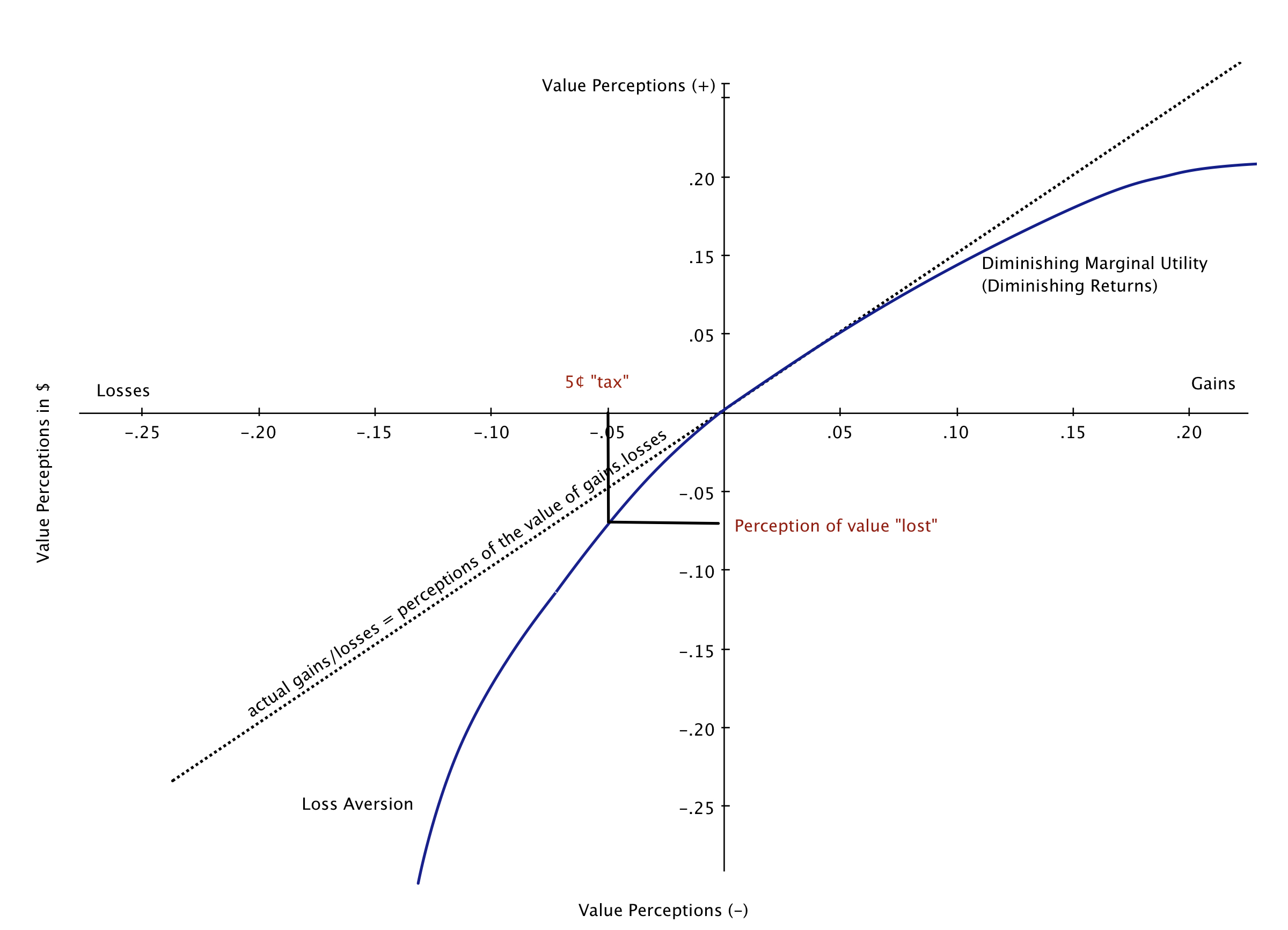
Prospect theory is part of the field of economic psychology, developed by Daniel Kahneman and Amos Tversky, which serves as a rival theory to the rational expected utility model, which is prevalent in economics.  Prospect theory is richer and more robust {sounds like a coffee} than expected utility, as it has greater explanatory power.  A cornerstone of the theory is how people treat gains and losses differently.  The classic example used is which do you prefer::

  • a 2% credit card surcharge  -or-
  • a 2% cash discount

So, let’s create a hypothetical example.  There’s a camera that a retailer sells at a cash price of $100 and a credit price of $102, i.e., two prices depending on the terms of payment.  Which would consumers prefer::

  • A stated price of $102, but with a cash discount price of $100
  • A stated price of $100, but with a credit card surcharge of $2, so the credit price is $102

These are equivalent scenarios, but most people don’t like the surcharge and prefer the cash discount.  It’s viewed as a “loss” that people will often go to great lengths to avoid and in prospect theory this is called loss aversion.  On the other hand, as gains increase, they are valued less, which fits economists’ “law” of diminishing marginal utility. These perceptions open the door for framing effects.

Prospect Theory graphic, by Kenneth M. Kambara with OmniGraph

Who cares, it’s just 5¢, right?  The 5¢ charge is effectively a tax on using an economic “bad” or environmental externality and the consumer perceived the loss of wealth to be greater than the 5¢.   It’s the money plus a wee bit of a psychological carrying charge to boot.  The consumer once got bags for “free” {actually the cost was imputed in prices}, but now must either furnish their own bags {diminished convenience} or pay 5¢ per bag {out-of-pocket costs}, so now they are subject to losses.  The loss aversion means the 5¢ can serve as a big disincentive for their use, particularly in a recessionary economy.  One supermarket chain, Metro {Dominion} instituted a 5¢ fee across Ontario and Québec, resulting in a 70% reduction in plastic bag use. What this tells me is that the status quo wasn’t entrenched and the policy is helping to alter behaviours.  What I’m hoping is that policies like this help to reduce the 4B plastic bags handed out annually, just in the province of Ontario.

Whoa, hold the phone.  Why not offer cash back for not using plastic bags?  Looking at the prospect theory graph, refunds for not using plastic bags aren’t perceived to be worth it.  In aggregate, getting a few nickels back is perceived to be worth less than the money, so many consumers may not feel compelled to change their behaviour.

In terms of a plastic bag surcharge policy, the carrot loses to the stick.

Twitterversion:: @Torontoist 2009 “hero,” the 5¢ plastic bag fee, is a policy that follows sound social science theory, based on Nobel laureate’s work. @Prof_K

Song:: The Submarines-“Modern Inventions”

Ken Kirsch-"Caledon Ontario Road"

Notes from North of 49ºN.

Macleans magazine, like any other, likes to create lists.  I was going through old issues before I pitched them and I spied an article about Canada’s Most Dangerous Cities.  {Here’s the 2009 version}. Caledon, Ontario for two years straight was deemed the safest place in Canada, a town of 58,000 about 40 kilometers/25 miles from Toronto.  I’ve seen Caledon from the air, heading into Toronto’s Pearson Airport, a town on the edge of the greater Toronto area {GTA}, where the 410 freeway peters out on the rural outskirts.   I recall the town where I worked the past few years, Thousand Oaks, CA, was deemed one of the safest places by the FBI, which wasn’t too surprising.  It was fairly affluent, suburban, and homogeneous at 85% white in the 2000 Census.  The 2008 Macleans article went into the reasons why Caledon had such low crime, while crime seemed to be on the rise in neighbouring Brampton.

How safe is Caledon.  According to the Macleans article::

“Of the 100 biggest cities or regions in Canada, Caledon is the safest. In 2006, the most recent year for which there’s annual data, it ranked the lowest —107 per cent below the national average — for a score combining six crimes (murder, sexual assault, breaking and entering, vehicle theft, aggravated assault, and robbery)”.

So, what makes it so “safe”?

  • Strict police
  • Visible police {6,000 hours of foot patrol with 100,000 interactions and only 12 public complaints}
  • “Restorative justice” {which brings suspect and victim together with a mediator instead of a court judge} has been used extensively since 2006 to resolve non-violent incidents, from neighbour disputes to vandalism.
  • Relative wealth:: median income of about $32,900, compared with $24,800 across Ontario.
  • The population is overwhelmingly white and English-speaking {almost half of all residents are third-generation Canadians or more}.

Are problems on the horizon?  The local youth complain of nothing to do and a lack of public transportation makes them feel “stuck” unless they have a driver’s license.  Petty crimes and vandalism are a going concern in Caledon.  The big concern is growth.  Problems with crime in Canada are correlated with areas of growth, where the local infrastructure and support mechanism are outgrown.  Crime has followed the pattern of Canadian growth in the West.  Population in Caledon is expected to increase by 48% by 2021 and “racial fights” are starting to erupt in local schools, where students from nearby Brampton {a town with over 60% first-generation Canadians} are being bussed to.  Also, while robberies in Caledon are rare, Brampton is seeing a spike, so local law enforcement {Caledon’s Ontario Provincial Police} is trying to be proactive with robbery prevention seminars.

What’s the policy implication here?  What’s the relationship between diversity and crime?  Toronto celebrates its diversity {the seal of Toronto has the motto, “diversity our strength”} and enjoys on of the lowest crime rates in North America, so the socioeconomics of cities likely plays a role, along with other factors like geography and demography, not to mention the cultural differences between Canada and the US.

I think what Caledon has now is a sense of “community,” based on a way of life that tends to be more homogeneous and with a slower pace.  Does impending growth threaten this, particularly with the scalability of the public infrastructure.  Specifically, if growth outpaces the capacity of the public infrastructure, could there be a danger of those with the means starting an exodus -or- will those in the community work to strengthen the infrastructure?

A few weeks ago, I was in Sleepy Hollow, NY in Westchester County, less than a hour north of Manhattan.  While on the surface, the Village of Sleepy Hollow seems like a homogeneous suburb on the Hudson, it actually is diverse culturally and socioeconomically.  The “downtown” core is a vibrant shopping area and let’s face it, it’s Sleepy Hollow and has caché as a Washington Irving/Halloween-themed tourist destination, but one gets a sense of community and meaning.  I’m actually interested in visiting Caledon to see if it has what I observed in Sleepy Hollow.  I never got a sense that Thousand Oaks had any sense of community and meaning, but I freely admit I never looked very hard to find it.

Twitterversion:: Dissecting Canada’s “safest” cities. Role of diversity? Scalability public infrastrture? Community/meaning? http://url.ie/2xmk #ThickCulture @Prof_K

Song:: Lavender Hill – The Kinks

OpenTO
Brian Gilham map created from OpenTO data

Notes from North of 49ºN

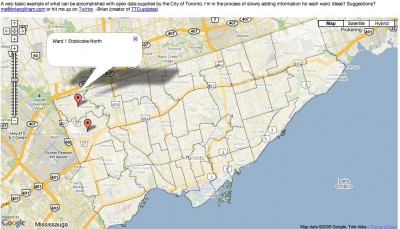
Toronto Mayor David Miller recently unveiled the opening of city datasets on the OpenTO website, ushering in the city’s new era of Gov 2.0.  In less than an hour, the above map of the city’s wards  was generated from the shapefiles.  According to Now Magazine::

“Basically, OpenTO amounts to the city offering up puzzle pieces and the public putting them together. It costs taxpayers next to nothing, creates a wing of local government in which citizens can participate directly, and makes everything more transparent.

At present, not a whole lot of data sets are available. But now that some have been liberated, it won’t be long before others follow.”

While it is true that there isn’t that much data available right now, it’s clear that there are great possibilities here.  The openness of the data will allow crowdsourced analysis of urban questions facing Toronto, which is a hotbed of urbanist activity.  This ostensibly can create more knowledge for use by Toronto’s Planning Department, as well as grassroots activists, non-profits, entrepreneurs, and corporate interests.  The transparency has a flipside.  While transparency of data can serve to “keep the city honest,” in the future, as more data goes online, how will individual citizens’ privacy concerns be addressed?  For example, should data on ex-convicts {or the like} be listed for public use, such as Megan’s Law databases in the United States?  What about data on abandoned property?  While this could assist in redevelopment, it might be used for more nefarious purposes.

While data openness is a hallmark of Web 2.0, in terms of policy, what parameters should be in place?

Twitterversion:: @mayormiller’s OpenTO offers #Toronto’s database access, offering Gov2.0 transparency& crowdsourcing opps. #ThickCulture http://url.ie/2tfw

Song:: The Planners Dream Goes Wrong – The Jam

3dfc4fe24db79afd4863922c9cbf

Notes from North of 49ºN

Up here in Canada, Remembrance Day is coming up on the 11th, so plenty of red poppies have cropped up, which is a Commonwealth tradition.  Until Afghanistan, it’s been a while since Canada has been in a “war” and the specifics of getting out of Afghanistan has entered into the news up here.  The Conservatives and the Liberal parties in Canada already agreed in 2008 to withdraw from Afghanistan::

“Canada’s top soldier, Chief of Defence Staff Walter Natynczyk, has given the order for Canadian Forces logistics whizzes to begin mapping out the move, expected to be finished by the end of 2011. That’s in keeping with a 2008 deal between the Harper government and Opposition Liberals that extended the combat mission until July, 2011, with a pullout taking until Dec. 31.”

On a sidenote, shortly after Harper’s announcement, news of the pricetag was released.  It was reported that by 2011 the military mission in could cost up to $1.8B CAN, or $1,500 per household.  While the decision was made last year, the logistics and details of the estimated skeleton crew of 500-600 soldiers to stay behind to protect redevelopment efforts and train local police has remained an open question.  In the interim, the war has become increasingly unpopular and according to Allen Sens, a University of British Columbia political scientist::

“Canada’s government and public is suffering from Afghanistan fatigue…There’s been a lack of progress, and I think the public has a sense that it’s time for other countries to step up and move into the south, where the fighting has been the toughest.”

The Obama Factor

The Liberals in Canada are quick to point out the failure of humanitarian efforts.  Canada had the objective of building 50 schools by 2011 but because of the instability, only five have been built.  So, why should Prime Minister Harper {Conservative} drag his feet on the “drawdown” planning?

“the Prime Minister acknowledged that not every single soldier will return with the combat pullout, and is expected lingering pressure from the Obama administration to help out may lead to a contingent remaining.”

Will Canada cave to possible pressure from the Obama administration to stay?  Politically, the opposition Liberals would be wise to shift as much decision-making on Harper and the Conservatives before triggering another federal election, something the Liberals have been threatening for most of the year.  Obama is faced with a tough decision and is running out of time.  Barack is faced with::

  1. A deteriorating situation in Afghanistan
  2. White House decisions based on reports painting an incomplete picture
  3. Little progress despite doubling troop numbers in 2009 {hence balking at McChrystal’s original recommendations}
  4. The election débâcle in Afghanistan where Karzai won amid fraud allegations
  5. Waning public support in the US of the war

Obama needs to assess whether his objectives can be met in Afghanistan, specifically in terms of what is possible and probable as outcomes, given a flailing domestic economic situation.  While the stakes are clearly lower for Canada than for the US and Obama, I wonder if Canada will react to any pressure from Obama to stick around, even with just 500-600 “non-combat”  troops.  I also wonder if the Liberals will try to push decisions that may irk Obama onto Harper.

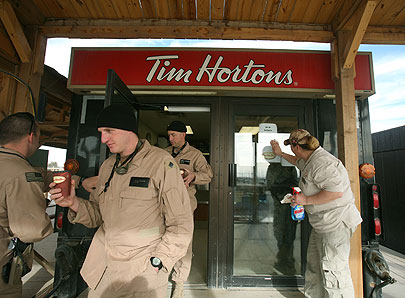
Image:: Iconic Tim Horton’s coffee shop in Kandahar.

Twitterversion:: Canadian Forces pressure deets on wthdrwl fr.Afghanistan. What will Obama do&how will Cdn politcns play it? #ThickCulture http://url.ie/2t3

Song::  Shipbuilding – Elvis Costello & the Attractions {about workers building ships for the UK Falklands War with Argentina}