Tonight is Barack Obama’s State of the Union address. Let’s hope it’s more exciting than Steve Job’s iPad announcement and I’m sure many Dems. hope it elicits less ridicule.
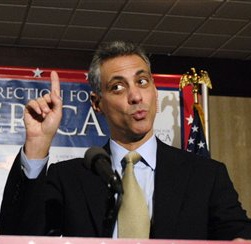
The WSJ has an even article on Rahm Emanuel, the White House Chief of Staff, about how he’s taking heat from the left.
“The friction was laid bare in August when Mr. Emanuel showed up at a weekly strategy session featuring liberal groups and White House aides. Some attendees said they were planning to air ads attacking conservative Democrats who were balking at Mr. Obama’s health-care overhaul.
‘F—ing retarded,’ Mr. Emanuel scolded the group, according to several participants. He warned them not to alienate lawmakers whose votes would be needed on health care and other top legislative items.”
From a strategic perspective, I feel both the Republicans and Democrats are rudderless. The Republicans have taken potshots at Obama and the Democrats, but don’t have a unifying vision. The Democrats led by Obama are taking heat for not addressing the problems-at-hand head-on and the left wing of the party feels the administration is compromising ideology.
A year ago, Obama was ushered in on a mandate of change. Emanuel is a Clintonian centrist and deals in a raw pragmatism in the service of getting things done. So, while many in the Democratic party in wake of the loss of Ted Kennedy’s old Senate seat in Massachusetts {hey, I spelled it right, unlike Coakley} think the party should go more centrist. Strategically, the Obama administration needs to address the concerns of the people in effective ways. While Emanuel’s centrist pragmatism may seem like a reasonable way to push policies through, it’s passive. Love him or hate him, George W. Bush was good at changing the game with the help of Karl Rove. Jon Stewart for weeks has lambasted the Dems. for focusing so much on retaining a filibuster-proof Senate majority, something W never had. While it could be argued that this is because of many centrist constituencies that Senators are beholden to, I see a dearth of effective communication and policies that people can get behind.
The lack of support on health care reform is a perfect storm. The right has framed it as a government interventionist boondoggle and the left have failed to communicate what they perceive the stakes to be. I see “centrist pragmatism” as resulting in the proposed healthcare legislation, which is overly complex, hard to understand, and reeks of compromise. As we’ll see below, healthcare is now the “wrong” issue, no matter how hard politicians try to spin it as being tied to the economy.
Rahm’s centrism is wrongheaded, but blindly following a hard left agenda would also be a mistake. I think the Obama administration needs to look at the priorities of the people and the challenge will be to craft policy addressing these and communicating how the policy will effect change.
What are the public’s priorities? According to a Pew Research study conducted earlier in the month, overall, the economy is looming large as a concern::
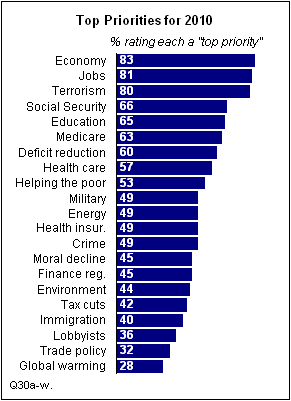 Terrorism is third, with the Christmas airline bombing attempt fresh in people’s minds. The next three are interesting with possible drivers:: social security {decimated retirement plans and obliterated pensions}, education {rising costs}, and Medicare {rising pharmaceutical costs}. Breaking things down by ideological lines, the following pattern emerges::
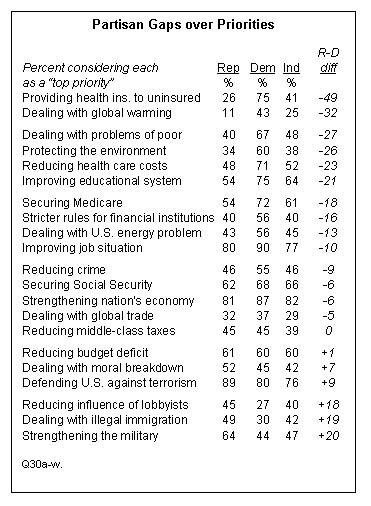
| Republican | % | Democrat | % | Independents | % |
| Defending the US against terrorism | 89% | Improving job situation | 90% | Strengthening nation’s economy | 82% |
| Strengthening nation’s economy | 81% | Strengthening nation’s economy | 87% | Improving job situation | 77% |
| Improving job situation | 80% | Defending the US against terrorism | 80% | Defending the US against terrorism | 76% |
| Strengthening the military | 64% | Improving educational system | 75% | Securing Social Security | 66% |
| Securing Social Security | 62% | Securing Medicare | 72% | Improving educational system | 64% |
Interestingly, what matters to all groups is pretty similar. Healthcare is only in the top 5 for Democrats, painting the issue as partisan, given its divisiveness.
What to do? All roads lead to the economy and while the deficit is a concern, strategically, I see populist Keynesian measures that put people to work as a way to win over independents, appeal to the Democratic base, and would be hard for Republicans to fight.
Twitterversion:: Centrist pragmatist R. Emanuel under fire from left-Democrats, but what about people’s priorities? Insights fr. Pew data. http://url.ie/4sen @Prof_K