Mitt Romney

Times Square, NYC, 31 October 2012-Romney & Obama electoral prediction—Kenneth M. Kambara

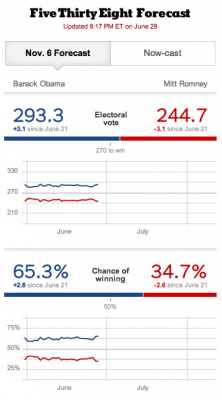
Greetings from NYC, post Sandy, but pre-election. I have been really busy this election season, so I haven’t had the time to cover this election or do as much reading as I would like. I have C-SPAN on now watching the last minute speeches by Romney, Obama, Ryan, and Biden and seeing a bit on punditry. I didn’t compile predictions like I did for 2008, but this time I’ll go into some detail on my swing state picks. Here’s a compilation I saw on my Twitter feed.

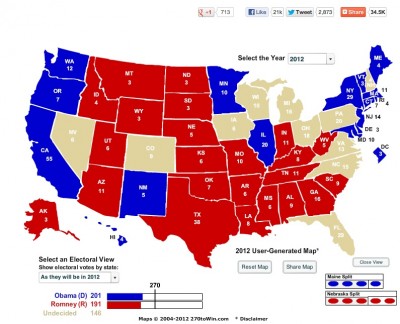
Here’s the electoral map that I started with. The 146 electorals in the swing states are beige, while Romney’s states are red and Obama’s are blue. The breakdown is 201 [Obama], 191 [Romney], 146 in play, and with 270 needed to win.
Florida [29] The polls show the momentum shifting towards Romney in the state. I think the post-mortems will find that the I-4 corridor decided the election and the Democratic hopes of winning the state hinge upon keeping it close here. I don’t know the “house effects” for Mason-Dixon, but their poll of the area for the Tampa Bay Times has Romney leading.

North Carolina [15] I don’t think North Carolina is in play. Obama wasn’t appearing there himself and while Bill Clinton was pitching for the cause with the likes of Mariah Carey, I think his campaign has conceded it to Romney. Romney’s campaign has signalled its confidence since mid-October. Unemployment is high in the state and it was a narrow Obama victory in 2008 which tends to vote Republican in Presidential races.

Pennsylvania [20] Romney made a recent push in Pennsylvania, including a $12M adspend, which may have raised some eyebrows. I think it’s “too big to ignore” and his people felt it was worth the stretch. Michael Barone of The National Review went out on a limb with Pennsylvania, citing Romney’s appeal specifically in the western part of the Keystone state and the Philadelphia suburbs. It could be close, as this article on Philly.com notes.

Michigan [16] Another bellwether and a must-win for Obama was a beneficiary of the 2009 auto bailouts. Democrats are expecting Debbie Stabenow to hold her US Senate seat and are hoping to pick up some House seats, including MI-1 in the upper peninsula (Bart Stupak’s [D] old seat). The tea party candidate, Dan Benishek, is facing a tough race in a district that benefits greatly from federal monies. I see blue as trending in the state.

Nevada [6] I don’t see Nevada as being in play, despite the sky high unemployment of 11.8%. Obama has focused on courting Hispanics and the union vote, while Romney has worked a ground game strategy in the Las Vegas suburbs.

Colorado [9] NBC has this at a dead heat and early voting is trending for Romney. Colorado tends to vote Republican and didn’t go for Clinton in 1996. I see the closeness of the race at this time being bad news for Obama’s fortunes in the state.

Iowa [6] I think Obama’s rhetoric in Iowa might be a tipoff. Unlike in Ohio, where he characterized Romney as “not one of us”, his messaging in Iowa was more hope & change. The northwest has Evangelical Christians who aren’t too excited about Mitt Romney so turnout is key there. Obama will need to do well in the cities along I-80 to pull off Iowa.

Wisconsin [10] I see Wisconsin as a schizophrenic state. The trend has been towards Democrats in the presidency, but Republicans are a force at the state level and one of the US Senate seats and 5 of 8 House seats. The polls have Obama in the lead and my take is that despite Ryan on the ticket, this will hold.

This brings us to a 259 to 244 tally with Obama leading Romney with 35 electorals in play.
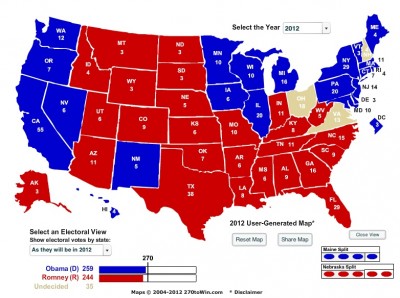
I see the following states as the swingingest of the swing states. These are varying shades of “purple” in my book (between red & blue) and as of 2:18AM EST, I think they will go Obama. I don’t feel very solid about this and I think there’s a good chance that if Virginia and Ohio don’t show clear trends early, it’s going to be a long election night.

I don’t like not having a definitive prediction, so I’ll go on the record with a 294-244 Obama win. The caveat being that much of this is based on polling data.
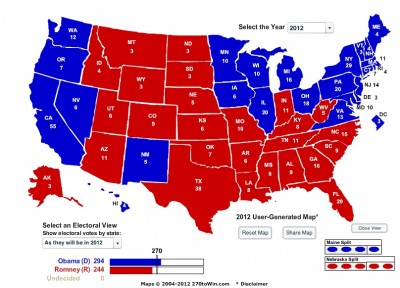
Ohio [18] Bellwether Ohio has been trending towards Obama, buoyed by a recovery and relatively low unemployment. The populist vote indebted to the auto bailout. The rural vote may make things close for Mitt Romney if turnout in Cleveland and the urban manufacturing centers falters.

New Hampshire [4] I think New Hampshire might be really close, but I think it’s leaning Obama. Romney was making headway in October, but it looks like his momentum has stalled. My concerns after following Canadian politics is the polls being off, particularly in constituencies with a rural composition. I wouldn’t be surprised if Romney pulls this out.

Virginia [13] I think this is a true toss-up. I think the fate of the Commonwealth electorals resides in three northern swing counties. I think Romney’s protectionist stance on China might hurt him with selected educated suburbanites. I think if turnout is high in northern Virginia, Obama gets a slight edge, but I think it will be very close.

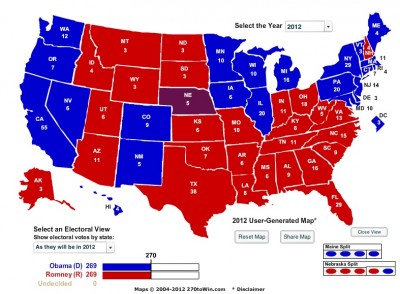
At the risk of sounding like I’m hedging, I see the opposite as a definite possibility, i.e., Romney sweeping these three. Although the data might support my above prediction, there is the danger that the polls are off. While Nate Silver correctly predicted 49 of 50 states in 2008, he missed Indiana. I called Indiana for Obama based on Karl Rove’s observation that Barack was doing well in the northwestern corner of the state near Hammond & Gary. That’s why I’m thinking the following 279-259 Romney win could happen. It would be something, but not likely, if there was a 269-269 tie. This could happen with Obama getting Colorado and an electoral in Nebraska, while losing New Hampshire, Virginia, and Ohio. The likely result of a tie: President Mitt with Joe as Veep.
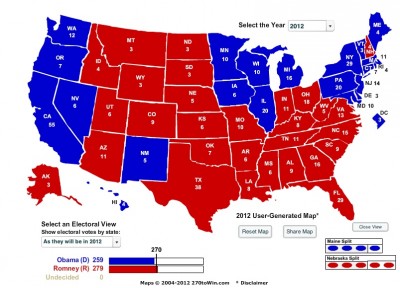
Romney winning Virginia, New Hampshire, & Ohio.
269-all tie with Obama getting Colorado and Nebraska’s 2nd. District.

Note: Thanks to Fred Strauss for pointing me to this National Review post and several other sources that informed my opinion.
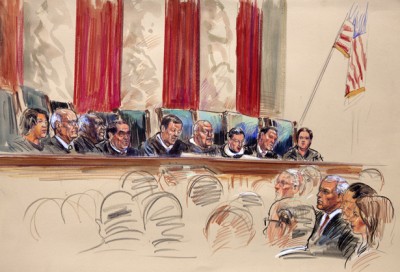
From left are, Justices Sonia Sotomayor, Stephen Breyer, Clarence Thomas, Antonin Scalia, Roberts, Anthony Kennedy, Ruth Bader Ginsburg and Elena Kagan. (AP Photo/Dana Verkouteren)

Yesterday’s SCOTUS ruling [full text] on Barack Obama’s Patient Protection and Affordable Care Act (PPACA or ACA) was an interesting one on several fronts. This post will go over political, legal, and health policy ramifications of the decision, focusing specifically on the individual mandate.

The Election

Earlier this year, I was of the opinion that regardless of the outcome of the case, Obama wins. Now, I’m not so sure that would have been the case. While a ruling against ACA would provide Barack and the Democrats election fodder by offering evidence of an activist conservative Court that is willing to override the will of Congress, I think a bigger danger would be tied to a divisive law that was a centerpiece to Obama’s first term that was deemed as unconstitutional. My opinion is that the electoral calculus favors Obama, but for him to be able to enact any change in his second term, he will need a mandate and enjoy Democratic control of the House and Senate. That might be a long shot. The trifecta of Presidency, House, and Senate is the real issue and precondition for an agenda of change—not the nationwide polling numbers, although perceptions of a close election are in the best interests of the media and could boost turnout, which would favor the Democrats.


Like Ike

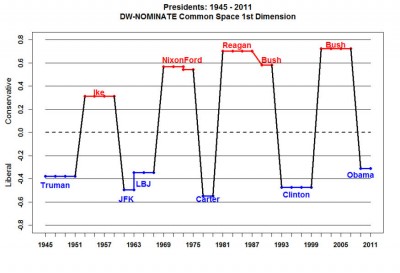
While Romney and the Republicans may try to make hay out of repealing ACA, I’m not sure how much traction it will get. It could be part of anti-taxation rhetoric, given that’s what the Supreme Court based the ACA decision on, but that could be problematic given that Romney has already committed to tax cuts for the wealthy. While some of Mitt’s recent political rhetoric has a populist ring to it, the devil’s in the details. I think in the battle for swing state independents and moderates, I think Romney’s only shot is to go populist and appeal with a middle-class populism. While Obama’s track record, based on Voteview’s analysis of roll call votes {albeit an imperfect measure for the presidencies}, shows him as the least liberal Democrat since Johnson {who was a hawk during the Vietnam War}, Eisenhower was the least conservative Republican.

Perhaps rather than harken back to Reagan, Romney should go back to 1950s traditionalism and the political moderation of Ike. I feel that Romney is allowing himself to be heavily defined by others—be it Obama or the more socially conservative wing of the party. Maybe this is a reaction to McCain’s maverick, seat of the pants style that involved choosing a Sarah Palin, who wasn’t always rowing in the same direction as the campaign, and suspending his campaign during the fall 2008 financial crisis. Addressing ACA as a moderate populist makes more sense than taking potshots at Obama’s “bad law” that is now deemed as constitutional. Plus, Justice Ginsburg stated Romneycare was a reason she sided with the majority, which can be thrown in Romney’s face.

Taxation vs. The Commerce Clause

While Chief Justice John Roberts is being lauded for his genius, this DC Bar post from January of 2011 presages his take on the matter. Jack Balkin of the Yale Law School is quoted:

“Balkin believes the best argument for the constitutionality of the individual mandate is that it is a tax. ‘It is an amendment to the Internal Revenue Code. It is collected on your tax return. It is collected by the Internal Revenue Service (IRS). It’s computed based in part on your income. It’s a tax.’”

A commerce clause interpretation gets murky fast because it’s one thing for Congress to regulate commerce, but quite another to require it. Chief Justice Roberts [pdf] made this clear:

“Construing the Commerce Clause to permit Congress to regulate individuals precisely because they are doing nothing would open a new and potentially vast domain to congressional authority. Congress already possesses expansive power to regulate what people do. Upholding the Affordable Care Act under the Commerce Clause would give Congress the same license to regulate what people do not do. The Framers knew the difference between doing something and doing nothing. They gave Congress the power to regulate commerce, not to compel it. Ignoring that distinction would undermine the principle that the Federal Government is a government of limited and enumerated powers. The individual mandate thus cannot be sustained under Congress’s power to ‘regulate Commerce.’”

Tom Scocca in Slate argued that this could limit the ability of Congress to enact law through the use of the Commerce Clause. David Cole in The Nation isn’t so sure:

“When one adds the dissenting justices, there were five votes on the Court for this restrictive view of the Commerce Clause. But that is not binding because the law was upheld on other grounds. And while some have termed this a major restriction on Commerce Clause power, it is not clear that it will have significant impact going forward, as the individual mandate was the first and only time in over 200 years that Congress had in fact sought to compel people to engage in commerce. It’s just not a common way of regulating, so the fact that five Justices think it’s an unconstitutional way of regulating is not likely to have much real-world significance.”

The ultimate policy effect of the “tax” or “penalty” will probably work because of social psychology’s prospect theory—people don’t like losses and will avoid them. This will compel compliance with the program, allowing the pooling of the population to spread out the risk.

Health Policy

Is the ACA good health policy? Well, one view is that it’s flawed from a health economics point of view, as Larry Van Horn states. I think he conveniently omits the fact that there’s a difference between actuarial and social insurance, which I blogged about on ThickCulture back in 2009. The healthcare industry faces uncertainty, as the increased demand for services may not be offset by pressures on margins. The main question for patients will be whether access to high quality care will be available. As a documentary producer and researcher on the subject of primary healthcare, I’ve been following what’s been done in Massachusetts, i.e., Romneycare. Yes, there are issues with rural healthcare in the Commonwealth and CUNY-Hunter College Public Health professors, David U. Himmelstein and Steffie Woolhandler {former Massachusetts MDs} are advocating for a public health program that would further reform healthcare. I think they make some very valid points, but I tend towards viewing healthcare as social infrastructure. Specifically, they are advocating for:

  1. Cutting out middlemen {costly insurance overhead}
  2. Pay hospitals based on costs, not on a per-patient basis
  3. Enforce real health planning
  4. More primary care, less specialists
  5. Price controls on pharmaceuticals
  6. Cap salaries on health executives

My take is that the ACA will have a positive net effect on health outcomes by increasing demand and adding to the insurance pool, younger patients who tend to have lower incomes [see pdf from US Census]. I think the best to hope for in the current model is a minimal care floor that serves as a lower threshold. It won’t be perfect and it may eventually move the industry towards rationalizing prices, which can be quite exorbitant, as evidenced in a LATimes report:

“Of course, and it’s all part of a years-long game in which the charge for service, the true cost of the service, and the acceptable payment are in three different orbits. And that doesn’t even take into account how the charges are adjusted up or down depending on who’s paying them and whether they have worked out a deal. How can patients hope to make sense of such an indefensibly convoluted system?”

Why? The insurance companies won’t be able to cherrypick healthy patients and will actively seek ways to cut costs. Although, they will most likely try to continue the practice of finding ways to limit payouts to physicians, I can see the insurance industry scrambling to develop new models of healthcare with segmented markets and there may be innovations stemming from the policy. The industry will push hard for as little regulation as possible.

Finally, who will be the big winners in all of this? In my opinion, the lobbyists. Oh, and mea culpa…{h/t Kathleen Maloney}