
midterm election

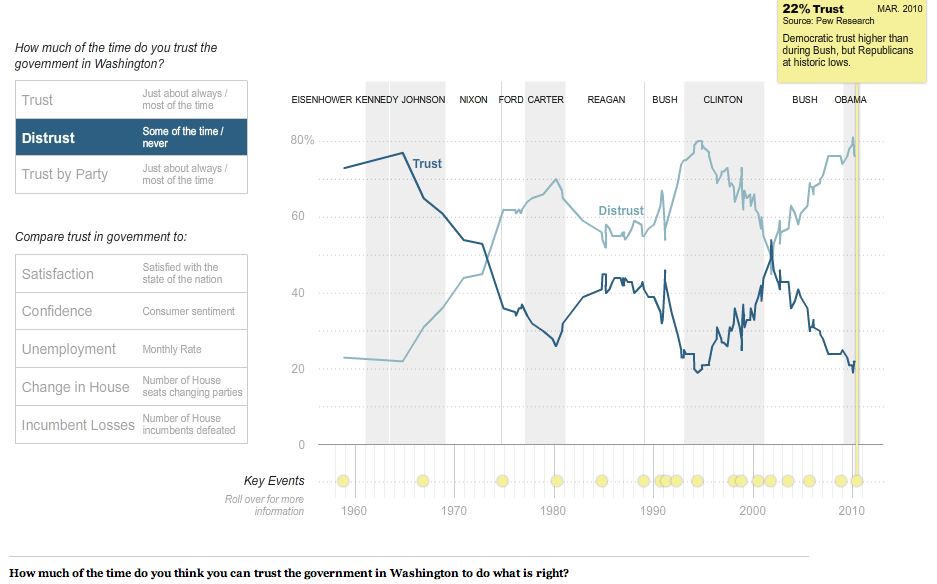
Trust/Distrust Perceptions, Pew Research Center for the People & the Press, 1958-2010

A recent report from Pew has an interactive map on perceptions of trust of the government. There are also key events that attempt to contextualize the trends, as well as charts with changes in the House and incumbent losses. In 1992, Clinton inherited slipping trust from George H. W. Bush and Reagan inherited low, but rebounding numbers from Carter.

Should we expect a bloodbath in this fall’s midterms?

I think both parties need to be concerned, particularly given the trends on this chart::
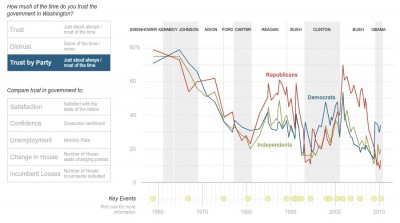
Trust by party affiliation, 1958-2010

Under George W. Bush, trust was in freefall for everyone in his second term. In my opinion, there was a perfect storm, which literally involved a storm. Katrina hit in 2005 and the conservative coalition started to break down, which I think became evident in the Harriet Miers nomination for the Supreme Court. The 2006 midterms with a surge of Democrat wins and Obama’s election in 2008 served to further cause Republicans to have less trust in the government.

Politicians on either side of the aisle should heed the antecedents of trust, in order to increase the odds of getting votes. In my opinion, negative rhetoric that doesn’t address increasing trustworthiness for a focal candidate is a danger.

What are the drivers of trust?

I’m working on a paper on organizational trust, based on the social psychology literature. The three antecedents of trust my co-author and I are using are::

  1. Ability
  2. Integrity
  3. Benevolence

These are subject to contextual constraints, i.e., the current economy and the political zeitgeist which is up in the air regarding big or small government. The challenge is to craft a strategy to build trust. In a sense, Obama’s reaching across to Republicans should be appealing to benevolence, but it’s not. It may be overshadowed by integrity and ability, which given the economic woes will be hard to convince Obama’s detractors that his policies are leading us in the right direction, given the credence qualities {hard to gauge efficacy even after implementation} of economic policy. If obama and the Democrats don’t realize that this is a battle of “communication” that needs to be addressed quickly, expect losses in November.

Twitterversion:: New Pew study shows trust of the government at only 22% and for Republicans an all-time low. How can social psych. inform political strategy? @Prof_K

Song:: KMFDM-‘Trust’

Video:: Biden to Obama, “This is a big f*cking deal”

The signing of the healthcare bill last week was significant in more ways than one. I feel it galvanized the Democrats and I also feel it was critical for Obama to make the healthcare bill “personal” and get fellow Democrats to be rowing in the same direction. I think this was quite a challenge, as the liberal factions of the party are ideologically distinct from the more conservative Blue Dog Democrats.

In the wake of the signing, the Democrats got good news in the form of a public opinion poll reporting 49% saying the bill was a good thing, compared to 40% saying it was bad. There was also a spike in donations, with $1M pouring in last Tuesday without a direct ask.

There has been a backlash and alleged incidents of offices being vandalized. The Republicans needed to respond to thwart any momentum, but I’m not convinced their strategy is sound. Sarah Palin started a bit of controversy with her reload and targeting comments in a speech in Senate Majority Leader Harry Reid’s hometown of Searchlight, NV::

The media tried to whip Sarah Palin’s “targeting” and “reload” comments into pageview fodder, but I think the big issue for Republicans is a lack of a message that resonates with a country in the economic doldrums. John McCain claims that Palin’s words are just political rhetoric::

While this all makes for good drama, I’m not sure how effective this type of press coverage is in building support. I can’t help but think of the utter carnage of the 1994 midterm elections. Bill Clinton was weakened by a lack of support in Congress from his own party as a Washington outsider and…Newt Gingrich’s Contract with America. This C-SPAN footage is a bit dry, but it shows a systematic delineation of undermining public support of Democrats and was more successful than many anticipated. The Democrats would go on to lose 8 seats in the Senate and 54 in the House, earning a majority in both.

I think there was and perhaps still is an opportunity for the Republicans to pick up quite a few seats, but there needs to be rhetoric that moderates can sink their teeth into. Without a more substantial agenda resonating, I predict low turnout, as voters sit the midterms out.

Twitterversion:: Post healthcare, Dems get bump in polls & donations last wk. Rep. backlash ensues. Doubtful if 2010 will be another 1994 @Prof_K

Song:: Okkervil River-‘Our Life Is Not a Movie’