
legitimacy

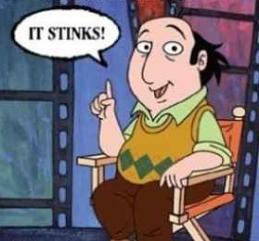
image:: "Jay Sherman" from The Critic {1994-1995} voiced by Jon Lovitz

It may seem like all I do is bitch about other articles on here, but I am getting old and cranky. Today’s target, I mean subject is an article from The Chronic{le} of Higher Education by Thomas Doherty, The Death of Film Criticism. Doherty laments the rise of blog film critics on the wild expanses of the Internet that don’t have much to say beyond the trivial by scribes who don’t even read books. He does a good job of describing the rise and fall of film criticism in the 20th. century and it’s worthwhile reading. Where he loses me is how he doesn’t see how utterly predictable this all is. The main target market for films is the youth. That’s not to say older people don’t see movies, but for the most part, they matter far less than the teenager. Why? The blockbuster needs repeat viewings by throngs of theatregoers. So, the medium is increasingly targeted towards teen audiences, along with the current infatuation with celebrity culture. The Hollywood machine caters to the “head” of the long tail, i.e., the blockbuster, which is all about delivering spectacle. It’s not about artistry, how Paul Thomas Anderson’s Magnolia {1999} has umpteen layers of symbolism and references couched within, or what Lars Von Trier and the Dogme95 movement are doing with films like Antichrist {2009}. The rise of the bloggers, who could care less about allusion or auteurs, goes hand in glove with where much of the industry is today. These days it’s about horror, action, and vampires.

Where Doherty gets interesting is how he says the Internet is also spawning interesting intellectual dialectic discussion on film by academics. Unfortunately, such work isn’t weighted the same way as publications, bringing up the issue of how institutional logics lag behind the new technologies. I see this as a big problem for two reasons.

First, while I “get” the idea that peer-review publications and books in journals and presses serve a legitimation function, this same function serves dominant paradigms in fields and places academic knowledge behind paywalls. Should academic knowledge be free? I feel that what distinguishes higher education research from applied industrial research is that it serves the public good, so I feel university knowledge should be towards no or low cost to obtain. Even in the areas of innovation, I believe universities can be a catalyst for “open innovation”, where technologies are licensed to multiple entities at a lower cost structure to spur distributed collaborative work. The idea is to speed up the innovation process by allowing knowledge to flow through networks, not silos {within companies or even departments}.

Second, I think that higher education may be at a crossroads. Right now, it has a monopoly on providing the legitimizing totem of the accredited degree, which has a ceremonial function in the workforce. In 2007, I was at an event where a local employer discussed what skills they are looking for from recent college graduates. What were they looking for? Critical thinking? Domain knowledge? Sure. But what came through as highlights were “meeting” skills and knowledge of Microsoft Office. This made me cringe, as I thought this was a harbinger as the university as merely vocational education.

Nevertheless, I’m wondering if with globalization that higher education needs to be relevant more than ever. Relevant to all of its stakeholders, which may mean a swifter adaptation to changes afoot, in terms of the institutional character of higher education and what it rewards and values. Future blog posts of mine will develop my ideas on this and provide a blueprint for the university in Web 2.0+.

Is the film critic dead? Well, no, it’s just her/his audience may be a lot more fragmented.

Twitterversion:: Death of the film critic? WWW killng the profession-also fostering academic dialectic while higher ed scoffs.#ThickCulture @Prof_K

Song:: Steely Dan-“Reeling in the Years”
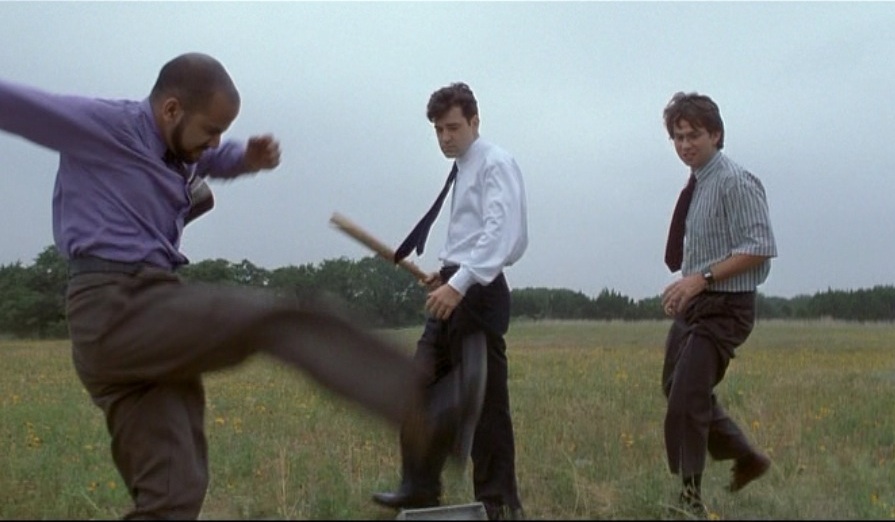
Office Space scene "The Going Away Present" of printer destruction

Over on OpenSalon, Mary Elizabeth Williams did a post on author’s social media e-sponses to negative reviews .  At first, I was amused by the spirited rejoinders.  Williams cites Ayelet Waldman’s response to Jill Lepore’s review of Bad Mother in the New Yorker, was allegedly a succinct “The book is a feminist polemic, you ignorant twat.” My favorite was Alain de Botton’s response to Caleb Crain’s review in the New York Times on the latter’s blog::

“Caleb, you make it sound on your blog that your review is somehow a sane and fair assessment. In my eyes, and all those who have read it with anything like impartiality, it is a review driven by an almost manic desire to bad-mouth and perversely depreciate anything of value. The accusations you level at me are simply extraordinary. I genuinely hope that you will find yourself on the receiving end of such a daft review some time very soon – so that you can grow up and start to take some responsibility for your work as a reviewer. You have now killed my book in the United States, nothing short of that. So that’s two years of work down the drain in one miserable 900 word review. You present yourself as ‘nice’ in this blog (so much talk about your boyfriend, the dog etc). It’s only fair for your readers (nice people like Joe Linker and trusting souls like PAB) to get a whiff that the truth may be more complex. I will hate you till the day I die and wish you nothing but ill will in every career move you make. I will be watching with interest and schadenfreude.” [Emphasis added]

I chose to show the full comment, not just the last sentences in bold that many are quoting, since I wanted to provide context and show that it wasn’t just a two-line virulent jab.  Some might call this churlish, but I saw it as a writer showing he has the chops as a writer to defend his book against criticism.

I do understand why Williams offers her advice of being careful about ranting at critics.  Such angry behaviour can make can one seem shrill and immature, although I do enjoy the sheer drama of it all.  Publishing, as it stands today, is hypercompetitive and there are influential gatekeepers like critics.  I wonder if these interactions in social media are showing how the “authority” of the critic is being decentered.  Social media allow for dialogues and will expectations shift, in that critics will have to justify their reviews to authors and audiences alike.  Interestingly, Caleb Crain chose not to respond to Alain de Botton’s comment, only offering an unsatisfying::

“Folks: Thanks for all your comments. A broad range of opinions have been expressed, and I’m going to close comments on this post now. all best wishes, Caleb”

That said, I wonder what the future of publishing and criticism are, given Web 2.0 and beyond.  The critic serves a winnowing function, granting {or taking away} legitimacy and status.  Will this function be replaced by an increasingly intelligent Web 3.0 with “crowdsourced” reviews?  What are the implications for acadème and peer-review journals?  Will the “wisdom of the crowd” topple the institutional fiefdoms controlling knowledge?

I know critiquing work can be tough.  While not that in-depth, the act of reviewing Soderburgh’s The Girlfriend Experience was illuminating for me, particularly after seeing how many reviewers were taking the easy road.  I’ve done peer-review for over 15 years now and have been through the double-blind review process, as well.  I’ve always tried to be constructive with my reviews, even with what I see is a flawed manuscript, offering citations and {hopefully} theoretical or methodological insights.  I’ve read that Will Ferrell is very constructive as a colleague, often taking the time to help others work through something not working with their comedy, and I’m trying to pattern myself after this.  My take is that if you can’t be constructive and if you tear something down without backing it up, you better be prepared to fight it out and social media is the perfect venue for this.

Song:: There Is Nothing Wrong With Hating Rock Critics (Cd) – Of Montreal


Video:: Office Space “The Going Away Present”

Twitterversion:: Authors using #socialmedia to lash out at negative reviews. #Fail or #Web2.0 decentering of critics as #gatekeepers in publishing? @Prof_K