
Jack Layton

YouTube Preview Image

I was taking a break from a stack of work and watched a bit of the Australian Open on TSN here in Montréal. I saw the above attack ad by the Conservative Party of Canada, targeting Liberal Party of Canada leader Michael Ignatieff, and I was wondering if it was recycled, since the rhetoric was rather familiar. After some research, I saw that impolitical, who is always on top of these things, already blogged about the new campaign. In a phrase, “forced and desperate”. This ad is one of several attack ads on the CPC YouTube channel. I could analyze these ads but this overview in the National Post pretty much says what I wanted to say {also has the ads embedded in the post}.

I think strategically this crop of ads is phoning it in. Maybe PM Stephen Harper is believing the hype that he can eradicate the Liberals.  This “stay the course ad” doesn’t inspire and only makes sense if the Conservatives wanted to hold onto a comfortable majority in Parliament, not get one::

YouTube Preview Image

The rest of the ads represent, in my opinion, muddled thinking and a lack of strategic prowess. The attacks on Ignatieff are saying nothing new and border on making Stephen Harper and the Conservatives look like bullies. Attacking the NDP’s Jack Layton definitely makes Stephen Harper and the Conservatives look like bullies. Plus, here in Québec, the ads are targeting the Bloc’s Gilles Duceppe {in French, but you can get the drift with the on-screen text}::

YouTube Preview Image

Layton is a relatively popular leader of a relatively unpopular party. Attacking Layton, rather than the NDP, is an interesting way to go. I tend to agree with the conventional wisdom that a strong NDP erodes Liberal support by splitting the vote on the left, so attacking the NDP only makes sense if the objective is to get converts. If the strategy is to shift support from the NDP to the Conservatives, that’s an uphill battle. In 2010, those polled by EKOS who support the NDP are more likely to support {as a second choice} the Liberals, no other party, or the Greens, in that order, rather than the Conservatives. Attacking Duceppe on his home turf, as opposed to showing the positives of the Conservative Party for Québec, seems downright reckless. Bloc Québécois supporters’ second choice is no other party, the NDP, the Greens, and then the Liberals and Conservatives, in that order.

Over the holidays, I heard a pundit on CBC radio saying that it might be the end of the road for all of the party leaders including Harper. He hasn’t obtained a majority and if this is part of his bid to do so, I think it’s a risky strategy. The negativity runs the risk of coalescing ABC, anything but Conservative, sentiments and fostering strategic voting. While in the US there’s a call to tone down the negative rhetoric, the CPC is turning the heat up.

It’s always better to be lucky than good and I’ve always wondered when Harper’s luck would run out. With this advertising strategy, I wonder if his time is up.

As for the featured 2nd. round matches at the Australian Open, Venus Williams and Maria Sharapova advanced.

Twitterversion:: [blog+videos] The Offensive Offensive:: Conservative Attack Ads Target Ignatieff http://t.co/KOkTFPZ #ThickCulture
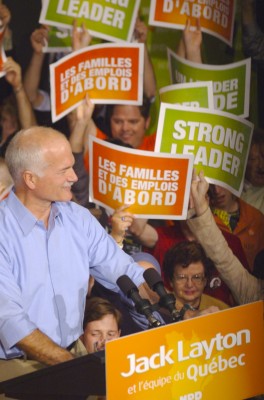
Jack Layton, Leader of the New Democratic Party of Canada

Notes from north of 49ºN

Update 4 August:: Video on Jack Layton from MSNBC-below.

Jack Layton is the leader of the New Democratic Party of Canada whose riding is the next one over from me, Toronto-Danforth.  Over on the Huffington Post, Jack did a post on the realities of the Canadian health care system.

I have a lot of strong views on health care in the US based on my work in non-profit health and my research on the biotech industry.  It’s worth mentioning that today’s US health care system began as employer perquisites {benefits}, back when health care and pharmaceuticals were cheap.  The private insurance model starts to break down when costs escalate resulting in employers and employees getting squeezed and uninsured rates rising.  Some say a perfect storm of events {recession, rising costs, uninsured rate of 19%, and Obama} is leading to a tipping point in health care.  It should be noted that the US will not adopt a health care system like Canada’s, where the government {provinces} provide health care, but rather a system where the government finances health care delivered by private enterprise.

On the The Huffington Post, Jack makes some compelling points, whether you agree with his politics or not::

“Costs are under control in Canada. We spend similar amounts on public care – around 7% of GDP. For that price, Canada covers everyone, the U.S. just one third of the population. In case you’re worried Canada wastes money on bureaucracy, know that just 2.4% of our total costs go to administration compared to 7% of what your government spends. In end, Canadian care costs $2,500 less per capita – and covers everyone.”

He points out that the system isn’t perfect::

“Our system does have flaws. We need better prescription drug coverage, better remote access to care and better practices in hospitals and clinics. No honest advocate for our health care system would dismiss these things. But Canadian health care works — and works well.”

Does all this mean that the United States should adopt Canada’s health care system?…No. America can no more adopt our health care system than we can swap hockey for baseball as our national pastime. A good health care system reflects a country’s values, and each country’s values are different…But a system with 47 million uninsured, coverage denied due to pre-existing conditions and people thrown off plans when they become ill? That doesn’t reflect American values.”

Unfortunately, there are other competing values in play in the US, making healthcare a contentious issue.  It’s not a simple matter of costs and taxes, but one that also affects innovation and entrepreneurship.  Biotechnology is predicated upon using the human genome to better match diseases, patients, and therapies.  “Pre-existing conditions” and genetic skeletons in one’s closet can thwart innovation in biotech because it adds additional business risk.  If insurance refuses to pay, where are the revenues?

One question on my mind and one I pose to my students, is healthcare a public infrastructure or should it be treated strictly as a business?  The Canadian model is one where the state is the financier and provider, where the provinces oversee a large, integrated health infrastructure.  As stated above, a new US healthcare model is unlikely to be this comprehensive, instead focusing in financing.  The current US model uses market mechanisms heavily, where healthcare delivery, insurance, and pharmaceuticals all having a dog in the healthcare reform fight.  Altering the landscape through healthcare reform will alter business models and likely create windfall gains and losses.  On the other hand, we have that perfect storm of recession, rising costs, uninsured rate of 19%, and Obama.  Another implication of the current model, where healthcare is an employment benefit, is that it limits new business creation, i.e., creates “entrepreneurship lock.”  A recent working paper supports this reasoning::

“Overall we find some evidence that the U.S. emphasis on employer-provided health insurance may be limiting entrepreneurship.  The clearest evidence comes from the regression discontinuity results which create the most comparability in experimental and controls groups.  The finding of ‘entrepreneurship lock’ is important as it suggests that the bundling of health insurance and employment may create an inefficient allocation of which or when workers start businesses.”

Healthcare can also has an affect on the arts in the US in same fashion, necessitating that creatives take on dayjobs with health benefits.  One artist once told me that money {or lower costs} means the freedom to create.  The current system does precious little to create incentives for cash-strapped entrepreneurs and creatives to innovate and create.  Does this matter?  I think it does in terms of sustainable economic growth and treating healthcare as a publicly financed infrastructure, i.e., a social good, paid with {gasp} taxpayer dollars makes more sense than the current system, but the devil’s in the details and good implementation is critical in order for a new system to be successful.  That said, these challenges shouldn’t be reasons not to do it.
Video:: Jack Layton on MSNBC’s The Ed Show, NDP Blog via Twitter

Link

YouTube Preview Image

Visit msnbc.com for Breaking News, World News, and News about the Economy

Twitterversion:: Jack Layton of #NDP clarifies healthcare in #Canada. Should healthcare be infrastructure? Implications for innovation & entrepreneurship. #ThickCulture @Prof_K

Song::  Planet Health – Chairlift {Brooklyn, NY of iPod Nano fame}