

Tag Archives: city planning

Dissecting Utopia?:: Canada’s Safest City

Ken Kirsch-"Caledon Ontario Road"

Ken Kirsch-"Caledon Ontario Road"

Notes from North of 49ºN.

Macleans magazine, like any other, likes to create lists.  I was going through old issues before I pitched them and I spied an article about Canada’s Most Dangerous Cities.  {Here’s the 2009 version}. Caledon, Ontario for two years straight was deemed the safest place in Canada, a town of 58,000 about 40 kilometers/25 miles from Toronto.  I’ve seen Caledon from the air, heading into Toronto’s Pearson Airport, a town on the edge of the greater Toronto area {GTA}, where the 410 freeway peters out on the rural outskirts.   I recall the town where I worked the past few years, Thousand Oaks, CA, was deemed one of the safest places by the FBI, which wasn’t too surprising.  It was fairly affluent, suburban, and homogeneous at 85% white in the 2000 Census.  The 2008 Macleans article went into the reasons why Caledon had such low crime, while crime seemed to be on the rise in neighbouring Brampton.

How safe is Caledon.  According to the Macleans article::

“Of the 100 biggest cities or regions in Canada, Caledon is the safest. In 2006, the most recent year for which there’s annual data, it ranked the lowest —107 per cent below the national average — for a score combining six crimes (murder, sexual assault, breaking and entering, vehicle theft, aggravated assault, and robbery)”.

So, what makes it so “safe”?

  • Strict police
  • Visible police {6,000 hours of foot patrol with 100,000 interactions and only 12 public complaints}
  • “Restorative justice” {which brings suspect and victim together with a mediator instead of a court judge} has been used extensively since 2006 to resolve non-violent incidents, from neighbour disputes to vandalism.
  • Relative wealth:: median income of about $32,900, compared with $24,800 across Ontario.
  • The population is overwhelmingly white and English-speaking {almost half of all residents are third-generation Canadians or more}.

Are problems on the horizon?  The local youth complain of nothing to do and a lack of public transportation makes them feel “stuck” unless they have a driver’s license.  Petty crimes and vandalism are a going concern in Caledon.  The big concern is growth.  Problems with crime in Canada are correlated with areas of growth, where the local infrastructure and support mechanism are outgrown.  Crime has followed the pattern of Canadian growth in the West.  Population in Caledon is expected to increase by 48% by 2021 and “racial fights” are starting to erupt in local schools, where students from nearby Brampton {a town with over 60% first-generation Canadians} are being bussed to.  Also, while robberies in Caledon are rare, Brampton is seeing a spike, so local law enforcement {Caledon’s Ontario Provincial Police} is trying to be proactive with robbery prevention seminars.

What’s the policy implication here?  What’s the relationship between diversity and crime?  Toronto celebrates its diversity {the seal of Toronto has the motto, “diversity our strength”} and enjoys on of the lowest crime rates in North America, so the socioeconomics of cities likely plays a role, along with other factors like geography and demography, not to mention the cultural differences between Canada and the US.

I think what Caledon has now is a sense of “community,” based on a way of life that tends to be more homogeneous and with a slower pace.  Does impending growth threaten this, particularly with the scalability of the public infrastructure.  Specifically, if growth outpaces the capacity of the public infrastructure, could there be a danger of those with the means starting an exodus -or- will those in the community work to strengthen the infrastructure?

A few weeks ago, I was in Sleepy Hollow, NY in Westchester County, less than a hour north of Manhattan.  While on the surface, the Village of Sleepy Hollow seems like a homogeneous suburb on the Hudson, it actually is diverse culturally and socioeconomically.  The “downtown” core is a vibrant shopping area and let’s face it, it’s Sleepy Hollow and has caché as a Washington Irving/Halloween-themed tourist destination, but one gets a sense of community and meaning.  I’m actually interested in visiting Caledon to see if it has what I observed in Sleepy Hollow.  I never got a sense that Thousand Oaks had any sense of community and meaning, but I freely admit I never looked very hard to find it.

Twitterversion:: Dissecting Canada’s “safest” cities. Role of diversity? Scalability public infrastrture? Community/meaning? http://url.ie/2xmk #ThickCulture @Prof_K

Song:: Lavender Hill – The Kinks
The Walkable City:: Toronto, Transit, & Car Culture

Crossposted on Rhizomicomm

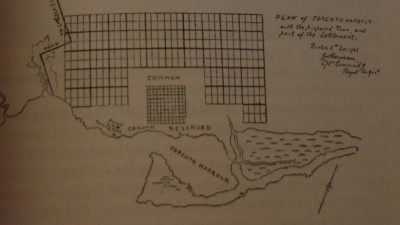
In 1959, my Chicagoan parents visited Toronto, Ontario and the city left little impression upon them.  Architecturally nondescript, it was seen as an unfortunate product of postwar growth in an uninspired age.  I remembered this and when I was driving from Montréal to Los Angeles in 1992, I didn’t even stop to visit Toronto.  My only recollection of the city was seeing a cluster of highrises in the distance while on a huge swath of a highway with express and collector lanes, the mighty 401.  Living in Toronto over the past few summers, I’ve found the city to be much more fascinating than I gave it credit and a lot has to do with how much of the downtown core is walkable.  I’m reading a book, Walkable City, by Mary Soderstrom that draws heavily on Jane Jacobs, a key urbanist figure here in her adopted Toronto.  Toronto from its inception, started with a grid::

York {Toronto}, 1803

York {Toronto}, 1803

Toronto’s grid, unlike that of New York City’s Manhattan, consisted of short streets and encouraged the development of neighborhoods and community.  José’s blog earlier this year notes how grids are safer than dendritic street patterns.  Jane Jacobs helped to thwart a freeway project, the Spadina Expressway, which would have taken cars from the mighty 401 allowing them access into the heart of the downtown core.  The expressway would have encouraged more sprawled developments outside of the core, but some have argued that Toronto’s anti-car policies have driven development out towards the suburbs, with cheaper land and lower taxes.  One of the outcomes of the Spadina Expressway failure was the creation of the Spadina subway line, which focused development along that corridor.

Flying into Pearson and seeing maps of the Greater Toronto Area, there is no mistake that there is sprawl.  The Toronto I’ve encountered is one of surprises, as the downtown core is walkable and much can be accessed on foot.  While I complain about the local mass transit, the TTC, particularly since it’s often crowded and expensive {cashfare of $2.75 CAN is one of the highest in Canada}, it works.  If you live in the downtown area, one doesn’t need a car and like in Manhattan, a car is often a liability, rather than a convenience.  Nevertheless, I see Toronto as at a city at a crossroads.  Increasingly dependent on automobiles in an era of volatile oil prices, with an infrastructure dependent on gas taxes and registration fees.  Toronto is the largest city in Canada, comparable in size to Boston, but runs the risk of being gridlocked and subject to the “tyranny of the automobile,” as a prescient 1966 Toronto Planning Commission warned.  From a marketing point of view, I see glossy developers’ ads enticing residents with more space and lower prices {and possibly lower taxes} outside of the downtown core, which I’m sure are compelling to many.  Unfortunately, many of these developments aren’t factoring in walking.  While they may be close to mass transit, they often aren’t in vibrant communities with mixed-use {housing and businesses} and adequate amounts of affordable housing.  I’m afraid the thinking is still along the lines of modernity’s arboreal tree, as opposed to the Deleuzean rhizome, but A City Is Not a Tree.

In discussing public financing of infrastructure, a curious split occurs.  When discussing freeways, there’s often a mentality of built more to alleviate the strain.  Like Internet bandwidth, there can never be too much carrying capacity.  The minute one talks about mass-transit, there’s often a discussion of whether or not usage and fare revenues will be sustainable.  Transit-oriented development might be a solution, if increases in property values from proximity from mass transit can be leveraged to finance its construction {an overview of this is here}.

In the past few years, I’ve come across a microculture of mass-transit afficionados.  Some go as far as to create “fantasy” transit maps, particularly of subways or light rail::

Fantasy Toronto Transit Map-2030

Fantasy Toronto Transit Map-2030

I think this stuff needs to get plugged into a Sim-City-like environment, but like any abstraction, it’s only as good as its assumptions.  My utopian vision of Toronto is one with concentrated development along corridors and with a direct connection to Pearson {Airport}.  My idea was a line that went from Pearson to downtown, following Queen in the downtown core, and eventually looping back up to the Bloor-Danforth line.

Any thoughts on your town/city?  Is it walkable?  Does it matter?

Twitterversion:: WalkableCity-#Toronto,Transit& CarCulture.Can TO dvelpmnt be shaped,creating vibrant communities sans cars? http://url.ie/1zuk #ThickCulture @Prof_K

Song:: Come To Milton Keynes – The Style Council