
capitalism

There are times when I feel Salon.com should be accompanied by a laughtrack or at least a wide assortment of humourous sound effects from Hanna-Barbera cartoons. This week, there’s a confessional tale by a guy who loved a scam. Jason Jellick was man who says he preyed upon liberal returns policies and was willing to tell lies to get free food from McDonalds or free upgrades at 5 star hotels. These mad skills made his friends green with envy. His idea was purportedly to stick it to the man, the corporate hegemon,—not individuals, but over time it became clear that he was interested in the art of the steal. He makes the distinction between shoplifting and conning trusting individuals and gaming a system meant to ensure customer satisfaction, but those distinctions are lost on me. In consumer behaviour lingo, Jellick is guilty of slippage—consumer actions that result in losses, and the only moral high ground he can stand on over shoplifters or Winona Ryder is that his actions are harder to detect as crimes or torts.

He sets this all up by recounting a tale of his mother’s Christmas scam and his conjecture that she was a member of the enlightened bourgeoisie::

“This was something I learned from watching my mother, who knew all too well how to root out a good con. Her defining scam was the Christmas special, when, on the day after Christmas, she’d gather up the presents from under the tree and return them to the stores along with the masses — poor Mommy forced to return all of her thoughtful gifts. But unlike most of those people, she’d circle back to the stores (once the shift change had taken effect) and repurchase those same presents for vastly reduced prices. Was this out of necessity? Was it out of some need to display her cunning? Looking back, I suspect my mother had become convinced of some higher moral agenda, in which the weak (the middle class) outfox the strong (the rich). All I know is that we always got what we wanted for Christmas.”

Ha! No, mommy was a hustler and taught her kids that the ends justify the means. I’m sure mommy would say that she’s just working the system. Don’t bitch her out, bitch out the system.

Jellick goes on to chronicle how he laxed his rule of only targeting corporations once he got a sweet taste of the confidence scam, including a bizarre Minnesota motel scam that went sideways. There’s also a bit of mea culpa and penance thrown in, since Salon needs to have some semblance of a moral centre. Salon tried to use the article as a springboard for more confessional tales::
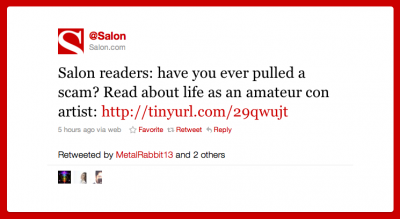
While I think that stealing from {e.g., de Certeau’s “perruque”} or engaging in antisocial behaviour towards {e.g., Darnton’s “The Great Cat Massacre”} those with power is part of everyday life, there’s a Machiavellian posture taken by Jellick that leaves a bad taste in one’s mouth.

As an aside, this is the perfect Salon article attempting to get people to rethink pathological behaviour by ascribing some sort of higher meaning to the actions. Many commenters weren’t buying it and bitched Jellick out—there are 18 pages of comments, as of 2:25 PM EST. On Twitter, there are plenty of naysayers calling bullshit on his story {e.g., see @snarkysmachine}.

I think there are social implications for Jellick’s actions. I see them as the consumer counterpart to corporate practices that push in the opposite direction. I know of an instance at Wal*Mart in the 1990s where managers had unwritten policies that denied returns. Why? It helped the bottom line, which made the department manager look good, which made the store manager look good, which made the district manager look good…all the way to the shareholder. One could argue that Jellick and the Wal*Mart example are both pathological extremes. Jellick’s alleged “duping” of capitalism and Wal*Mart’s practices to limit returns are cut from the same bolt—these are highly individualistic actions motivated by gain. Jellick does recognize his own rationalizations for his behaviours, but one gets a sense that Jellick is just mouthing the words. His values are that of the theoretical homo economicus, acting rationally in his own self interest in a world of atomized, arms-length social actors. Mommy would be proud.

Twitterversion:: Jason Jellick @Salon article on conning capitalism. The grift is the reward, but sweeter w/phony bourgeois enlightenment. @ThickCulture @Prof_K

I must admit I’ve been a bit intrigued by the Jay-Z song, “Empire State of Mind” featuring Alicia Keys, which is a perfect example of a crossover hit complete with musical hooks, orchestral pop grandeur, and an anthemic quality that goes beyond mere shout-outs. On my other blog, I have a link to a mashup showing the places the song is referring to. The comparisons to “New York, New York”, which Frank Sinatra made famous, are obvious and Shawn Carter makes it explicit::

“I’m the new Sinatra
and since I made it here
I can make it anywhere
yeah they love me everywhere”

What strikes me about this song is how it embodies an American mythology that’s perfect for the Great Recession and has the potential to transcend place. In contrast to the lyrics of “New York, New York”, “Empire State of Mind” crafts a narrative that contextualizes the American dream with its darker elements. Here’s a link to the lyrics. Granted, it’s just a song and not ethnography, but I think it offers up a revised mythology that’s from a different point of view and one that resonates in these times of uncertainty. The song makes references to being from Bed-Stuy in Brooklyn, but with characteristic bravado showing the upside of success::

“now I live on Billboard
and I brought my boys with me
Say what up to Ta-ta
Still sipping Mai Tais
Sitting courtside
Knicks and Nets give me high-5
Nigga, I be Spiked out
I could trip a referee”

“I made you hot nigga,
Catch me at the X with OG at a Yankee game,
shit I made the Yankee hat
more famous than a Yankee can”

The soaring chorus sung by Alicia Keys reinforces this part of the mythology, which may well be what listeners “hear” the most::

“New York!!!!
Concrete jungle where dreams are made of,
There’s nothing you can’t do,
Now you’re in New York!!!
These streets will make you feel brand new,
the lights will inspire you,
Let’s hear it for New York, New York, New York”

The overt and subtle drug references, e.g., “MDMA” and “If Jeezy’s payin’ LeBron, I’m paying Dwayne Wade” {a reference to Jeezy’s song, “Kobe and Lebron” that uses the players’ numbers as code for cocaine prices per kilo}, and cautionary tales of smashed-up dreams and getting addicted to the limelight, serve to juxtapose possibilities with the darker elements of modern life. A modern life increasingly “hard knock” for many in 2009-10. Falling prey to the limelight may not be a life lived by most, but serves as a metaphor. The public consumes through a thirst for the entertainment spectacle, pointing to our collective culpability with respect to what is valued.

I’m not sure how closely people are paying that attention to the lyrics, but I think it’s the simultaneous depiction of what “can be” and “what is” that resonates with listeners. It captures how many see the mythology of the American dream, in the wake of financial meltdowns, bailouts, and double-digit unemployment, which is now 10.6% in NYC.

Twitterversion:: DDoes Jay-Z’s Empire State of Mind create perfect depiction of the American dream, warts&all? Life in the great recession @Prof_K


Ségolène Royal-French Socialist & possible French Presidential Candidate in 2012
Ségolène Royal-French Socialist & probable French Presidential Candidate in 2012

It was May Day here in Ontario.  I just Tweeted about a program I saw on TVO with socialism as a theme with Ontario NDP leader, Andrea Horwath, and political scientist at York University, Leo Panitch.

The discussions were interesting, but what really stuck with me was whether or not good politicians follow the votes or get the electorate to see things differently.  For example, given the anti-corporate climate, will politicians pander to where they think the electorate is or will they try to shape thinking about the economy?

Sell the sizzle, not the steak

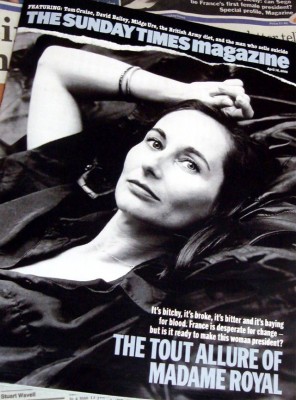
In a shameless attempt to drive more pageviews, I included a pic. and cartoon of Ségolène Royal {Ségolène is a ThickCulture crowd-pleaser, according to our Google Analytics}, a French socialist {Parti Socialiste, PS} centre-left politician who ran for President in 2007 {losing to Sarkozy} and may run in 2012.    Say what you will about Ségolène, she manages to capture attention.  She has been known to have a quirky, evangelical style and has been accused by some as having a Joan of Arc complex.  Well, this sounds familiar (see Glenn Beck video from last fall).

The comparison isn’t accidental.  Obama with his power of persuasion, thus far, and the state of the economy may be providing a perfect storm for a change in the political zeitgeist. Will the Democrats see this as an opportunity to embrace that dreaded third-rail word, socialism, in terms of either rhetoric or implemented policy -or- would that just bring about a Gingrichian revolt akin to 1994?  Change?  What kind of change?  New Deal change?  New Frontier change?  Great Society change?  Is it a matter of the public looking for it -or- will savvy politicians frame a “new” economic order for them?  I think we’re in for seeing plenty of sizzle sold, but at some point, steak will have to be on the table, specifically, in terms of economic recovery.

The upcoming election in British Columbia is pitting the centre-left  (NDP) versus the centre-right (BC Liberal) {e.g., see blog on the BC Carbon Tax issue}, where the centre-left has a shot of controlling the provincial government.  Nationwide, the NDP support has risen 1 point since December to 13%, while the Liberals and Tories swapped positions and are polling 36 and 33%, respectively.  Perhaps regionally, there may a shift to the left {Canada has had NDP provincial governments in the past}, but I wonder as joblessness continues and bailouts persist, will national-scene politics in Canada and the US move towards a more socialist agenda?  While Barack is far from a socialist, he’s gaining comfort in his centre-left stance::

“The economic philosophy that Mr. Obama developed during the presidential campaign drew from across the ideological spectrum even as it remained rooted on the center-left. As that philosophy has been tested in practice through his early months in office, the president has if anything become more comfortable with an occasionally intrusive government as a counterweight to market forces that are now so powerful and fast-moving that they cannot be counted on to be self-correcting when things go wrong.”

–“Obamanomics: Redefining Capitalism After the Fall,” NYT, Richard W. Stevenson

So, are you ready for some socialism?  Will we see the selling of socialism?  Sounds like an oxymoron, but it may be a matter of time before we see something like this.  What’s Springsteen up to this summer?

I welcome any and all thoughts.

OK Ségo fans, while not entirely flattering, the following cartoon should help you with your fix. 

s_go_caricature_7554_f520_1_
Caption - François Hollande (fellow Socialist & now ex-partner): "Ségolène, what are you doing in my wardrobe?" Ségolène Royal: "Frankly, don't you find it looks better on me than on you?") Via Hillblogger3

Twitterversion:: EpicFail for capitalism? Given current econ & political climate, is US/Canada ready for socialism? Will politicns pander or reshape thinkng?

Song::