Big Recession

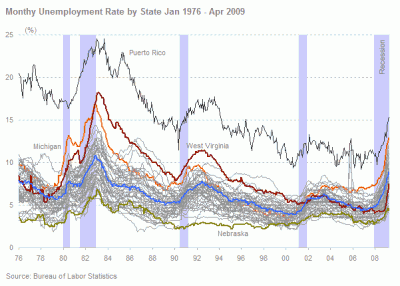
US Unemployment Rate (blue line) & recessions, 1976-2009, BLS

Greetings from Kingston, Ontario. Happy Civic Holiday/Provincial Day weekend to many Canadian readers.

José’s post on the Democrats and the Voting Income Gap got me thinking about historical unemployment, which was 9.6% in June of 2010. One of the things to recall is that recessions and episodes of nationwide high unemployment tend to be short. Mobilizing lower income voters and increasing numbers of the middle class should be easier for the Democrats over time, if The Big Recession persists. Moreover, it’s not clear that the Republicans are offering platforms that are resonating outside of their base.

Looking at the Canadian unemployment rates, there are lingering eras with years of rates being over 8%. Generally speaking, these eras of high unemployment correspond with the rise of the fortunes of the New Democrats, a left-centre pro-labour party.
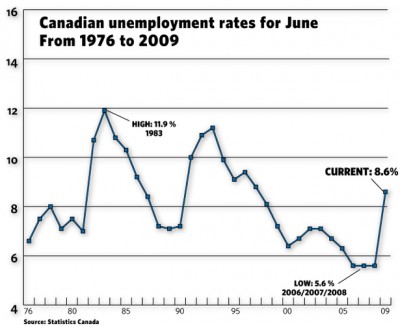
Canadian Unemployment Rates, 1976-2009

The NDP saw surges in Parliamentary seats in the elections of 1984 and 1997, in the midst of eras of high unemployment. Currently, the NDP is polling relatively strongly, although so are the Greens, which may fragment the vote on the left. Stephen Harper’s minority Conservative government is hanging on because the Liberal Party is in disarray, with both of the major parties {Liberals & Conservatives} being relatively unpopular.

Lessons for the US?

It’s the economy, stupid. The Big Recession is hitting the middle class and rhetoric is only going to go so far. A big question is whether Democrats are willing move beyond centrist policies and if {a big if} they go towards Keynesianism, how will that be implemented?

Song:: Heaven 17-‘This Is Mine’

Twitterversion:: [blog] The politics of unemployment. Looking at economic eras in Canada & the US #ThickCulture @Prof_K
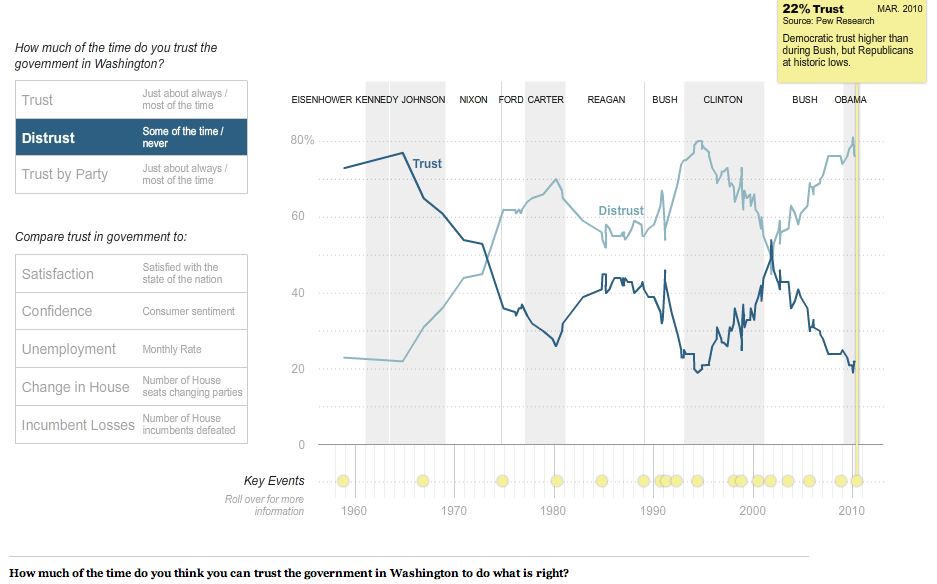
Trust/Distrust Perceptions, Pew Research Center for the People & the Press, 1958-2010

A recent report from Pew has an interactive map on perceptions of trust of the government. There are also key events that attempt to contextualize the trends, as well as charts with changes in the House and incumbent losses. In 1992, Clinton inherited slipping trust from George H. W. Bush and Reagan inherited low, but rebounding numbers from Carter.

Should we expect a bloodbath in this fall’s midterms?

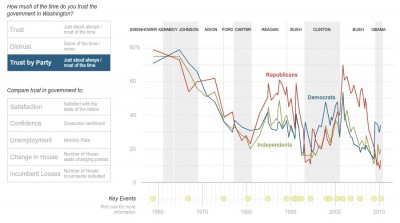
I think both parties need to be concerned, particularly given the trends on this chart::

Trust by party affiliation, 1958-2010

Under George W. Bush, trust was in freefall for everyone in his second term. In my opinion, there was a perfect storm, which literally involved a storm. Katrina hit in 2005 and the conservative coalition started to break down, which I think became evident in the Harriet Miers nomination for the Supreme Court. The 2006 midterms with a surge of Democrat wins and Obama’s election in 2008 served to further cause Republicans to have less trust in the government.

Politicians on either side of the aisle should heed the antecedents of trust, in order to increase the odds of getting votes. In my opinion, negative rhetoric that doesn’t address increasing trustworthiness for a focal candidate is a danger.

What are the drivers of trust?

I’m working on a paper on organizational trust, based on the social psychology literature. The three antecedents of trust my co-author and I are using are::

  1. Ability
  2. Integrity
  3. Benevolence

These are subject to contextual constraints, i.e., the current economy and the political zeitgeist which is up in the air regarding big or small government. The challenge is to craft a strategy to build trust. In a sense, Obama’s reaching across to Republicans should be appealing to benevolence, but it’s not. It may be overshadowed by integrity and ability, which given the economic woes will be hard to convince Obama’s detractors that his policies are leading us in the right direction, given the credence qualities {hard to gauge efficacy even after implementation} of economic policy. If obama and the Democrats don’t realize that this is a battle of “communication” that needs to be addressed quickly, expect losses in November.

Twitterversion:: New Pew study shows trust of the government at only 22% and for Republicans an all-time low. How can social psych. inform political strategy? @Prof_K

Song:: KMFDM-‘Trust’

I must admit I’ve been a bit intrigued by the Jay-Z song, “Empire State of Mind” featuring Alicia Keys, which is a perfect example of a crossover hit complete with musical hooks, orchestral pop grandeur, and an anthemic quality that goes beyond mere shout-outs. On my other blog, I have a link to a mashup showing the places the song is referring to. The comparisons to “New York, New York”, which Frank Sinatra made famous, are obvious and Shawn Carter makes it explicit::

“I’m the new Sinatra
and since I made it here
I can make it anywhere
yeah they love me everywhere”

What strikes me about this song is how it embodies an American mythology that’s perfect for the Great Recession and has the potential to transcend place. In contrast to the lyrics of “New York, New York”, “Empire State of Mind” crafts a narrative that contextualizes the American dream with its darker elements. Here’s a link to the lyrics. Granted, it’s just a song and not ethnography, but I think it offers up a revised mythology that’s from a different point of view and one that resonates in these times of uncertainty. The song makes references to being from Bed-Stuy in Brooklyn, but with characteristic bravado showing the upside of success::

“now I live on Billboard
and I brought my boys with me
Say what up to Ta-ta
Still sipping Mai Tais
Sitting courtside
Knicks and Nets give me high-5
Nigga, I be Spiked out
I could trip a referee”

“I made you hot nigga,
Catch me at the X with OG at a Yankee game,
shit I made the Yankee hat
more famous than a Yankee can”

The soaring chorus sung by Alicia Keys reinforces this part of the mythology, which may well be what listeners “hear” the most::

“New York!!!!
Concrete jungle where dreams are made of,
There’s nothing you can’t do,
Now you’re in New York!!!
These streets will make you feel brand new,
the lights will inspire you,
Let’s hear it for New York, New York, New York”

The overt and subtle drug references, e.g., “MDMA” and “If Jeezy’s payin’ LeBron, I’m paying Dwayne Wade” {a reference to Jeezy’s song, “Kobe and Lebron” that uses the players’ numbers as code for cocaine prices per kilo}, and cautionary tales of smashed-up dreams and getting addicted to the limelight, serve to juxtapose possibilities with the darker elements of modern life. A modern life increasingly “hard knock” for many in 2009-10. Falling prey to the limelight may not be a life lived by most, but serves as a metaphor. The public consumes through a thirst for the entertainment spectacle, pointing to our collective culpability with respect to what is valued.

I’m not sure how closely people are paying that attention to the lyrics, but I think it’s the simultaneous depiction of what “can be” and “what is” that resonates with listeners. It captures how many see the mythology of the American dream, in the wake of financial meltdowns, bailouts, and double-digit unemployment, which is now 10.6% in NYC.

Twitterversion:: DDoes Jay-Z’s Empire State of Mind create perfect depiction of the American dream, warts&all? Life in the great recession @Prof_K

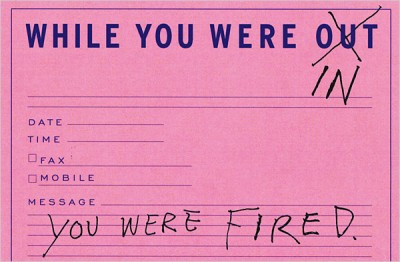
The proverbial "pink slip," AKA layoff notice.

Good jobs, that is.  Not to be a cassandra, but I have concerns about the structure of the economy.  History has shown that the high standard of living in late-Renaissance Venice wasn’t sustainable [*].  While the relatively expensive goods of Venice were often of high quality, cheaper, mass-market goods produced in Britain, France, and the Netherlands were gaining in popularity.  Will the US suffer from the same fate?  In other words, are the high wages and standard of living in the US sustainable, economically?  Robert Reich has a gloomy outlook on his blog::

“But here’s the real worry. The basic assumption that jobs will eventually return when the economy recovers is probably wrong. Some jobs will come back, of course. But the reality that no one wants to talk about is a structural change in the economy that’s been going on for years but which the Great Recession has dramatically accelerated.

Under the pressure of this awful recession, many companies have found ways to cut their payrolls for good. They’ve discovered that new software and computer technologies have made workers in Asia and Latin America just about as productive as Americans, and that the Internet allows far more work to be efficiently outsourced abroad.

This means many Americans won’t be rehired unless they’re willing to settle for much lower wages and benefits. Today’s official unemployment numbers hide the extent to which Americans are already on this path. Among those with jobs, a large and growing number have had to accept lower pay as a condition for keeping them. Or they’ve lost higher-paying jobs and are now in a new ones that pays less.”

I think he might be on to something and I tend to be an optimist.  If this were 1992, I’d say we’re going to grow out of the recession the US was in back then.  Innovation, efficiency, and productivity increases would be part of the upswing in the ever-present business cycles.  But, are we in a different economic situation?  Have we maxed-out efficiency?  What about innovation?  Will we still be competitive in that arena?

I have two main concerns.  One is of industrial organization and the other is of income inequality, which I believe are inter-related.

  1. Industrial organization.  In the US, smaller businesses are expected to create the most new jobs, but the deck is stacked against them, which is also a political and policy issue.  There’s a pressure towards increased scale and size.  Larger enterprises may be more efficient, but often are less innovative, categorically, due to constraints on “dynamic capabilities” {ability to innovate, learn, or continuously reposition itself more effectively than its rivals} and disincentives in the form of disruptions to current income streams {e.g., pharmaceuticals selling several profitable on-patent drugs in a category of drugs having little incentive to develop and market a “cure” for a particular disease in a new category of drugs.  Hence “incremental” innovations of slight modifications and new patents based on them.}
  2. Income distribution.  I feel that over time, the pressure towards increased the scale of organizations will put downwards pressure on wages and the standard of living for most employees.  Why?  If industries are dominated by a few players there will be a tendency towards oligopsony {few “buyers” and many “sellers”} in labour markets.  Employees will have less bargaining power because the few employers will tend to tacitly collude.  If global competition inhibits growth, there will be further pressure to cut wages and/or outsource.

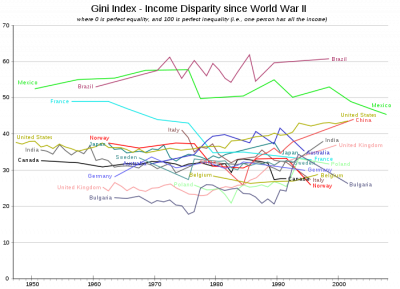
The feather in the US’s cap is human capital talents and a large skilled labour pool, but these matter the most in innovative and high value-added firms.  If the US starts to lose its innovative edge, there will be less demand for skilled workers and managers.  More income inequality.  While hardly definitive, the gini coefficient measures this::

Gini coefficient over time-selected countries. 0=most equitable distribution, 1=inequitable distribution.

In the US, the gini is on the rise, indicating a growing gap between the wealthy and poor.  What would be really telling is to examine what’s happening to the middle class over time, i.e., the shape of the Lorenz curve}.  I think for the vast majority of Americans, there may be more diminished expectations in store.  The top 2% have no worries.

So, I agree with much of what Reich has to say.  The goal isn’t just jobs, but good paying ones.  In my opinion, part of this in the private sector {as opposed to public sector efforts, such as stimulus spending} is more basic R&D that fuels innovation and more entrepreneurship, which will require policies to support it.

Twitterversion:: #RobertReich blogs on jobs in US. Given his take, are big firms&lack of innovation a big part of problem? #ThickCulture http://url.ie/3f80 @Prof_K

Song:: The Bleeding Heart Show-The New Pornographers