academia

image:: "Jay Sherman" from The Critic {1994-1995} voiced by Jon Lovitz

It may seem like all I do is bitch about other articles on here, but I am getting old and cranky. Today’s target, I mean subject is an article from The Chronic{le} of Higher Education by Thomas Doherty, The Death of Film Criticism. Doherty laments the rise of blog film critics on the wild expanses of the Internet that don’t have much to say beyond the trivial by scribes who don’t even read books. He does a good job of describing the rise and fall of film criticism in the 20th. century and it’s worthwhile reading. Where he loses me is how he doesn’t see how utterly predictable this all is. The main target market for films is the youth. That’s not to say older people don’t see movies, but for the most part, they matter far less than the teenager. Why? The blockbuster needs repeat viewings by throngs of theatregoers. So, the medium is increasingly targeted towards teen audiences, along with the current infatuation with celebrity culture. The Hollywood machine caters to the “head” of the long tail, i.e., the blockbuster, which is all about delivering spectacle. It’s not about artistry, how Paul Thomas Anderson’s Magnolia {1999} has umpteen layers of symbolism and references couched within, or what Lars Von Trier and the Dogme95 movement are doing with films like Antichrist {2009}. The rise of the bloggers, who could care less about allusion or auteurs, goes hand in glove with where much of the industry is today. These days it’s about horror, action, and vampires.

Where Doherty gets interesting is how he says the Internet is also spawning interesting intellectual dialectic discussion on film by academics. Unfortunately, such work isn’t weighted the same way as publications, bringing up the issue of how institutional logics lag behind the new technologies. I see this as a big problem for two reasons.

First, while I “get” the idea that peer-review publications and books in journals and presses serve a legitimation function, this same function serves dominant paradigms in fields and places academic knowledge behind paywalls. Should academic knowledge be free? I feel that what distinguishes higher education research from applied industrial research is that it serves the public good, so I feel university knowledge should be towards no or low cost to obtain. Even in the areas of innovation, I believe universities can be a catalyst for “open innovation”, where technologies are licensed to multiple entities at a lower cost structure to spur distributed collaborative work. The idea is to speed up the innovation process by allowing knowledge to flow through networks, not silos {within companies or even departments}.

Second, I think that higher education may be at a crossroads. Right now, it has a monopoly on providing the legitimizing totem of the accredited degree, which has a ceremonial function in the workforce. In 2007, I was at an event where a local employer discussed what skills they are looking for from recent college graduates. What were they looking for? Critical thinking? Domain knowledge? Sure. But what came through as highlights were “meeting” skills and knowledge of Microsoft Office. This made me cringe, as I thought this was a harbinger as the university as merely vocational education.

Nevertheless, I’m wondering if with globalization that higher education needs to be relevant more than ever. Relevant to all of its stakeholders, which may mean a swifter adaptation to changes afoot, in terms of the institutional character of higher education and what it rewards and values. Future blog posts of mine will develop my ideas on this and provide a blueprint for the university in Web 2.0+.

Is the film critic dead? Well, no, it’s just her/his audience may be a lot more fragmented.

Twitterversion:: Death of the film critic? WWW killng the profession-also fostering academic dialectic while higher ed scoffs.#ThickCulture @Prof_K

Song:: Steely Dan-“Reeling in the Years”

So says Mark Taylor in a New York Times op-ed.

Most graduate programs in American universities produce a product for which there is no market (candidates for teaching positions that do not exist) and develop skills for which there is diminishing demand (research in subfields within subfields and publication in journals read by no one other than a few like-minded colleagues), all at a rapidly rising cost (sometimes well over $100,000 in student loans).

His piece questions the efficacy of graduate education, but many of his prescriptions could also be applied to undergraduate programs.  The gist of his concerns is that we’ve tilted so far in our graduate training toward academic specialization that our product has become idiosyncratic, unrewarding, and irrelevant to the larger society. This graduate training spills over to undergraduate teaching by reproducing a structure that keeps academic work in departmental silos. Here are a few of his suggestions for transforming the university:

Restructure the curriculum, beginning with graduate programs and proceeding as quickly as possible to undergraduate programs. The division-of-labor model of separate departments is obsolete and must be replaced with a curriculum structured like a web or complex adaptive network.

I personally love the use of the complex adaptive network metaphor. Some of my students are working on a project where they would gather our faculty’s research interests, code them and conduct a cluster or network analysis to determine cross-disciplinary commonalities. From there you could create learning communities of faculty and students that could then be linked to similar clusters around the world.

This complex adaptive system approach to developing a curriculum seems to be where our students live. I’ve had 2-3 students inquire about getting a Ph.D. and they all are drawn to interdisciplinary programs. Knowing what I know about the biases in academia, I’ve tried to encourage them to go for more traditional disciplinary-based programs so that they have more flexibility on the academic job market, but to little effect.

I submit that our challenge is that Web 2.0 has stripped from the academy it’s monopoly on knowledge. Young people’s unfettered access to information (of both dubious and stellar quality) places greater demands on the university as an institution to be as flexible as Google in how we organize knowledge and information. When an institution comes to a student with a major checklist or an undergraduate curriculum checklist, an increasingly common response is to see it as an arbitrary set of hoops to jump rather than a carefully considered set of courses. In other words, it looks like Yahoo circa 1996 (i.e. knowledge organized in pre-selected categories).
.

Instead, our students expect the academy to have the same customizability, flexibility, and functionality of the Web searches they do everyday.

Which leads me to Taylor’s second prescription:

Abolish permanent departments, even for undergraduate education, and create problem-focused programs. These constantly evolving programs would have sunset clauses, and every seven years each one should be evaluated and either abolished, continued or significantly changed.

I’m inclined to agree with Michael Berube on this one — we should be careful not to conflate department with discipline. People can still operate within the structure of a department and pursue an interdisciplinary agenda (like a political scientist blog hosted by a Sociology association). I think completely untethering academics from disciplinary moorings is probably a bit too extreme and unnecessary in my view. There are some real benefits to being rooted in a “discipline.” You could accomplish Taylor’s goal by increasing the number of joint appointments or developing “programs” or “emphases” that get at the same objectives. Besides, if we abolished departments, what type of evaluation/peer review process would replace it?

Despite these reservations, I think the academy does require a serious rethink in no small part because the nature of idea dissemination has changed so radically. The larger question might be whether we should try to respond in kind or should we take William F. Buckley’s advice for budding conservatives and “stand athwart history yelling stop”!

I’d be curious to hear what others think.

I’m putting together a public policy course for the first time since graduate school.  It reminds me what I love about what I do.  Public policy is about how we solve common problems.  The palete from which to choose readings is unlimited.  That’s been part of my problem…there’s so much interesting material to talk about out there it’s impposible to narrow it down.

One area that sorely lacking in public policy scholarship is the effect of the presentation of information on decision-makers.  Im having my students read a few articles about Edward TufteBonanos, C. (2007) The Minister of Information. New York Magazine. and  Smith, F. (2007) Intelligent Designs. STANFORD Magazine. Tufte is a self declared arch-enemy of power point and is famous for pointing out NASA’s scientists’ inability to convey important information to higher-ups before the Challenger disaster.

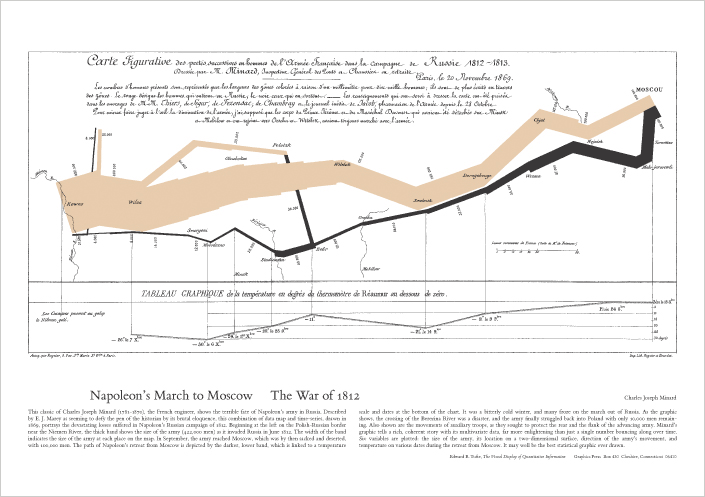
He’s also famous for popularizing this map by Charles Joseph Minard that shows the losses incurred by Napoleon’s army in the Russian campaign of 1812. The diagram show how Napoleon’s army thinned (beige band) as temperatures in Russia dropped (black band).

It makes me wonder how different our disciplines would be if most of us put thought into the form of our data presentations. We’re trained to focus solely on function but, mostly because of cost concerns, our conferences provide us little opportunity to use technologies that could bring our data to life. Would having LCD displays at academic conferences make them more policy relevant? Would they encourage more journalists to attend?