
obama election politics president clinton conflict consensus

I apologize in advance if this is post is of interest only to survey research nerds. But I find the following chart from FiveThirtyEight fascinating:
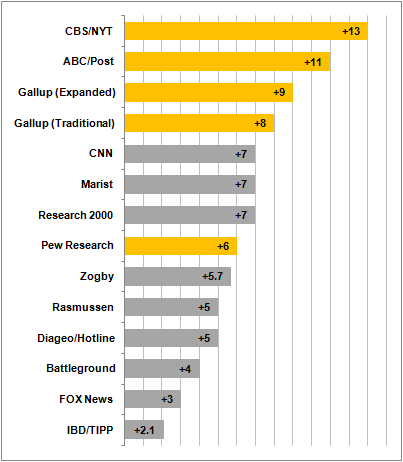
Various Presidential polling sample with those in yellow incorporating cell phones.

It seems to suggest cell phone-only users (presumably young people) are enough to swing most polls about 2 points toward Barack Obama. No telling how this translates into voter turnout and actually results.

One more thought: while many may think of cell phone-only users as just young people, it is increasingly common way for working class and poor people have phones. So, it may include many black and lower income voters, too.

I saw this politically-flavored ad in New York City this weekend and it struck me as unusual.

Advertisement for a storage company

In an election year, we can expect to see many product advertisements that utilize political imagery or poke fun at political culture. Along the same block, I saw a display featuring cardboard cutouts of the two presidential candidates bearing various wines and spirits. But most of these ads, do not take a political perspective or mount a critique. They tend to be of the “whether you support Obama or McCain” variety. This ad for a storage company make a very clear criticism of Sarah Palin — albeit on experiential and not policy grounds.

Is this actually unusual? Is it permissible because NYC is a fairly liberal place? Or perhaps because Obama-Biden are such clear frontrunner? What do you think?

Paul Burka’s January 12th op-ed in the New York Times makes the case that consensus oriented candidates like Barack Obama cannot sustain their message of unity if elected because politics is essentially rooted in conflict. In his view of the American political system:

the imperative of the majority is to hold power and the imperative of the minority is to seize power for itself. It may serve the minority’s interest to cooperate from time to time, but in principle it can advance itself only by opposing the majority.

This view might be true as a theory of securing legislative or executive control, but it is not a good theory of effective governance. Ours is a consensus based system. As our current political stalemate teaches us, capturing control of power is a necessary but not sufficient condition for realizing an agenda. Slim majorities are neither filibuster nor veto proof.

To affect significant change requires expanding your power base. In a country that remains ideologically divided, it seems implausible that either party can effectively govern for long by simply appealing to their base support and either ignoring or vilifying the opposition. This has a devastating effect on the public’s perception of government and their willingness to engage with it to solve common problems.

This is why electing Hillary Clinton would likely result in the same politics we currently have. If recent head-to-head polls are any indication, her victory margins in a general election would be in the low 50’s. No poll has her garnering more than 56% of the vote in a head to head with any Republican candidate. Given the dislike for the Clinton’s among conservative voters, it’s unlikely that she’d have much of a coattail effect for congressional candidates.

Barack Obama, on the other hand, has the potential to be a transformational figure in American politics. His recent reference to Ronald Reagan in a recent interview with a Nevada newspaper, while no doubt upsetting the base of his party, suggests that he understands the fundamental nature of consensus based systems. You need to create super-majorities to realize a legislative agenda. Otherwise, your legislative accomplishments become marginal. Take for example Bill Clinton. What was Bill Clinton’s greatest legislative accomplishment? Maybe the Earned Income Tax Credit? Welfare reform?

Obama might not become this transformational figure that can build a sustainable center-left progressive majority in this country, but if you’re interested in making real headway on our impending social issues, then he seems to me the only choice.