Author Archives: Kenneth M. Kambara

It’s Three Years Before An Election…Time for an Attack Ad:: Conservative Party of Canada Attacks Third Party Leader

YouTube Preview Image

While I’m in NYC these days, much of my social media still comes from Toronto & Canada. The Conservative Party of Canada is running attack ads against the third party. Not the opposition, but against the Liberal Party interim leader, Bob Rae. This ad came out while the official opposition party, The New Democrats, were choosing a new leader, who was chosen yesterday, Thomas Mulcair. OK, to further complicate things, Rae was once a New Democrat at the provincial level in Ontario and Mulcair was a Liberal at the provincial level in Québec. I know, you probably need a scorecard. Anyway, while there’s no election in sight for years {barring a finding of widespread election fraud from the robocall scandal}, the Conservative attack ad slams Rae’s record from his stint as Ontario Premier in the early 1990s, as an Ontario New Democrat. Last year, I wrote a brief analysis of the Bob Rae premiership on vox.rhizomicon that explains how Rae inherited an impossible situation worsened by a macroeconomic perfect storm. In fact, Rae’s policies had much more in common with—a fiscally conservative strategy.

John Ibbitson of the Globe & Mail thinks the Tories are scared of Rae and the resurgence of the Liberals. There may be something to that. They ran ads in 2009 against then Liberal leader, Micael Ignatieff, framing him as an outsider because of his living abroad in the past. Why not use the wayback machine to do the same to Bob Rae?

One could argue that the Conservatives have more money than good sense right now. While it’s no secret that the Conservatives want to keep the Liberals down and replace them as the “natural governing party of Canada”, the strategy has its risks. Sure, it will get the Liberals to spend money on return-fire ads, which the Liberals vow to do, but the ad concept isn’t fresh and the content is dated. While Andrew Coyne think the Conservatives win either way, I think he’s wrong. It’s not an election and the negative ads on the third party leader can be viewed as playing unfairly, particularly in light of the robocall scandal. The main problem I have with the Conservative ads is they have tipped their hand. Bob Rae has them worried and they’re signaling it. Unlike Ignatieff, Rae is a seasoned politician and a good communicator. Liberal support isn’t dead and the ads allegedly boosted Liberal fundraising by $225,000 and Rae offered this soundbite:

“You can’t just abandon the airwaves to the jerks on the right-hand side of the spectrum.”

While the Conservatives have a majority in Parliament, they know that with Rae and Mulcair opposing them, they’ll have their hands full with a war in the media and the court of public opinion. They’ll want to discredit both, but let’s face some ugly marketing truths. They’re the majority party and should act accordingly. Attack ads now look desperate and mean. The Conservatives’ main ace up their sleeves is “stay the economic course.” They don’t have a hot-tempered firebrand from Québec who makes the news by being the news in a Thomas Mulcair. They don’t have an elder statesman who can effectively sound as if he’s railing at the establishment in a Bob Rae. The Conservatives are selling ”stay the course” and they don’t have many degrees of freedom that can really energize the masses, while unemployment remains fairly high and a housing bubble looms. Their current positioning is fairly moderate, which is how they won the last election by taking Liberal ridings in Ontario {assuming election fraud isn’t shown in the robocall scandal, which is probably a stretch}. It makes the most sense to build the appeal to moderates by building a case why the Conservatives are good for stability on positives, even if there isn’t any “there” there.

It will be interesting to see how the Conservatives deal with Mulcair. I’m sure his dual citizenship with France will factor in, as the Tories try to question his allegiance to Canada. Given the NDP strongholds of Québec and urban centers, it won’t matter much to the NDP base and pressing the issue could turn off the new Canadians that the Conservatives are trying to court.

It’s over three years until the next Canadian election and it’s a tad early to start being tiresome.


Let Them Eat Veggies

Originally posted on vox.rhizomicon
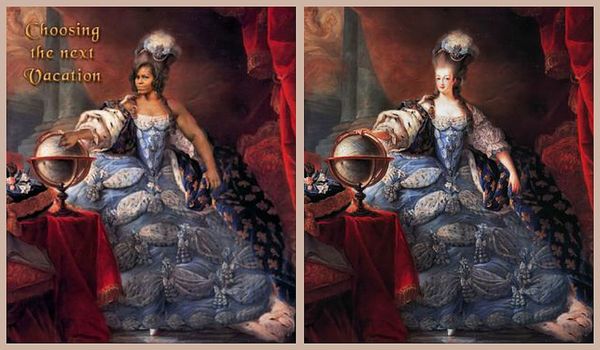
A photo of a “buff” Michelle Obama as Marie Antoinette is making the rounds again, due to an upcoming iCarly appearance. On the Nickelodeon sitcom, Michelle is referred to as “your excellency” and “sort of likes it”. The right wing is having a field day and the left wing is calling foul, saying it’s racist and evokes the “uppity negro” stereotype. The ‘Shopped version of Gautier-Dagoty’s iconic painting {below right} dates back to the summer of 2010.
The deconstruction of the tropes of leveling Michelle Obama seems to be a part of a theme in the way she’s serving as a lightning rod for pundits and journos. Hillary Clinton faces the same battles and Condi Rice was targeted with a mid-2000s spoof site that was something like CondiRiceIsAngry.com, so this isn’t a clear cut left/right issue. In all instances, there seems to be a theme of defeminizing them by making them mannish, angry, or otherwise unattractive. It’s not enough to have the Marie Antoinette Michelle be a symbol of being out of touch, but the burly arm reinforces the point that she’s threatening to a set of ideals.

Ontario Elects…

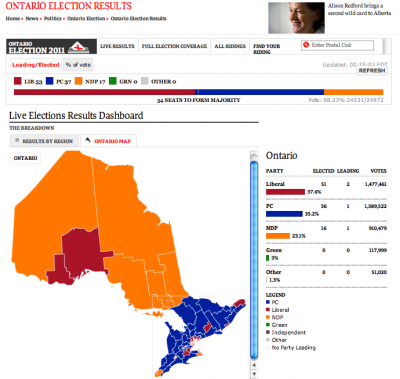
Globe & Mail Election Map, 6 October 2011, late night

A Liberal minority government, one seat shy of the coveted majority.  The turnout was a record low and many pundits are saying that the Progressive Conservatives and Tim Hudak frittered away a golden opportunity to unseat the Ontario Liberals and Premier Dalton McGuinty. Some cynical journos are folding their arms decrying the state of politics as reaching an alltime low with inflammatory rhetoric…sometimes, ironically, shovelling more inflammatory rhetoric onto the fire. {As an aside, I really don’t recall the alleged Liberal insinuation Coyne is referring to, let alone it entering into the political discourse in the 2007 election. If someone has a reference/quote/cite, please comment.}

Some are saying the “hat trick” comment by Stephen Harper at derailed Hudak’s Tories::

YouTube Preview Image

My take is that the Ontario Liberals dodged a bullet. They lost their majority, losing 19 seats to the PC {-12} and NDP {-7}, but hold on to power. I thought McGuinty was in trouble, but the Liberals ran a smart campaign given the circumstances and it paid off. This election could have been much worse for the Liberals. While watching the election from New York and Illinois, all of the campaigns {well, let me clarify, the big 3} were appealing to centrism and there were big issues that really motivated voters to go to the polls. My guess is that explains the low turnout more than anything {BTW, Elections Ontario will be looking into the decline.} After all, the PCs and the NDP were left with the charge of advocating a change, but not too much change, since the mantra of this election was the middle of the road. I think the big winner is Andrea Horwath, leader of the Ontario New Democrats, who increased her political capital in this election, as well as her likability and visibility. The Conservatives in Ontario at the provincial and federal levels must be scratching their heads to a certain extent. A Liberal implosion at all levels failed to materialize and the idea of a new era with the Conservative Party of Canada being the natural governing party of Canada seems far from a certainty.

Manitoba Elects…

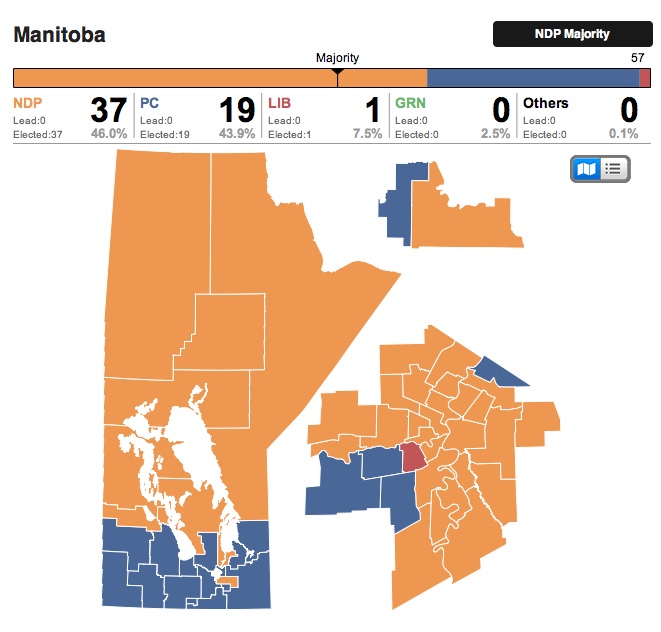
Manitoba Provincial 2011 Results

The Manitoba New Democrats rolled to a 4th straight majority win over the Progressive Conservatives. Canadian election campaigns are mercifully short and while the Manitoba contest was a curt 4 weeks, the advertising and rhetoric was brutal in this battle for the political middle. The Manitoba economy, like parts of the upper Midwest of the US isn’t reeling like the rest of North America, so there wasn’t a great thirst for change. The opinion polls had the Progressive Conservatives up earlier in the year, but the New Democrats rallied under Premier Selinger.

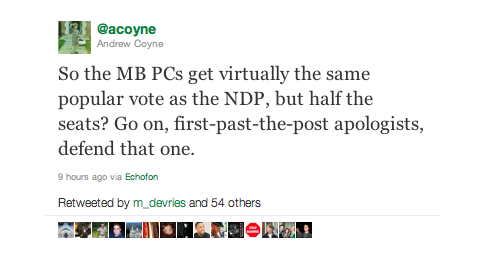
The Progressive Conservatives narrowed the gap in terms of the popular vote, but gained no additional seats. Andrew Coyne of Macleans expressed his annoyance at the current first-past-the-post {candidate with a plurality of votes wins the riding, i.e., district}::

He used the “anomalous” results to plug his articles on election reform. I’m actually in favor of election reform, such as STV, but I have serious doubts if it would matter in Manitoba. The province is divided:: the rural south votes Progressive Conservative by a wide margin, while urban Winnipeg and the aboriginal North votes NDP by a sizeable but lesser margin, on average. The unofficial results are here. Given the geographic party split of the province and the two-party “duopoly”, I’m not seeing a lot of opportunity for vastly different results. If there were larger ridings with more seats per riding, the STV gamechanging math breaks down when one looks at the regional breakdowns for 2007. The NDP and PCs had their respective regional strongholds and it will be interesting to see how the final 2011 shake out.

This doesn’t mean I feel STV shouldn’t be implemented, but that the 2011 Manitoba results might not be the best case to pitch for it. Tomorrow’s Ontario provincial election, well, that’s a different story. Ontario has three strong provincial parties {PC, Liberal, NDP} and strategic voting is likely to be a factor in quite a few ridings.


Are You Ready for Some Godwin’s Law?

Hank Williams Jr., sporting a Joaquin Phoenix look à la the actor’s I’m Still Here-related appearance, is in hot water for this Fox News interview::

It’s a bit hard to take someone who isn’t blind and wears sunglasses indoors too seriously. Williams compared Obama to Hitler, in reference to Obama’s golf outing with Speaker of the House John Boehner, evoking another instance of a TV variant of  Godwin’s Law.

ESPN pulled Williams’ Monday Night Football theme and Hank Jr. offered a statement, but not an apology::

“Some of us have strong opinions and are often misunderstood. My analogy was extreme — but it was to make a point. I was simply trying to explain how stupid it seemed to me – how ludicrous that pairing was.”

Fox News was eager to leverage Williams’ celebrity and get his 2¢ on the 2012 Presidential candidates, billing him as a pundit of sorts who knows “a little bit about politics.” I’m not sure which would be the more cynical move. Having Williams on the show with the high likelihood that he would bash the Democrats or having him on knowing he might self-immolate, providing fodder for viral video and subsequent ratings boosts.

Journalists Getting Pwned

Charles Arthur & AnonymouSabu on Twitter, click on image for entire thread

Charles Arthur of the Guardian tried to get an exclusive from an Anonymous hacktivist, only to get ridiculed. While PCWorld pointed to AnonymouSabu and the Anonymous crowd being jerks, the article and the Arthur exchange show a culture clash—these journalists just don’t get it. Frankly, it’s embarrassing that anyone covering the tech beat have such a fundamental lack of knowledge of the Anonymous microculture.

In my opinion, Arthur expected his position in the institution of the media to grant him some status, by aligning interests. Unfortunately, his lack of knowledge and posturing only served to raise the ire of AnonymouSabu. This highlights the problem that much of today’s journalism is as deep as a birdbath and subject matter experts are giving way to generalists on a deadline.

Whither Capital Markets?

YouTube Preview Image

This CollegeHumor parody eTrade ad has been making the rounds. In light of the recent stock market “correction”, what is underscored is there is a two-tiered market, as Jon Stewart claimed when he had Jim Cramer on The Daily Show in 2009—one for the powers that be and one for the rest of us. Economic sociology blasts apart the naïve assumption that markets have “atomized” agents guided by rational choice. There are embedded social networks and institutional factors that create information asymmetries, with the deck stacked in favour of those “in the know”. The individual investor and those relying on the market through defined contribution plans, IRAs, etc. for their retirements might relate to this parody ad far too well. Oh, how we should long for the days of the defined benefit pension.

As an aside, as one who has ditched the ivory tower for navigating the entrepreneurial waters, I can say one thing that I knew all along, but is abundantly clear in so many ways—the system is geared towards business and doors open that are closed to individuals, save for those with great means.

In light of the threat of the “r” word—recession, it’s easy to second-guess the “jobless recovery” and US economic policy aimed at bailouts {Obama style} and propping up the capital markets. While corporations are better off than they were three years ago, they have grown accustomed to sitting on cash and extracting more out of the labour force because it’s a buyers’ market. The unanimous consensus is that the economic indicators aren’t rosy and the prospects for US GDP growth are dim. The political focus on deficits is the last thing that the economy needed.

Was the stock market yet another bubble that’s about to burst? Canada’s housing bubble should cause worries, as well, as Canadian unemployment is still relatively high. Of course, Canada’s Finance Minister, Jim Flaherty, refuses to acknowledge there’s a housing bubble, hoping the Canadian economy grows out of any and all predicaments, which is exactly what Obama, Geithner, et al were hoping from day one.

The New Counterculture:: Hacktivism?

This NYTimes article brings up some interesting questions about hacktivism and whether or not it’s a form of protest. I think for many, it’s hard to be sympathetic to the LulzSec/Anonymous crowd with their taunts and adolescent antics, but the idea that many of these young people echo protesters of the 60s who may have been naïve in their understanding of the gravitas of their actions. More interesting to me is how LulzSec and hacktivism can develop into a social movement, tapping into youthful angst in the current zeitgeist in this era of diminished expectations in the West.

I’ve been thinking about LulzSec as a social movement that uses social media to tell the tale of their exploits and get the word out. Last year, Malcom Gladwell asserted that social media takes away from real social change, fostering a lazy form of “one click” activism::

“The evangelists of social media don’t understand this distinction; they seem to believe that a Facebook friend is the same as a real friend and that signing up for a donor registry in Silicon Valley today is activism in the same sense as sitting at a segregated lunch counter in Greensboro in 1960.”

Gladwell was unmoved by the events of the Arab spring, remaining skeptical of social media’s impact. I think what’s missing isn’t just the content of the communication, but the meaning of it and what it does to people psychologically. Social media can be empowering, creating {dare I say} tipping points from social contagion. In other words, people seeing large numbers supporting a cause acting as a motivator that goes beyond low commitment acts.

Hacktivism has a draw as a counterculture, given it’s a movement {evident in social media} and has the objective of pushing back on the power structures—often with adolescent churlishness. Perhaps the computer makes the seduction easier, since one doesn’t have to go outside and don a balaclava. Consequences seem remote, akin to the pirating of IP. In the Times article, Professor Spafford of Purdue was skeptical that the arrests last weeks will make a difference::

“A whole bunch of people were angry, they didn’t really think about whether it was legal or not. It never entered their minds. This was kind of the equivalent of a spontaneous street protest, where they may have been throwing rocks through windows but never thought that was against the law or hurting anybody.”

The allure is empowerment through destruction for a cause. It isn’t all destruction, though. The legal targeting of PayPal in a boycott, due to not allowing Wikileaks to collect donations, will be interesting to watch. While it may not result in any real change, it may be part of a meaning system that attracts more followers and emboldens them, perhaps in the spirit of a Palahniukian Fight Club.

While the Toronto G20 protests serve to remind us that even lawful assembly can get you locked up, I wonder if in the wake of that, counterculture activists are rethinking their strategies. Will there be an allure of civil disobedience behind a proxy IP? Disrupting the communication technologies we’ve all grown reliant on, in order to bring attention to their cause or block the powerful’s media access through denial of service attacks.

I think it’s early days to make any statements about whether or not social media is a bust when it comes to social movements. I don’t think there is a restriction on what types of activities can be fostered with social media, so the beliefs that it cannot spawn anything requiring commitment and that it takes away from “real” social movements seems premature. While hacktivism may seem distasteful, I feel it can develop into a decentralized counter culture movement that delights in destroying the house of cards of data we’re all dependent upon.

I’ll leave you with two thoughts. It will be hard for governments to control the activities of people, particularly as computer security knowledge diffuses and when there are sufficiently large numbers of people acting together simultaneously or relentlessly. The former narrows the information asymmetry between user and law enforcement and the latter is contagion overwhelming the order. We live in interesting times.

The Culture War Is Not Really Taking Place

This is the second instalment of a three-part series of posts on the media:

  1. Media & the Selective Outrage Machine
  2. The Culture War Is Not Really Taking Place
  3. The Big Hit:: CBC v. The Canadian Cancer Society

My last post was the media’s role in creating a dramaturgical stage of manufactured outrage that’s affecting how people behave within institutional contexts. This post is about media manufacturing a reality by presenting stylized facts and selectively using the “culture war” to do it. While partisan punditry becomes increasingly popular, I would argue that what’s bound to evolve is a news positioning that’s market-driven in more ways than one. The free market is reified and deified, but in a way that’s meant to appeal to advertisers {subscribers and pageviews} and consumers {an economic orthodoxy based on neoliberal views or views positioned as such}. The market is both subject and object. A media culture war has already emerged along specific faultlines, with “code” used by the combatants to frame the rhetoric on both sides. And, it is a war. There’s no room for civil discourse on the battlefield, but perhaps more aptly, there’s no patience for it.

Given the recent News of the World scandal, journalists are getting scrutinized for their ethics, but aren’t the nefarious and illegal tactics allegedly used by NoW the logical progression in an era of extreme coverage that’s meant to evoke visceral reactions and tap into raw emotions? I would argue, in the vein of Jean Baudrillard’s The Gulf War Did Not Take Place, that the institution of journalism helps to construct a configuration of society, often based upon, for example, lurid details, scandal, fail, and the polarities of the culture war. Currently, the drawn battle lines tend to cleave along political party affiliations::

  • rural regions/suburbs v. cities
  • social & cultural programmes v. market fundamentalism
  • traditionalism v. progressivism
  • fiscal conservatism v. “tax and spend”
  • multiculturalism v. “anti-political correctness”
  • Pro-immigration v. xenophobia
  • Pro choice v. pro life
  • Marriage is between “Adam & Eve” v. “Adam & Steve”
  • Unions v. management

Canadians will be subject to another divide::

  • Québec v. ROC (rest of Canada)

You get the picture. The idea is to exploit wedge issues by fostering controversy. But, the culture war isn’t really taking place—we seeing is a media manufactured manifestation of it and what we know about the opposing position is a fiction created by media rhetoric that places the values of those who don’t share our views as on a different planet. A few select juicy quotes here or a controversial soundbite there serve as empirical truth of what’s going on. After all, how many people know that the post-Katrina violence in the Superdome & Convention Center were vastly overstated? I would hazard to guess that many who heard the initial stories of anarchy in the Big Easy in the wake of the storm still have the perception that the city decended into a Hobbesean state akin to the Lord of the Flies. Of course, how this is framed means that cultural logics can be cued without saying anything outright, which is part of the theatrics.

I would argue that this use of the culture war will evolve into a more complex mapping that transcends traditional party lines, in both the US and Canada. In this current era, journalism isn’t rewarded for reporting on the issues, but for shaping and manufacturing them in an often desperate attempt to garner subscriptions and pageviews. Something may start as “grassroots” or may “go viral”, but as soon as the media gets a hold of it, it morphs into a piece of an agenda. You can blame it on the 24/7 news cycle and the rise of infotainment that successfully monetized the “news”, but it doesn’t matter; the genie is out of the bottle. The culture war is perfect fodder to whip readers into a frenzy by presenting the extremes and those across the divide as a polar opposite, while constructing a reality that may not even exist. This works by tapping into our values and attitudes and framing stories to get maximum polarity. It’s an economic imperative for the business model.

The above list of culture war wedge issues isn’t a continuum in practice; it’s binary. The opposing view is characterized as a polar opposite, often with inflammatory rhetoric. This is exacerbated by the fact that the public is less interested in news on a purely factual basis, particularly in the realm of politics and the economics, given the attention economy {the scarce commodity is our time}. We often seek information that’s been pre-digested in a manner most palatable to us. The function of news media now is to present the extraordinary with an emphasis on the sensational. The “cultural products” of the news media are soundbites and sexy attention grabbing headlines, increasingly important as Internet headlines can persuade and “inform” without even being clicked on.

Up in Canada, while many media outlets will stoke the fires of the culture wars, merely invoking the term invites criticism. When pollster Frank Graves of EKOS used it last year to identify a strategy for the Liberals, all hell broke loose. After all, why would anyone want to bring the ugliness of US-style politics to Canada? Well, the truth of the matter is that the news media has much to gain from the culture war and the class war that’s nested within it, but don’t want to ever get caught promoting it. Graves’ great crime was putting a possible strategy out there that could  be used against the Conservatives that some construed as distasteful::

“I told them that they should invoke a culture war. Cosmopolitanism versus parochialism, secularism versus moralism, Obama versus Palin, tolerance versus racism and homophobia, democracy versus autocracy. If the cranky old men in Alberta don’t like it, too bad. Go south and vote for Palin.”

The “controversy” of Graves’ statement was manufactured and used as evidence of his partisanship, but it’s hardly shocking. Graves wasn’t talking about anything new in terms of Canadian political marketing, he just dared to put it out there in such stark terms. He unmasked the great Oz and violated the social compact by showing how the persuasion sausage is made.

The US is more accustomed to journalists, pundits, and politicians invoking the culture war and I would argue that the heated rhetoric dividing the left and the right is a product of the media manufacturing realities so that groups become extreme caricatures. Underlying all of this right now is a general uneasiness of the future of the middle class and partisan rhetoric is shaping a class war by using the culture war.

Canada has a few journalists who are exemplars of what I see as the future of this trajectory. What might this future be? Look to journalistic statements in magazines like Maclean’s magazine {a Canadian weekly} and by journalists like its national editor, Andrew Coyne and his ilk, e.g.Margaret Wente, are couched in false dichotomies with the volume turned to 11. The emphasis is on commentary, as opposed to hard news, but there’s a sly twist. Journalists like Coyne and Wente position themselves as iconoclasts that defy partisan lines, but know how to sniff out controversy and milk it for all it’s worth. They would scoff at this idea they’re exploiting the culture war, which is also part of the shtick. In this era of social media and conversations, Coyne prefers to use all media at his disposal {Maclean’s, Twitter, CBC-’At Issue’ panelist on The National} like a megaphone aimed at the masses and that’s too bad. What’s lost is nuance and real dialogue. What this brand of journalism does is foster people shouting at each other, because, after all in a Charlie Sheen world, it’s about the winning—and the drama. The name of the game is staying relevant and Coyne and Wente are making a play with their centrist, iconoclastic approach. It would be brilliant if it weren’t so utterly sloppy in its execution, but I’ll be blogging more about this in a future entry. The result is that it’s hard to take either Coyne or Wente seriously.

My lament for what’s lost with this journalistic divisive theatre is somewhat half-hearted because what else should we expect when the fourth estate is tied to business models and financial imperatives? George Monbiot, in his “A Hippocratic Oath for Journalists”, makes some interesting observations in the wake of the NoW scandal::

“Journalism’s primary purpose is to hold power to account. This purpose has been perfectly inverted. Columnists and bloggers are employed as the enforcers of corporate power, denouncing people who criticise its interests, bullying the powerless. The press barons allowed governments occasionally to promote the interests of the poor, but never to hamper the interests of the rich.”

Monbiot’s words may sound a bit strong, but given that journalism is a business trying to keep its head above water these days, it makes perfect sense that the institution will use whatever means to ensure its own survival. I agree that journalism’s function these days is anything but holding power to account and would argue that most of the time it has functioned as chief architect in the fabrication of an elaborate cultural reality—a simulacrum embedded within media economics.

There is room for pushback. Big media are subject to the constraints of mass markets and by ultimately who pays the bills, i.e., the consumer and advertisers. Technology can enable a cost-effective end-run around the prefab strategies and canned approaches that are more about marketing than news. The target market being people wanting in-depth analysis, as opposed to dramaturgical showmanship. In essence, the long-tail of news. The Economist noted back in 2006 that hard-hitting journalism won’t die and there will be a market for it, but I would argue that in order to serve the journalistic function of holding power to account, alternative models will need to offer substance over infotainment. Ironically, it may well be the mainstream media and its reality distortion machine to produce the future that serves to create a consciousness that rejects it. What could possibly break the bonds of the news-consumption cycle? Prolonged economic doldrums that sow the seeds for a bona-fide class war, not an imagined one.

Twitterversion:: [blog] How the culture war “isn’t” really taking place & how angry “iconoclastic centrism” is journalism’s next big thing @Prof_K @ThickCulture

Media & the Selective Outrage Machine

This is the first of a three-part series of posts on the media:

  1. Media & the Selective Outrage Machine
  2. The Culture War Is Not Really Taking Place
  3. The Big Hit:: CBC v. The Canadian Cancer Society

While it’s not new that news journalism is a business in financial dire straits and the newspaper already has its death date set in 2043, the pressure to remain relevant has pushed it from infotainment into a neo-Hearstean monster. While William Randolph Hearst would engage in fabrication, known for his quote, “You furnish the pictures and I’ll furnish the war”, news these days is about dramaturgy in the narrative in a cynical grab for viewers, subscribers, and pageviews.

Jon Stewart coined the term “selective outrage machine” to characterize Fox’s outrage at the Common-White House controversy. In order to be fair, the same tactics can be seen on MSNBC, as well as on the far right and left of the political spectrum. It’s how the game is played in the attention economy.

I think in our current culture of optics, the other side of the “fail” coin is the blatant attempt to manipulate the news media’s thirst for the dramatic. It’s a Goffman world, ruled by the tenets of The Presentation of the Self in Everyday Life.

DSK & Roman Polanski

Watching the Dominique Strauss-Kahn rape allegation was particularly cringeworthy. I thought Cyrus Vance’s {Manhattan District Attorney} mouthing off to the press was setting the stage for disaster. While some were playing the angle, I was thinking of the Duke lacrosse players. Let’s face it, the story as it unfolded was red hot. A rich, powerful champagne socialist with a history of womanizing rapes an asylum-seeking Islamic immigrant  housekeeper at in his pricey suite at the Sofitel. It was one of those divisive stories where even being neutral was deemed as tacit complicity in violence against women. The media frenzy created an indefensible whipping boy in DSK, which, to me, seemed premature given that the facts surrounding the case left some ambiguity with respect to its supposed airtight nature. The case started to unravel, with allegations that the accuser lied and had inconsistent stories, along with supposed assertions by the NY Post that the victim was part of a prostitution ring.

Salon.com has annoyed me over the years by actively creating an adversarial mosh pit, where feminism is positioned in ways to extract maximum ire. I would argue that Kate Harding’s 2009 piece on Roman Polanski, reminding readers that the self-exiled director raped a child, served the single purpose of invoking the outrage machine against someone Harding deems as indefensible. Rather than explore the nuances of the case and the strange prosecutorial and judicial circumstances of 1977 that was the crux of the matter in 2009, readers were reminded what a monster Polanski is and implying that due process be damned. My post on Roman Polanski was a reaction to Harding’s piece, which I felt was troubling to say the least, in its knee-jerk simplicity that plays to generating controversy. Then again, 722 comments and 236 Facebook likes probably added up to mission accomplished.

Fast forward to this month. Salon posts an OpenSalon blog entry by Heather Michon in the same vein as Harding’s as a Editor’s pick. The focus is on the discrediting of the accuser because of her past lies, some of which are more material to the case than others. Michon is concerned that there’s a gulf between what transpired and whether the government thinks it has a case to make a conviction. This supposed “disconnect” is due process. So, how does this all play out? Salon selectively ignores the accuser’s conflicting stories that can sink the case, while focusing on the scrutiny of the accuser’s past. Meanwhile, others in the media pat the system on the back for “working”, by eventually coming to some “truth”. The reality is that this is all pure theatre and a theatre that’s entering into the logical calculus of those within the institutions that should be above using the media to generate hype for publicity and political gain. This isn’t new, but the ubiquity of media is and this should concern us. The alignment of interests of the media and the state is the logical extension of infotainment presaged by Wolfe’s Bonfire of the Vanities and my sense is that the genie is out of the bottle with little that can be done to put it back.

Casey Anthony & Nancy Grace

The public outrage regarding the Casey Anthony acquittal was pretty predictable. The stage was set for this generation’s OJ trial, fuelled by another media frenzy. The most interesting article I read in the aftermath was Brian Dickerson’s column on how Anthony’s #1 detractor, Nancy Grace, made her acquittal possible.

Nancy Grace became part of a media hype machine, using her punditry soapbox to paint Casey Anthony as incarnate evil, complete with the derisive moniker, Tot Mom. Dickerson argues that the publicity given to Anthony vaulted her from indigent defendant obscurity to a criminal defence lawyer career maker. Grace used Anthony as a punching bag in her well-orchestrated drama of the indefensible defendant. Polanski raped a child and Anthony killed hers. Manufacturing the outrage provides for a clear and easy target to direct the hate in the name of justice. Through the outrage, everyone can participate in meting out justice for the victim, Caylee Anthony.

The problem again is that due process takes a back seat to the hype. Let’s face it, due process isn’t sexy. Particularly when it evokes examples of “technicalities”, allowing the “guilty” to go free.

In another media twist, the defense team used social media to fine tune their approach by analyzing public sentiments. While the efficacy of such maneuvering is still up in the air, crowdsourcing opinions of testimony in high profile cases is likely to be de rigueur.

The selective outrage machine has the potential to morph how we the public form opinions. Appealing to a sense of justice in a juicy narrative is where the media is at, while social media digests it and puts it back out there. This further influences others and serves as a feedback loop into social institutions, such as the courts. I don’t see news as getting better or journalists becoming more ethical about their craft because, frankly, the market could care less and I don’t see any way of legislating style or professionalism, in light of free speech.