democracy

Originally posted August 4, 2014

The richest one percent own about one-third of all assets in America and about four-fifths of assets around the world – and wealth concentration is growing. Sharply skewed financial resources lead not only to lives of luxury amid want; they also afford the ultra-rich extraordinary influence over elections, public policy, and governance. In my new book Billionaires, I take a close look at the growing political clout of billionaires and the ways in which they have pioneered activist forms of politics and philanthropy. What does billionaire political activism mean for the health of democracy – here in the United States and across the globe?

more...

Image from Graham Lees via Flickr Creative Commons
Image from Graham Lees
via Flickr Creative Commons

Originally published February 25, 2016

Most politicians and journalists discuss immigration laws and reforms – everything from comprehensive immigration reform to border fences – in ways that imply only individual immigrants are affected. But immigration laws that claim to target individuals in certain statuses – such as undocumented individuals – regularly have broader social consequences for families, neighborhoods, and work groups where, of course, immigrants and citizens are intertwined in daily life. This intermingling of citizens and immigrants is visible in all corners of American life, from university campuses to fast food restaurants and neighborhood parks. Immigration laws, especially punitive laws, affect those settings when co-workers and neighbors are deported or withdraw from social life in an attempt to avoid detection.

Nowhere are the reverberations of punitive immigration laws and policies more strongly felt than in family homes with immigrant parents, spouses, or children. Because families so often include people of different legal statuses, mixed-citizenship families provide a unique lens through which to study the true reach of laws regulating both citizenship and non-citizenship. Through these families’ experiences, we see the spectrum of immigration laws’ effects on families and communities. My research on mixed-citizenship couples allows me to explore the full range of direct and indirect effects of laws that appear to target only non-citizen immigrants but actually affect many citizens at the same time. more...

If you can "vote with your feet," can you vote with your key strokes? Sebastien Wiertz, Flickr CC.
If you can “vote with your feet,” can you vote with your key strokes? Sebastien Wiertz, Flickr CC.

Originally posted on Jan. 19, 2016

In every election cycle, news stories tout the potential of online activism to engage people who have historically been less engaged in offline politics – particularly young people, women, and people with less education and income. Could this be true? If so, there would be new possibilities for enlarging American democracy – in an age when one in three eligible U.S. adults skips voting in presidential elections and two thirds of potential voters fail to show up in midterm elections.

But what if online activism mainly offers ways for citizens who are regularly politically active offline to amplify their already loud voices? In that case, online political opportunities would largely reinforce existing political inequalities.

Using national data on Americans who engage in various types of online and offline political participation, our research examines the evidence about these competing “new mobilization” and “reinforcement” perspectives on the impact of online activism. more...

Photo by Sarah Goslee, Flickr CC https://flic.kr/p/drck21
Photo by Sarah Goslee, Flickr CC

Originally published on March 28, 2016.

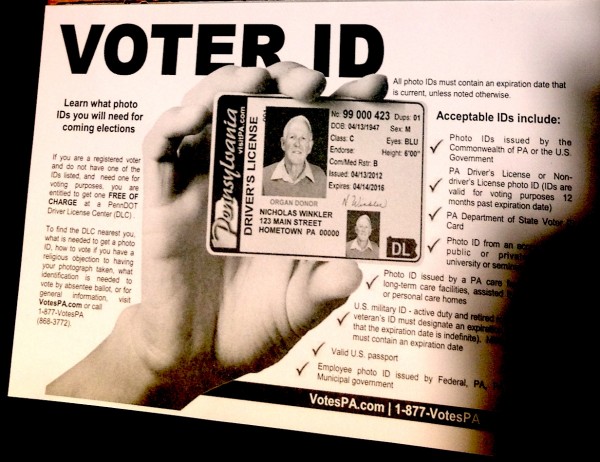
Strict voter identification laws are proliferating all around the country. In 2006, only one U.S. state required identification to vote on Election Day. By now, 11 states have this requirement, and 34 states with more than half the nation’s population have some version of voter identification rules. With many states considering stricter laws and the courts actively evaluating the merits of voter identification requirements in a series of landmark cases, the actual consequences of these laws need to be pinned down. Do they distort election outcomes? more...

Image from Mark Rain via Flickr Creative Commons

One of the most important cases the Supreme Court reviewed this year was United States v. Texas, which ruled on challenges to two Obama administration initiatives – Deferred Action for Parents of Americans and Lawful Permanent Residents and an expanded Deferred Action for Childhood Arrivals program – that would have affected up to five million people. In November 2014, President Obama announced Executive Actions that included additional temporary protections for immigrants who arrived as children (also referred to as “DREAMERS”) and a new program for parents of U.S. citizens or lawful permanent residents. The programs would allow them to remain in the country and apply for work permits if they have been here for at least five years and have not committed felonies or repeated misdemeanors. These actions have been on hold since early 2015, when a district court issued a preliminary injunction in response to a challenge brought by Republican authorities in Texas and ultimately joined by 25 other states. The actual focus of the case was quite mundane: Texas argued that it would suffer significant financial damages if required to subsidize the cost of driver’s licenses to those qualifying for the s new programs. However, the larger context was an unwillingness to allow the President to enact policy change following years of blocked and failed efforts at immigration reform at other governmental levels.

The Supreme Court was unable to reach a decision in June. The case resulted in a 4-4 tie, an unusual but not unexpected result given the current makeup of the court following the death of Justice Antonin Scalia and reflecting the politically divisive nature of the case. This means that the decisions of the lower courts remain in place and the two initiatives are blocked, for now. more...

Back in October 2014, pollster Robert Jones pointed out that white evangelicals were declining as a percentage of the U.S. population, even in the South – which could have been bad news for Republicans who count on loyal support from white evangelical voters. Starting in November 2014, Jones predicted, evangelical population decline could start tipping close races to Democrats in Bible Belt states like Arkansas, Georgia, Kentucky, and North Carolina. But Election Day on November 4th proved Jones wrong. White evangelicals turned out at high rates and played a major role in handing Republicans decisive victories in Senate races across the country. White evangelicals may be declining as a percentage of the population, but because they flock to the polls when Democratic constituencies often stay home, they still rule the midterms. more...

Photo by Daniel Latorre, Flickr CC.

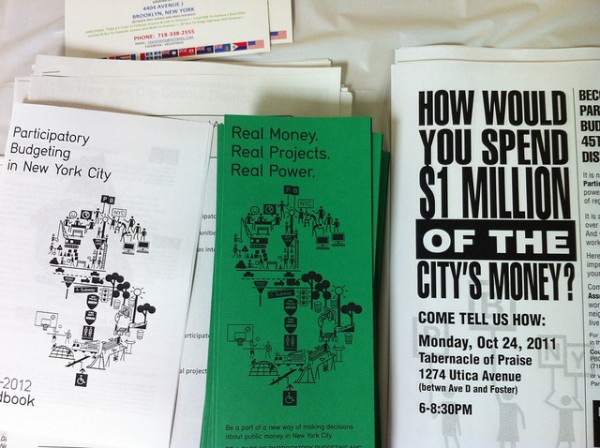
With sagging voter turnout, plummeting trust in government, and multi-billion dollar elections, U.S. democracy is marred by chasms between government and citizens. Gaps may be greatest at state and local levels, where voter turnout is especially low and citizens only rarely attend public meetings or contact local elected officials about policy decisions. Against this backdrop, communities across the country are experimenting with “participatory budgeting” – a reform that lets residents of cities, towns, and districts decide how to allocate taxpayer dollars.

By giving communities real decision-making power in a collaborative process, participatory budgeting can strengthen ties between citizens and officials. First implemented in Brazil in 1989, it has been employed by more than 1,500 cities worldwide and made its U.S. debut in Chicago in 2009. This reform has won support from the White House and officials of all political stripes, as well as from social justice coalitions like the Right to the City Alliance. more...

New volunteers gather at the Western Washington University Low Income Housing Institute. Photo by City of Seattle Community Tech via Flickr CC.


Educators and political leaders exhort Americans to be more civically engaged. Across the country, high schools require community “service learning” projects in the hope that students will pick up good habits. Local newscasts regularly tell people how they can “make a difference” by volunteering – joining walks to end hunger, tutoring a child, or re-painting an elderly person’s home for free. Civic action seems to be accomplished outside of the constraints – and bad influences – of money and bureaucracy, a matter of volunteering a few hours a week serving others; and it is portrayed as a sure-fire way to weave connections and trusting ties among otherwise atomized citizens. But my co-author and I have reviewed many studies and done our own close-up research on housing advocacy, youth service networks, and a variety of other civic undertakings. We find the standard images to be quite misleading.

Forms of Civic Action

At its core, civic action means ordinary citizens working together to address public problems and help determine the fortunes of communities, nation, and the world. Yet in our time, “improving” can mean vastly different things – and the activities used to improve society vary considerably.

  • Consider a parent club that raises money to fund after-school programs for disadvantaged kids, a protest vigil outside a clinic that provides abortions, or a citizen’s task force on toxic waste disposal. All involve citizens who volunteer for a shared project.
  • But consider, also, housing professionals who devise complicated plans to develop affordable apartments that rent at below-market rates. They, too, aim to improve society.

As these examples show, participatory collective efforts to improve society may be more or less professionalized, paid or done for free, informally or bureaucratically organized. more...

Voter turnout among members of different groups of Americans varies widely, with Latinos and Asians generally lagging behind other groups. Blacks usually fall in between, with turnout usually ahead of other minorities but behind whites—although black participation surged in 2008 and 2012 in response to the historic candidacy of Barack Obama. Additional segments of the American public also vote less than they might, including lower-income citizens and youth.

Low levels of voting matter, because election results are supposed to reflect the preferences of all Americans. In addition, recent trends indicate that Latinos, if they vote at their full potential, have considerable capacity to influence election outcomes, increasingly at the national as well as state and local level. Getting out the Latino vote was a crucial part of the Obama 2012 reelection strategy, and activists striving to boost Democratic Party prospects in Texas are spending tens of millions of dollars registering eligible Latinos. Understanding how to motivate voting by Latinos and other under-engaged citizens is thus of concern to candidates and parties as well as scholars.

How Can Reluctant Voters Be Mobilized?

more...

In some ways, the United States has made great progress toward including men and women from minority backgrounds in elective offices. A black president sits in the White House; the 113th Congress includes two Asian American and two Latino Senators along with 44 black and 30 Latino members of the House. More than one thousand minorities sit in state legislatures, 13 percent of the total; and the ranks of black and Latino mayors have also swelled. Yet despite this progress, gains for minorities in U.S. elective offices have failed to keep up with the presence of racial and ethnic minorities in the national population—and the shortfall is growing.

What explains this gap in representation? Since the passage of the Voting Rights Act of 1965, social scientists have investigated minority underrepresentation from a demand perspective—that is, they have asked how the attitudes and behaviors of voters influence the chances of minority candidates to win elections and take office. However, minorities cannot win elections if they do not run, so my research also focuses on the prior, critical issue of the supply of minority candidates. To what degree is representational imbalance due to too few minority contenders? more...