Tag Archives: toys/games

‘Tis the Season for Reinforcing Gender Differences

Time for another round-up of gendered kids’ items!

Will L. noticed something interesting recently at Old Navy. The boys’ section offered two styles of jeans, Skinny and Regular:

But when he looked at the corresponding section in the girls’ clothing, he found not Skinny and Regular, but Skinny and…Super Skinny:

Caro Reusch sent us an example of kids;’ t-shirts with messages about what we value for men and women. She saw the following at a mall in Berlin:

The blue one says “My daddy is stronger than yours,” while the pink announces, “My mommy is prettier than yours.”

Similarly, Lindsey B. saw two themed bibs for sale at Target. The blue bib is a doctor and the pink one is a ballerina:

Shantal Marshall, a postdoc student at UCLA with a Ph.D. in social psych and blogger at Smartie Pops, noticed that Crayola has a new product out, the Crayola Story Studio.  It lets you upload a photo of yourself, have it turned into a cartoon, and then it’s inserted into one of 3 themed templates: Disney Princess, Spiderman, or Cars. You can then print off various versions of coloring books based on those templates. The commercial for the Spiderman version shows a boy excitedly becoming a superhero:

For the Disney Princess version, we see a girl excited to become a princess, then dancing in the background with her very own Prince Charming:

As Shantal said, it’s a bit dispiriting that Crayola’s slogan for these items is “give everything imaginable,” but the pre-existing templates, and their marketing, don’t seem to include an imaginable alternative to the “boys = superheroes” and “girls = princesses” division we see so often in kids’ toys.

Madelyn C. saw a store in Warsaw, Poland, that just goes ahead and makes the gendered division of the toy industry explicit:

Finally, Jessica M. sent in a link to a GOOD post by Christopher Mims about the Toy Industry Association’s 2011 Toy of the Year Awards. There are general categories of toys, such as educational, innovative, and action, but of course also girl and boy categories (also, I personally can’t think of “boy toy of the year” without thinking of Madonna’s outfit in her “Like a Virgin” performance at the first MTV Video Music Awards, but maybe the ’80s are sufficiently behind us that the phrase resonates differently for most people). Anyway, Mims discusses the gendered messages in the commercials for the nominees in the two categories. Among other things, the categorization is rather confusing. Hexbugs are nominated in the boy category, even though commercials for them show girls as well:

Also, Mims points out that the boys’ category “includes a strong undercurrent of Beyond Thunderdome via WWE.” Exhibit A: The commercial for Beyblade Metal Masters, “performance tops” to be used in “strategic battles”:

Playing with tops has gotten super hardcore, I guess. Probably they should look into a sponsorship from an energy drink.

Examining Cultural Change: Children’s Tattoo Toys

Cross-posted at Cyborgology.

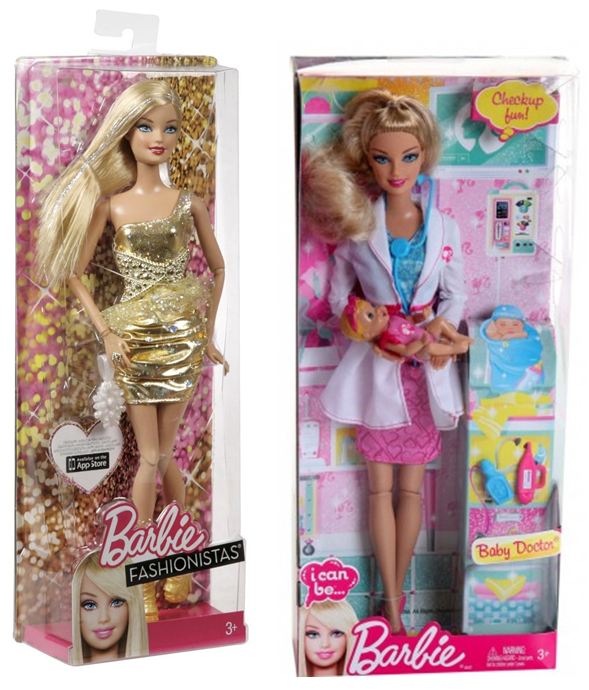
As part of my research into the popularization of tattooing, I have accumulated quite a few interesting links on tattoo toys for children. I don’t mean those temporary tattoos we all used to get from the vending machines at popular chain restaurants. This toys I am talking about have drawn flack from parents as being “inappropriate” for kids, creating an example of a burgeoning “moral panic”. Some examples include: tattoo inspired toddler weartattoo machines for kids, and of course, tattooed Barbie dolls.

The most recent children’s tattoo toy to come under attack is the collector’s edition “Tokidoki Barbie,” which features prominent arm, chest, and neck tattoos. This is the first Barbie to come out of its packaging with tattoos already applied. The first tattooed Barbie called “Totally Stylin’ Tattoo Barbie” was interactive and designed for children, allowing them to paste the temporary tattoos (actually stickers) on themselves or the doll. This new “Tokidoki Barbie” is not a toy so much as a collector’s item, meant to capture a particular historical moment in time and to be exchanged between collectors (the doll is now auctioning for roughly $500 each). With a hefty $500 price tag, I do not see many children playing with this doll. It is also not sold in stores, and is only available online.

Tokidoki Barbie:

Toys like these have been released every few years since the 1990s, when tattooing was ranked as the 6th fastest growing industry in the country (Vail 1999). But we are now seeing more children’s tattoo toys spring up, dovetailing with the increasing popular interest in the craft. We may very well be observing a second Tattoo Renaissance (Rubin 1988), especially given the expansion of the industry and the artistic flowering that has occurred since the tattoo reality TV shows first emerged in summer 2005. 

I believe we are we observing a cultural paradigm shift (Kuhn 1962) regarding tattooing.  Cultural trends are slowly reshaping popular conceptions of tattooing, turning them from “marks of mischief” (Sanders 1988) into an “ironic fad” (Kosut 2006) of consumer capitalism. Whereas tattooing was once largely reserved for working-class men, sailors, carnival performers, and exotic dancers, we have since seen the practice become widely popular amongst all races, genders, and classes.

G8 Tat2 Maker by Spin Master Toys:

Beginning with the Tattoo Renaissance of the 1960s (Rubin 1988) and more recently with the expansion into reality television (Lodder 2010), we have seen the cultural cache of tattooing shift in favor of middle-class notions of identity work (Atkinson 2003); that is, towards seeing the body as a vehicle for expressing oneself, towards actively controlling and crafting the body as a form of empowerment, and towards the development of “distinctive individualism” through appearance (Muggleton 2002). The highly narrative focus of tattooing contained in popular reality TV shows like “LA Ink” or “NY Ink” only bolster these trends, as new tattoo enthusiasts invest deeply-held meanings into each tattoo.

But these trends do not mean that tattoo toys aimed at children are any less offensive to some. Largely, it appears to be a generational divide: youth are much more supportive (in fact, largely celebratory) towards body art like tattoos and piercings, but the baby boomers continue to view tattoos through the lens of deviance.

For people of my parents generation, tattoos continue to be a symbol of deviant proclivities. Some have even called it a “disease” plaguing the youth of today. I have taken issue with such an interpretation of tattooing, especially by social scientists who continue to conceptualize the practice as an indicator of mental pathology or emotional instability, and have proposed a “pro-social” conception of contemporary body modifications like tattooing and piercing [you can read my work here]. In my opinion it is just a matter of time before prominent and visible tattoos become commonplace in professional and public settings, tattooed Barbie notwithstanding.

——————————

David Paul Strohecker (@dpsFTW) is a PhD student at the University of Maryland, College Park. He studies issues of intersectionality, consumption, and popular culture. In addition to his work on the popularization of tattooing, a project on the revolutionary pedagogy of public sociology, and more theoretical work on zombie films as a vehicle for expressing social and cultural anxieties. He previously wrote for the blog Racism Review and currently blogs at Cyborgology.

For more from Strohecker, see his posts on facial tattoos, the origins of zombies, QR codes and the digital divide, and laughing at disability.

If you would like to write a post for Sociological Images, please see our Guidelines for Guest Bloggers.

The Last Sideshow Fat Man

I like this post. And it’s the two-year anniversary of Bruce Snowdon’s death. So, here’s my toast to the last sideshow fat man.

He’s so big and so fat it takes four girls to hug him and a box car to lug him.  When he dances you’ll swear he must be full of jelly, cause jam don’t shake that way.  And you know girls!  He is single and lookin’ for a wife, he’ll make some lucky girl a fine husband, why he’s so big and fat, he’ll provide you with a lot of shade in the summertime, keep you nice and warm in the winter time and give you lots of good heavy lovin’ all of the time!

– Carnival Spiel by Ward Hall

On Nov. 9th 2009, Harold Huge, a man billed as the very last sideshow fat man, died.  He weighed 607 pounds or so.

Harold’s real name was Bruce Snowdon.  He had degrees in paleontology, anthropology and chemistry. In 1977, he found himself bored with his work and stumbled across the idea of being a Fat Man:

I had put on a lot of weight between the time I was 20 and 25. I was up to about 450 in those days. I went to the local library, and I was poking through some old circus books and I see this one picture about a sideshow, maybe circa 1905, and I’m looking at this fat man and I’m saying to myself, “He can’t weigh more than 350 pounds.”

Now, I ask myself, how the hell would I go about getting into a sideshow? I’d never even seen a sideshow in my lifetime. In the late ’70s the industry was a very pale ghost of its former self. Instead of thousands, there were maybe dozens left then. So I figured, logically, there’s got to be some sort of trade journal for the carnival industry. It’s Amusement Business. And I’m looking through the AB. Taking a lucky stab, I wrote the editor, Tom Powell. And Tom Powell happens to be a very good friend of Ward Hall. Bingo. I had the job.

Bruce, 1978:

In an interview with James Taylor (from which the above quote is also taken), Snowden explained:

I don’t mind being enormously fat… I come from a long line of fat people. My old man tortured himself for 40 years going from 200 to 300 [pounds] and back again. He eventually lost the weight, but he also lost his mind.

Snowdon played Harold Huge for 26 years.  The year of his retirement, in 2003, he played himself in the movie, Big Fish:

After retirement, he raised chickens:

So the sociological question I would like to pose is: Why is Snowdon the last fat man?

Marc Hartzman suggests that fat men and woman became less of a curiosity because “waistlines expanded and obesity became less of a laughing matter.  As the years went by, spotting a man who weighed more than quarter of a ton was not that unusual…”  So there’s two  hypotheses: (1) we see fat people everywhere and so it’s no longer a curiosity and (2) obesity has become a very serious matter, not to be played with at sideshows or elsewhere.

Another hypothesis might involve (3) a growing distaste for objectifying and dehumanizing those who are unusual.   As the human rights era evolves, we increasingly embrace difference and promote tolerance.

(4) Perhaps sideshows themselves are simply out-of-fashion, a drab alternative to Avatar in 3D or a Wii.  Or, (5) maybe the internet has made all curiosity easier to quench.  With a click of the button, we can see DD breasts, thalidomide babies, and cats playing the piano… who needs a sideshow?

I can think of reasons to endorse and reject all of these hypotheses.

So, in honor of Snowdon’s 26 years of service and delightful sense of humor (“If there’s a bitchy type of human being, it’s somebody on a diet”), let’s speculate.

Sources: Sideshow World, AOL News, Shocked and Amazed, Randall Levenson photography, and Shapely Prose.

—————————

Lisa Wade is a professor of sociology at Occidental College. You can follow her on Twitter and Facebook.

The Evolution of the Easy Bake Oven

Yesterday Hasbro announced a new model of the Easy Bake Oven designed in response to the growing efficiency of light bulbs.  This sounded to me like a perfect opportunity to bring back our post on the evolution of the toy.  You’ll see the new model at the end.

—————————

My niece got an Easy Bake Oven for Christmas this year and I was shocked.  Shocked!

No, not because of gendered gift giving, socialization, blah blah blah… (I don’t know where you would get that idea).  Instead, I was shocked by what cooking apparently looks like in 2009.  But let me start at the beginning…

The first Easy Bake Oven was released by Hasbro in 1963 (history here).  It looked like a range with a stove top and an oven:

6a00d83452989a69e200e5503ce76d8833-800wi

It looked like this, with minor changes in color and amenities, for a while.

1964:

64

1971:

71

Then, 1978.  It turns out, in 1975, for the first time, sales of microwave ovens exceeded those of gas ranges.  And, what do you know, the Easy Bake Oven was suddenly a microwave with a digital clock:

78

1983:

83

Presumably, between 1963 and 1978, what cooking looked like changed dramatically and the evolution of the Easy Bake Oven reflected that.  This is what surprised me when I saw my niece’s oven.

Ironically, this year’s Oven is painted in the original turquoise, as a nod to 1963, but it is still clearly a microwave:

easyBake

2011: Commercially available light bulbs are no longer inefficient enough to bake goodies.  This year’s model, then, is actually a real oven, reaching temperatures up to 375 degrees:


So that’s technological and socioeconomic change as signified by the Easy Bake Oven.

—————————

Lisa Wade is a professor of sociology at Occidental College. You can follow her on Twitter and Facebook.

Stereotypes of Native Americans in Video Games

Dolores R. sent us a link to a video posted at Racialicious about stereotypes of Native Americans in video games. Beth Aileen Lameman, the director and narrator, discusses a number of frequent tropes used when depicting Native Americans in games, such as the half-breed hero, the wise old Indian sage, and, of course, the hottie Indian princess, as well as the tendency to conflate many different tribes and cultures. It’s a great summary of common representations of Native Americans in pop culture more broadly:

Native Representations in Video Games from Elizabeth Lameman on Vimeo.

Gender and Power in Duke Nukem

I don’t play video games. The few times I have played a game it involved a furry animal working his way through some kind of tropical forest and the most violent it got was when he hit a villainous turtle on the head with a coconut. So, I am not familiar with Duke Nukem.

Of course, one Google search tells me he is a supremely popular, freakishly over-muscled, machine gun-wielding, hyper-aggressive action “hero” who is described in the Wikipedia entry as “frequently politically incorrect.” His character profile also claims that when he was first introduced, he was a CIA operative hired to save Earth from Dr. Proton. But the current marketing materials make clear what the really important aspects of the game are. Exhibit A is this ad, which greeted me as I came out of the subway this morning:

Duke Nukem is sitting on a throne while two women in schoolgirl outfits sit at his feet. The caption leaves no doubt about the main attractions: “This game has bazookas. Both types.”

The game’s website presents a guy who looks intensely devoted to his steroid regimen, has a penchant for unloading 50 rounds into anything with tentacles, and who appears to live in a post-apocalyptic land which is somehow still able to generously supply women with fetish outfits, bikinis, and manicures. In a video promo for the game on YouTube there are scenes of Duke on a shooting rampage interspersed with what appears to be him walking into a room and seeing a switched-on vibrator skidding around the room. He then encounters two women (the Holsom Twins, Mary and Kate) in schoolgirl outfits who drop their weapons to touch and caress each other in sexually suggestive ways. Duke is watching this while pointing a gun at them, saying, “allll right, time for my reward” (NSFW due to images and language):

Unfortunately for the twins, they later have sex with an alien and get themselves into trouble (thanks to Michael R. for this clip; also NSFW):

Many other reviews of Duke Nukem have also pointed out its violent sexual imagery and encouragement of sexually violent behavior towards women. Just to tally up, we have:

  1. Fetishizing and infantilizing women by putting them in outfits associated with children.
  2. Referring to their breasts as “bazookas,”  both objectifying women and equating  their bodies with a military weapon.
  3. A lesbian encounter presented as titillation for the male viewer.
  4. Watching women engage in sexual activity with one another, and even threatening women with weaponry to continue engaging in sexual activity with one another, is your reward. You deserve it – you deserve to be sexually gratified.

People learn by watching. This can be good and bad. It can make us more accepting of others’ opinions and outlooks, and it can also desensitize and normalize harmful opinions and behaviors. In regards to Duke, the latter is where the risk lies — the more one sees images like those presented by Duke Nukem, the more likely they are to be seen as what is acceptable and usual. Normalizing harmful, degrading, and insulting stereotypes of and behavior toward women seems like a high price to pay for a video game’s success.

———————-

Larkin Callaghan is a doctoral student at Columbia University studying health behavior and education. She is particularly concerned with gender disparities in access to healthcare and prevention services, and has done research on adolescent female sexual health, how social media operate as an educational platform, and differences by gender in the effectiveness of brief health interventions. You can follow her on Twitter, Tumblr, and at her blog.

Who’s Teaching Creationism to Kids?

When someone gave us this chunky dinosaur puzzle, I did a double-take. Yes, that’s a caveman there with the dinosaurs:

The blurb on the company’s website says that, along with the puzzle, “ The accompanying board book teaches young learners about dinosaurs.” Teaches, that is, with lessons like this:

A little harmless fun, or a little creationist indoctrination? (Do sociologists even believe in “harmless fun”?)

According to the Shure company, they deliver these “common threads” in all their products: “Originality and inventiveness; Excellence in design; Attention to detail; Exceptional quality; Educational merit.” So, not just entertainment.

A quick perusal suggests the rest of their products are not creationist — just the usual toy-gendering. They do have a Noah’s Ark puzzle, but it doesn’t claim to be educational. In that Shure is just keeping up Melissa & Doug (whose puzzle is at least Genesis-correct in not naming Noah’s wife):

And anyway, the story of Noah’s Ark is actually not a bad way to talk about reproduction.

But back to dinosaurs and people. Dinosaurs are not really more problematic for creationism than any other creatures that pre-date humans. But maybe because kids love dinosaurs so much, creationists spend inordinate energy trying to place them chronologically with people. Writes one such site:

The idea of millions of years of evolution is just the evolutionists’ story about the past. No scientist was there to see the dinosaurs live through this supposed dinosaur age. In fact, there is no proof whatsoever that the world and its fossil layers are millions of years old. No scientist observed dinosaurs die. Scientists only find the bones in the here and now, and because many of them are evolutionists, they try to fit the story of the dinosaurs into their view.

Up against this kind of propaganda, it is tempting to bring the hammer down on “harmless fun” featuring humans and dinosaurs playing together. That would mean none of these, either:

That is basically the argument of James Wilson, a University of Sussex lecturer, who has a talk on the subject here on Youtube.

In any case, we may be so used to seeing toys or other products like this — with humans and dinosaurs side-by-side — that we forget to ask whether they’re teaching kids a lesson, one that is at odds with science.

————————

By the way, for non-biologists, like me, who like evolution and want some ammunition to defend it, I recommend Richard Dawkins’ recent book The Greatest Show on Earth. Some do find it a little dogmatic, and in the grand scheme I prefer Stephen Jay Gould, but it’s good for this purpose. Because rather than block access to dinosaur cartoons, I would rather arm myself – and the surrounding children – with the tools they need to handle them with confidence.

“Nature’s Little Helpers” Links Women to Nature

Yesterday, I was at the grocery store in the checkout line, when I saw a Disney book about how Tinkerbell and her fairy friends “Nature’s Little Helpers.”  Intended to interest small children in being environmentally conscious, the fairies, all female, help nature go about its daily tasks.  The connection to the nymphs of Greek mythology at once is evident.  Nymphs were essentially fairies that embodied parts of nature: water, trees, etc. They were almost always female, and often played the role of temptress to the male gods.  These Disney fairies play on the same idea; they tend to nature and are connected with nature because of their being female.

(source)

Why is this a problem?  First, the book connects women to nature on the basis of biology, the idea that women are naturally nurturing.  This suggests that only women can really take care of nature, because they are better suited for it than men.  Second, by linking women and nature, they suggest that being Green is ‘girly,’ when in fact being Green should be gender-neutral.

“Nature’s Little Helpers” ties women and nature together in harmful ways: it assumes that women are caretakers of nature because of an inherent nurturing ability and it feminizes the teaching of environmental studies, even interest in nature.  I have no doubt that Disney intended for this book to up its Green profile, but its message is as harmful as the Disney princess line. We should be teaching children about nature without gendering the process.

—————————

Lisa Seyfried is recent graduate of the George Washington University Women’s Studies Master’s Program.  Her interest is in the intersection of women and the environment, and generally helping the world to become a more just and sustainable place.  She is also a blogger at Silence is Complicit.

If you would like to write a post for Sociological Images, please see our Guidelines for Guest Bloggers.