Tag Archives: social psychology

Climate Denial and American Voluntarism

Cross-posted at Montclair SocioBlog.

At the GOP convention in August, Mitt Romney’s cavalier dismissal of global warming got the intended laughs.  Today, it seems less funny and the Democrats are capitalizing on the turn of events:

Here’s the transcript:

President Obama promised to begin to slow the rise of the
oceans and to heal the planet.  My promise is to help you and your family.

In two short sentences, Romney gives us the broader context for the denial of global warming:  the denial of society itself.  He echoes Margaret Thatcher’s famous dictum

There is no such thing as society. There are individual men and women, and there are families.

This doesn’t mean that there are no groups beyond the family.  But those larger groups are valid only because individuals, consciously and voluntarily, chose to create them.  This way of thinking about the relation between individuals and groups has long been an underlying principle of American thought.  Claude Fischer, in Made in America calls it “voluntarism” – the idea that the only legitimate groups are the ones that people voluntarily form or join.*  The individual has a strong obligation to those groups and their members, but he has little or no obligation towards groups and people he did not choose.

That is a moral position.  It tells us what is morally O.K., and what is not.  If I did not choose to join a group, I make no claims on others, and it is wrong for others – whether as individuals or as an organized group, even a government – to make any claim upon me.

That moral position also shapes the conservative view of reality, particularly about our connectedness to other people and to the environment.  Ideas about what is right determine ideas about what is true.  The conservative rejects non-voluntary connections as illegitimate, but he also denies that they exist.  If what I do affects someone else, that person has some claim upon me; but unless I voluntarily enter into that relationship,  that claim is morally wrong.  So in order to remain free of that claim, I must believe that what I do does not affect others, at least not in any harmful way.

It’s easy to maintain that belief when the thing being affected is not an individual or family but a large and vague entity like “society” or “the environment.”  If I willingly join with many other people, then I will see how our small individual acts – one vote, one small donation, one act of charity, etc. – add up to a large effect. That effect is what we intended.  But if we separately, individually, drive a lot in our SUVs, use mega-amounts of electricity, and so on, we deny that these acts can add up to any unintended effect on the planet.

As Fischer says, voluntarism is characteristically American.  So is the denial of global warming.  The incident at a recent Romney rally illustrates both (a video is here).

When a protester yells out the question, “What about climate?” Romney stands there, grinning but silent, and the crowd starts chanting, “USA, USA.”  The message is clear: we don’t talk about climate change; we’re Americans.

—————————

Jay Livingston is the chair of the Sociology Department at Montclair State University.  You can follow him at Montclair SocioBlog or on Twitter.  Two more posts on voluntarism are here and here.

Confirmation Bias and the iPhone 5

Confirmation bias is the tendency to search for or interpret information in a way that reaffirms our pre-existing beliefs. We may selectively notice information; for instance, if we think the full moon makes people act weird, we’re likely to notice and remember strange things we see people doing during a full moon better than strange things we observe at other times (or than all the people we see acting perfectly normally during a full moon). We tend to perceive what we expect to see, our brains struggling to come up with reasons that justify what we already think.

Dmitriy T.C. sent in a video that illustrates this particular type of selective thinking. Jimmy Kimmel gave people on the street an exclusive look at the iPhone 5 and asked what they thought of it. Except, of course, the iPhone 5 isn’t available yet. What he actually gave them was an iPhone 4S. But when told they’re looking at a new version of the iPhone, everyone immediately perceives clear improvements that make it better than the iPhone 4.

You might expect this from people who don’t have much knowledge of iPhones; they don’t have a clear basis for comparison, so whatever features seem neat, they assume are new. But even people holding their own iPhone 4 up for direct comparison perceive the “iPhone 5″ Kimmel hands them to be superior, noting a range of details — it’s lighter, faster, just clearly better. They think a new version of a gadget must be way more awesome than the previous version, and Apple has an aura of coolness that leads people to expect their new products should be extra amazing. Since people expect a new iPhone to be awesome, they notice, or invent, features that confirm that it is, indeed, awesome.

It’s a really fun demonstration of this cognitive bias:

College, Fun, and Pluralistic Ignorance

This week on PostSecret I stumbled across the following confession: 

The idea that certain beliefs about college may not be true reminded me of the concept of pluralistic ignorance.  The phrase refers to a phenomenon in which a large proportion of a population misunderstands reality.

For example, while many college students think that lots of people hook up a lot, 80% of college students hook up less than once a semester, on average.  About 40% of those hook ups involve intercourse, while a strong third just involve getting horizontal and making out.  Students, for what it’s worth, also tend to consistently overestimate how much drugs and alcohol other students are consuming.

So, while “everyone thinks” that “everyone has fun during their freshman year.”  In fact, the person who wrote this confession may be a lot less alone than s/he thinks, even if most people think that everyone does, in fact, have fun.

Lisa Wade is a professor of sociology at Occidental College. You can follow her on Twitter and Facebook.

Human Brain Synchronicity: The Body as Dependent Variable

The mass media often enjoys stoking the fires of the “nature/nurture debate,” an argument between those who believe that human behavior is largely inborn (nature) and those who believe it is largely learned (nurture).  In fact, most scholars reject this forced choice in favor of the idea that nature and nurture are forces that shape each other.

In this view, biology is both an independent and a dependent variable.  That is, it acts on us in ways that shape our interactions with others (such that behavior is dependent on biology) and our interactions with others shape our biology (such that our biology is dependent on our behavior).  I’ve published professionally on this topic and we’ve previously posted examples involving the socio-genetic causation of psychopathythe response of testosterone levels to political victories, and the historical shift in the average age of menstruation.

Today’s example comes from an fMRI study of emotion.  They discovered that, when we watch others experience emotions, our brains sync up with theirs.  Our bodies, in other words, strongly react to environmental stimuli.  This, argues one of the researchers, “…facilitates understanding others’ intentions and actions… [as well as] social interaction and group processes.”

It may seem obvious that our neural activity would respond to our environments, but I think it bears emphasizing.  It is too easy for us, in a society that seems eager for a biological explanation for everything, to ignore the ways in which the body is a dependent variable as well as an independent one.  In many ways it makes sense to think of our biologies as the matter through which social interaction occurs.  In other words, while we often think of society as the medium for the transmission of genes, I also like to think of biology as the medium for the transmission of society.

—————————

Lisa Wade is a professor of sociology at Occidental College. You can follow her on Twitter and Facebook.

Classic “White Girl” Microaggressions

Thanks to Leticia, Caely, Anjan G., Liz, Bradley K., and Kelsey P. for their patience.  Our SocImages email inbox is a hot mess, and sometimes things fall through the cracks.  This is certainly true for the short video below, one of the responses to the “Shit Girls Say” clip that inspired a round of copycats last December.  We decided to post about it belatedly because it remains a great example of something called a microaggression.

Microaggressions are “brief and commonplace daily verbal, behavioral, or environmental indignities, whether intentional or unintentional, that communicate hostile, derogatory, or negative… slights and insults” (source).  These are often subtle.  So the recipient feels badly, but it can be difficult to explain exactly why, especially to someone who isn’t sympathetic to issues of bias.  The Microaggressions Project has hundreds, maybe thousands, of examples.

In this video, Franchesca Leigh poses as a “White girl” and says many of the things that she and other “Black girls” hear routinely.  To Leigh, these are microaggressions.  They variously trivialize and show insensitivity towards race and racism, remind the listener that she is considered different and strange, homogenize and stereotype Black people, and more…

—————————

Lisa Wade is a professor of sociology at Occidental College. You can follow her on Twitter and Facebook.

Media Coverage of Mass Murders

In the wake of the shootings in a Colorado theater last week, Sean D. sent in a BBC video clip commenting on media coverage of mass murders.  It criticizes the typical response, which usually involves intense coverage dissecting every piece of the story, focusing closely on the killer and his motivations.  This can go on for days.

The narrator argues that this is exploitative — the media is using gruesome events to drive ratings (often for days at a time) — and it feeds into the public’s tendency towards voyeurism.  He also includes an interview with a forensic psychiatrist, Dr. Park Dietz, who specializes in such cases; he says that this type of coverage is the exact opposite of what the media should do… if it is interested in saving lives.  The attention, especially to the criminal himself, encourages other “anti-heros” to contemplate and execute mass murders themselves.


—————————

Lisa Wade is a professor of sociology at Occidental College. You can follow her on Twitter and Facebook.

The Economy is Lousy… Over There

Cross-posted at Montclair SocioBlog.

What’s familiar isn’t so bad, even if it’s bad.

One of the things I remember from my days in the crim biz is that people’s perceptions of crime don’t have a lot to do with actual crime rates.  This was back in the high-crime decades, and people were more afraid of crime than they are now.  But people felt safer in their own neighborhoods than in other neighborhoods, even when their own neighborhoods had a higher crime rate.

These were the days when I would give someone directions to my building — “Get off the IRT* at 72nd St…” — and they would often ask, “Is it safe?”

“Of course it’s safe.  It’s my neighborhood,” I would say, “I live here. I ought to know.”   Yet when I would go to a party in the East 20s or, God forbid, Brooklyn, I would emerge from the subway and follow the directions with a certain sense of apprehension and caution.

Apparently, the same link between far and fear holds true for people’s perceptions of economic well-being.  A recent Gallup poll asked people how the economy was in places ranging from their own city or area to the world generally.  The closer to home, the better the economy.  The farther from home, the lower the percent of people rating economic conditions as excellent or good.And the farther from home, the higher the percent of people rating economic conditions as “only fair” or poor.Republicans were the most pessimistic about the economy, regardless of location.  Democrats were the most sanguine, with Independents in between. The graph shows the percent who rated the economy positively minus the percent who rated it Poor.This obviously has nothing to do with familiarity but with contempt.  Apparently, for Republicans, a Democrat – especially a Kenyan socialist Democrat – in the White House means that the economy must be bad everywhere.

* These old subway line designations – IRT, BMT, IND – are no longer in official use.  But when did the MTA jettison them?  If you know the answer, please tell me.

———————

UPDATE, June 22 Andrew Gelman has formatted the data as line graphs, making the comparisons and trends clearer.  He has also added his own observations – things I wish I had known or thought of.

Conformity to Innocuous Social Norms

Solomon Asch was a social psychologist famous for his experiments in conformity.  In 1962 he collaborated with Candid Camera, a TV show, to show just how easy it is to reverse an innocuous social norm: the direction one stands in an elevator.

Does it still work?  Watch this University of South Florida replication:

Asch did many such experiments, including showing that people will agree with others when asked a simple question, even if they suspect everyone else is wrong.  The implications are obvious.  Social pressure is incredibly powerful and we’ll do things that seem pretty bizarre just to fit in.  How one stands in an elevator, of course, is a trivial matter and has almost no consequences short of feeling funny.  Imagine how much we’ll be willing to do when the consequences are even a little bit greater.

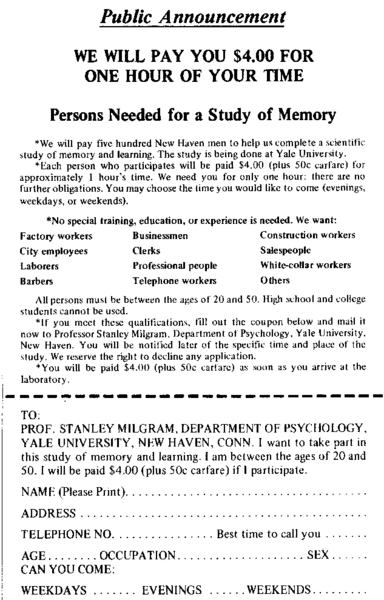
For more great social psychology: entering a theater full of bikers, doing nothing, change blindness, norm breaching, Milgram’s obedience experiment (plus the original flyer).

—————————

Lisa Wade is a professor of sociology at Occidental College. You can follow her on Twitter and Facebook.