Tag Archives: nation: Spain

International Comparisons of Equality and Prosperity

An infographic accompanying an article at the New York Times reveals how “advanced economies” compare on various measures of equality, well-being, educational attainment, and more.  To illustrate this, for each measure countries that rank well are coded tan, countries that rank poorly and very poorly are coded orange and red respectively, and countries that are in the middle are grey.  The countries are then ranked from best to worst overall, with Australia coming in #1 and the United States coming in last.  You might be surprised how some of these countries measure up.

Thanks to Dmitriy T.M. for the link.

The United States: A Nation of Immigrants?

The United States is a nation of immigrants… in that the majority of its citizens are not part of the native population of North America.  In other words, because it was and remains a colonized land.

That aside, is the United States unique in receiving an extremely large number of new immigrants relative to its size?  It turns out, No.

Lane Kenworthy, at Consider the Evidence, posted this figure, showing that the U.S. population does indeed include a substantial proportion of first generation immigrants (both legal and illegal), but it is not unique in that regard, nor does it carry the highest percentage:

It also fails to be true, as many anti-immigration people claim, that the U.S. accepts a uniquely large number of immigrants who need help once they arrive:

Are Americans More Patriotic than Citizens of Other Countries?

Claude Fischer at Made in America offered some data speaking to the idea that Americans are especially patriotic. That they, in other words, are more likely than citizens of other nations to think that “We’re Number One!”

Fischer provides some evidence by Tom Smith at the International Social Science Programme (ISSP; Tom’s book).  The ISSP, Fischer explains…

…involves survey research institutions in dozens of countries asking representative samples of their populations the same questions. A couple of times the ISSP has had its members ask questions designed to tap respondents’ pride in their countries… One set of questions asked respondents how much they agreed or disagreed with five statements such as “I would rather be a citizen of [my country] than of any other country in the world” and “Generally, speaking [my country] is a better country than most other countries.”

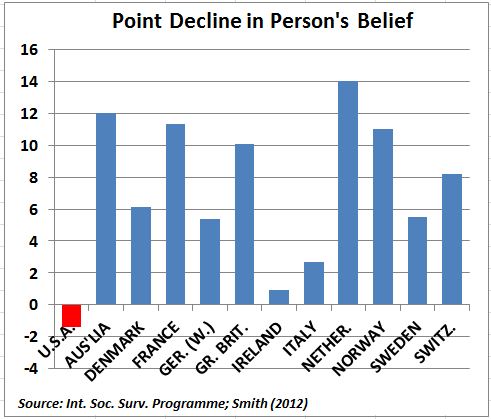
Smith put responses on a scale from 5 to 25, with 25 being the most patriotic.  Here are the results from some of the affluent, western democracies (on a shortened scale of 5 to 20):

As Fischer says, “Americans were #1 in claiming to be #1.”  Well, sort of.  Americans were the most patriotic among this group.  They turned out to be the second most patriotic of all countries.  Venezuela beat us.

(In any case, what struck me wasn’t the fact that the U.S. is so patriotic, but that many other of these countries were very patriotic as well!   The U.S. is certainly no outlier among this group.  In fact, it looks like all of these countries fall between 14 and 18 on this 20-point scale.  Statistically significant, perhaps, but how meaningful of a difference is it?)

Fischer goes on to ask what’s good and bad about pride and closes with the following concern for U.S. Americans:

We believe that we are #1 almost across the board, when in fact we are far below number one in many arenas – in health, K-12 education, working conditions, to mention just a few. Does our #1 pride then blind us to the possibility that we could learn a thing or two from other countries?

Global Recognition of Same-Sex Marriages

Courtesy of FiveThirtyEight, this graph shows the increase since 2001 in the number of people worldwide who live in jurisdictions where gay same-sex (or homogamous, if you prefer) marriage is legal. As of 2010, roughly 250 million people live in such areas (each column represents the total number for that year, broken into individual colors to show the number in each region):

The spike in 2008 is due to the California courts recognizing same-sex marriages, so the U.S. data pushed the total number upward; that, of course, was quickly reversed by Prop 8, so that bump disappears in 2009. Currently within the U.S., same-sex marriages are legal in Vermont, New Hampshire, Iowa, Connecticut, Massachusetts, and Washington, D.C., while apparently New York, New Mexico, California, and Rhode Island don’t allow them to be performed but recognize those performed elsewhere (a friend of mine who lives in Rhode Island couldn’t marry his boyfriend there, but drove a half hour from their home into Massachusetts to do so and then went home, where his out-of-state marriage was then entirely legal). California recognizes those same-sex marriages that occurred between June and November 2008, before Prop 8 passed. Within Europe (which is all thrown together here, unfortunately), as far as I know the specific countries where it’s legal are Sweden, Norway, the Netherlands, Belgium, Spain, Portugal, and Iceland), with Portugal and Iceland both doing so this year. In Mexico, same-sex marriages are legal only in Mexico City, but if performed there, must be recognized in other areas. And Argentina became the first country in South America to legalize them just last Thursday. (I’m not including domestic partnerships and other arrangements that are somewhat equivalent to, but clearly distinguished from, marriage here; adding those would certainly increase the number significantly.)

This is a small percentage (about 3.7%) of the total global population of nearly 7 billion, and they are highly concentrated in (Western) Europe and North America, with those in Africa, Asia, and Central and South America largely excluded. But the global pattern is a slow but steady rise over time just over the past decade in the recognition of same-sex marriages.

The Medical School Glass Ceiling in Spain

Nia A. sent in a chart from an article in the Revista Española de Cardiología about gender in medical schools in Spain. Overall, the medical field is increasingly feminized. In 2008, 73% of new medical school graduates (licenciadas en medicina) were female (note that in Spain they use commas where we would use a decimal in a number in the U.S., so 73,04 = 73.04):

It’s a significant increase, but women also earned a significant majority of medical degrees by 1998, so this isn’t a new phenomenon. Women also earned just over half (52%) of Ph.D.s in 2008 (tesis doctorales aprobadas).

When we look at faculty (docentes en la universidad, total), women are a distinct minority, making up only 20%. This varies quite a bit by position (I’m relying on Nia’s comments and Wikipedia to translate Spain’s academic ranks to the U.S. equivalent; please let me know if I’ve misunderstood a category):

  • The percentage of women serving as teaching assistants (profesoras ayudantes) has gone down from 72% in 1998 to 50% in 2008 (the only area where the percentage of women decreased).
  • Women make up 22% of lecturers (profesoras asociadas, who may or may not be tenured) and 9% of titulares de universidad (which I think are what we would call associate professors in the U.S.). They make up a sizable minority of contratadas doctoras, a tenured position similar to a professor (42%).
  • Women made up a larger percentage of titulares de escuela universitaria (53%), a position at non-Ph.D. granting and technical colleges; however, this position was abolished in some academic restructuring in 2007. Those holding it keep their jobs, but no new hires will be made.
  • However, women make up only a tiny portion (4%) of catedráticas de universidad (roughly the same as a full professor — received tenure and then met a number of other requirements for promotion). Only this group is eligible to become a rector (university president)

This pattern is widespread in universities (see our post on engineering and tech faculty), and likely due to a number of factors. There is always lag time between demographic changes in a field and changes in faculty, since unless a lot of new positions are created, potential faculty have to wait until current ones retire. All things being equal, we’d expect the % of women faculty to go up steadily over time as more female Ph.D. candidates apply for positions previously held by men. Of course, women have been earning the majority of medical degrees since before 1998, so there’s been sufficient time for gender changes in the field to affect the composition of faculty.

But all things aren’t equal in university hiring. Historically women have faced significant gender discrimination, and this continues to occur. However, a large body of evidence indicates that family/work conflicts play a huge role. Because women still, as a group, have primary responsibility for childcare, they are more likely than men to face difficulties balancing family time with work requirements, such that they are less likely to advance to tenure or promotions. They are more likely to opt out of more demanding positions — applying to be Dean, say, or accepting a position at a research-heavy university as opposed to a community college — but also find that they may be “mommy tracked” by hiring committees who assume they’ll be taking too much time out of the paid workforce to raise their kids (and often make these assumption whether or not the woman has or plans to have kids or stay home with them).

I also suspect that if the data were broken down into specialty, we’d see more women earning degrees or teaching in areas associated with women or the family (ob/gyns, for example) as opposed to more masculinized specialties, often perceived as very high-status, like neurosurgery (we see more women than men in pediatrics and ob/gyn in the U.S., for instance).

Will the percent of female med school faculty in Spain and elsewhere increase? Undoubtedly over time it will. But due to factors including those I just discussed, it’s also likely that the increase will lag significantly behind what we’d expect just based on the number of women earning medical degrees.

Disparate Trends in Permissiveness: Homosexuality and Prostitution

Will Wilkinson posted the following two figures, both featuring data from the World Values Survey, and asked his readers to join him in speculating as to the difference.

This first figure shows that, across several industrialized countries, tolerance for homosexuality has been going up (or, more reflectively of the image, intolerance is going down) over time:

Photobucket

This suggests that countries are becoming more liberal and permissive.  However, this second figure shows that tolerance for prostitution has progressed much less.  The overall trend is towards more tolerance, but with significant backlashes and a much gentler slope downwards.

Photobucket

What gives?

Wilkinson offers five possible explanations:

(1) Being versus doing. People just are homosexual, and it’s not up to us if we are. Prostitution on the other hand is an activity we can more easily choose to avoid.

(2) The cash nexus. Some things just shouldn’t be sold, and sex is one of them. The problem is the money not the sex, and the law reflects that.  Homosexuality, like sexuality generally, is mostly expressed outside the cash nexus.

(3) Related: Exploitative versus non-exploitative. Prostitution is a low-status line of work that people avoid if they have better alternatives. Taking advantage of the fact that people don’t have better alternatives is exploitative and demeaning.

(4) Sexist paternalism. Homosexuality is (wrongly) primarily conceived popularly as a man-on-man sort of thing. Prostitution is (rightly) primarily conceived popularly as a man-on-woman sort of thing.  Men (and their virtue) don’t need protection from men, but women (and their virtue) need protection from men.

(5) Marketing. There has been an ongoing, effectively carried-out campaign to de-stigmatize/normalize homosexuality. There has been no similar effort to destigmatize/normalize sex work, so the reputation of prostitution continues to languish.

What do you think?

Youth and Adult Unemployment


How have adults and young people weathered the worldwide economic downturn? This two-minute 12-second video shows that young people have been harder hit by joblessness in almost all OECD countries:

From the OECD Factblog.

Spain, Mexico, Whatever.

Laura N. sent in this photo a friend of hers took of a Verizon advertisement in the Las Vegas airport, in which we are told Verizon provides “coverage in Spain. And more than 220 other countries.” See anything…odd?

Photobucket

Her friend, who is from Spain, couldn’t help but notice that the ad represents Spain with images of (stereotypical) Mexican culture.

I studied in Spain for a semester as an undergrad, and only once did I see a mariachi band: when I ate at a Mexican restaurant. That was also the only time I saw flour tortillas or refried beans.

Laura suggests the ad illustrates the tendency for many people in the U.S. to conflate anything described as “Spanish,” “Hispanic,” etc., as “Mexican,” thinking that the cultural practices they associate with Mexico represent the cultures of all Spanish-speaking countries. Presumably either the Verizon team didn’t notice the problem, or didn’t think many other people would notice or care.