
nation: Somalia

Katrin sent us a link to a image at GOOD that illustrates the geopolitics of first-person shooter video games. The image was created by a group at Complex to illustrate the way that the changing actual political landscape can be seen in the nationality of villains in video games. Peter Rubin, of Complex, explains, “Gone are the days of all FPSes being either World War II or sci-fi; in the new milennium, developers are on the hunt for enemies that are speculative but still plausible.”

They looked at 20 FPS games from the past decade (unfortunately, they give no details about how those 20 games were chosen
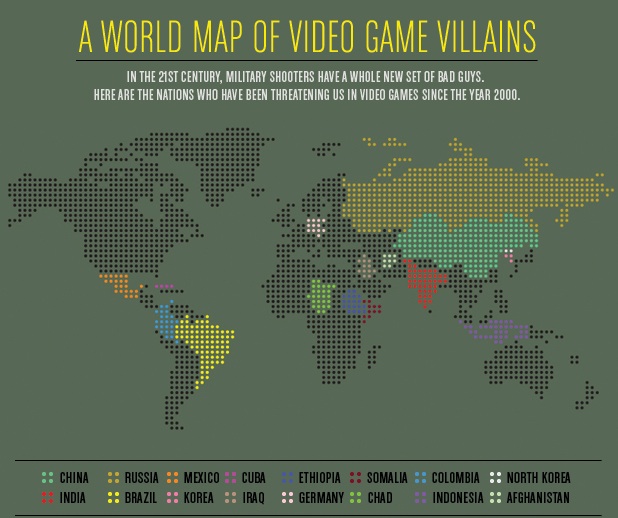
The selected titles:

Return to Castle Wolfenstein (2001): Germany
Tom Clancy’s Ghost Recon: Desert Siege (2002): Ethiopia
Tom Clancy’s Ghost Recon: Island Thunder (2003): Cuba
Delta Force: Black Hawk Down (2003): Somalia
Tom Clancy’s Ghost Recon: Jungle Storm (2004): Colombia
Tom Clancy’s Ghost Recon 2 (2004): North Korea
Joint Operations: Typhoon Rising (2004): Indonesia
Tom Clancy’s Ghost Recon 2: Summit Strike (2005): Afghanistan
Delta Force Xtreme (2005): Chad
Tom Clancy’s Ghost Recon: Advanced Warfighter (2006): Mexico
Call of Duty 4: Modern Warfare (2007): Russia/Afghanistan
Army of Two (2008): Somalia/Afghanistan/China/Iraq
Frontlines: Fuel of War (2008): Russia/China
Call of Duty: Modern Warfare 2 (2009): Russia/Afghanistan/Brazil
Operation Flashpoint: Dragon Rising (2009): China/Russia
Singularity (2010): Russia
MAG (2010): Russia/China/India
Army of Two: The 40th Day (2010): China
Homefront (2011): Korea (They don’t specify if it’s North or South Korea)
Operation Flashpoint: Red River (2011): China

Anyway, it provides a nice little illustration of the way that global politics seeps into this element of pop culture, as well as a snapshot of nations currently perceived as rivals or even enemies of the U.S. — a mixture of old tensions (Russia, Germany), ongoing anxiety about China, and emerging focal points.
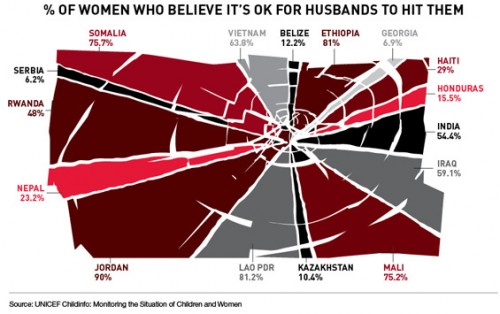
Teresa C. sent in this image created using UNICEF data to show what percent of women surveyed in various countries said it was acceptable for their husbands to hit them:

international-womens-attitudes-towards-domestic-v-28079-1250786064-13

(Found at BuzzFeed.)

You can find the data and a breakdown of UNICEF data collection methods here. The data for many more countries are available there too. I can’t quite figure out why these particular countries were used in the image; they aren’t all of the countries with the highest percentages. As far as I can tell, the UNICEF data table only includes numbers for the “developing” nations and some countries from eastern Europe, which is UNICEF’s focus. But I do wonder what the numbers would be if you asked women in the U.S. a question along the lines of “is it ever acceptable for a man to hit a woman?” or “can you think of any situation where it might be understandable that a man would hit his wife or girlfriend?” You might get higher “support” for violence against women than you’d think. The UNICEF page doesn’t provide the wording of this question, which would be interesting to know.

That’s not to downplay the issue of women justifying or accepting violence against women, just that those of us in the “developed” nations need to be sure not to pat ourselves on the back too much about how enlightened we are about domestic violence.

And I can’t help but dislike the image, in that at first glance it would appear to be a pie chart in which all of the sections add up to 100%; really a bar graph would be a better way to illustrate this. But then, I had a dissertation advisor with a 5-page single-spaced document outlining his standards for data presentation.

UPDATE: Reader P. makes the point I was getting at above (that the wording might greatly impact how much “support” you find for violence against women) much better than I did:

What they were actually asked, in the MICS and the DHS (the two primary sources for the data), was this question:

“Sometimes a husband is annoyed or angered by things that his wife does.  In your opinion, is a husband justified in hitting or beating his wife in the following situations:

– If she goes out with out telling him?
– If she neglects the children?
– If she argues with him?
– If she refuses sex with him?
– If she burns the food?”

I bet you get very different rates for different “justifications,” which is important both for data-gathering/presentation and for anti-domestic violence campaigns. And, again, I bet if you broke down various “reasons” for hitting a woman, I bet you’d get higher-than-expected acceptance of them in countries in the “developed” countries that weren’t presented in the table.