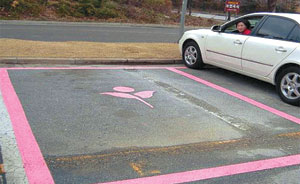
nation: Croatia

Cross-posted at Reports from the Economic Front.

There is big trouble brewing in Europe.  John Ross, in his blog Key Trends in the World Economy, highlights this brewing crisis in a series of charts, some of which I repost below.

This first chart shows the extent of the recovery from the recent economic crisis in the U.S., the EU, and Japan.  While the U.S. GDP has finally regained its past business cycle peak, the same cannot be said for Europe (or Japan).  As of the 3rd quarter 2011, EU GDP was still 1.7% below its previous business cycle peak.  The Eurozone was 1.9% below.

Recent GDP estimates for the 4th quarter show European GDP once again contracting, which strongly suggests that the region is headed back into recession without having regained its previous business cycle peak.  This development implies that Europe faces serious stagnationist pressures.

gdp1.jpg

This chart looks at the growth record for the 5 largest European economies.  Germany has regained its previous GDP peak.  France is making progress toward that end.  These two countries account for 36.2% of European GDP.  However, things are quite different for the UK, Italy, and Spain.  These three countries account for 34.7% of European GDP and not only do they each remain far below their respective previous GDP peaks, their economies are once again heading downward.

gdp2.jpg

The third chart highlights the economic performance of the three countries which have received the most media attention because of fears that their governments will be unable to repay their respective debts.  They are clearly in trouble, adding to the downward pressure on European GDP.  However, despite all the attention paid to them, their combined economies are only one-eighth the size of the combined economies of the UK, Italy and Spain.

gdp3.jpg

The next two charts highlight the fact that economic trends are also dire throughout much of Eastern Europe.

gdp4.jpg

gdp5.jpg

The take-away is that European economic problems are not limited to a few smaller countries.  Some of the largest are also performing poorly and apparently headed back into recession without ever having regained their past business cycle peaks.  It is hard to see Europe escaping recession.  And it is hard to see the U.S., Asia, and Africa escaping the consequences.
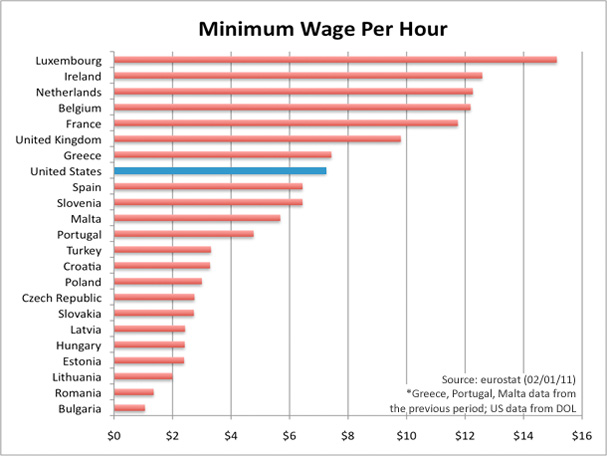
I am trying to re-enter society after several days being sick, so I’m going with something short and simple today. Eden H. sent in this chart, found at Business Insider, that compares hourly minimum wages in a number of European countries to the U.S.:

The European data are available from Eurostat (though note they report minimum wages in terms of Euros per month, not hour, so the data was converted for the chart).

Katrin drew our attention to the Christmas character of the Christkind, found in regions as diverse as Austria, Italy, Hungary, Slovakia, the Czech Rebublic, Croatia, Slovenia, Germany, Liechtenstein, Switzerland and, according to Wikipedia, “…parts of Hispanic America, in certain areas of southern Brazil and in the Acadiana region of Louisiana.”

The Christkind was introduced by the German Protestant priest Martin Luther (1483-1546).  At the time, tradition held that gifts were given by St. Nicholas.  Protestants, however, didn’t acknowledge saints, so they needed an alternative mythological gift giver.  The Christkind was originally depicted as baby Jesus, but in many places today is instead an angelic blond child or adult woman.

In Nuremberg, Germany, a Christkind is chosen every two years in a pageant reminiscent of American beauty pageants (source).  This year the Christkind is Rebekka Volland (source):

More photographs of the Christkind:

(source)

(source)

(source)

Lisa Wade, PhD is an Associate Professor at Tulane University. She is the author of American Hookup, a book about college sexual culture; a textbook about gender; and a forthcoming introductory text: Terrible Magnificent Sociology. You can follow her on Twitter and Instagram.

Chris S. sent in a link to a post at Korea Beat about a town in South Korea that now has parking spots designated for women only. My first thought was that maybe they were for pregnant women–when I lived in Utah I’d sometimes see parking spots that were reserved for expectant mothers. But no. These are just for women in general. Here’s a photo:

090402_09_1

Part of the English translation of the original article, from Korea Beat:

The “pink lines”, painted pink, are 2.5 meters wide rather than the standard 2.3, offering aid to women drivers unskilled at parking.

This in a city chosen by a South Korean official as “the first woman-friendly city.”

I wonder if there’s any evidence that female drivers in South Korea are involved in more accidents or have a harder time parking than men. What, exactly, led to this? I don’t know a ton about South Korean culture; for those of you who do, is there a good reason we’d expect women to be less skilled at driving/parking than men? Are women generally discouraged from driving or something? Insights will be greatly appreciated.

NEW! (July ’10): Majd Al-Shihabi sent us a photo of similar parking spaces in Croatia. They are next to the parking spaces for those with disabilities and are about 50% wider than standard spaces: