Tag Archives: gender: history

From Manly to Sexy: The History of the High Heel

Cross-posted at The Huffington Post.

Why do women wear high heels?  Because men did.

Men were the first sex to don the shoe. They were adopted by the European aristocracy of the 1600s as a signal of status.  The logic was: only someone who didn’t have to work could possibly go around in such impractical footwear.  (Interestingly, this was the same logic that encouraged footbinding in China.)

Women started wearing heels as a way of trying to appropriate masculine power.  In the BBC article on the topic, Elizabeth Semmelhack, who curates a shoe museum, explains:

In the 1630s you had women cutting their hair, adding epaulettes to their outfits…

They would smoke pipes, they would wear hats that were very masculine. And this is why women adopted the heel — it was in an effort to masculinise their outfits.

The lower classes also began to wear high heels, as fashions typically filter down from elite.

How did the elite respond to imitation from “lesser” people: women and workers?  First, the heels worn by the elite became increasingly high in order to maintain upper class distinction.  And, second, heels were differentiated into two types: fat and skinny. Fat heels were for men, skinny for women.

This is a beautiful illustration of Pierre Bourdieu’s theory of class distinction.  Bourdieu argued that aesthetic choices function as markers of class difference.  Accordingly, the elite will take action to present themselves differently than non-elites, choosing different clothing, food, decor, etc.  Expensive prices help keep certain things the province of elites, allowing them to signify their power; but imitation is inevitable.  Once something no longer effectively differentiates the rich from the rest, the rich will drop it.  This, I argue elsewhere, is why some people care about counterfeit purses (because it’s not about the quality, it’s about the distinction).

Eventually men quit wearing heels because their association with women tainted their power as a status symbol for men.  (This, by the way, is exactly what happened with cheerleading, originally exclusively for men).  With the Enlightenment, which emphasized rationality (i.e., practical footwear), everyone quit wearing high heels.

What brought heels back for women? Pornography.  Mid-nineteenth century pornographers began posing female nudes in high heels, and the rest is history.

Lisa Wade is a professor of sociology at Occidental College. You can follow her on Twitter and Facebook.

Sunday Fun: Modern Appliance Girls, 1936

In an earlier post, Caroline Heldman offered a typology of objectification. No. 6 was a conflation of a person with a commodity.  This photo of a display at the 1936 Los Angeles Electrical Exposition seems to qualify, but somehow that doesn’t make it any less charming!

Hat tip: Retronaut.

Lisa Wade is a professor of sociology at Occidental College. You can follow her on Twitter and Facebook.

Women and Exclusion from Long Distance Running

For the last week of December, we’re re-posting some of our favorite posts from 2012.

I’ve recently been reading a lot about the sociology of sport and I found myself inspired by feminist resistance to exclusion from long distance running.  The first Olympic marathon was held in 1896.  It was open to men only and was won by a Greek named Spyridon Louis. Women weren’t to be counted out entirely, however. A woman named Melpomene snuck onto the marathon route. She finished an hour and a half behind Louis, but beat plenty of men who ran slower or dropped out.

Women snuck onto marathon courses from that point forward.  Resistance to their participation was strong and, I believe, reflects men’s often unconscious fear that women might in fact be their equals.  Why else would they so vociferously object to women’s participation?  If women are, indeed, so weak and inferior, what’s to fear from their running alongside men?

Illustrating what seems to be a degree of panic above and beyond an imperative to follow the rules, the two photos  below show the response to Syracuse University Katherine Switzer’s running the man-only Boston marathon in 1967 (Switzer registered for the marathon using her initials).  After two miles, race officials realized one of their runners was a girl.  Their response?  To physically remove her from the race. Luckily, some of her male Syracuse teammates body blocked their grab:

Why not let her run? The race was man-only, so her stats, whatever they may be, were invalid. Why take her out of the race by force?  For the same reason that women were excluded to begin with: their actual potential is not obviously inferior to men’s.  The only sex that is threatened by co-ed sports is the sex whose superiority is assumed.

Women were included in competitive marathoning from 1972 forward. The first Olympic women’s marathon was run in 1984.  Not so very long ago.

Lisa Wade is a professor of sociology at Occidental College. You can follow her on Twitter and Facebook.

Class Privilege and Parental Leave

For the last week of December, we’re re-posting some of our favorite posts from 2012. Cross-posted at Pacific Standard and Global Policy TV.

The United States is unusual among developed countries in guaranteeing exactly zero weeks of paid time-off from work upon the birth or adoption of a child. Japan offers 14 weeks of paid job-protected leave, the U.K. offers 18, Denmark 28, Norway 52, and Sweden offers 68 (yes, that’s over a year of paid time-off to take care of a new child).

The U.S. does guarantee that new parents receive 12 weeks of non-paid leave, but only for parents who work in companies that employ 50 workers or more and who have worked there at least 12 months and accrued 1,250 hours or more in that time.  These rules translate to about 1/2 of women.  The other half are guaranteed nothing.

Companies, of course, can offer more lucrative benefits if they choose to, so some parents do get paid leave.  This makes the affordability of having children and the pleasure and ease with which one can do so a class privilege.  A new report by the U.S. Census Bureau documents this class inequality, using education as a measure.  If you look at the latest data on the far right (2006-2008), you’ll see that the chances of receiving paid leave is strongly correlated with level of education:

Looking across the entire graph, however, also reveals that this class inequality only emerged in the early 1970s and has been widening ever since.  This is another piece of data revealing the way that the gap between the rich and the poor has been widening.

Just to emphasize how perverse this is:

  • People with more education, who on average have higher incomes, are often able to take paid time off; but less-economically advantaged parents are more likely to have to take that time unpaid.  During the post-birth period, then, the economic gap widens.

There’s more:

  • Many less-advantaged parents can’t afford to take time off un-paid, so they keep working.  But even this widens the gap because their salary is lower than the salary the richer person continues to receive during their paid time off of work.  So the rich get paid more for staying home than the poor get for going to work.

We often use the minimizing word  “just” when  describing what stay-at-home parents do.  “What are you doing these days?” asks an old friend at a class reunion.  “Oh, just staying home and taking care of my kids,” a parent might say, as if raising kids is “doing nothing.”  We trivialize what parents do.  But, in fact, raising children is a valuable contribution to the nation.  We need a next generation to keep moving forward as a country.  Unfortunately the U.S. continues to treat having kids like a hobby (something its citizens choose to do for fun, and should pay for themselves).  Without state support for early parenting, being present in those precious early months is a class-based privilege, one that ultimately exacerbates the very class disadvantage that creates unequal access to the luxury of parenting in the first place.

Lisa Wade is a professor of sociology at Occidental College. You can follow her on Twitter and Facebook.

The Manly Origins of Cheerleading

For the last week of December, we’re re-posting some of our favorite posts from 2012.  Cross-posted at Jezebel, the Huffington Post, and Pacific Standard.

You might be surprised to learn that at its inception in the mid-1800s cheerleading was an all-male sport.  Characterized by gymnastics, stunts, and crowd leadership, cheerleading was considered equivalent in prestige to an American flagship of masculinity, football.  As the editors of Nation saw it in 1911:

…the reputation of having been a valiant “cheer-leader” is one of the most valuable things a boy can take away from college.  As a title to promotion in professional or public life, it ranks hardly second to that of having been a quarterback.*

Indeed, cheerleading helped launch the political careers of three U.S. Presidents.  Dwight D. Eisenhower, Franklin Roosevelt, and Ronald Reagan were cheerleaders. Actor Jimmy Stewart was head cheerleader at Princeton. Republican leader Tom DeLay was a noted cheerleader at the University of Mississippi.

Women were mostly excluded from cheerleading until the 1930s. An early opportunity to join squads appeared when large numbers of men were deployed to fight World War I, leaving open spots that women were happy to fill.


When the men returned from war there was an effort to push women back out of cheerleading (some schools even banned female cheerleaders).  The battle over whether women should be cheerleaders would go on for several decades.  Argued one opponent in 1938:

[Women cheerleaders] frequently became too masculine for their own good… we find the development of loud, raucous voices… and the consequent development of slang and profanity by their necessary association with [male] squad members…**

Cheerleading was too masculine for women!  Ultimately the effort to preserve cheer as an man-only activity was unsuccessful.  With a second mass deployment of men during World War II, women cheerleaders were here to stay.

The presence of women changed how people thought about cheering.  Because women were stereotyped as cute instead of “valiant,” the reputation of cheerleaders changed.  Instead of a pursuit that “ranks hardly second” to quarterbacking, cheerleading’s association with women led to its trivialization.  By the 1950s, the ideal cheerleader was no longer a strong athlete with leadership skills, it was someone with “manners, cheerfulness, and good disposition.”  In response, boys pretty much bowed out of cheerleading altogether. By the 1960s, men and megaphones had been mostly replaced by perky co-eds and pom-poms:

Cheerleading in the sixties consisted of cutesy chants, big smiles and revealing uniforms.  There were no gymnastic tumbling runs.  No complicated stunting.  Never any injuries.  About the most athletic thing sixties cheerleaders did was a cartwheel followed by the splits.***

Cheerleading was transformed.

Of course, it’s not this way anymore.  Cultural changes in gender norms continued to affect cheerleading. Now cheerleaders, still mostly women, pride themselves in being both athletic and spirited, a blending of masculine and feminine traits that is now considered ideal for women.

See also race and the changing shape of cheerleading and the amazing disappearing cheerleading outfit.

Citations after the jump:

(more…)

Lisa Wade is a professor of sociology at Occidental College. You can follow her on Twitter and Facebook.

Vintage Anti-Suffrage Postcards

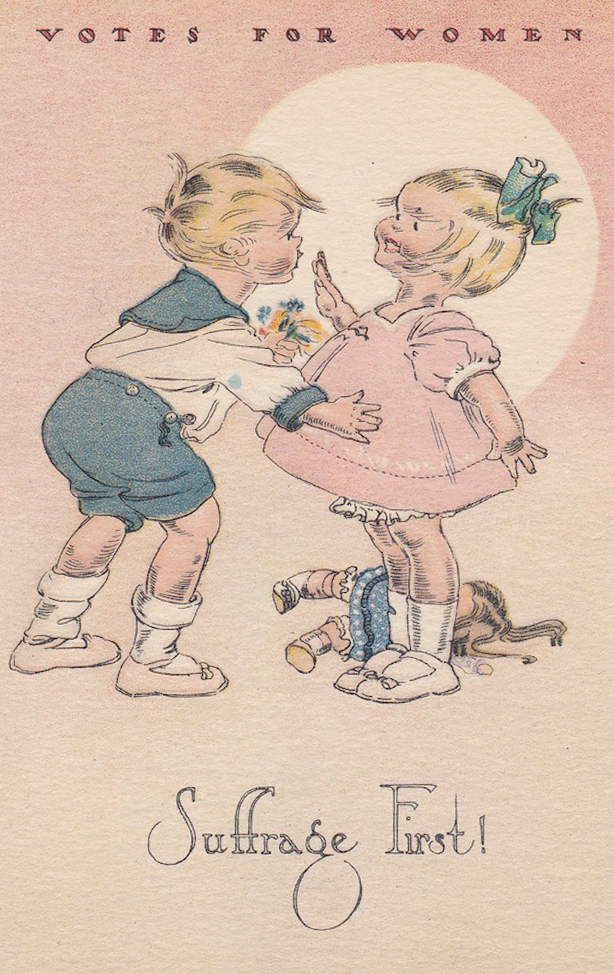
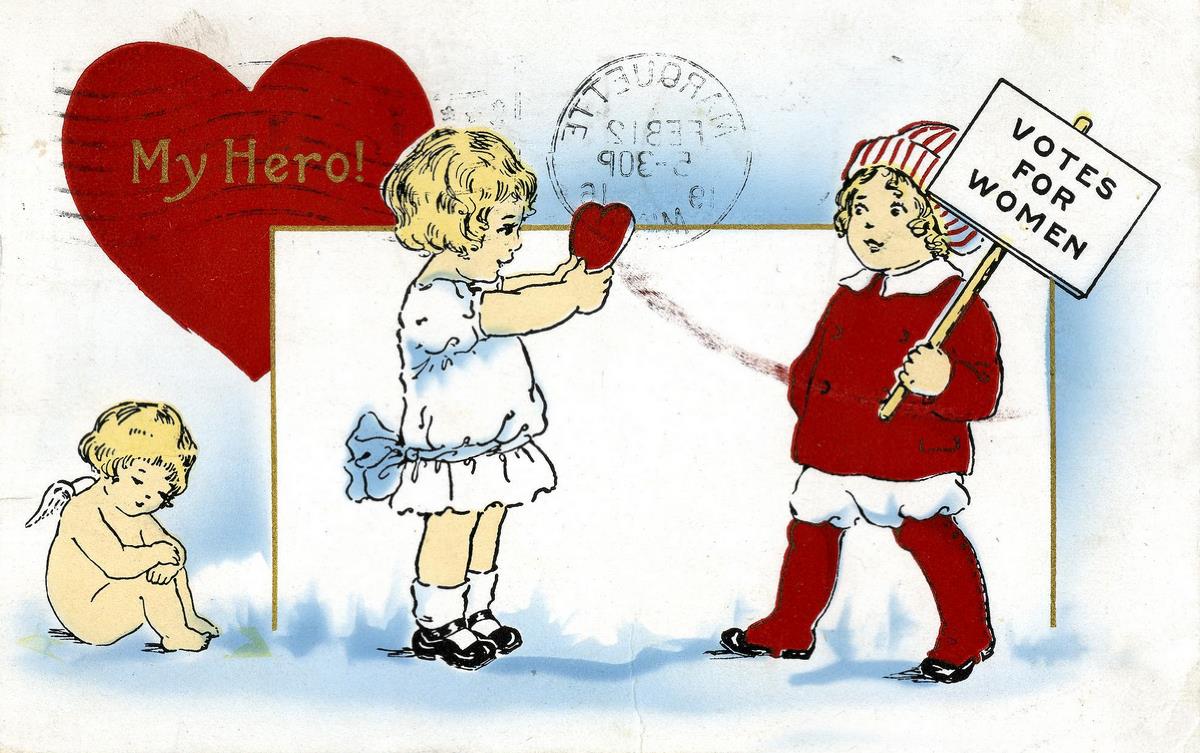
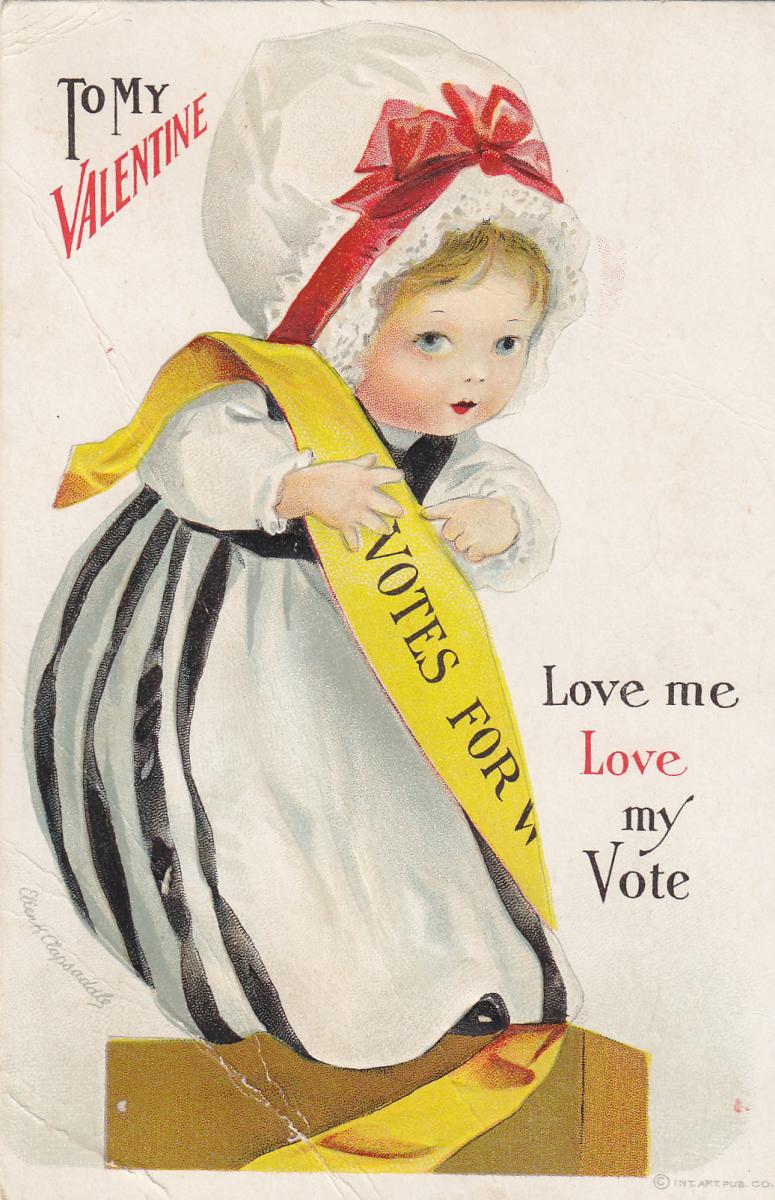
A while back, David Dismore posted about his archive of suffragist postcards, which appeared in the early 1900s as part of the campaign for women’s right to vote. The postcards got the messages of the movement across in short, clear, and often humorous ways.

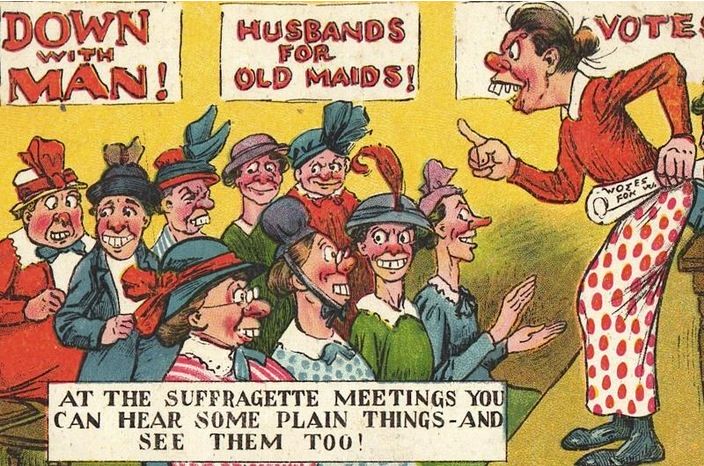
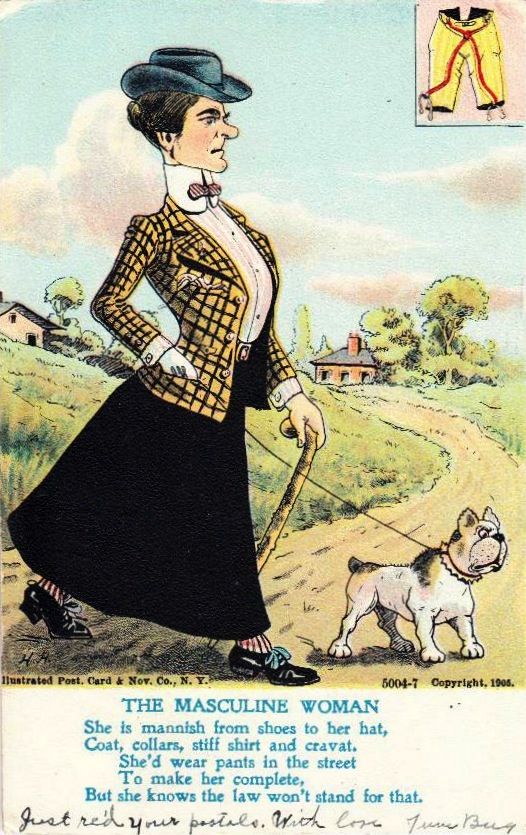
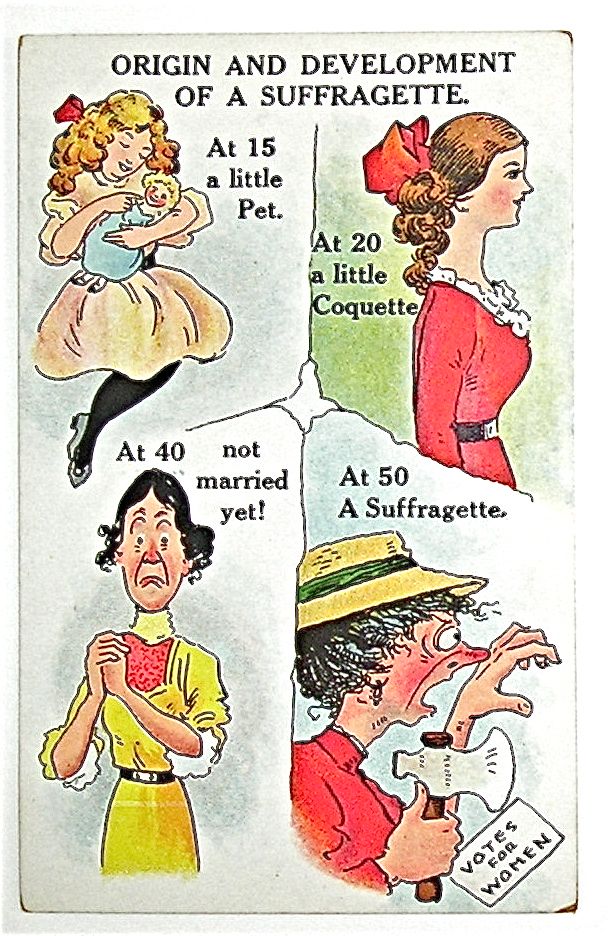
Those opposed to women’s suffrage also used postcards to get their message out to the public. The Palczewski Postcard Archive at the University of Northern Iowa, sent to us by Katrin, has a number of great examples that illustrate the frames used to present women’s full political participation as threatening.

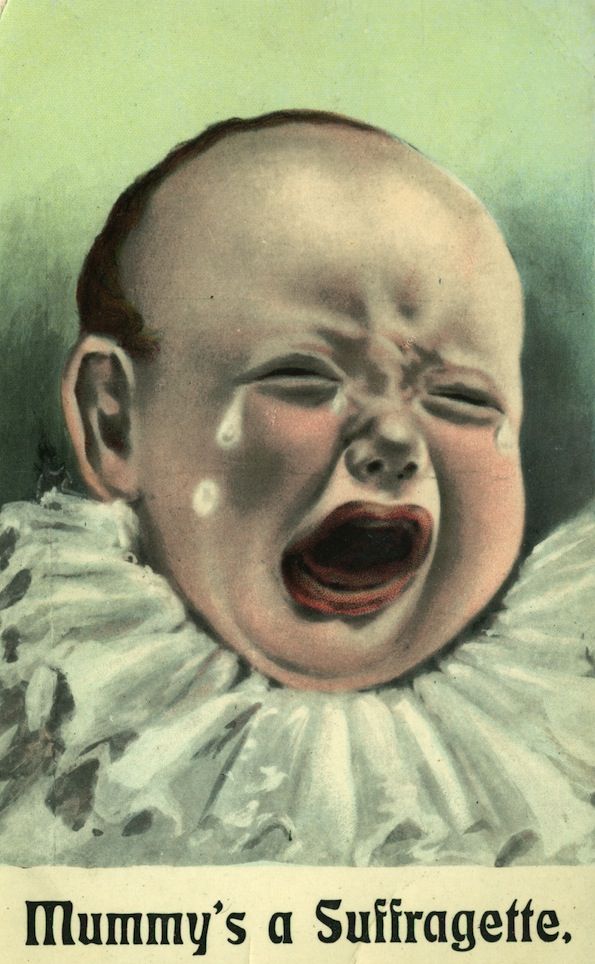
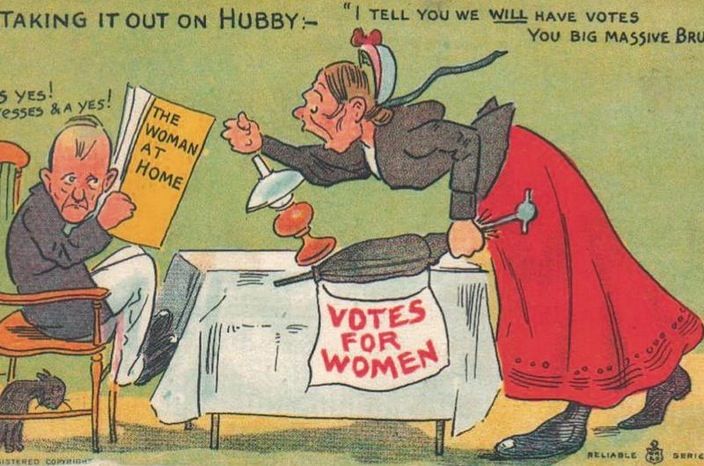
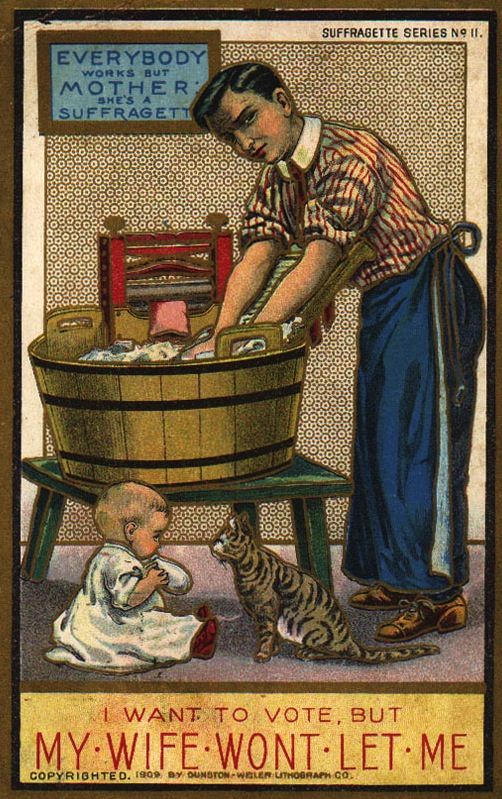
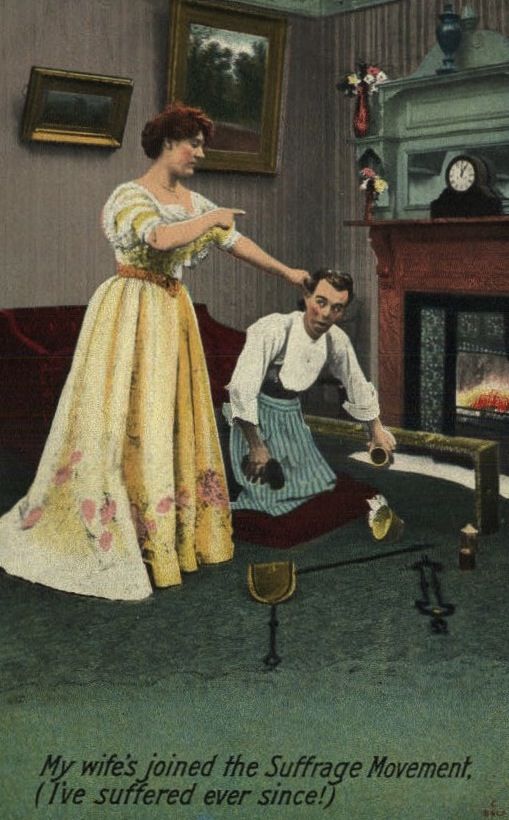
For instance, a 12-card series produced by Dunston-Weiler Lithographic Company presented suffrage as upending the gender order by masculinizing women and feminizing men. Suffragists, the postcards tell us, cause women to abandon their household duties and become aggressive and unladylike:

In an effort to win her own rights, then, women make their families suffer — a message complete with visuals that don’t seem out of place among stock images of crying babies and their working mothers today, as Katrin pointed out:

Equality in voting rights is clearly presented as female domination:

Postcards issued by other groups reflect these same themes. The clear message is that giving women the right to vote threatens men, the family, and the entire natural order of things:

The archive has a bunch more examples, categorized by various themes — including Cats and Suffrage, because lolcats are timeless.

Gwen Sharp is an associate professor of sociology at Nevada State College. You can follow her on Twitter at @gwensharpnv.

Is Marriage a “Universal Human Value”?

Cross-posted at PolicyMic.

In this clip from a campaign rally, Vice Presidential nominee Paul Ryan argues that “traditional marriage” is a “universal human value.”

Ryan could not be more wrong. In fact, few practices have undergone more fundamental transformation.

For thousands of years, marriage served economic and political functions unrelated to love, happiness, or personal fulfillment.  Prior to the Victorian era, love was considered a trivial basis for marriage and a bad reason to marry.  There were much bigger concerns afoot: gaining money and resources, building alliances between families, organizing the division of labor, and producing legitimate male heirs.

These marriages were patriarchal in the strictest sense of the term.  Men were heads of households and women were human property, equivalent to children, slaves, servants, and employees.  Women didn’t choose to enter a marriage that defined her as property, she was entered into the marriage by her father, who owned her until he “gave her away.”

Ultimately, in response to feminist activism as well as other forces, marriage would change.  By the 1950s, a new kind of marriage would become ideal.  This is the one that Ryan likely means when he uses the terms “traditional” and “universal.”  In this model, men and women married by choice and were expected to find sustenance in their relationship.  Women were not legally subordinate to their husbands (that is, she was no longer property).  But the rights and responsibilities of husbands and wives continued to be defined differently.  Women owed men domestic services (cleaning, cooking, childcare, and sex); in return, men were legally required to support their wives financially.

This type of marriage signed its own death warrant, a story I’ll tell in another post, and was relatively short-lived (and not at all universal, even at its peak in the U.S.).  It was soon replaced by an ideal of marriage based on gender-neutral roles that spouses could work out for themselves. Today married couples are free to organize their lives however they wish.  And they do.  Stephanie Coontz, famed historian of marriage, writes:

Almost any separate way of organizing caregiving, childrearing, residential arrangements, sexual interactions, or interpersonal redistribution of resources has been tried by some society at some point in time.  But the coexistence in one society of so many alternative ways of doing all of these different things—and the comparative legitimacy accorded to many of them—has never been seen before.

Ryan is right, then, in that “traditional marriage,” however you define it, is not normal in the U.S.  He’s completely wrong, though, it calling it universal.  Even a quick review of American history reveals it not to be so.

Sources:

  • Coontz, Stephanie. 1992. The Way We Never Were: American Families and the Nostalgia Trap.  New York: Basic Books.
  • Coontz, Stephanie.  2004. The World Historical Transformation of Marriage. Journal of Marriage and Family66, 4: 974-979.

See also The Daily Show on nostalgia, the “traditional” age of marriage, and mocking “traditional marriage.”

Lisa Wade is a professor of sociology at Occidental College. You can follow her on Twitter and Facebook.

Women, Education, and Trends in Childlessness

In doing research for a book I may write about voluntary childnessness, I came across a telling graphic from the Pew Research Center.  First, note that the percent of women age 40-44 without a biological child has almost doubled since the late ’70s.  Today about one-in-five such women (18%) have never given birth:

The percent of women is even higher among women with professional degrees (a master’s or equivalent and higher).  One-in-four women with a master’s degree, and nearly that many women with PhDs, have no biological children by ages 40-44.

Here’s where the really telling graph comes in.  Though women with higher levels of education are less likely to have biological children than other types of women, the trend  of increasing childlessness shown above doesn’t apply to them.  In fact, women with master’s and PhDs in the most recent data are more likely to have children than their counterparts 14 years ago.  In the first half of the 1990s, nearly one-in-three women with professional degrees did not have biological children; today it’s one-in-four. Childbearing among the most educated women, then, bucks the trend. It has gone up.

The data probably reflect greater endorsement of the idea that a woman can, or should be able to, balance both a career and a family, as well as the rise of policies that make that possible.  University of Florida sociologist Tanya Koropeckyj-Cox, who’s studied this stuff, says as much.  It may be hard to imagine now, but there was a time when having children would destroy a woman’s always-already fragile career; as much as we may love or hate the “mommy track,” at least today there is one.  Koropeckyj-Cox also suggests that women with higher incomes may have greater access to infertility treatments, making overcoming health problems or delayed childbearing more possible for them than it is among women with less education.

In any case, the data suggests an interesting story about gender, childbearing, educational achievement, and historical change.  I’d be happy to hear more interpretation in the comments.

Lisa Wade is a professor of sociology at Occidental College. You can follow her on Twitter and Facebook.