Tag Archives: gender: feminism/activism

Mardi Gras Krewes, Tourism, and Segregation

This post originally appeared in 2011.  Revised and re-posted in honor of Mardi Gras.

If you attend a Mardi Gras parade this year, you’ll likely notice that the float riders will be all-White or all-Black and all-female or all-male.  In fact, the majority of krewes — clubs that sponsor parades and other festivities — are race- and gender-segregated.  This is not de facto, but according to official krewe policy. And it remains legal to discrimate along these lines.  How did this happen?

According to Kevin Fox Gotham‘s book, Authentic New Orleans, Mardi Gras was transformed from an unorganized local festival to a rationalized tourist attraction by white elites. The first organized parade occurred in 1857 and was organized by the Mystick Krewe of Comus, several dozen social elites. This krewe, like many that followed, was race, gender, and class specific. Only white males who could afford membership in the krewe (essentially a social club) could participate.

Krewe of Comus (1867):

ComusLeslies1867Epecurian

White only parades were part of a strategy to make New Orleans a tourist destination for white travelers. Unlike today, when New Orleans capitalizes on its multicultural heritage, for a very long time New Orleans tried to suppress popular knowledge of its non-white population, disinvested in that population, and drove them out of touristy areas.

It was not until 1991 that the City Council proposed banning racial segregation of the krewes and the Council voted unanimously to make bias illegal. Krewes that refused to integrate (in principle, if not in reality) would be denied “city services and parade permits, and would require jail time and fines” (p. 182). Mayor Sidney Barthelemy said:

We close off streets. We deny the taxpayer the right to drive down the street to give a segregated club the opportunity to parade. Now that’s unbelievable in 1991.

The decision brought simmering racial tension to a boil. Two krewes, the Krewe of Comus and the Knights of Momus, cancelled their parades in 1992 rather than comply with the new law. Another, the Krewe of Proteus, canceled the following year. An African American krewe, the Krewe of Zulu, mocked the decisions of the all-white krewes in 1992.

Krewe of Zulu:

zulu1

Ultimately the anti-bias law came under fire from all-female krewes. Wanting to preserve their exclusive membership, Iris and Venus “opposed any discrimination ordinance because they recognized that it would undermine their power to exclude men” (p. 185).

Krewe of Iris:

In the end:

…the City Council voted to remove the jail sentence provisions in the ordinance and shifted the burden of proof onto individuals who maintained that they had been discriminated against if they attempted to join a krewe (p. 185).

But even this did not hold. Courts decided that the anti-bias laws violated laws of free association and, when the case came before the Supreme Court, they declined to revisit it. So, race and gender segregation of krewes remains legal.

Today, krewes segregated by race and gender still persist (and people without means are excluded from krewes generally, as they are very expensive), though newly formed krewes are often integrated on both axes, including Harry Connick Jr.’s Krewe of Orpheus:

mardi-gras_45240939

For previous posts on Mardi Gras, see here, here, and here.

Lisa Wade is a professor of sociology at Occidental College. You can follow her on Twitter and Facebook.

From Manly to Sexy: The History of the High Heel

Cross-posted at The Huffington Post.

Why do women wear high heels?  Because men did.

Men were the first sex to don the shoe. They were adopted by the European aristocracy of the 1600s as a signal of status.  The logic was: only someone who didn’t have to work could possibly go around in such impractical footwear.  (Interestingly, this was the same logic that encouraged footbinding in China.)

Women started wearing heels as a way of trying to appropriate masculine power.  In the BBC article on the topic, Elizabeth Semmelhack, who curates a shoe museum, explains:

In the 1630s you had women cutting their hair, adding epaulettes to their outfits…

They would smoke pipes, they would wear hats that were very masculine. And this is why women adopted the heel — it was in an effort to masculinise their outfits.

The lower classes also began to wear high heels, as fashions typically filter down from elite.

How did the elite respond to imitation from “lesser” people: women and workers?  First, the heels worn by the elite became increasingly high in order to maintain upper class distinction.  And, second, heels were differentiated into two types: fat and skinny. Fat heels were for men, skinny for women.

This is a beautiful illustration of Pierre Bourdieu’s theory of class distinction.  Bourdieu argued that aesthetic choices function as markers of class difference.  Accordingly, the elite will take action to present themselves differently than non-elites, choosing different clothing, food, decor, etc.  Expensive prices help keep certain things the province of elites, allowing them to signify their power; but imitation is inevitable.  Once something no longer effectively differentiates the rich from the rest, the rich will drop it.  This, I argue elsewhere, is why some people care about counterfeit purses (because it’s not about the quality, it’s about the distinction).

Eventually men quit wearing heels because their association with women tainted their power as a status symbol for men.  (This, by the way, is exactly what happened with cheerleading, originally exclusively for men).  With the Enlightenment, which emphasized rationality (i.e., practical footwear), everyone quit wearing high heels.

What brought heels back for women? Pornography.  Mid-nineteenth century pornographers began posing female nudes in high heels, and the rest is history.

Lisa Wade is a professor of sociology at Occidental College. You can follow her on Twitter and Facebook.

Fox News Says Feminists Want to Have Sex with Underage Men

Cross-posted at PolicyMic.At the end of my sociology of gender class, I suggest that the fact that feminists are associated with negative stereotypes — ugly, bitter, man-haters, for example — is not a reflection of who feminists really are, but a sign that the anti-feminists have power over how we think about the movement.  The very idea of a feminist, in other words, is politicized… and the opposition might be winning.

A clip forwarded by Dmitriy T.C. is a great example.  In the 1.38 minute Fox News clip below, two pundits discuss a North Carolina teacher, Leah Gayle, who was accused of having sex with her 15-year-old student.  One of the show’s hosts suggests that feminism is to blame for Gayle’s actions. She says:

There’s something about feminism that lets them know, I can do everything a man does. I can even go after that young boy. I deserve it… It’s turning women into sexualized freaks.

This clip reveals a discursive act.  She is defining who feminists are and what they believe.  And this idea is being broadcast across the airwaves.

This happens all day every day.  Some of the messages are friendly to feminists, and some are not.  These messages compete in our collective imagination.  Most have little to do with what feminists (who are a diverse group anyway) actually believe and many are outrageous lies and distortions, like this one.

So, next time you hear someone describing a feminist, know that what you’re hearing is almost never a strict definition of the movement. Instead, it’s a battle cry, with one side competing with the other to shape what we think of people who care about women’s equality with men.

Lisa Wade is a professor of sociology at Occidental College. You can follow her on Twitter and Facebook.

IKEA Erases Women for Saudi Arabian Audience

For the last week of December, we’re re-posting some of our favorite posts from 2012. Originally cross-posted at Ms.

Mojca P., Jason H., Larry H., and Cindy S. sent us a link to a story about a Saudi Arabian version of an IKEA catalog in which all of the women were erased.  Here is a single page of the American and Saudi Arabian magazines side-by-side:

After the outcry in response to this revelation began, IKEA responded by called the removal of women a “mistake” “in conflict with the IKEA Group values.”   IKEA seems to have agreed with its critics: erasing women capitulates to a sexist society and that is wrong.

But, there is a competing progressive value at play: cultural sensitivity.  Isn’t removing the women from the catalog the respectful and non-ethnocentric thing to do?

Susan Moller Okin wrote a paper that famously asked, “Is Multiculturalism Bad for Women?”  The question led to two decades of debate and an interrogating of the relationship between culture and power.  Who gets to decide what’s cultural?  Whose interests does cultural sensitivity serve?

The IKEA catalog suggests that (privileged) men get to decide what Saudi Arabian culture looks like (though many women likely endorse the cultural mandate to keep women out of view as well).  So, respecting culture entails endorsing sexism because men are in charge of the culture?

Well, it depends.  It certainly can go that way, and often does.  But there’s a feminist (and anti-colonialist) way to do this too.  Respecting culture entails endorsing sexism only if we demonize certain cultures as irredeemably sexist and unable to change.  In fact, most cultures have sexist traditions.  Since all of those cultures are internally-contested and changing, no culture is hopelessly sexist.  Ultimately, one can bridge their inclinations to be both culturally sensitive and feminist by seeking out the feminist strains in every culture and hoping to see those manifested as it evolves.

None of this is going to solve IKEA’s problem today, but it does illustrate one of difficult-to-solve paradoxes in contemporary progressive politics.

—————————

Lisa Wade has published extensively on the relationship between feminism and multiculturalism, using female genital cutting as a case.  You can follow her on Twitter and Facebook (where she keeps discussion of “mutilation” to a minimum).

The Gender Politics of the Dollhouse

Cross-posted at Jezebel.

This holiday season, a dollhouse may be a feminist gift for a little girl.

A tweet from Natalie Novik inspired me to look into the toy.  She had discovered a gender-neutral dollhouse being sold at Etsy.  Following up on her lead, I went over the Toys R Us website to see what gender messages dollhouses were sending.  Some of the results surprised me.

Among the 22 best selling dollhouses at Toys R Us, four came without people, six came with a preponderance of females, ten came with a male, female, and children, and there were two I couldn’t categorize.  (All humans were white — some dollhouses included non-human creatures — and just about everyone appears to be wealthy.)

The majority of dollhouses, then, came in two types.  The first was an explicitly family-themed toy.  The message of these was heteronormative, for sure, and also pro-coupling and pro-reproduction.   The Fisher-Price Loving Family Home for the Holidays Dollhouse is an example:

The second type of house, however, had themes of friendship and, dare I say, female-independence.  These houses had only women or, more often, a group of women and one man.  They gave the impression of female home-ownership and female-dominated social interaction.  The Exclusive Barbie Malibu Dreamhouse is an example:

Interestingly, most of the dollhouses that fell into this second type were Barbie affiliated.  People disagree as to whether Barbie is a good role model for young women.  She is roundly criticized for upholding a harmful standard of beauty, but she also tells women they can run for President and go to the moon.  In this case, Barbie is sending girls the message that they can have fulfilling lives and own homes without a husband.

As if to capture the paradox completely, the dollhouse featured above comes complete with a Barbie in a bikini doing astronomy:

Children, of course, play with toys both creatively and in resistance to the messages they send.  We’d be happy to hear your stories and observations in the comments.

Lisa Wade is a professor of sociology at Occidental College. You can follow her on Twitter and Facebook.

Vintage Anti-Suffrage Postcards

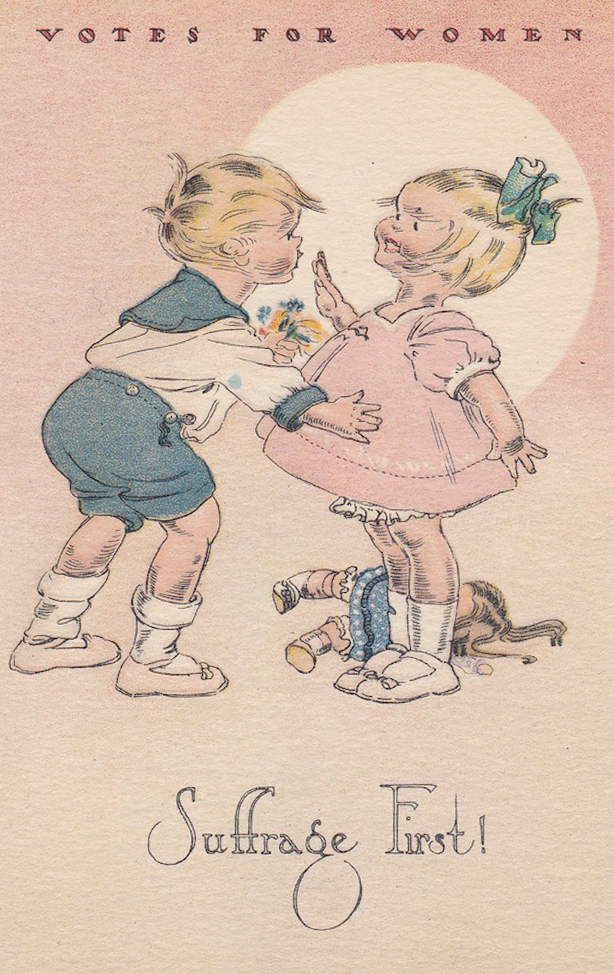
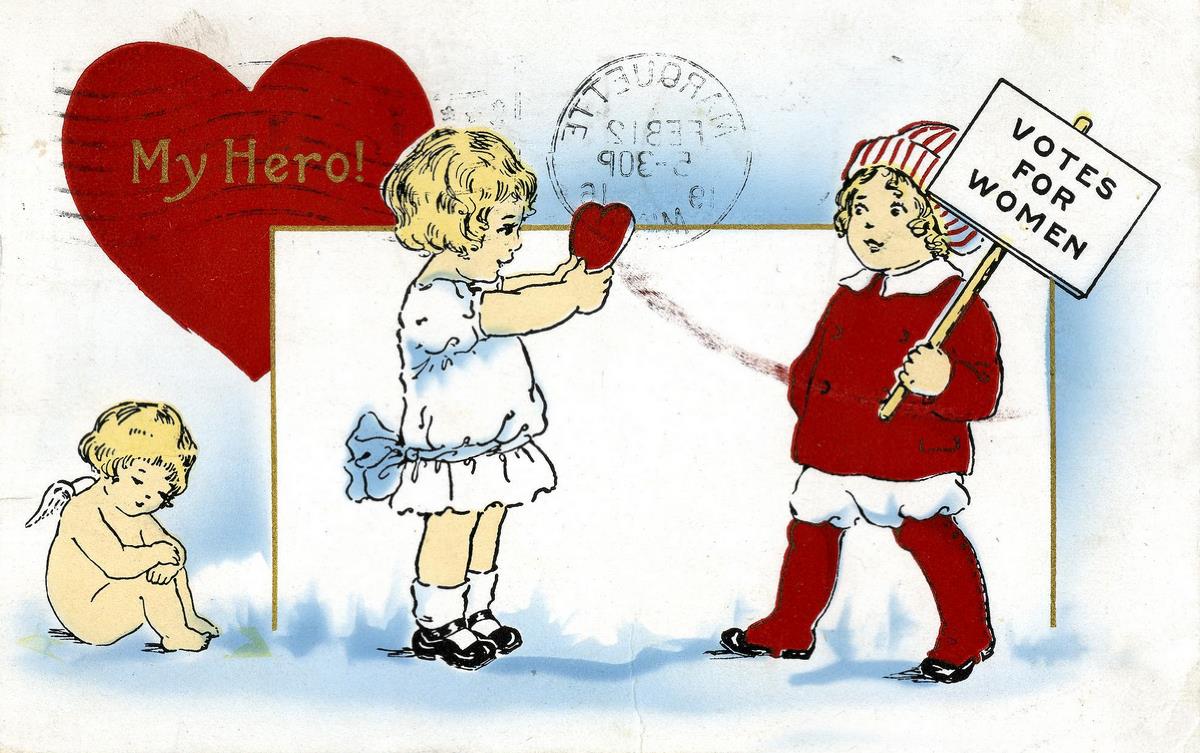
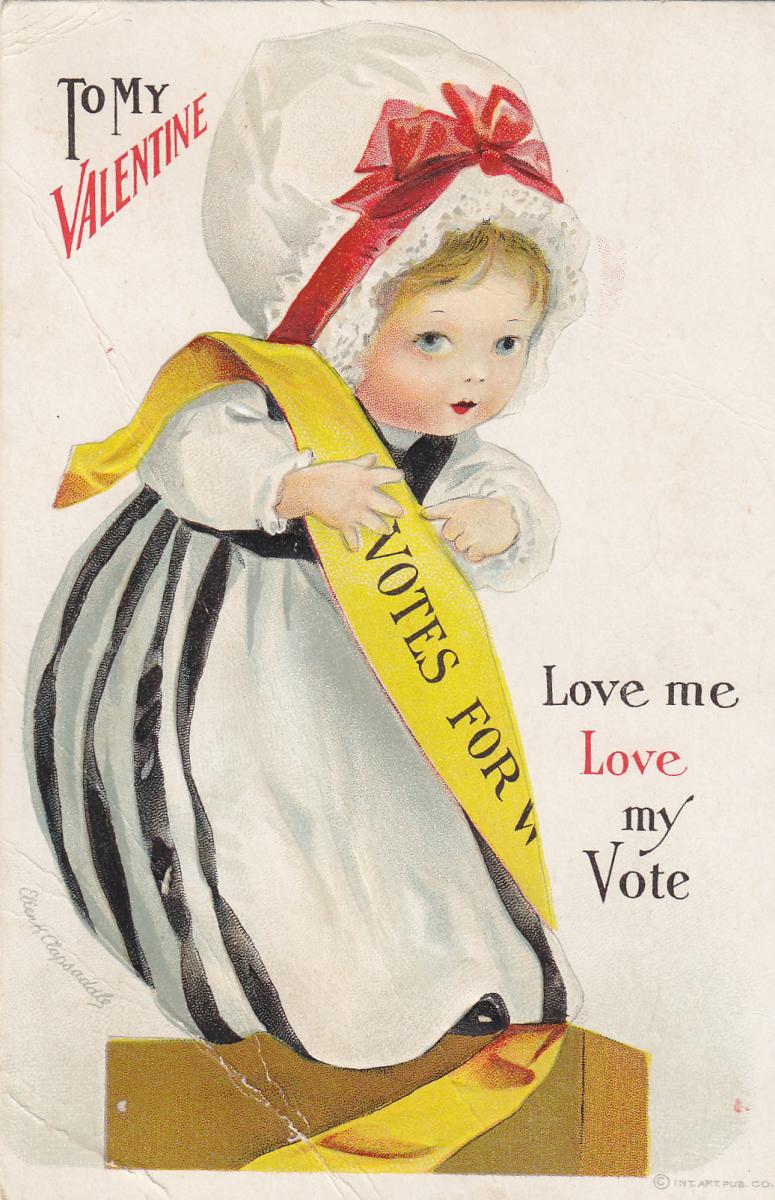
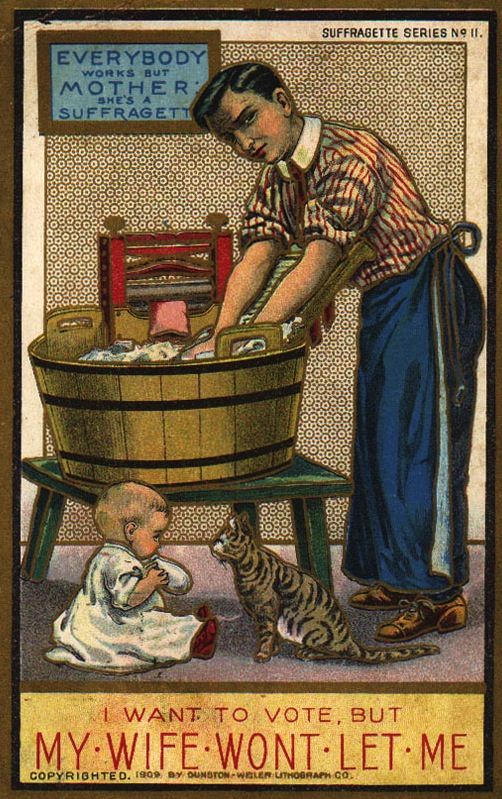
A while back, David Dismore posted about his archive of suffragist postcards, which appeared in the early 1900s as part of the campaign for women’s right to vote. The postcards got the messages of the movement across in short, clear, and often humorous ways.

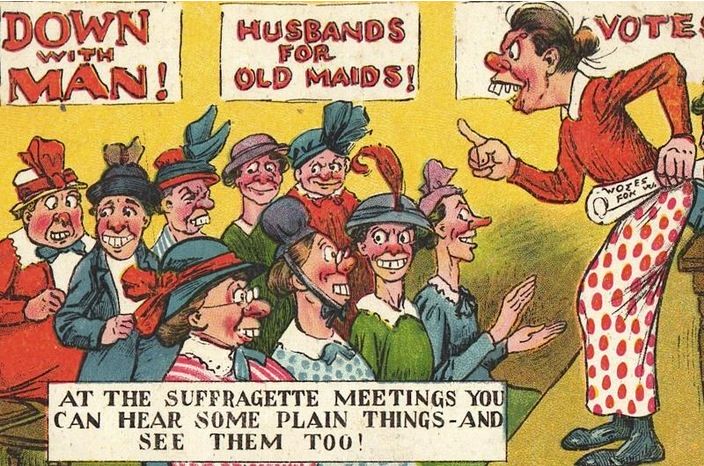
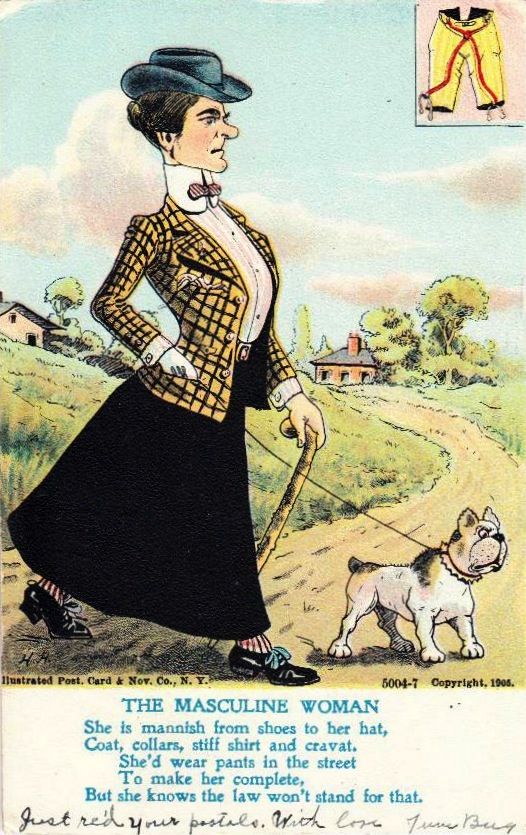
Those opposed to women’s suffrage also used postcards to get their message out to the public. The Palczewski Postcard Archive at the University of Northern Iowa, sent to us by Katrin, has a number of great examples that illustrate the frames used to present women’s full political participation as threatening.

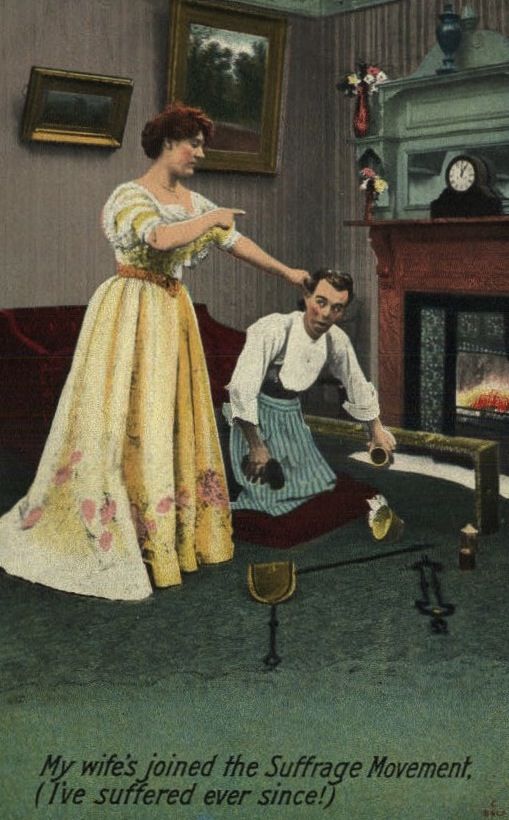
For instance, a 12-card series produced by Dunston-Weiler Lithographic Company presented suffrage as upending the gender order by masculinizing women and feminizing men. Suffragists, the postcards tell us, cause women to abandon their household duties and become aggressive and unladylike:

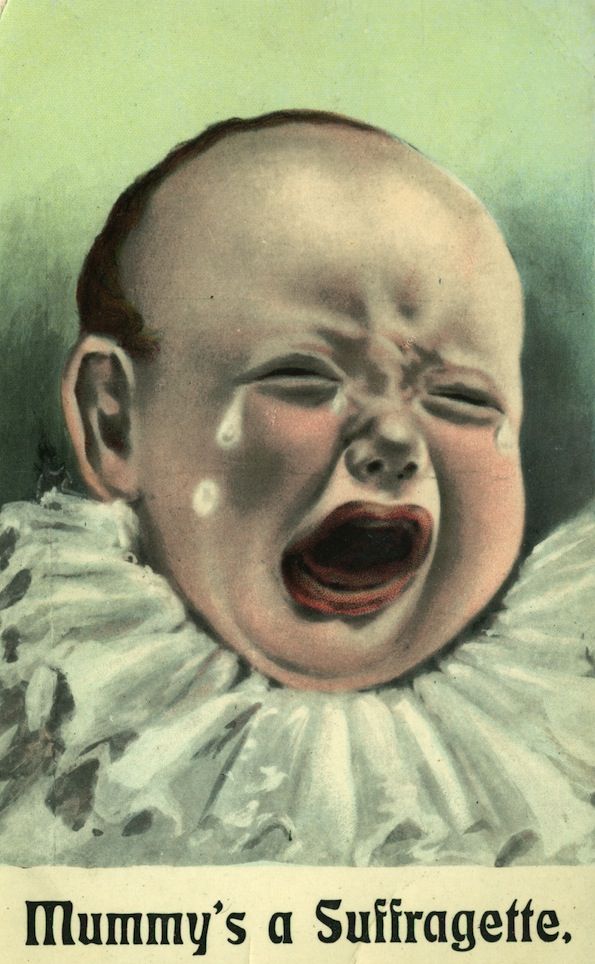
In an effort to win her own rights, then, women make their families suffer — a message complete with visuals that don’t seem out of place among stock images of crying babies and their working mothers today, as Katrin pointed out:

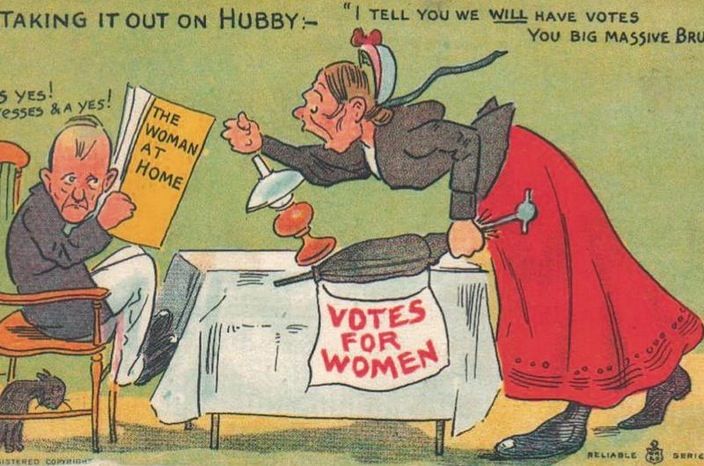
Equality in voting rights is clearly presented as female domination:

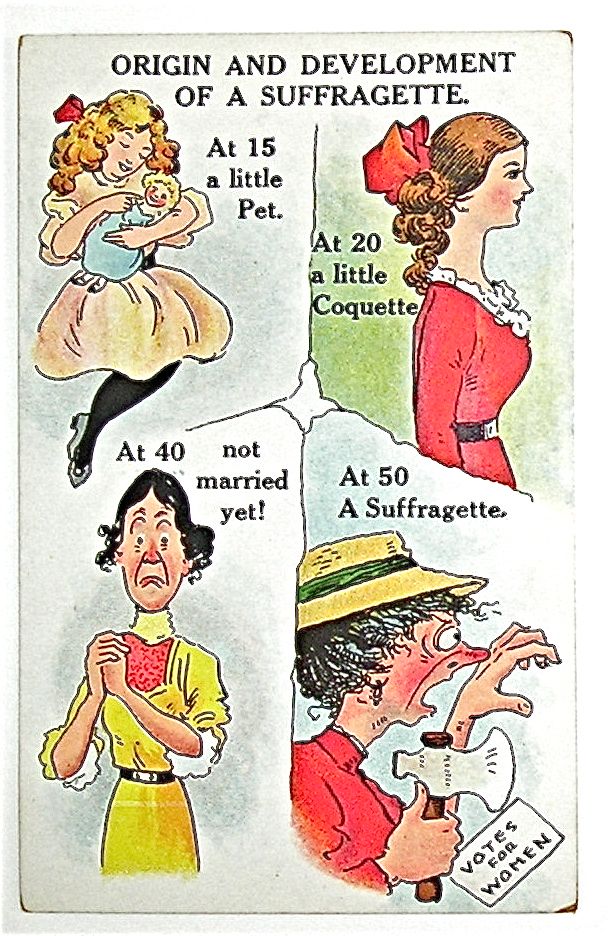
Postcards issued by other groups reflect these same themes. The clear message is that giving women the right to vote threatens men, the family, and the entire natural order of things:

The archive has a bunch more examples, categorized by various themes — including Cats and Suffrage, because lolcats are timeless.

Gwen Sharp is an associate professor of sociology at Nevada State College. You can follow her on Twitter at @gwensharpnv.

Feminism FAQs: Jarrah Hodge Tells It Like It Is

Jarrah Hodge, the woman behind the Canadian feminist blog Gender Focus, has started a new video series called Feminism F.A.Q.s.  They’re short videos aimed at addressing myths about gender inequality and the people who care about it.  She’s already got 10 videos up, but here are a couple of my favs.

What Have Women Been Told They Can’t Do?

Ride bicycles (’cause of “bicycle face”), get a credit card, run marathons, and much more.

Did Feminists Burn Bras?

Answer: Nope!

Lisa Wade is a professor of sociology at Occidental College. You can follow her on Twitter and Facebook.

Waxing for Girls 15 and Younger

Thanks to YetAnotherGirl and Kari B., we can now feast our eyes on this ad from Unik (“unique”) Wax Center.  It’s a promotion offering 50% off hair waxing for girls “15 and younger.”  The Consumerist reports that all procedures are fair game, including bikini waxes.

The usual concerns regarding the sexualization of young girls apply here.  Why do girls this young need to be concerned about how they look in bikinis?

Perhaps more interesting is the frame for why such a girl might want to undergo waxing. According to the 4th of July-themed ad, it’s to “celebrate freedom and independence.”  Implicitly, hers. So, to follow the logic to its endpoint, a girl of 15 or younger can’t feel free unless she’s hairless.

The company, responding to criticism, gave arguments along these lines.  They framed waxing as a “regular activity” and a “process in life” that “goes along with our country.”  Moms are coming in to get waxed (as all women do), explained the corporate offices, they’re dragging their tweens along with them (obviously), and the girls “have questions” and “get bored,” so the next step is to initiate them into the ritual.

So, the whole process is “natural,” as the ad copy specifies.  It is just an inevitable step in a supposedly universal way of (female) life.  And one that liberates women from… um, I don’t know what… embarrassment, I guess.

The ad is reminiscent of many similar campaigns aimed at adult women, ones that frame consumption of clothes, make-up, jewelry, and cosmetic procedures as expression of freedoms.  In this way, it’s a capitalist appropriation of feminism/liberation ideology.  It’s also a naturalization of what is, in reality, a lifetime of compulsory, expensive, and sometimes harmful beauty practices.

—————————

Lisa Wade is a professor of sociology at Occidental College. You can follow her on Twitter and Facebook.