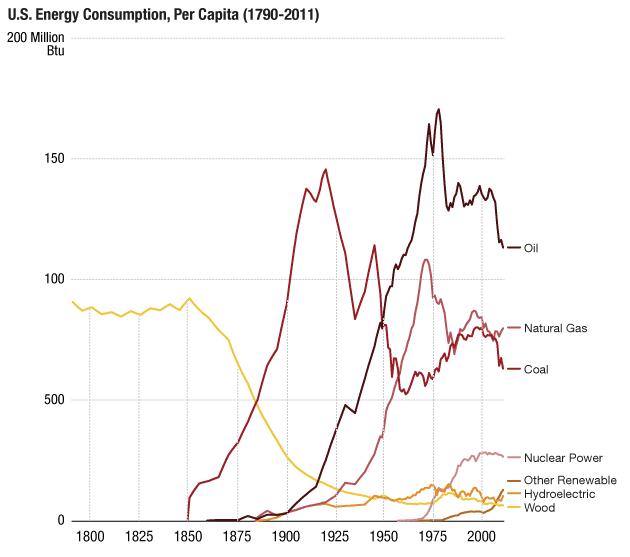
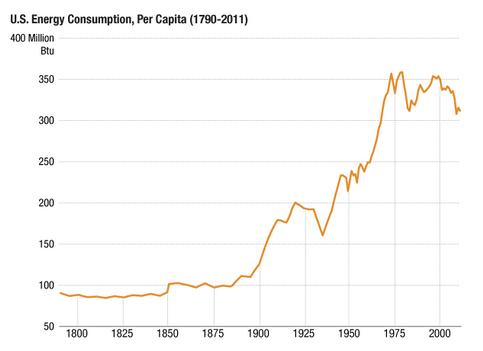
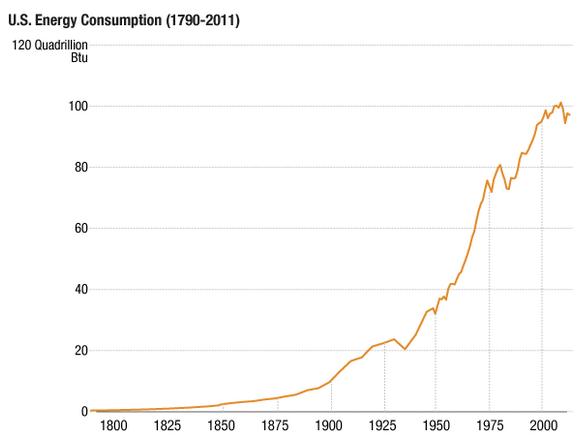
Planet Money’s Jacob Goldstein and Lam Thuy Vo offered some interesting data last week about the history of energy consumption in the U.S. First they offered data on the rise and fall of alternative energy sources.
Coal, the first to replace wood, became a common energy source largely thanks to the railroads. Wood was more or less everywhere, but coal had to be transported.
The invention and spread of the internal combustion engine drove the demand for oil. According to this site (PM doesn’t say), natural gas becomes common in the ’50s thanks to the improvement of techniques for making metals and welding. This facilitates the building of oil pipelines, hence the rise of oil.
The overall rise in energy consumption per capita is worrisome, but it has fallen off since the mid-70s. Thanks to high prices that encourage lower use and greater efficiency of appliances, our appetite for energy seems to have leveled off.
Not to end on an optimistic note, though. That data is per capita. Because our population has been rising, our overall energy use has continued to go up.
At the GOP convention in August, Mitt Romney’s cavalier dismissal of global warming got the intended laughs. Today, it seems less funny and the Democrats are capitalizing on the turn of events:
Here’s the transcript:
President Obama promised to begin to slow the rise of the
oceans and to heal the planet. My promise is to help you and your family.
In two short sentences, Romney gives us the broader context for the denial of global warming: the denial of society itself. He echoes Margaret Thatcher’s famous dictum
There is no such thing as society. There are individual men and women, and there are families.
This doesn’t mean that there are no groups beyond the family. But those larger groups are valid only because individuals, consciously and voluntarily, chose to create them. This way of thinking about the relation between individuals and groups has long been an underlying principle of American thought. Claude Fischer, in Made in America calls it “voluntarism” – the idea that the only legitimate groups are the ones that people voluntarily form or join.* The individual has a strong obligation to those groups and their members, but he has little or no obligation towards groups and people he did not choose.
That is a moral position. It tells us what is morally O.K., and what is not. If I did not choose to join a group, I make no claims on others, and it is wrong for others – whether as individuals or as an organized group, even a government – to make any claim upon me.
That moral position also shapes the conservative view of reality, particularly about our connectedness to other people and to the environment. Ideas about what is right determine ideas about what is true. The conservative rejects non-voluntary connections as illegitimate, but he also denies that they exist. If what I do affects someone else, that person has some claim upon me; but unless I voluntarily enter into that relationship, that claim is morally wrong. So in order to remain free of that claim, I must believe that what I do does not affect others, at least not in any harmful way.
It’s easy to maintain that belief when the thing being affected is not an individual or family but a large and vague entity like “society” or “the environment.” If I willingly join with many other people, then I will see how our small individual acts – one vote, one small donation, one act of charity, etc. – add up to a large effect. That effect is what we intended. But if we separately, individually, drive a lot in our SUVs, use mega-amounts of electricity, and so on, we deny that these acts can add up to any unintended effect on the planet.
As Fischer says, voluntarism is characteristically American. So is the denial of global warming. The incident at a recent Romney rally illustrates both (a video is here).
When a protester yells out the question, “What about climate?” Romney stands there, grinning but silent, and the crowd starts chanting, “USA, USA.” The message is clear: we don’t talk about climate change; we’re Americans.
In 1956 sociologist C. Wright Mills published a book titled The Power Elite. In it, he argued that our democracy was corrupt because the same people exercised power in business, the military, and politics. This small group, with so many important roles and connections, had an influence on our society that was far out-of-proportion with their numbers. This, he concluded, was a dire situation.
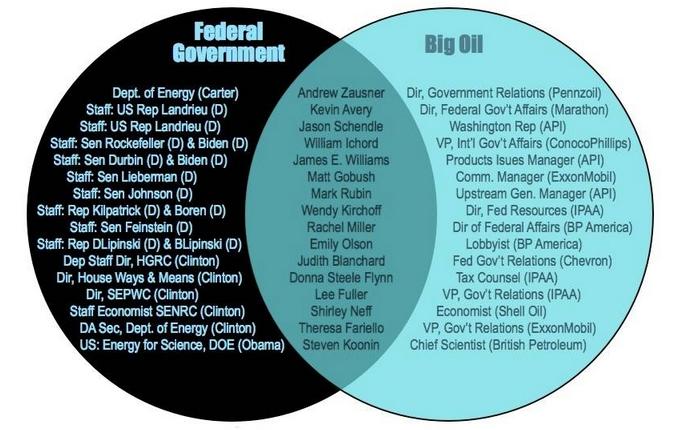
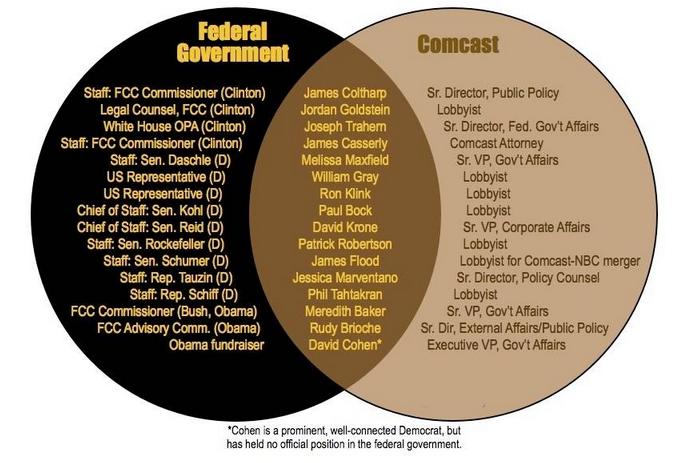
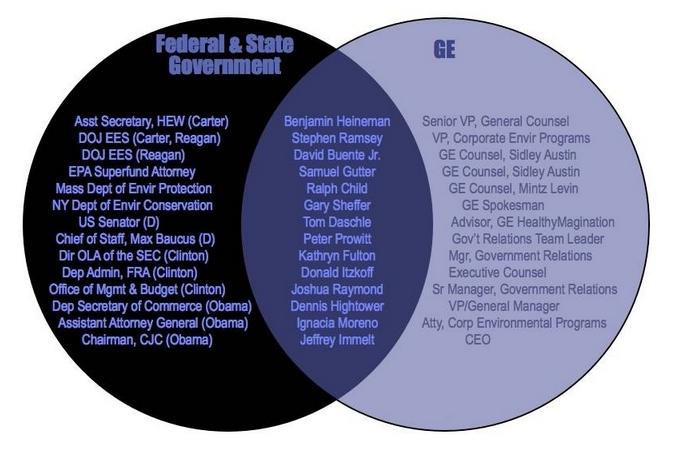
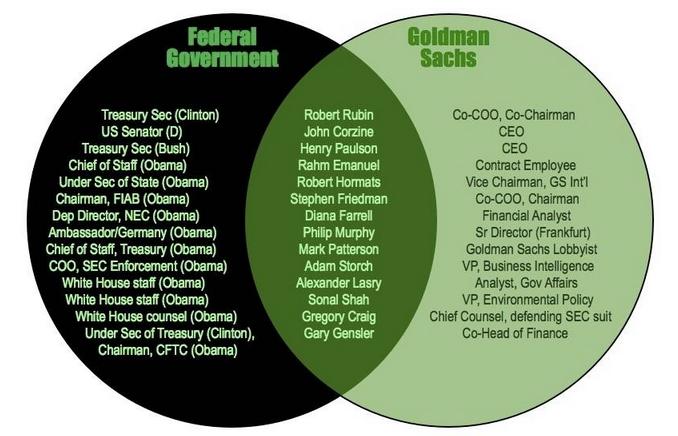
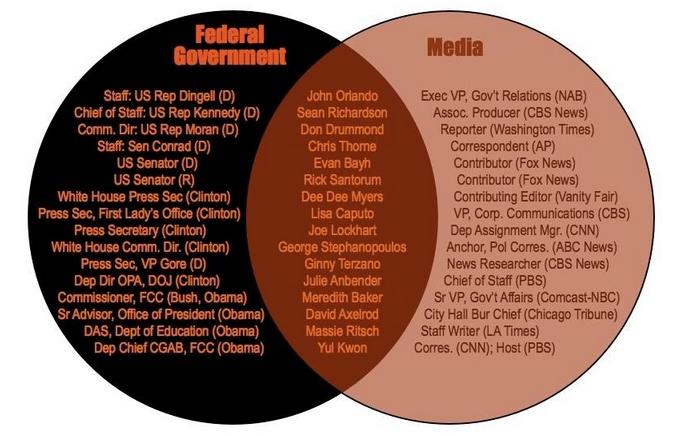
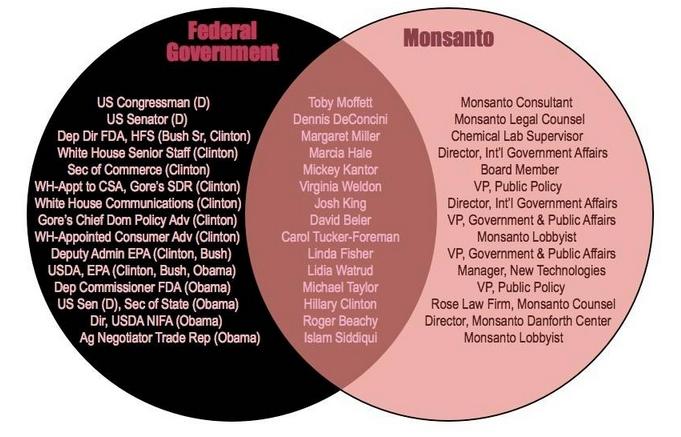
Fast forward to 2012 and Lambert Strether posted a series of Venn diagrams at Naked Capitalism. Strether writes:
[This] nifty visualization… shows how many, many people, through the operations of Washington’s revolving door, have held high-level positions both in the Federal government and in major corporations. To take but one example, the set of all Treasury Secretaries includes Hank Paulson and Bob Rubin, which overlaps with the set of all Goldman Sachs COOs. The overlapping is pervasive. Political scientists and the rest of us have names for such cozy arrangements — oligarchy, corporatism, fascism, “crony capitalism” — but one name that doesn’t apply is democracy.
UPDATE: I’ve included a criticism of the methodology after the diagrams; the overlap portrayed here is almost exclusively among Democratic politicians and the diagrams were explicitly intended to point out connections among progressives.
See for yourself:
On the methods for putting together these diagrams, Strether writes about the person who’s behind the diagrams:
Herman’s honest: Her goal is to “expose progressive corporatism,” and — assuming for the sake of the argument that D[emocrat]s are progressive, and that “progressives” are progressive — her chart does exactly that, and very effectively, too.
But what her data does not do is expose corporatism as such; there are very, very few Rs listed; it strains credulity that Hank Paulson was the only high-level GS operative in the Bush administration, for example, and if GS isn’t the R[epublican]s’ favorite bank, there’s surely another.
Hence, Herman’s chart, if divorced from context[2], might lead somebody — say, a child of six — to conclude that the only corporatists in Washington DC are D[emocrat]s.
Thanks to Carolyn Taylor for pointing out the methods bias.
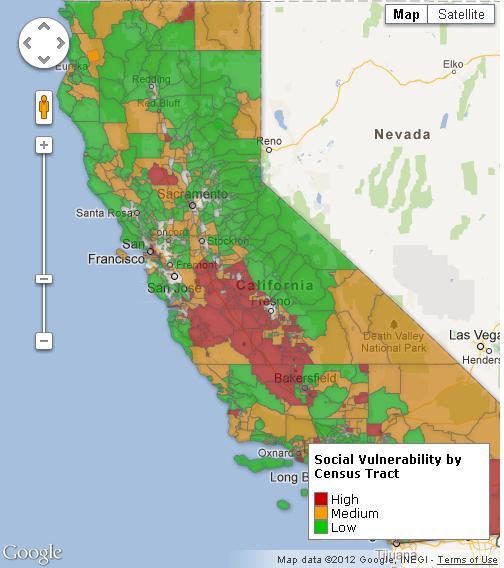
Scholars are busy attempting to predict the effects of climate change, including how it might harm people in some parts of the globe more than others. A recent report by The Pacific Institute, sent in by Aneesa D., does a more fine-grained analysis, showing which Californians will be the most harmed by climate change.
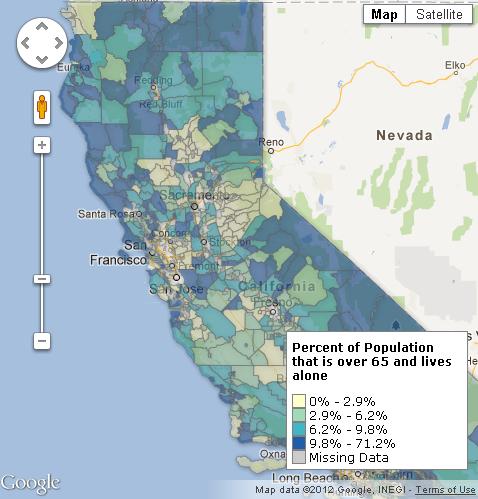
They use a variety of measures for each Census tract to make a Vulnerability Index, including natural factors (like tree cover), demographic factors (like age), and economic factors (like income). At the interactive map, you can see the details for each Census tract. Their compiled index looks like this:
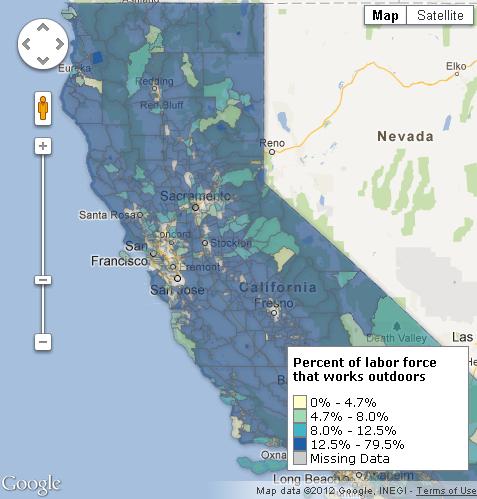
And here’s the data for the percent of workers who labor outside:
There’s lots more data at the site, but what’s interesting here is that, even in incredibly wealthy parts of the world, climate change is going to have uneven effects. When it does, the most vulnerable people in the more vulnerable parts of the state are going to migrate to the other parts. Most Californians don’t imagine that their cities will be home to refugees, but this is exactly what will happen as parts of California become increasingly difficult to live in.
In subarctic climates — ones in which the mean annual temperature is below 32° — the soil is frozen all year round. It’s damn cold, but a nice base on which to build. Until climate change starts melting the permafrost, of course.
These two now crooked buildings can be found in Dawson City, Canada. Carleton University geographers have shown that the average temperatures have been increasing, melting the permafrost, and destabilizing the town:
This image reminds me that I am only barely beginning to understand climate change and its consequences. How we will pay for climate change, and who will do so, is something I suspect I’ll learn much more about in the coming years.
In the six-minute video below, Kate Pickett talks about how more equal societies are kinder to each other, give more in foreign aid, are less status-conscious, consume less, and even recycle more. Based on this, she argues that reducing inequality within societies is a good strategy towards addressing climate change.
How to increase equality? It turns out there are lots of options.