Tag Archives: emotion

When “Intensive Mothering” Meets Special Needs

For the last week of December, we’re re-posting some of our favorite posts from 2012.

In Mother-Blame in the Prozac Nation, sociologist Linda Blum describes the lives of women with disabled children.  While mothers are held to an essentially impossibly high standard of motherhood in the contemporary U.S. and elsewhere, mothers of disabled children find themselves even more overwhelmed.

The daily care of their child is often more intensive but, in addition to that added responsibility, mothers were actively involved in getting their children needed services and resources.  The need for mothers to be proactive about this was exacerbated by the fact that they had to negotiate different social institutions, each with an interest in claiming certain service spheres, but also limited budgets.  ”While each system claims authoritative expertise,” Blum writes, ” either system can reject responsibility, paradoxically, when costs are at issue.”  Because they often had to argue with service providers and find ways to beat a system that often tried to keep them at bay, they had to become experts in their child’s disability, of course, but also public policy, learning styles, the medical system, psychology/psychiatry, pharmaceutics, manipulation of jargon and law, and more.

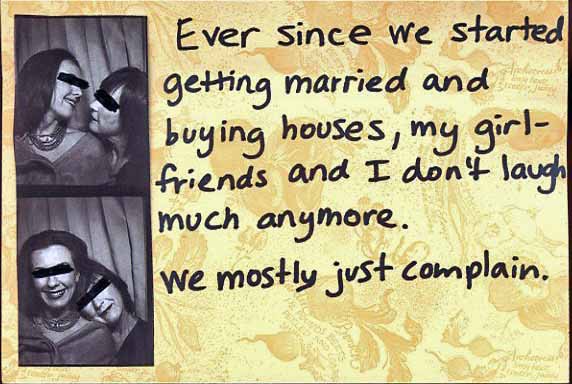
Mothers often felt that they were their child’s only advocate, with his or her health and future dependent on making just one more phone call, getting one more meeting with an expert, or trying one more school. Accordingly, they were simultaneously exhausted and filled with guilt.  I wondered, when I came across this Post Secret confession, if this mother was experiencing some of the same things:

Lisa Wade is a professor of sociology at Occidental College. You can follow her on Twitter and Facebook.

Women, Opportunity, and the Military

Pew Research Center reports that, as of 2010, women make up about 15% of enlisted soldiers and commissioned officers:

Not all types of women are entering the military at the same rate.  Nearly a third of women in the military are Black, about twice their proportion in the general population.  In contrast, about half are white, about 2/3rds their proportion among civilian women.

A larger proportion of women, compared to men, said that they joined the military because it was difficult to find a good civilian job:

They were just as likely as men, however, to report other more common reasons for joining:

Interestingly, women reported high levels of strain re-entering the civilian population and the majority believe that the wars in Afghanistan and Iraq are not worth fighting:

Nevertheless, a large majority felt that entering the military was good for their personal growth and career opportunities:

Lisa Wade is a professor of sociology at Occidental College. You can follow her on Twitter and Facebook.

Liberals: Can’t Get No Satisfaction

Cross-posted at Montclair SocioBlog.

Liberal women want more sex.

Controversial sociologist Mark Regnerus has been fooling around with the New Family Structures Survey.  Back in June, Regnerus used the NFSS data to conclude that gay parents are bad for children.  Now, he runs the regressions and finds that liberalism leaves women sexually dissatisfied.

Question:“Are you content with the amount of sex you’re having?”

The possible answers:

  • Yes
  • No, I’d prefer more
  • No, I’d prefer less

The differences were clear.

Those liberal women, they try and they try and they try; they can’t get no… satisfaction. Hey, hey, hey — that’s what they say.

The differences held even with controls for how much sex the woman had had recently.  Nor did adding other possible explanatory variables dampen the effect:

[T]he measure of political liberalism remains significantly associated with the odds of wanting more sex even after controlling for the frequency of actual intercourse over the past two weeks, their age, marital status, education level, whether they’ve masturbated recently, their anxiety level, sexual orientation, race/ethnicity, depressive symptoms, and porn use.

Regnerus says he was puzzled and asked an economist friend for her explanation.  She, like Regnerus, is a serious Christian, and saw it as a matter of seeking “transcendence.”  Liberal women want to have more sex because they feel the lack of sufficient transcendence in life and seek it in sex.  Conservative women find transcendence in the seemingly mundane — “sanctifying daily life” — so they do not need sex for transcendence.  Or as Regnerus puts it, “Basically, liberal women substitute sex for religion.”

To test this idea, Regnerus controlled for religious attendance.  When he did,  “political liberalism finally went silent as a predictor.”  Churchgoing liberals were no more insatiable than were their sexually content conservative co-worshipers.

So here’s the scenario.  All women want transcendence.  Since liberal women are not religious, they seek transcendence in sex and don’t find it.  They’re dissatisfied, but they cling to the idea that sex will bring them transcendence if only they have more of it.   So they keep looking for transcendence in all the wrong places.  Conservative women seek transcendence in religion and in everyday activities.  And that works.

Conclusion: Religion is deeply satisfying; sex, not so much.

This explanation, with its attribution of psychological-spiritual longing, makes some huge assumptions about what’s going on inside women’s heads.

I can offer a contrasting sociological explanation for Regnerus’ findings.  It looks not to deep inner longings for transcendence but to social norms, beliefs, and values.  It rests on the assumption that people’s desires are shaped by external forces, especially the culture of the social world they live in.  In some groups, sex for women is good, so it’s OK for them to want more sex.  In other social worlds, sex for women has a lower place on the scale of values.  It is less of a “focal concern.”

These differences make for differences in who is content with what — a liberal, East Coast man and a WASP woman from the Midwest, for example:

Can we really say that the difference here is about spiritual transcendence?

In some social worlds, a woman can never be too thin or too rich.  In those worlds, women diet and exercise in a way we might find obsessive.  But that’s what their culture rewards.  Some cultures hold that sex is a good thing — certainly more pleasurable than dieting and exercising — therefore,  more is better.  In some social worlds, that’s the way some people feel about money.  Are these desires really about transcendence, or they about cultural values?

Oh, and on the sexual discontent matter, there are two other possibilities that may not to have occurred to Regnerus: (1) maybe conservative men are better lovers; they satisfy their conservative bedmates in ways liberals can only dream of.   Or (2) conservative men are so bad at sex that when you ask their partners if they want more, the answer is, “No thanks.”

—————————

Jay Livingston is the chair of the Sociology Department at Montclair State University.  You can follow him at Montclair SocioBlog or on Twitter.

Jay Livingston is the chair of the Sociology Department at Montclair State University. You can follow him at Montclair SocioBlog or on Twitter.

Is Marriage a “Universal Human Value”?

Cross-posted at PolicyMic.

In this clip from a campaign rally, Vice Presidential nominee Paul Ryan argues that “traditional marriage” is a “universal human value.”

Ryan could not be more wrong. In fact, few practices have undergone more fundamental transformation.

For thousands of years, marriage served economic and political functions unrelated to love, happiness, or personal fulfillment.  Prior to the Victorian era, love was considered a trivial basis for marriage and a bad reason to marry.  There were much bigger concerns afoot: gaining money and resources, building alliances between families, organizing the division of labor, and producing legitimate male heirs.

These marriages were patriarchal in the strictest sense of the term.  Men were heads of households and women were human property, equivalent to children, slaves, servants, and employees.  Women didn’t choose to enter a marriage that defined her as property, she was entered into the marriage by her father, who owned her until he “gave her away.”

Ultimately, in response to feminist activism as well as other forces, marriage would change.  By the 1950s, a new kind of marriage would become ideal.  This is the one that Ryan likely means when he uses the terms “traditional” and “universal.”  In this model, men and women married by choice and were expected to find sustenance in their relationship.  Women were not legally subordinate to their husbands (that is, she was no longer property).  But the rights and responsibilities of husbands and wives continued to be defined differently.  Women owed men domestic services (cleaning, cooking, childcare, and sex); in return, men were legally required to support their wives financially.

This type of marriage signed its own death warrant, a story I’ll tell in another post, and was relatively short-lived (and not at all universal, even at its peak in the U.S.).  It was soon replaced by an ideal of marriage based on gender-neutral roles that spouses could work out for themselves. Today married couples are free to organize their lives however they wish.  And they do.  Stephanie Coontz, famed historian of marriage, writes:

Almost any separate way of organizing caregiving, childrearing, residential arrangements, sexual interactions, or interpersonal redistribution of resources has been tried by some society at some point in time.  But the coexistence in one society of so many alternative ways of doing all of these different things—and the comparative legitimacy accorded to many of them—has never been seen before.

Ryan is right, then, in that “traditional marriage,” however you define it, is not normal in the U.S.  He’s completely wrong, though, it calling it universal.  Even a quick review of American history reveals it not to be so.

Sources:

  • Coontz, Stephanie. 1992. The Way We Never Were: American Families and the Nostalgia Trap.  New York: Basic Books.
  • Coontz, Stephanie.  2004. The World Historical Transformation of Marriage. Journal of Marriage and Family66, 4: 974-979.

See also The Daily Show on nostalgia, the “traditional” age of marriage, and mocking “traditional marriage.”

Lisa Wade is a professor of sociology at Occidental College. You can follow her on Twitter and Facebook.

Sad White Babies with Mean Feminist Mommies

In a stroke of brilliance, Jessica Valenti has named a new trope: Sad White Babies with Mean Feminist Mommies.   The trope offers a visual “no” to the question that won’t die, “Can women have it all?”  It serves as a cautionary tale to all the ambitious feminist ladies out there: go right ahead, get a good job, but don’t think for a second that you’re doing the right thing for your (future) child.  Thanks to Larry H. and Zeynep A. for sending it in!

Here’s a collection borrowing from Valenti and my own Google Image search for “working mother”:


Here’s an alternative image of the working mom that I thought was quite cute (TIME):

Lisa Wade is a professor of sociology at Occidental College. You can follow her on Twitter and Facebook.

Sexual Objectification (Part 2): The Harm

This is the second part in a series about how girls and women can navigate a culture that treats them like sex objects (see also, part One)Cross-posted at Ms. and Caroline Heldman’s Blog.

The “sex wars”  of the 1980s pitted radical feminists, who claimed that female sexual objectification is dehumanizing, against feminists concerned about legal and social efforts to control and repress female sexuality.  Over a decade of research now shows that radical feminists were right to be highly concerned.

Getting back to the “sex wars” and how radical feminists were right, women who grow up in a culture with widespread sexual objectification tend to view themselves as objects of desire for others. This internalized sexual objectification has been linked to problems with mental health (e.g., clinical depression“habitual body monitoring”), eating disordersbody shameself-worth and life satisfactioncognitive functioningmotor functioningsexual dysfunctionaccess to leadership, and political efficacy.  Women of all ethnicities internalize objectification, as do men to a lesser extent.

Beyond the internal effects, sexually objectified women are dehumanized by others and seen as less competent and worthy of empathy by both men and women.  Furthermore, exposure to images of sexually objectified women causes male viewers to be more tolerant of sexual harassment and rape myths.  Add to this the countless hours that most girls/women spend primping and competing with one another to garner heterosexual male attention, and the erasure of middle-aged and elderly women who have little value in a society that places women’s primary value on their sexualized bodies.

Theorists have also contributed to understanding the harm of objectification culture by pointing out the difference between sexy and sexual.  If one thinks of the subject/object dichotomy that dominates thinking in Western culture, subjects act and objects are acted upon.  Subjects are sexual, while objects are sexy.

Pop culture sells women and girls a hurtful lie: that their value lies in how sexy they appear to others, and they learn at a very young age that their sexuality is for others.  At the same time, being sexual, is stigmatized in women but encouraged in men. We learn that men want and women want-to-be-wanted. The yard stick for women’s value (sexiness) automatically puts them in a subordinate societal position, regardless of how well they measure up.  Perfectly sexy women are perfectly subordinate.

The documentary Miss Representation has received considerable mainstream attention, one indicator that many are now recognizing the damaging effects of female sexual objectification.

YouTube Preview Image

To sum up, widespread sexual objectification in U.S. popular culture creates a toxic environment for girls and women.  The following posts in this series provide ideas for navigating new objectification culture in personally and politically meaningful ways.

Humanizing the Homeless

Unless we’re one of them, many of us learn the habit of looking away from the down-and-out when we’re going about our daily lives.  Truly seeing the homeless, the mentally ill, the drug-addicted, and others in crisis (not overlapping populations, but intersecting ones) potentially forces us to think about our role in a society that has largely abandoned them.

Meanwhile, art photography of these populations tends to force us to look, to see just how much pain and suffering there is to see on the streets.

In light of this — not looking vs. looking to see the pain — I found the photography of Chris Arnade to be a breath of fresh air.  Featured at Mother Jones, his portraits of “drug abuse, sex work, and homelessness in the Bronx” are humanizing. Many of them show smiling faces, dignity, pride, and peace.  I reproduce a few of them here, but I recommend going to see the full Flickr set.

Natalie:
Clarence:Takeesha:Jessica:Jose:DeShawn:

—————————

Lisa Wade is a professor of sociology at Occidental College. You can follow her on Twitter and Facebook.

She Works Hard For No Money

Cross-posted at Montclair SocioBlog.

The politics of motherhood reared its head again last month when Hilary Rosen, who the news identified as a “Democratic strategist,” said that Ann Romney (Mrs. Mitt) had “never worked a day in her life.” (A NY Times article is here.)

“Worked” was a bad choice of words.  Raising kids and taking care of a home are work, maybe even if you can hire the kind of help that Mrs. Romney could afford.  Rosen’s comment implied that family work is not as worthwhile as work in the paid labor force.  That’s not such an unreasonable conclusion if you assume that we put our money where our values are and reward work in proportion to what we think it’s worth.  Mitt’s supporters use this value-to-society assumption to justify the huge payoffs Romney derived from those leveraged buyouts at Bain Capital.*

Even Mrs. Romney apparently felt that there must be some truth to the enviability of a career.   Why else would she refer to stay-at-home motherhood as a career?  “My career choice was to be a mother.”

Still, regardless of the truth of Rosen’s remark, it was insulting.**  Stay-at-home motherhood is work – a job.

But is it a good job?

A recent Gallup poll provides some more evidence as to why stay-at-home moms might be both envious or resentful of their employed counterparts.  Gallup asked women about the emotions, positive and negative, that they had felt “a lot” in the previous day.  Gallup then compared the stay-at-home moms, employed moms, and employed women who had no children at home.

The stay-at-home moms came in first on every negative emotion.  Some of the differences are small, but the Gallup sample was more than 60,000 so these differences are statistically significant.   The smallest difference was for Stress – no surprise there, since paid work can be stressful.  Worry and Anger too can be part of the workplace.  The largest differences were for Sadness and Depression.  Stay-home moms were 60% more likely to have been sad or depressed.

Gallup also asked about positive feelings (Thriving, Smiling or Laughing, Learning, Happiness, Enjoyment), and while the differences were smaller, they went the same way, with stay-at-home moms on the shorter end.  Still it’s encouraging that 86% of them had Experienced Happiness 86%; so had 91% of the employed moms.

Money matters.  As Rosen said,

This isn’t about whether Ann Romney or I or other women of some means can afford to make a choice to stay home and raise kids. Most women in America, let’s face it, don’t have that choice.

Gallup found a small interaction effect.  The stay-at-home mom-employed difference was greater for low-income women.

The Gallup poll does not offer much speculation about why stay-at-home moms have more sadness and less happiness. One in four experienced “a lot” of depression yesterday.  That number should be cause for concern.

Maybe women feel more uncertain and less able to control their lives when they depend on a man, especially one whose income is inadequate.  Maybe stay-at-home moms find themselves more isolated from other adults. Maybe they are at home not by choice but because they cannot find a decent-paying job. Or maybe money talks, and what it says to unpaid stay-at-home moms is society does not value your work.  Nor, in comparison with other wealthy countries, does US society or government provide much non-financial support to make motherhood easier.

The late Donna Summer sang,

She works hard for the money
So you better treat her right

But how right are we treating women who work hard for no money?

——————————-

* For example, Edward Conrad is a former partner of Romney.  In a recent article in the Times Magazine, Adam Davidson writes, “If a Wall Street trader or a corporate chief executive is filthy rich, Conrad says that the merciless process of economic selection has assured that they have somehow benefitted society.”

** Hillary Clinton committed a similar gaffe twenty years ago in response to a reporter’s question about work and family “I suppose I could have stayed home and baked cookies and had teas, but what I decided to do was to fulfill my profession which I entered before my husband was in public life”