Tag Archives: politics: election 2008

Income, Religious Attendance, and Voting Behavior

Andrew over at FiveThirtyEight posted about the association between religious attendance and voting behavior. Looking at the 2008 Presidential election, Pew data indicates that frequency of religious attendance is strongly related to likelihood of voting for McCain:

pewrelatt

But looking more closely at the data, we can see that the relationship is more pronounced for some groups, such as born-again Protestants and Catholics, than others, such as non-born-again Protestants:

pewreligrelatt

From the original post over at FiveThirtyEight:

The size of each circle is proportional to the number of people represented in the survey. In particular, most of the people who attend church more than weekly are born-again Protestants.

Another interesting thing to look at is the how income interacts with religion to influence voting patterns. These graphs show the McCain vote by income among various religious groups:

pewreliginc2

Notice that among Jews and the non-religious, increased income didn’t substantially increase the chances of voting for McCain (and those in the “other” category are just confusing). For these groups, being rich doesn’t appear to have been enough to draw them to McCain, whereas for most Christians we see a clear trend: the richer adherents were, the more likely they were to vote Republican. Both Jews and non-adherents started out much less likely to vote for the Republican ticket, and their opposition was strong enough that it trumped what we would expect to see if people voted on a narrow interpretation of self-interest (i.e., “I make $300,000 and Obama says he’ll raise income taxes on incomes above $250,000, so I’ll vote for the other guy”). Presumably Republican positions on social issues, or close association with evangelical Christians, put off some wealthy non-religious and Jewish voters who might otherwise be likely to vote for them based on fiscal policy, but that’s just a guess, since we don’t have data here on voters’ explanations of their candidate preferences.

Election Exit Poll Redux

Nate Silver of FiveThirtyEight.com has a new column, The Data, in Esquire. In his innaugural article, he revisits how Obama won the election, looking specifically at rural/suburban/urban voters.

Presidential Candidates’ Share of White Votes, 1968-2008


Via Slate.

Have We Moved to the Left? It Depends How You Look at it.

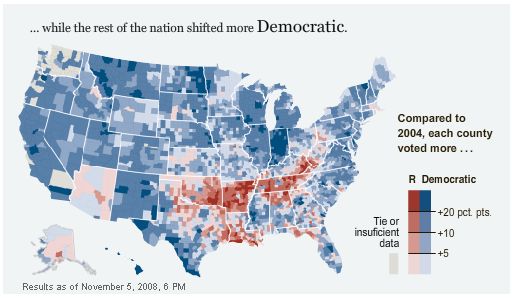
Many of you may have seen the image below. It compares the 2004 to the 2008 vote and shows, by color, how much more Democratic (blue) or Republican (red) each county leaned in 2008. In essence, compared to 2004, in this election Democrats increased the proportion of the vote that they received in most counties.

You may not have seen, however, this next image. This next image shows the same data but compares 1992 to 2008. Looking across those sixteen years it is clear that, while this last election may have looked good for Democrats, the last five have moved the country significantly to the right. If you are a Democrat, then, this election is one step forward after 10 steps back. And, if you are a Republican, it may very well be a very small setback.

(Data from the New York Times; images found here.)

The Relationship Between Today’s Political Map, the Economy, and Geological Time

I have borrowed the information and images below from Jeff Fecke at Alas A Blog.  His discussion, if you’re interested, is more in depth.

There is a winding line of counties stretching from Louisiana to South Carolina, a set of states that largely voted for McCain in this last election, that went for Obama.  The map below shows how counties voted in blue and red and you can clearly see this interesting pattern.


These counties went overwhelmingly for Obama in part because there is large black population.  Often called the “Black Belt,” these counties more so than the surrounding ones were at one time home to cotton plantations and, after slavery was ended, many of the freed slaves stayed.  This image nicely demonstrates the relationship between the blue counties and cotton production in 1860:


But why was there cotton production there and not elsewhere?  The answer to this question is a geological one and it takes us all the way back to 65 million years ago when the seas were higher and much of the southern United States was under water.  This image illustrates the shape of the land mass during that time:

I’ll let Jeff take it from here:

Along the ancient coastline, life thrived, as usually does. It especially thrived in the delta region, the Bay of Tennessee, if you will. Here life reproduced, ate, excreted, lived, and died. On the shallow ocean floor, organic debris settled, slowly building a rich layer of nutritious debris. Eventually, the debris would rise as the sea departed, becoming a thick, rich layer of soil that ran from Louisiana to South Carolina.

65 million years later, European settlers in America would discover this soil, which was perfect for growing cotton.

So there you have it: the relationship between today’s political map, the economy, and geological time.


The View Redefines Women’s Issues


Politics has long been considered a masculine domain.  After all, there are issues, and there are “women’s issues.”  However, in this election season, The View has delved deeply into politics.  Reactions to this reveal the assumption that politics are for men.

First, Bill O’Reilly’s appearance on The View can be described as nothing if not sexist.  Essentially, his message was “Don’t worry your pretty, little emotional heads about politics, ladies!” The View is just “entertainment,” according to O’Reilly, because it’s for women.

YouTube Preview Image

Second, soon after Joy Behar appeared on Larry King, King asked her “When did ‘The View’ become this?  When did it go off-track?”  King’s question reveals his assumption that women’s media is for women’s issues, and those are, simply, not real politics (read the transcript here).

Ironically (awesomely), after 12 years on the air, this election season marks the first time that The View has been the #1 watched daytime show, “…garnering its biggest aud[ience] ever (6.2 million) on Nov. 5, the Wednesday after the election” (source).

So, it turns out, women are interested in politics after all.

(Thanks to Gwen for help on this post.)

Special 2008 Presidential Election Round-Up!

In honor of the election, we offer you a summary of all our election 2008 posts.

This election has certainly brought racial tensions front and center. We highlighted two racist caricatures of Obama: on a waffles box and as a cannibal. We also discussed the cover of The New Yorker on which Barack and Michelle Obama were caricatured as terrorists. Whether or not this was racist was widely discussed and offered an interesting opportunity to ask “Who decides what we talk about?” In response to the argument that we were being too sensitive about the caricatures, we offered some evidence that caricatures of black people do not need to be racist.

Anti-Obama propaganda also included comparison with OJ Simpson, a monkey, celebrities, Osama Bin Laden, fascists and communists, a terrorist, a terrorist again, and a “half-breed Muslin.” See here for other racist anti-Obama propaganda.  Gwen asked “So what if Obama is an Arab?” (Note, too, this satirical T-shirt.)

We saw racialization–or the active production of racial meaning–in the fist bump controversy, in calling Michelle Obama a “baby mama,” and in asserting the whiteness of the White House. We discussed the resemblance between Obama and his Grandfather and the meaning of “Main Street” to illustrate the social construction of race.  And we offered examples of white privilege: in one we discuss the option of white ethnics to emphasize their ethnicity; in two we discuss a cartoonist who calls Colin Powell a race traitor for endorsing Obama and a Howard Stern clip that suggests that Blacks only endorse Obama because he’s Black.  We also remark on how easy it is to deride social theories of inequality.

The McCain/Palin ticket was no stranger to derision.  See also our post in which the McCain/Palin ticket is said to be favored by Nazis, another in which Palin effigy is lynched, and a third that discusses ageism in the election.

We’ve also seen plenty of sexism in this campaign. Hillary Clinton has been represented as a nut buster, asked to “iron my shirt,” critiqued for crying, and called a “bitch.” There are more examples here and here.  Also see this montage of sexism among political pundits. Both Hillary Clinton and Sarah Palin were sexualized. See here, here, and here for Clinton and here, here, here, here, and here for Palin. (By the way, Barack Obama was sexualized as well, see here, here, and here.)

We commented, more sociologically, on the gender politics of this election. We discussed the mothering of baby Trig, conservative feminism, the politics of pink, and took a humorous look at the women’s vote with Sarah Haskins.

We also pointed to the way in which Obama and Clinton attempted to appeal to small town people and the ease with which we make fun of them.

For the intersection of race and gender, see our post in which Michelle Obama is called an angry black woman, is said to need to “soften” to be a First Lady, and our post that features the Bros Before Hos T-shirt (scroll to the bottom). For the intersection of race and class, see our post on Obama’s negotiation of the “elitist” label.  And, in making intersectionality invisible, see the SNL skit, “bitch is the new black.”

Looking more broadly at politics and media coverage, we discussed the portrayal of evil in the Reverend Wright scandal, McCain’s trivialization of war, the linking of a Democratic adminstration with a terrorist attack, pundit hypocrisy, political networks, a voter registration campaign that uses bondage imagery, suspiciously delicious polling techniqueshow cell phones shape polling findings, and trends in media coverage of Obama versus Clinton and Obama versus McCain.

In addition, we offered some examples of punditry from alternative media: on young voters, a call for alliance from the labor movement, a call to get your Jewish grandparents to vote for Obama, a political revival of the Budweiser Wassap video, and two examples of art inspired by the election (here and here).

We also put up posts of figures representing public opinion on blacks, a woman president, and politician parents.  And we offered images illustrating how the world would vote.

Finally, our favorite: “We’re not sociologists, we’re Americans!”

The Trouble with Cell Phones

Many of the polls that we have been consuming voraciously have not included people without a land line (like me).  In the figure below, we can see what a difference that makes in the results.  Yellow bars are polls that included cell phones and grey bars are polls that did not.  Those that excluded cell phones are significantly skewed towards McCain, and falsely so insofar as people without a landline vote.

From 538 via Thick Culture.