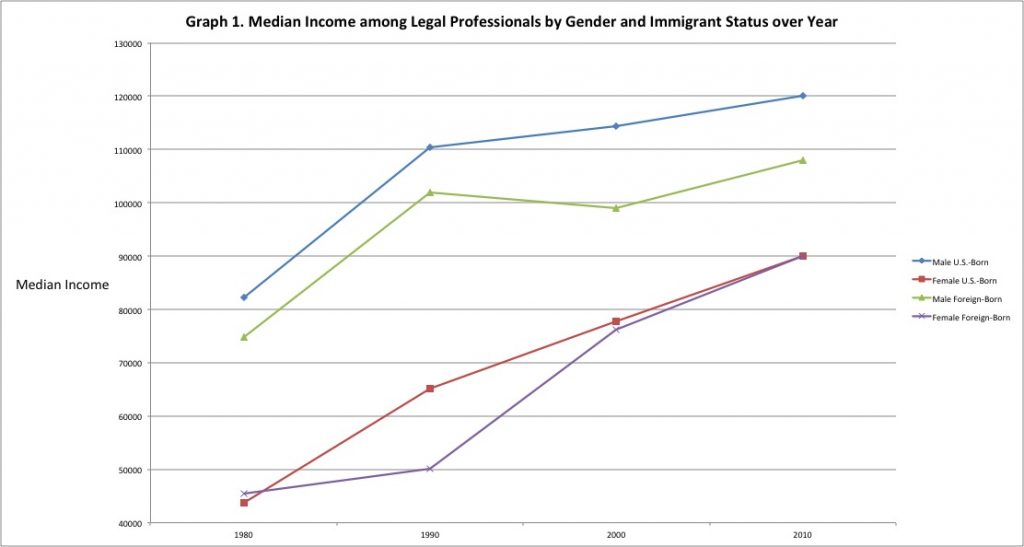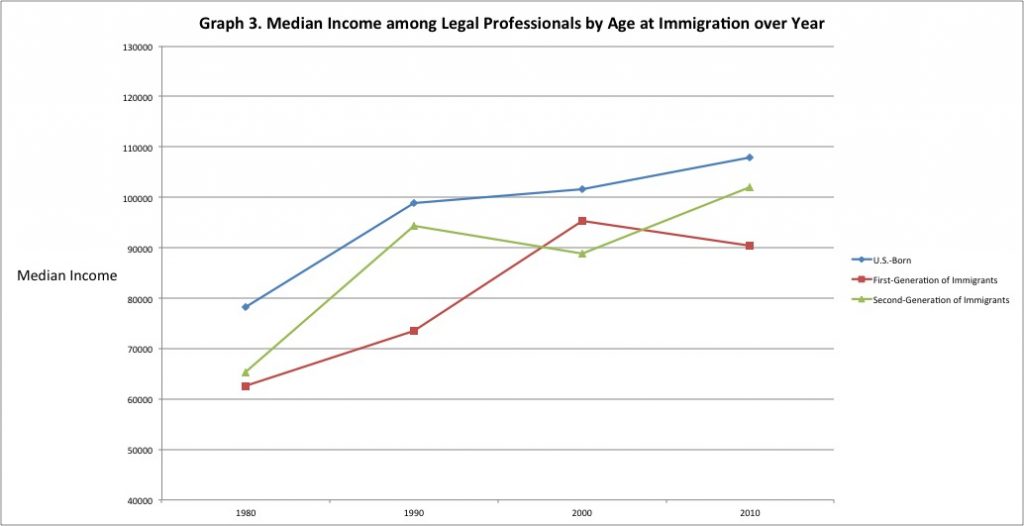
Data presented by Pew Social Trends suggests that immigrants are strongly assimilated by the second generation. While first-generation immigrants (the children of migrants) often do worse on measures of economic security, second-generation immigrants (their grandchildren) are essentially indistinguishable from the general population. They’re also more likely to identify as a “typical American.”
These data should calm the fears of people who think that high fertility rates among immigrants will harm the country by creating a “dependent” underclass or a dangerous population of non-patriots.
While some austerity advocates really fear (although incorrectly) the consequences of deficit spending, the strongest proponents are actually only concerned with slashing government programs or the use of public employees to provide them. In other words their aim is to weaken public programs and/or convert them into opportunities for private profit. One measure of their success has been the steady decline in public employment. Floyd Norris, writing in the New York Times notes:
For jobs, the past four years have been a wash.
The December jobs figures out today indicate that there were 725,000 more jobs in the private sector than at the end of 2008 — and 697,000 fewer government jobs. That works into a private-sector gain of 0.6 percent, and a government sector decline of 3.1 percent.
In total, the number of people with jobs is up by 28,000, or 0.02 percent.
How does that compare? It is by far the largest four-year decline in government employment since the 1944-48 term. That decline was caused by the end of World War II; this one was caused largely by budget limitations.
The chart below, taken from the same post, also reveals just how weak private sector job creation has been over the past 12 years (compare the top three rows — the presidencies of Obama and Bush — w This graphic from the New York Timeshighlights just how significant the decline in public employment has been in this business cycle compared with past ones. Each line shows the percentage change in public sector employment for specified months after the start of a recession. Our recent recession began December 2007 and ended June 2009. As you can see, what is happening now is far from usual.
It is also worth noting that despite claims that most Americans want to see cuts in major federal government programs, the survey data show the opposite. For example, see the following graphic from Catherine Rampell’s blog post. As Rampell explains:
In every category except for “aid to world’s needy,” more than half of the respondents wanted either to keep spending levels the same or to increase them. In the “aid to world’s needy” category, less than half wanted to cut spending.
Not surprisingly, this assault on government spending and employment will have real consequences for the economy and job creation. All of this takes us back to the starting point — we are talking policy here. Whose interests are served by these trends?
When I approached my undergraduate mentors about graduate school in 1996, they warned me that many people who earn PhDs never get jobs in academia. This is sometimes deliberate, as their are jobs outside of academia for some degree-holders to get, but it’s also sometimes a grave disappointment. My mentors emphasized the extent of the risk (and frankly scared me quite a lot), but how bad was it? And is it worse today?
The Atlantic‘s Jordan Weissmann put together the data. The leftmost bars on his figure show that, on average, under a quarter of PhDs landed a full-time job at a college or university in 1991. That number had dropped to less than 20% by 2011. The numbers, however, vary significantly by field:
The looming question, of course, is what percentage of PhDs want a full-time academic job, something that certainly varies by field. In other words, there aren’t a boatload of bitter engineers bad-mouthing the academy while slinging lattes at Starbucks. Here’s a hint at an answer: A study published in 1999 found that 53% of all new PhDs said they wanted to become professors. Ten years later, just over half were tenured (54%) and a handful more were tenure-track (7%); a third weren’t in academia at all.
On the one hand, I think these numbers are really depressing. Five to ten years is a long time to train for a career only to discover that, for whatever reason, you won’t be employed in the area of your expertise. But I have two “on the other hands.”
On one other hand, I wonder how these numbers compare to other occupations? We accept that certain occupations are highly competitive and include a lot of dumb luck and failure. Modeling and acting are obvious examples, there are certainly others. I know someone who’s spent their lifetime trying to become an astronaut. Where does academia fall in the spectrum of risky job endeavors?
On a second other hand, I’d love to see some research on what happens to academics — especially in the humanities and social sciences — when they don’t get a job in academia or are denied tenure after getting there. Within academia, this is often framed as THE END OF YOUR LIFE. But maybe it’s often okay or pretty good. Honestly, I don’t know.
Interesting and useful data, to be sure, but far from the whole story.
Last week I posted about our college President’s suggestion that he is disinclined to believe students who report sexual assault. In response to this, and a series of other problems with our sexual assault policy, the Occidental Sexual Assault Coalition is filing a federal complaint with the Office for Civil Rights and a Clery Act complaint. No longer confident that our President and his administration will agree to implement the best practices for reporting and adjudicating sexual assault, faculty and students are turning to external mechanisms.
These seem like extraordinary measures, but I want to be clear that there is nothing extraordinary about the number of sexual assaults or the mishandling of reports by the Occidental administration. Occidental is no more or less unsafe than the vast majority of residential colleges and universities around the country. College attendance is a risk factor for sexual assault — it raises the likelihood that a person will be a victim of an attempted or completed assault — and Occidental is no different in that regard.
Instead of a sign that Occidental has a uniquely broken system, the activities on campus reflect a commitment to making the college a nationwide model. You see, we do believe that Occidental is different than other colleges. It’s extraordinary. And we’re committed to holding it to a higher standard. We want Occidental to usher in a new era of sexual assault policy and improved campus sexual culture. There will be a day when honest, transparent, and fair reporting and adjudication of sexual assaults will be the norm. When that happens, the approach we find on essentially all college campuses today — a high rate of non-report, pressure on victims to stay quiet, sloppy and biased adjudication, and suppression of sexual assault data — will be considered backward, inhumane, and unjust. That day is coming, and we want Oxy to get there first.
New data about the science aptitude of boys and girls around the world inspires me to re-post this discussion from 2010.
Math ability, in some societies, is gendered. That is, many people believe that boys and men are better at math than girls and women and, further, that this difference is biological (hormonal, neurological, or somehow encoded on the Y chromosome).
But actual data about gender differences in math ability tell a very different story. Natalie Angier and Kenneth Chang reviewed these differences in the New York Times. They report the following (based on the US unless otherwise noted):
• There is no difference in math aptitude before age 7. Starting in adolescence, some differences appear (boys score approximately 30-35 points higher than girls on the math portion of the SAT). But, scores on different subcategories of math vary tremendously (often with girls outperforming boys consistently).
• When boys do better, they are usually also doing worse. Boys are also more likely than girls to get nearly all the answers wrong. So they overpopulate both tails of the bell curve; boys are both better, and worse, than girls at math.
• That means that how we test for math ability is a political choice. If you report who is best at math, the answer is boys. If you report average math ability, it’s about the same.
• How you decide to test math ability is also political. Even though boys outperform girls on the SAT, it turns out those scores do not predict math performance in classes. Girls frequently outperform boys in the classroom.
• And, since girls often outperform boys in a practical setting, math aptitude (even measured at the levels of outstanding instead of average performance) doesn’t explain sex disparities in science careers (most of which, incidentally, only require you to be pretty good at math, as opposed to wildly genius at it). In any case, scoring high in math is only loosely related to who opts for a scientific career, especially for girls. Many high scoring girls don’t go into science, and many poor scoring boys do.
Now, let’s look at some international comparisons:
• Boys do better in only about ½ of the OECD nations. For nearly all the other countries, there were no significant sex differences. In Iceland, girls outshine boys significantly.
• In Japan, though girls perform less well than the boys, they generally outperform U.S. boys considerably. So finding that boys outperform girls within a country does not mean that boys outperform girls across all countries.
• Still, even in Iceland, girls overwhelmingly express more negative attitudes towards math.
So what’s the real story here? Well, one study found that the gender gap in math ability and the level of gender inequality in a society were highly correlated. That is, “…the gender gap in math, although it historically favors boys, disappears in more gender-equal societies.”
Part of the problem, then, is simply that girls and boys internalize the idea that they will be bad and good at math respectively because of crap like the “Math class is tough!” Barbie (sold and then retracted in 1992):
However, girls’ insecurity regarding their own math ability isn’t just because they internalize cultural norm, their elementary school teachers, who are over 90% female, sometimes do to and they teach math anxiety by example. A recent study has shown that, when they do, girl students do worse at math. From the abstract (this is pretty amazing):
There was no relation between a teacher’s [level of] math anxiety and her students’ math achievement at the beginning of the school year. By the school year’s end, however, the more anxious teachers were about math, the more likely girls (but not boys) were to endorse the commonly held stereotype that “boys are good at math, and girls are good at reading” and the lower these girls’ math achievement. Indeed, by the end of the school year, girls who endorsed this stereotype had significantly worse math achievement than girls who did not and than boys overall.
So, with only the possible exception of genius-level math talent, men and women likely have equal potential to be good (or bad) at math. But, in societies in which women are told that they shouldn’t or can’t do math, they don’t. And, as Fatistician said, “math is a skill.” People who think practicing it is pointless won’t practice it. And those who don’t practice, won’t be any good at it… Y chromosome or no.
Earlier this year a coalition of students and faculty at my institution, Occidental College, convinced the administration to make several changes to its sexual assault policy. One of these changes involved the addition of reports of sexual assault to our OxyAlert system. This meant that any time there was a report of a sexual assault, the college community would receive an email saying so, just as we now get alerts of all other crimes that are reported to have occurred in the vicinity. The administration agreed to do this.
Last week the students learned of a report of a sexual assault second-hand (from the media), simultaneously discovering that the administration had declined to send out an OxyAlert in response. Considering this a betrayal of their agreement, the students organized a march, petition, and tumblr.
Photo credit: Elke Teichmann
In response, the president of Occidental College, Jonathan Veitch, wrote a letter to the campus community. In it, he confirms what the students of Occidental fear: he is inclined to disbelieve students that report sexual assault. He writes that OxyAlerts in cases of reports of sexual assault are not “possible or desirable” because:
In the first few hours, days or even weeks, it is not always clear what has happened in incidents like these. Investigators need time to sort through conflicting accounts in order to provide a clear narrative of what took place.
By suggesting that “incidents like these” need vetting, Veitch is reproducing a bias against sexual assault victims that feminists have been trying to eradicate for decades. He is saying that sexual assault reports must be “sort[ed] through,” but reports of all other crimes can be taken at face value. In other words, there is nothing wrong with the OxyAlert system per se, he just doesn’t think that women who report sexual assaults should necessarily have access to it. This is unacceptable.
In fact, all crimes can be falsely reported and there is no evidence that reports of sexual assaults are more likely to be false than other reports of other crimes. The sparse research is inconclusive: some find that sexual crimes are more often reported falsely, some find less. So Veitch is on shaky ground suggesting that the college has a right to treat reports of sexual assault as hypothetical. Moreover, the OxyAlert system is not judge and jury. In all cases — whether it informs the community about a mugging, a stolen car, or a sexual assault — it simply states that there has been a report.
While I will admit that sexual assault is often complicated, this is a very black-and-white issue. Sexual assault is a crime, Occidental has a system for alerting people to reports of crime, when a person reports the crime of sexual assault, that report should be included in this system. To do otherwise is to allow college policy to be driven by the belief that women are uniquely untrustworthy and prone to malicious lies. That is bias against women, plain and simple.
One of the subthemes of current discussions about how best to reduce our national debt is that we must rein in out-of-control spending on federal safety net programs. The reality is quite different.
The chart below shows spending trends in terms of GDP for the ten major needs-tested benefit programs that make-up our federal social safety net. The programs, in the order listed on the chart, are:
The refundable portion of the health insurance tax credit enacted in the 2010 health care reform law
Medicaid and the Children’s Health Insurance Program (CHIP)
The Supplemental Nutrition Assistance Program (SNAP)
Financial assistance for post-secondary students (Pell Grants)
…for all the popular wisdom that programs to help low-income people are swallowing the economy, the truth is that like so much else that plagues our fiscal future, it’s all about health care spending. The figure shows that as a share of GDP, prior to the Great Recession, non-health care spending was cruising along at around 1.5% for decades. It was Medicaid/CHIP (Medicaid expansion for kids) that did most of the growing.
Regardless, the recent explosion in the ratio of Medicare/CHIP spending to GDP is largely due to the severity of the Great Recession, not the generosity of the programs. The recession increased poverty and thus eligibility for the programs, thereby pushing up the numerator, while simultaneously lowering GDP, the denominator. Moreover, spending on all non-health care safety net programs is on course to dramatically decline as a share of GDP. Even Medicare/Chip spending is projected to stabilize as a share of GDP.
These programs are essential given the poor performance of the economy, and in most cases poorly-funded. Cutting their budgets will not only deny people access to health care, housing, education, and food, it will also further weaken the economy, in both the short and long run.