Tag Archives: economics: great recession

Scaling The Fiscal Cliff: What Are Our Choices?

Cross-posted at Reports from the Economic Front.

With the election over, the news is now focused, somewhat hysterically, on the threat of the fiscal cliff.

The fiscal cliff refers to the fact that at the end of this calendar year several temporary tax cuts are scheduled to expire (including those that lowered rates on income and capital gains as well as payroll taxes) and early in the next year spending cuts are scheduled for military and non-military federal programs.  See here for details on the taxes and programs.

Most analysts agree that if tax rates rise and federal spending is cut the result will be a significant contraction in aggregate demand, pushing the U.S. economy into recession in 2013.

The U.S. economy is already losing steam.  GDP growth in the second half of 2009, which marked the start of the recovery, averaged 2.7% on an annualized basis.  GDP growth in 2010 was a lower 2.4%.  GDP growth in 2011 averaged a still lower 2.0%.  And growth in the first half of this year declined again, to an annualized rate of 1.8%.

With banks unwilling to loan, businesses unwilling to invest or hire, and government spending already on the decline, there can be little doubt that a further fiscal tightening will indeed mean recession.

So, assuming we don’t want to go over the fiscal cliff, what are our choices?

Both Republicans and Democrats face this moment in agreement that our national deficits and debt are out of control and must be reduced regardless of the consequences for overall economic activity.  What they disagree on is how best to achieve the reduction.  Most Republicans argue that we should renew the existing tax cuts and protect the military budget.  Deficit reduction should come from slashing the non-military discretionary portion of the budget, which, as Ethan Pollack explains, includes:

…safety net programs like housing vouchers and nutrition assistance for women and infants; most of the funding for the enforcement of consumer protection, environmental protection, and financial regulation; and practically all of the federal government’s civilian public investments, such as infrastructure, education, training, and research and development.

The table below shows the various programs/budgets that make up the non-security discretionary budget and their relative size.  The chart that follows shows how spending on this part of the budget is already under attack by both Democrats and Republicans.

Unfortunately, the Democrat’s response to the fiscal cliff is only marginally better than that of the Republicans.  President Obama also wants to shrink the deficit and national debt, but in “a more balanced way.”  He wants both tax increases and spending cuts.  He is on record seeking $4 trillion in deficit reduction over a ten year period, with a ratio of $2.50 in spending cuts for every $1 in new revenue.

The additional revenue in his plan will come from allowing tax cuts for the wealthy to expire, raising the tax rate on the top income tax bracket, and limiting the value of tax deductions.  While an important improvement, President Obama is also committed to significant cuts in non-military discretionary spending.  Although his cuts would not be as great as those advocated by the Republicans, reducing spending on most of the targeted programs makes little social or economic sense given current economic conditions.

So, how do we scale the fiscal cliff in a responsible way?

We need to start with the understanding that we do not face a serious national deficit or debt problem.  As Jamie Galbraith notes:

…is there a looming crisis of debt or deficits, such that sacrifices in general are necessary? No, there is not. Not in the short run — as almost everyone agrees. But also: not in the long run. What we have are computer projections, based on arbitrary — and in fact capricious — assumptions. But even the computer projections no longer show much of a crisis. CBO has adjusted its interest rate forecast, and even under its “alternative fiscal scenario” the debt/GDP ratio now stabilizes after a few years.

Actually, as the chart below shows, the deficit is already rapidly falling.  In fact, the decline in government spending over the last few years is likely one of the reasons why our economic growth is slowing so dramatically.

As Jed Graham points out:

From fiscal 2009 to fiscal 2012, the deficit shrank 3.1 percentage points, from 10.1% to 7.0% of GDP.  That’s just a bit faster than the 3.0 percentage point deficit improvement from 1995 to ’98, but at that point, the economy had everything going for it.

Other occasions when the federal deficit contracted by much more than 1 percentage point a year have coincided with recession. Some examples include 1937, 1960 and 1969.

In short, we do not face a serious problem of growing government deficits.  Rather the problem is one of too fast a reduction in the deficit in light of our slowing economy.

As to the challenge of the fiscal cliff — here we have to recognize, as Josh Bivens and Andrew Fieldhouse explain, that:

…the budget impact and the economic impact are not necessarily the same. Some policies that are expensive in budgetary terms have only modest economic impacts (for example, the 2001 and 2003 tax cuts aimed at high-income households are costly but do not have much economic impact). Conversely, other policies with small budgetary costs have big economic impacts (for example, extended unemployment insurance benefits).

In other words, we should indeed allow the temporary tax rate deductions for the wealthy to expire, on both income and capital gains taxes.  These deductions cost us dearly on the budget side without adding much on the economic side.  As shown here and here, the evidence is strong that the only thing produced by lowering taxes on the wealthy is greater income inequality.

Letting existing tax rates rise for individuals making over $200,000 and families making over $250,000 a year, raising the top income tax bracket for both couples and singles that make more than $388,350, and limiting tax deductions will generate close to $1.5 trillion dollars over ten years as highlighted below in a Wall Street Journal graphic .

However, in contrast to President Obama’s proposal, we should also support the planned $500 billion in cuts to the military budget.  We don’t need the new weapons and studies are clear that spending on the military (as well as tax cuts) is a poor way to generate jobs.  For example, the table below shows the employment effects of spending $1 billion on the military versus spending the same amount on education, health care, clean energy, or tax cuts.

defense.jpg

And, we should also oppose any cuts in our non-security discretionary budget. Instead, we should take at least half the savings from the higher tax revenues and military spending cuts — that would be a minimum of $1 trillion — and spend it on programs designed to boost our physical and social infrastructure.  Here I have in mind retrofitting buildings, improving our mass transit systems, increasing our development and use of safe and renewable energy sources like wind and solar, and expanding and strengthening our social services, including education, health care, libraries, and the like.

Our goal should be a strong and accountable public sector, good jobs for all, and healthy communities, not debt reduction.  The above policy begins to move us in the right direction.

—————————

Martin Hart-Landsberg is a professor of Economics and Director of the Political Economy Program at Lewis and Clark College.  You can follow him at Reports from the Economic Front.

The Jobs Gap

There is growing talk that the economy is finally on its way to recovery — “A Steady, Slo-Mo Recovery” — in the words of Businessweek.

Here is how Peter Coy, writing in Businessweek, explains the growing consensus:

Job growth is poised to continue increasing tax revenue, which will make it easier to shrink the budget deficit while keeping taxes low and preserving essential spending. All this will occur without any magic emanating from the Oval Office. It would have occurred if Mitt Romney had been elected president. “The economy’s operating well below potential, and there’s a lot of room for growth” regardless of who’s in office, says Mark Zandi, chief economist of forecaster Moody’s Analytics.

Something could still go wrong, but the median prediction of 37 economists surveyed by Blue Chip Economic Indicators is that during the next four years, economic growth will gather momentum as jobless people go back to work and unused machinery is put back into service. “The self-correcting forces in the economy will prevail,” predicts Ben Herzon, senior economist at Macroeconomic Advisers, a forecasting firm in St. Louis.

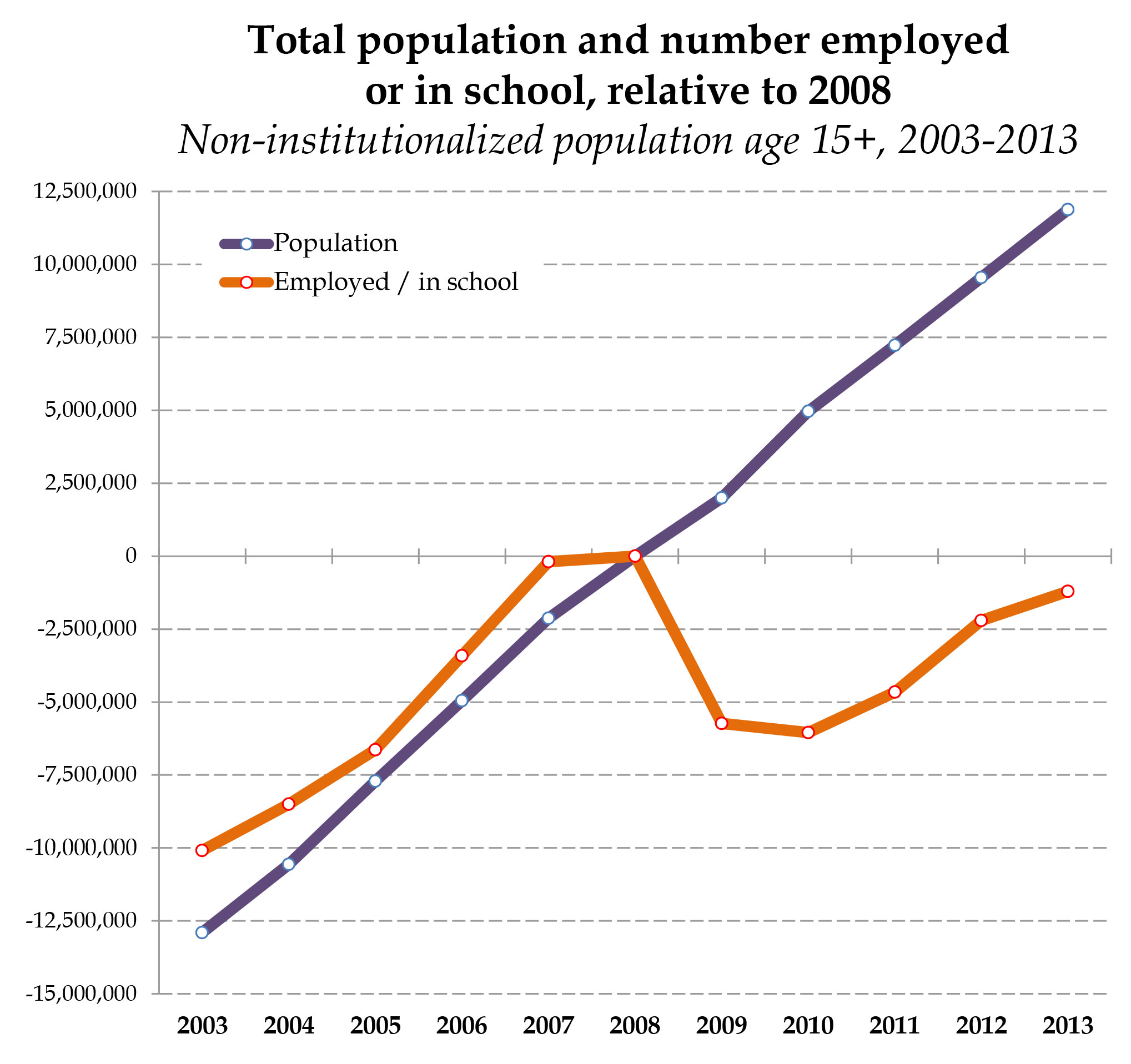
Before we get lulled to sleep, we need some perspective about the challenges ahead.  How about this: we face a 9 million jobs gap between the number of jobs we have and the number we need, and this doesn’t even address the low quality of the jobs being created.

The chart below, taken from an Economic Policy Institute blog post, illustrates the gap.

As Heidi Shierholz, the author of the post, explains:

The labor market has added nearly 5 million jobs since the post-Great Recession low in Feb. 2010. Because of the historic job loss of the Great Recession, however, the labor market still has 3.8 million fewer jobs than it had before the recession began in Dec. 2007. Furthermore, because the potential labor force grows as the population expands, in the nearly five years since the recession started we should have added 5.2 million jobs just to keep the unemployment rate stable. Putting these numbers together means the current gap in the labor market is 9.0 million jobs. To put that number in context: filling the 9 million jobs gap in three years — by fall 2015 — while still keeping up with the growth in the potential labor force, would require adding around 330,000 jobs every single month between now and then.

Unfortunately, our “job creators” only created 171,000 net jobs in October. And that was considered a relatively good month.   The chart below, from the Center on Budget and Policy Priorities,  gives a sense of what we are up against.

Of course, weak job growth in the past doesn’t mean that we cannot have strong job growth in the future.  On the other hand, such a change would require consensus on radically different policies than those currently being discussed and debated by those in power.

—————————

Martin Hart-Landsberg is a professor of Economics and Director of the Political Economy Program at Lewis and Clark College.  You can follow him at Reports from the Economic Front.


Interactive Graphs of Recession Trends

The Russell Sage Foundation and the Stanford Center on Poverty and Inequality have put together Recession Trends, an interactive website that lets you create graphs about issues related to the recession. It takes a couple of steps to get to the database (you have to agree to the terms before entering), but once you’re there, you can choose data about a variety of topics — crime, housing, immigration, income, political attitudes, family life, and a lot more. It’s a great way to quickly get an overview of many aspects of life in the U.S.

I looked at the ratio of median family income between African American and White families. Between the early 1970s and 2010, we’ve seen a consistent gap in earnings, with Black median household income hovering between about 52 and 60% that of Whites:

The graph of the mean net worth of the individuals on Forbes’s list of the 400 richest people in the U.S. shows that while they certainly saw their wealth take a tumble during the recession — it fell to a mere $3.3 billion or so — they’re recovering well:

Unsurprisingly, the number of job seekers per job opening went up sharply after 2007; it’s finally starting to drop off slightly, though we still have about 5 people looking for every 1 job that’s available:

You can add more than one dataset for many topics. Here’s the growth in the prison population since 1980, by gender:

There’s lots, lots more. Whatever topic you’re particularly interested in, there’s a good chance there’s something there that’ll grab your attention for a bit.

Gwen Sharp is an associate professor of sociology at Nevada State College. You can follow her on Twitter at @gwensharpnv.

The Continuing Relevance of Class

Cross-posted at Reports from the Economic Front.

Politicians always seem to be talking about the middle class.  They need some new focus groups.  According to the Pew Research Center, over the past four years the percentage of adult Americans that say they are in the lower class has risen significantly, from a quarter to almost one-third (see chart below).

Pew also found that the demographic profile of the self-defined lower class has also changed.  Young people, according to Pew, “are disproportionately swelling the ranks of the self-defined lower classes.”   More specifically some 40% of those between 18 to 29 years of age now identify as being in the lower classs compared to only 25% in 2008.

Strikingly, the percentage of whites and blacks that see themselves in the lower class is now basically equal.  The percentage of whites who consider themselves in the lower class rose from less than a quarter in 2008 to 31% in 2012.  This brought them in line with blacks, whose percentage remained at a third.  The percentage of Latinos describing themselves as lower class rose to 40%, a ten percentage point increase from 2008.

And not surprisingly, as the chart below shows, many who self-identify as being in the lower class are experiencing great hardships.   In fact, 1 in 3 faced four or all five of the problems addressed in the survey.

In short, there is a lot of hurting in our economy.

Recession Recovery? Most New Jobs are Bad Jobs

Cross-posted at Reports from the Economic Front.

The media has focused on the lack of jobs as a major election issue.  But the concern needs to go beyond jobs to the quality of those jobs.

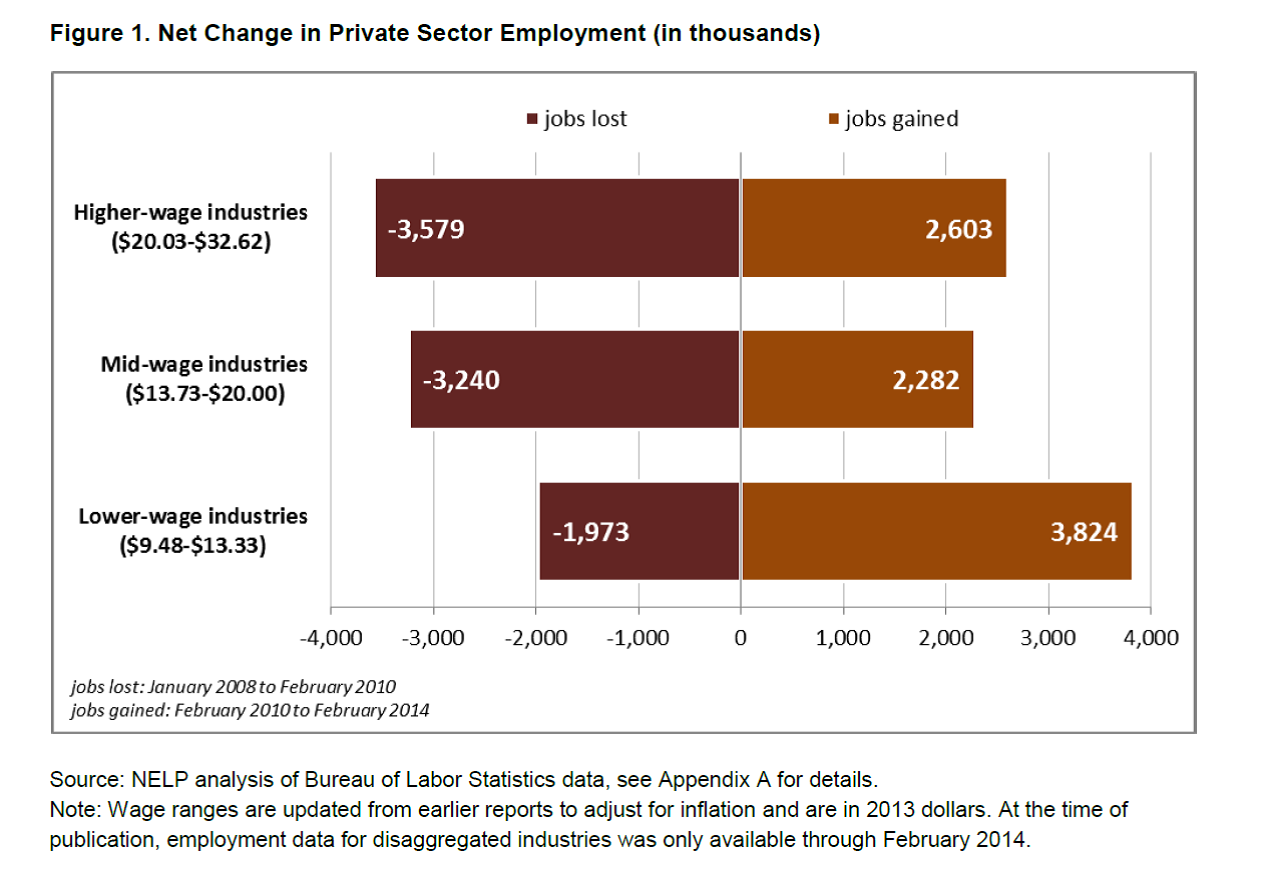
As a report by the National Employment Law Project makes clear, we are experiencing a low wage employment recovery.  This trend, the result of an ongoing restructuring of economic activity, has profound consequences for issues of poverty, inequality, and community stability.

The authors of the report examined 366 occupations and divided them into three equally sized groups by wage.  The lower-wage group included occupations which paid median hourly wages ranging from $7.69 to $13.83.  The mid-wage group range was from $13.84 to $21.13.   The higher-wage group range was from $21.14 to $54.55.

The figure below shows net employment changes in each of these groups during the recession period (2008Q1 to 2010Q1) and the current recovery (2010Q1 to 2012Q1).   Specifically:

  • Lower-wage occupations were 21 percent of recession losses, but 58 percent of recovery growth.
  • Mid-wage occupations were 60 percent of recession losses, but only 22 percent of recovery growth.
  • Higher-wage occupations were 19 percent of recession job losses, and 20 percent of recovery growth.

The next figure shows the lower-wage occupations with the fastest growth and their median hourly wages.  According to the report, three low-wage industries (food services, retail, and employment services) added 1.7 million jobs over the past two years, 43 percent of net employment growth.  According to Bureau of Labor Statistics projections these are precisely the occupations that can be expected to provide the greatest number of new jobs over the next 5-10 years.

 As the final figure shows, the decline in mid-wage occupations predates the recession.  Since the first quarter of 2001, employment has grown by 8.7 percent in lower-wage occupations and by 6.6 percent in higher-wage occupations.  By contrast, employment in mid-wage occupations has fallen by 7.3.


Significantly, as the report also notes, “the wages paid by these occupations has changed. Between the first quarters of 2001 and 2012, median real wages for lower-wage and mid-wage occupations declined (by 2.1 and 0.2 percent, respectively), but increased for higher-wage occupations (by 4.1 percent).”

A New York Times article commenting on this report included the following:

This “polarization” of skills and wages has been documented meticulously… A recent study found that this polarization accelerated in the last three recessions, particularly the last one, as financial pressures forced companies to reorganize more quickly.

“This is not just a nice, smooth process,” said Henry E. Siu, an economics professor at the University of British Columbia… “A lot of these jobs were suddenly wiped out during recession and are not coming back.”

Steady as she goes is just not going to do it and changes in taxes and spending programs, regardless of how significant, cannot compensate for the increasingly negative trends generated by private sector decisions about the organization and location of, as well as compensation for production.

What Kind of Jobs Are We Gaining?

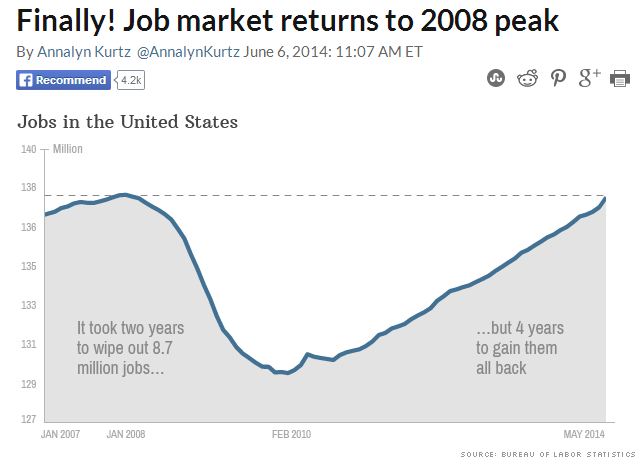
The recession is over in the U.S.. We’re now in the recovery period.

This would be more comforting if the pace of the recovery weren’t glacial. If you pay attention to weekly unemployment numbers or monthly economic reports, you’ve gotten used to the word “disappointing.” Yes, the economy is gaining jobs, but slowly. At this rate, it would take years to climb out of the hole the recession left us in.

But the slow pace of growth isn’t the only concern. The New York Times discusses the types of new jobs being created. While the majority of the jobs lost were midwage jobs, so far most of the new jobs are low-wage:

We’re not gaining new jobs very quickly. And when we do, it’s hard to find a job that provides a solidly middle-class income among those that are being added, continuing the trend of job polarization that economists have shown is reinforced during economic downturns.

Social Class and Well-Being

The Pew Research Center has released the results of a poll of 2,508 adults about social class and life experiences.

An important caveat to start with: the poll asked people to categorize themselves as upper (2% of respondents), upper-middle (15%), middle (49%), lower-middle (25%), or lower class (7%). We know that there’s a tendency among people in the U.S. to identify as middle class, even when their actual income falls far below or above what could reasonably be considered middle class, and the survey didn’t ask about incomes or assets to compare to individuals’ self-identification. There’s likely to be some overlap between the categories if we actually looked at the income/wealth of participants. The graphs below combine those who defined themselves as upper or upper-middle class together into the “upper class” category, while those who said lower-middle are assigned to the “lower class” group.

Not surprisingly, there were large differences by social class in a number of quality-of-life areas. The higher one’s class, the more likely they were to say they were better off than they were 10 years ago and were happy with life and rarely experience stress (though apparently we’re generally pretty stressed overall):

The lower class is much more likely than the other groups to say they are in worse shape than they were before the recession, indicating that they continue to suffer disproportionately from the effects of the economic meltdown and the slow recovery:

Those defined as lower class were much less satisfied with family life, their level of education, and their housing situation:

They were also much more likely to report specific difficulties in the past year, including trouble paying rent/mortgage and other bills, losing a job, and problems paying for medical care:

The results show a consistent, unsurprising pattern: the rich are weathering the slow recovery relatively well, while the poor suffer disproportionately. Check out the full report for information on participants’ perceptions of the wealthy, the fairness of the tax burden across classes, and which political party best represents each group.

The Election and the Economy

Cross-posted at Reports from the Economic Front.

It’s election season and Republicans and Democrats are working hard to demonstrate that they support dramatically different policies for rejuvenating the economy.

While the Democratic Party’s call for more government spending makes far more sense than the Republican Party’s call for cuts in government spending (see below), the resulting back and forth hides the far more serious reality that our existing economic system no longer appears capable of supporting meaningful social progress for the great majority of Americans.

The chart below helps to highlight our economy’s worsening stagnation tendencies.  Each point shows the 10 year annual average rate of growth and the chart reveals a decade long growth trend that is moving sharply downward.

As David Leonhardt explains:

The economy’s recent struggles arguably began in late 2001, when a relatively mild recession ended and a new expansion began. The problem with this new recovery was that it wasn’t especially strong. From the fourth quarter of 2001 through the fourth quarter of 2007 (when the financial crisis began), the economy grew at an average annual rate of only 2.7 percent. By comparison, the average annual growth rate of both the 1990s and 1980s expansions exceeded 3.5 percent.

This mediocre expansion was followed by the severe recession and weak recovery brought on by the financial crisis. The combined result is that, in recent years, the economy has posted its slowest 10-year average growth rates since the Commerce Department began keeping statistics in 1947.

In fact, the economic growth figures for the period 1995 to 2007 were artificially propped up by a series of bubbles, first stock and then housing.  Once those bubbles popped, average growth rates began steadily falling.

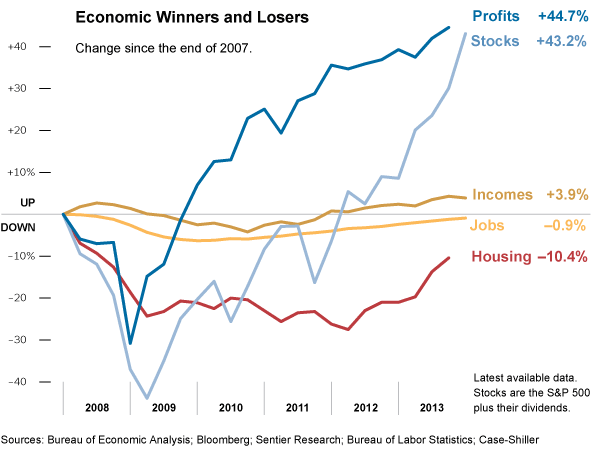
The weakness (and unbalanced nature) of our current weak recovery is well captured in the following chart from Catherine Rampell, which compares the percent change in various indicators in the current recovery (which began in June 2009) with previous post-war recoveries.  The first point to stress is that the current recovery lags the average in all indicators but one: corporate profits.  The second is that government spending has actually been falling during the current recovery, no doubt one reason that the percent increase in so many indictors remains below the average in previous recoveries; the public sector is actually smaller today than it was three years ago.

The relative strength in the performance of corporate profits helps to explain why the two established political parties feel no real pressure to focus on our long term economic problems; corporations just don’t find the current situation problematic despite the economy’s weak overall economic performance.

Even more telling of the growing class divide is the explosion in income inequality over the last thirty years, which is illustrated in the following chart.

In other words, while corporations have succeeded in raising profits at the expense of wages, those in the top income brackets have been even more successful in raising their income at the expense of almost everyone else.  Notice, for example, that median household income in 2010 is roughly where it was in the late 1980s while the median income of the top households racked up impressive gains. Thus, the very wealthy have every reason to do what they are currently doing, which is using their wealth to ensure that candidates restrict their economic proposals to reforms that will do little to change the existing system.

The takeaway: without a mass movement demanding change, election debates are unlikely to seriously address our steady national economic decline.